
January 2020
The Excellence Of Remembrance
Allah (Subhaanahu wa Ta’aala) says:
{Therefore remember Me, I will remember you and be grateful to Me, and never be ungrateful to me}, [Soorah al-Baqarah, Aayah 152]
{O you who believe! Remember Allah with much remembrance}, [Soorah al-Ahzaab, Aayah 41]
{And for men and women who engage much in Allah’s remembrance, for them has Allah prepared forgiveness and great reward}, [Soorah al-Ahzaab, Aayah 35]
{And bring your Lord to remembrance in your [very] soul, with humility and remember without loudness in words, in the mornings and evenings; and be not of those who are unheedful}, [Soorah al-A’raaf, Aayah 205]
The Prophet (sal-Allaahu `alayhe wa sallam) said:
((The comparison of the one who remembers Allah and the one who does not remember Allah, is like that of the living and the dead)), [al-Bukhaaree with al-Fat.h 11/208 and Muslim 1/539]
He (sal-Allaahu `alayhe wa sallam) also said:
((Should I not inform you of the best of deeds, and the most sanctifying of deeds before your Lord, which does more to raise your positions [with Him], and are better for you than the disbursement of gold and money or battle with the enemy?))
They [the companions] said: “Indeed! Inform us.”
He (sal-Allaahu `alayhe wa sallam) then said:
((Remembrance of Allah (Subhaanahu wa Ta’aala))), [at-Tirmidhee 5/459 and Ibn Maajah 2/1245, see: Saheeh Ibn Maajah 2/316 and Saheeh at-Tirmidhee 3/139]
The Prophet (sal-Allaahu `alayhe wa sallam) also said:
((Allah (Subhaanahu wa Ta’aala) says: “Indeed I am as My servant presumes Me to be, and I am with him when he remembers Me, so if he remembers Me to himself I remember him to Myself, and if he remembers Me amongst a company I remember him amongst a company greater than it, and if he draws near to Me the span of a hand I draw near to him the span of an arm, and if he draws near to Me the span of an arm I draw near to him the span of two outstretched arms, and if he takes a step towards Me I hastily step towards him”)), [al-Bukhaaree 8/171 and Muslim 4/2061, this specific wording is related by al-Bukhaaree]
On the authority of ‘Abdullaah Ibn Busr (radhi-yallaahu ‘anhu): “A man said to the Prophet (sal-Allaahu `alayhe wa sallam): “O Messenger of Allah, the rites of Islam are much for me, so tell me of something that I might hold fast to”
He (sal-Allaahu `alayhe wa sallam) said:
((Let not your tongue cease from the remembrance of Allah)), [at-Tirmidhee 5/458 and Ibn Maajah 2/1246, see: Saheeh at-Tirmidhee 3/139 and Saheeh Ibn Maajah 2/317]
The Prophet (sal-Allaahu `alayhe wa sallam) also said:
((Whoever recites a letter of Allah’s Book has for it, a merit and ten more like it, not to say that alif, laam, meem are one letter but rather alif is a letter, laam is a letter and meem is a letter)), [at-Tirmidhee 5/175, see: Saheeh at-Tirmidhee 3/9 and Saheeh al-Jaami’ as-Sagheer 5/340]
The Prophet (sal-Allaahu `alayhe wa sallam) also said:
((Whoever takes a seat and fails to remember Allah, has incurred upon himself a loss from Allah, and whoever lies down [relaxes] and fails to remember Allah, has incurred upon himself a loss from Allah)), [Abu Daawood 4/264 and others, see: Saheeh al-Jaami’ 5/342.]
Please note: All supplications are taken from the English translation of Hisnul-Muslim (“Fortification of the Muslim through Remembrance and Supplication from the Qur.aan and Sunnah”), as published by Invitation To Islam.
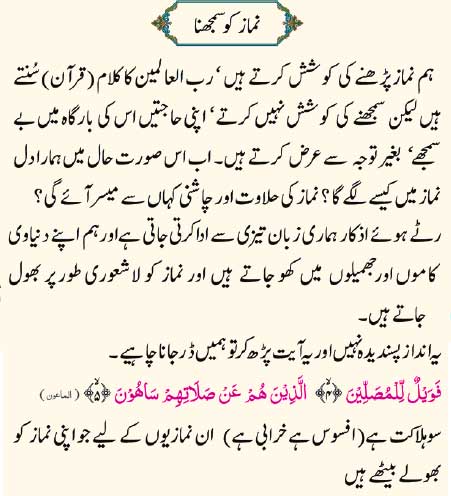
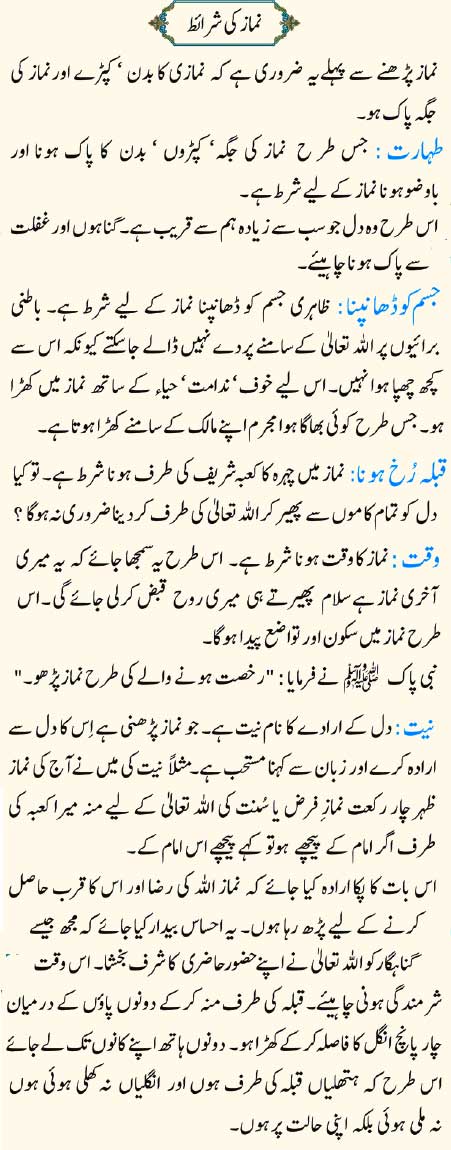
Namaz Ki Sharait
The Ideal Muslim Husband & Wife
Islamic view of marriage
Marriage in Islam offers tranquillity to the soul and peace of mind, so that man and woman may live together in an atmosphere of love, mercy, harmony, co-operation, mutual advice and tolerance, and lay the foundation for raising a Muslim family in a nurturing, sound environment.
The Holy Qur’an has described, in the most moving and eloquent terms, this eternal, natural relationship between man and woman, which is filled with tranquility, security, love, understanding and compassion:
“And among His Signs is this, that He created for you mates from among yourselves, that you may dwell in tranquillity with them, and He has put love and mercy between your [hearts]: verily in that are Signs for those who reflect.” (Qur’an, 30: 21)
Marriage is a union of souls, in the deepest sense. Allah joins these two souls together so that they may enjoy tranquillity and stability in a marital home filled with sincere love and compassionate mercy.
In Islam, the righteous woman is viewed as one of the joys of this life, and a great blessing to a man, for he comes home to her and relaxes after facing the struggles of life, and finds with her incomparable peace, comfort and pleasure. The Prophet (peace be upon him) spoke the truth when he said:
“This world is just temporary enjoyment, and the best comfort in this world is a righteous woman.” (Muslim)
Islam regards marriage very highly, and views femininity as something to be valued and cherished.
The ideal Muslim wife
On the basis of this view of marriage and of women, the Muslim is not attracted by the empty-headed attitude displayed by some girls nowadays. Rather, he is attracted by a sound Muslim personality, and he takes his time in choosing a partner for life, looking for a partner who has the right Islamic characteristics which will make for a stable and happy married life. Therefore he is not interested in the superficial physical beauty, grace and elegance that are the sole concerns of empty-headed youngsters. While he does not ignore physical looks, he also looks for strong religious belief and practice, intelligence, and good behavior, following the advice of the Prophet (peace be upon him).
“A woman may be married for four things: for her wealth, for her noble descent, for her beauty or for her religion. Choose the one who is religious, may your hands be rubbed with dust!” (Bukhari and Muslim)
Although the Prophet (peace be upon him) advised the young Muslim to look for a religious wife, this does not mean that he should ignore his preferences regarding physical beauty. The Prophet (peace be upon him) encouraged seeing a woman before finalizing the marriage, so that a Muslim will not find himself trapped in a marriage with a woman he finds unattractive.
Al-Mugheerah Ibn Shu’bah said:
“I got engaged to a woman during the time of the Prophet. He asked me, ‘Have you seen her?’ I said, ‘No.’ He said, ‘Go and have a look at her, because it is more fitting that love and compatibility be established between you.'”
A man who had got engaged to a woman of the Ansar came to the Prophet, who asked him: “Have you seen her?” He said, “No.” so the Prophet ordered him to go and see her.
The Prophet (peace be upon him) emphasized, in more than one Hadith, the fact that beauty is one of the basic characteristics that a man should look for in a woman, besides the other, moral, characteristics that are desirable. Indeed, the two are inseparable. For example, he told Ibn ‘Abbas:
“Shall I tell you the most precious thing a man can have? It is a righteous wife: when he looks at her he is pleased, when he tells her to do something she obeys, and when he is away she is faithful and loyal to him.”
Abu Hurayrah (may Allah be pleased with him) said:
“The Prophet was asked: ‘Which woman is the best?’ He said, ‘The one who pleases him when he looks at her, who obeys him when he tells her to do something, and who does not do something he dislikes with regard to herself or to his wealth.”
This is the guidance given by the Prophet (peace be upon him) regarding the personality of the woman who can bring happiness, tranquillity and stability to a man, and who can make a cheerful, pleasant and secure home in which to raise a brood of successful, courageous and intelligent children.
The Prophet (peace be upon him) insisted that marriage should be firmly built on a solid foundation, striking a balance between physical, mental, spiritual and emotional needs, so that it will not be rocked by personality clashes or differences in attitude. Therefore the true Muslim who is guided by the Shariah of Allah in all his affairs, does not fall for the wiles of the “Jezebels” who are the beautiful women of bad character; rather he tells people: “Beware of the ‘Jezebels’.”
– published by International Islamic Publishing House, Riyadh, Saudi Arabia
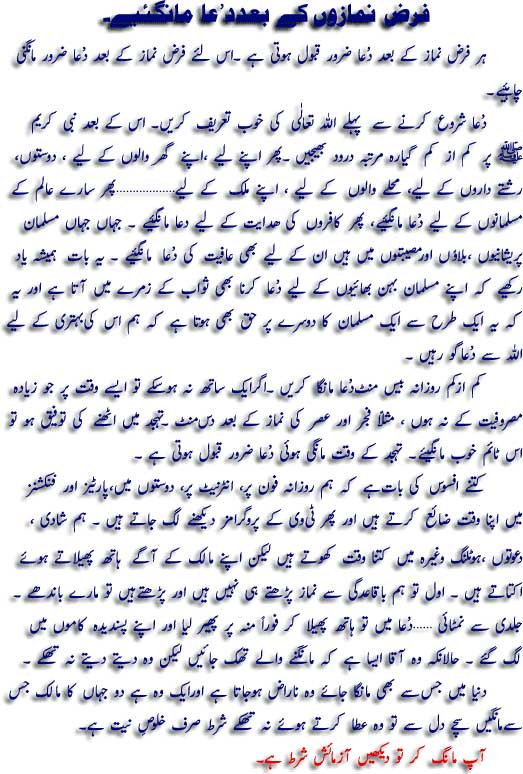
Farz Namaz Kay Baad Dua
Prophet’s Medicine On Treating Headaches
HEADACHES usually occur when the head becomes hot due to the pressure of a septic vapor that accumulates near it seeking a way out of the body, but fails. The pressure of the vapor intensifies, just as a pot that is heated but its steam is not able to escape from it. It is a fact that when moisture heats up, it seeks more space and causes a headache because it is unable to expand or escape from the body. This condition causes a type of dizziness.
There are various causes of headaches:
• When one of the four essential conditions (cold, hot, dryness and wetness) becomes predominant.
• Ulcers of the stomach cause headaches, because the cephalic (relating to the head) nerves and the stomach are connected.
• Thick flatulence might accumulate in the stomach then later ascend to the head and cause headaches.
• Headaches are sometimes cause by a tumor in the gastric veins that cause pain in the head.
• When the stomach is full of food it sometimes provokes headaches, as some of the food remains undigested.
• Headaches sometimes occur after sexual intercourse because the body will then be weakened and thus exposed to the heat of the air.
• Headaches sometimes occur after vomiting due to excessive dryness, or to accumulating gaseous materials (flatulence) that ascend to the head from the stomach.
• Not having enough sleep also causes headaches.
• Headaches are sometimes caused due to the pressure exerted on the head, such as when one carries a heavy object on his head.
• Excessive movements and physical activity can also provoke headaches.
• Sadness, depression, obsession, and evil thoughts also provoke headaches.
• Excessive hunger also provokes headaches.
• Those who suffer from a tumor in the cerebral lining sometimes feel as if hammers are constantly pounding on their heads.
• Fever also provokes headaches because of the intense heat that the body suffers from.
The weaker side of the brain will accept septic material and the migraine headache will be accompanied by pulsation in the arteries. The pain may be relieved in this case when one ties a bandage so that the pulsating of the arteries is stopped and thus the pain is lessened.
Abu Na’im said in his book on Prophetic medicine that the migraine type of headache used to attack the Prophet (peace be upon him) and that it would prevent him going out of his house for one or two days at a time. Also, Abu Na’im related from Ibn Abbas that he said, “Once, the Messenger of Allah (peace be upon him) delivered a speech while a cloth was tied around his head.”
Also the Sahih states that the Prophet (peace be upon him) said during the illness that preceded his death: “O my head!” and he used to tie a piece of cloth around his head.
Tying a piece of cloth around the head helps soothe the pain of headaches and migraines. Treating headaches varies according to their type and cause. Hence, headaches could be relieved by vomiting, eating, resting, using cold rags, cooling the body, elevating the temperature, avoiding noise, etc.
Knowing these facts, we should mention that treating headaches with Henna is partial and that it treats only some types of headache. If the headache is caused by high fever – and not by a spoiled substance that requires extraction – Henna blended with vinegar and applied to the forehead will relieve the headache. Henna also soothes the nerves when used as a bandage. Finally, Henna is not only favorable to relieve headaches, but also for various organs of the body and for the hot tumor and inflammations when used as a bandage.
– Ibn-ul-Qayyim is a 7th century Hijra Islamic scholar and this article on headaches is an excerpt from his book Healing with the Medicine of the Prophet.
Tahajjud Kay Fazail

Stinginess Draws Allah’s Wrath
How often we forget the blessings of Allah. This forgetfulness leads us to stinginess and pride. Our nature and with the less fortunate change as if they are people who have no worth.
A story mentioned in Surah Al-Qalam of the Qur’an about certain brothers who inherited a garden is a great reminder for all of us. Ibn Abbas (May Allah be pleased with him) said the polytheists of Quraish were likened to the people of the garden. The garden had trees and plants of various fruits, and the time for harvest had come.
Allah said: “When they swore” secretly “to pluck the fruits of the (garden)” i.e. to harvest it; “in the morning” to avoid being seen by the poor and needy, lest they should be forced to give them some fruits in charity.
So, the young men swore without saying Insha Allah (If Allah wills). Consequently, Allah the Almighty foiled their plans and sent over their garden a fire that burnt it and left nothing behind.
Allah said: “Then, there passed by on the (garden) something (fire) from your Lord at night and burnt it while they were asleep. So the (garden) became black by the morning, like a pitch dark night (in complete ruin).” “Then they called out one to another as soon as the morning broke,” i.e. they got up in the morning and told each other: “Go to your tilth in the morning, if you would pluck the fruits,” i.e. go early to your garden and pluck the fruits before the poor and needy come asking you for charity.
“So they departed, conversing in secret low tones,” “No Miskin (poor man) shall enter upon you into it today,” “And they went in the morning with strong intention, thinking that they have power (to prevent the poor taking anything of the fruits therefrom).” Ikrimah and Ash-Shu’abi said they went with rage and bad intention against the poor. “But when they saw the (garden),” “they said: Verily, we have gone astray”, i.e. we have lost our way to our own garden. Then they realized: “Nay! Indeed we are deprived of (the fruits)!”, i.e. we have been punished because of our bad intentions and were deprived of the blessing of our tilth.
And, “the best among them said” (Ibn Abbas, Mujahid and others said he was the best and the most moderate and just one among them).
“Did I not tell you: why do you not say: Insha’Allah (If Allah wills).” Meaning, to say a good word instead of what you have intended.
“They said: “Glory to Our Lord! Verily, we have been Zalimun (wrong-doers).” Then they turned one against another, blaming. They said: “Woe to us! Verily, we were Taghun (transgressors and disobedient),” They regretted and showed sorrow but it could not help them. They confessed their sin after they had been punished.
The men are said to be brothers who inherited that garden from their late father who used to give a lot in charity. But, when they inherited the garden they stopped giving in charity and intended to deprive the poor of its fruits. Thereupon, Allah the Almighty punished them and meted out to them the severest of penalties.
Allah has commanded that Zakah must be taken out on agricultural produce and should preferably be paid on the day of harvesting. He says: “Eat of their fruit when they ripen, but pay the due thereof (its Zakah, according to Allah’s Orders l/lOth or 1/20th) on the day of its harvest.” (Qur’an, 6:141)
– Stories of the Qur’an by Ibn Katheer