
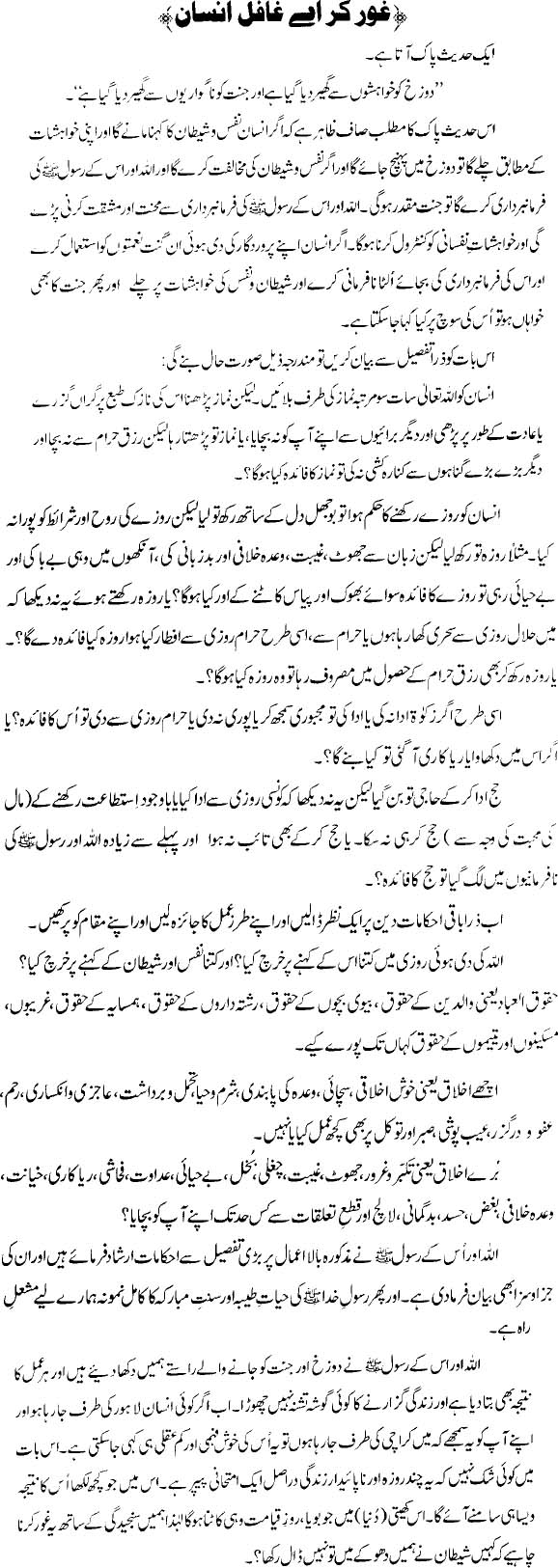
Ghor Ker Ay Ghafil Insan
July 2026
Sunan Of Clothing And Eating
Supplication upon wearing new clothes
It is narrated on the authority of Abu Saeed al-Khudree (may Allah be pleased with him), who said that when the Messenger of Allah sallallahu ‘alayhi wa salam used to wear new clothing, he would name it by its name, either qamees (shirt) or ‘imaamah (turban), then say: “O Allah, for you is praise! You clothed me in it, and I ask you for its good and for what it was made for. And I seek refuge in you from its evil and the evil of what it has been created for” [Abu Dawood: 4020]
Starting to wear the shoe on the right
It is narrated on the authority of Abu Hurayrah (may Allah be pleased with him), who said that when the Messenger of Allah sallallahu ‘alayhi wa salam said: “If one of you puts on shoes, let him begin with the right. And when he takes it off, let him begin with the left. And let him put them both on or let him take them off both.” [Agreed upon: 5495 & 5855]
Saying ‘bismillaah’ at the start of eating
It is narrated on the authority of Abu Salamah (may Allah be pleased with him), I was in the room of the Messenger of Allah, sallallahu ‘alayhi wa salam, and my hand was flying around the plate. So he said to me: “O young man, mention the name of Allah, eat with your right, and eat what is nearest to you.” [Agreed upon: 5376 & 5269]
Praising Allah after eating and drinking
It is narrated on the authority of Anas bin Maalik (may Allah be pleased with him), who said the Messenger of Allah sallallahu’ alayhi wa salam said: “Indeed Allah is pleased with the slave who eats food and then praises Him for it or drinks a drink and then praises Him for it.” [Muslim 6932]
Sitting when drinking
It is narrated on the authority of Anas (may Allah be pleased with him), who said the Prophet sallallahu ‘alayhi wa salam prohibited a man from drinking whilst standing. [Muslim 5275]
Rinsing one’s mouth after consuming milk
It is narrated on the authority of ‘Abbaas (may Allah be pleased with him) that the Messenger of Allah sallallahu ‘alayhi wa salam drank milk and then rinsed his mouth. He said, “It contains fat.” [Agreed upon 5609 & 798]
Not criticising food
It is narrated on the authority of Abu Hurayrah (may Allah be pleased with him) that he said the Messenger of Allah, sallallahu ‘alayhi wa salam, did not ever criticise food. If he liked it, he ate it, and if he disliked it, he left it. [Agreed
upon 5380 & 5409]
Eating with three fingers
It is narrated on the authority of Ka’b bin Maal (may Allah be pleased with him) that the Messenger of Allah sallallahu ‘alayhi wa salam used to eat with three fingers and lick his hand before wiping it. [Muslim 5297]
Drinking Zamzam water and using it as a cure
It is narrated on the authority of Abu Dharr (may Allah be pleased with him) that he said the Messenger of Allah sallallahu ‘alayhi wa salam said about Zamzam water: “It is blessed and a food that nourishes,” al-Tayaalisee adds, “And a cure for sickness.” [Muslim 6359]
Eating on Eed al-Fitr before going to the prayer area
It is narrated on the authority of Anas bin Maalik (may Allah be pleased with him) that he said the Messenger of Allah sallallahu ‘alayhi wa salam did not proceed on the day of al-Fitr until he had eaten some dates. And in another narration, He used to eat an odd number. [al- Bukhari: 953]
Imam Bukhari Ka Taruf
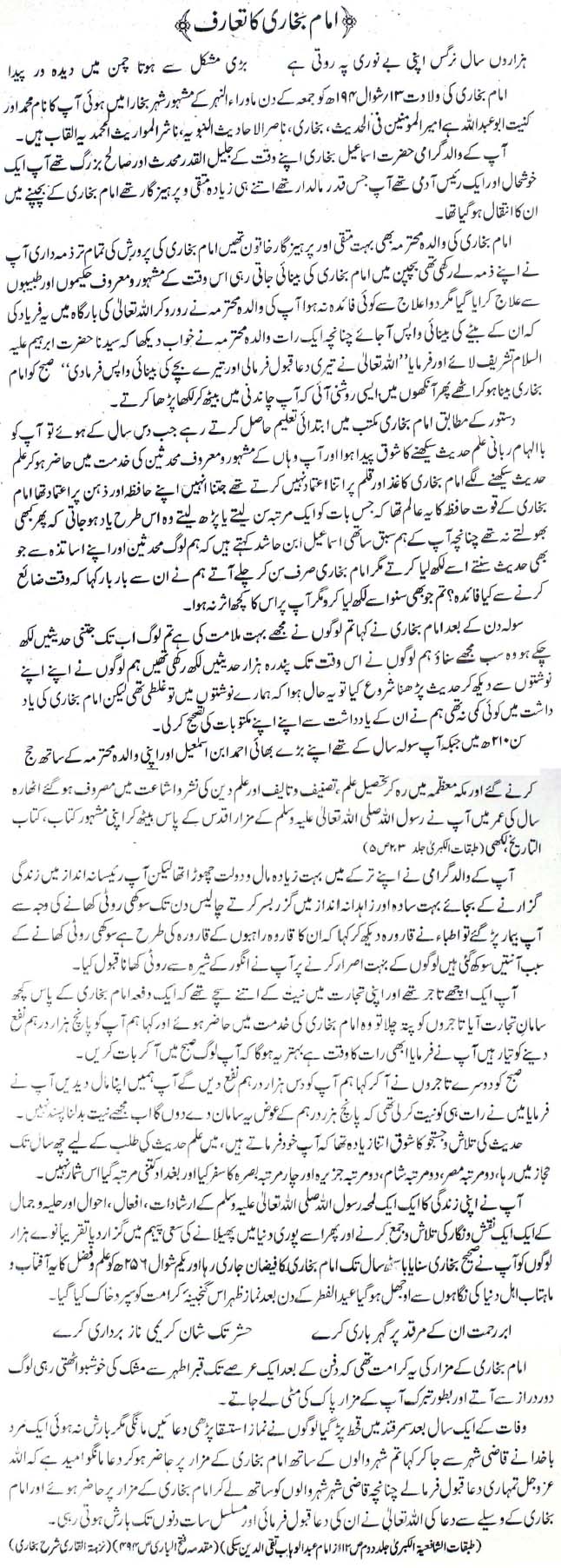
Imam Bukhari Ka Taruf
Sunan as-Safar (Travelling)
1. Appointing a leader when travelling:
It is narrated on the authority of Abu Saeed and Abu Hurayra (may Allah be pleased with them) who said that the Messenger of Allah sallallahu ‘alayhi wa salam said: “When three men travel together, they should make one of them their leader.” [Abu Dawood: 2608]
2. Saying ‘Allaahu akbar’ (Allah is Great) when ascending and saying ‘Subhanallah’ (Glory be to Allah) when descending:
It is narrated on the authority of Jaabir (may Allah be pleased with him) who said: “We used to say Allahu akbar when we ascended, and we said subhanallah when descending” [Bukhari 2994]
Riya Kari Aur Quran Pak Bhoolane Ki Saza
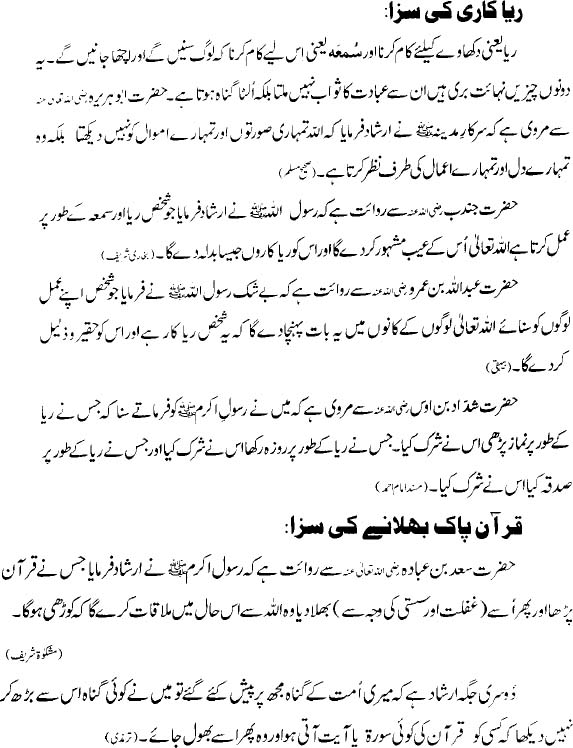
Riya Kari Aur Quran Pak Bhoolane Ki Saza
Sunan an-Nawm (Sleep)
1. Sleeping on Wudoo
The Prophet, sallallahu ‘alayhi wa salam, told al-Baraa bin ‘Aazib, radiallahu ‘anh, If you go to your bed, then do your wudoo (ablution) as you would do it for prayer, then lie on your right” [Agreed upon, No. 6311.]
2. Reading Soorat al-Ikhlaas, al-Falaq, and an-Naas before sleeping
From ‘Aishah radiallahu ‘anha, the Messenger, sallallahu ‘alayhi wa salam, used to recite “Qul
huwallahu ahad”, “Qul a’oothu birrabilfalaq” and “Qul a’oothu birrabinnaas” every night when he went to sleep, then wiped his face and whatever he was able from his body, beginning with his head and face, and what faces him from his body, three times. [al-Bukhaari: 5017]
3. Doing takbeer and tasbeeh when going to sleep
‘Ali, radiallahu, ‘anh narrates that the Messenger of Allah, sallallahu ‘alayhi wa salam, said when Fatimah asked him for a servant, “Shall I not lead you to that which is better for you than a servant? If you go to your mattresses, or rest to sleep, then say Allahu Akbar thirty-four times, and say subhaan Allah thirty-three times, and say alhamdulilah thirty-three times, for they are better for you than having a servant” [Agreed upon: 6318 & 6915]
4. Supplicating when awoken from sleep
‘Ubaadah bin as-Saamit, radiallahu ‘anh narrates that the Prophet, sallallahu ‘alayhi wa salam, said: “Anyone awoken in the night and says: Laa ilaha illa Allah, wahdatu laa shareeka lah, lahul-mulku walahul hamd, wa huwa ‘ala kulli shay`in qadeer, alhamdulilah was-subhaan Allah, wallahu akbar, wa laa hawla wa laa quwata illa billah, then said, Allahumma aghfirli or invoked Allah, he will be answered, and if he does ablution and prays, his prayer will
be accepted” [al-Bukhaari: 1154]
5. Supplicating once awake with the following supplication
Alhamdulilah alathee ahyaanaa ba’da maa amatana, wa ilayhin-nushoor (Praise be to Allah Who granted us
life after death, and to Him we will be resurrected) [al-Bukhaari, 6312, from Huthayfah bin al-Yamaan, radiallahu ‘anh]
Hazrat Ibn Zubayr Ki Bahaduri Rome Ki Larai Mein
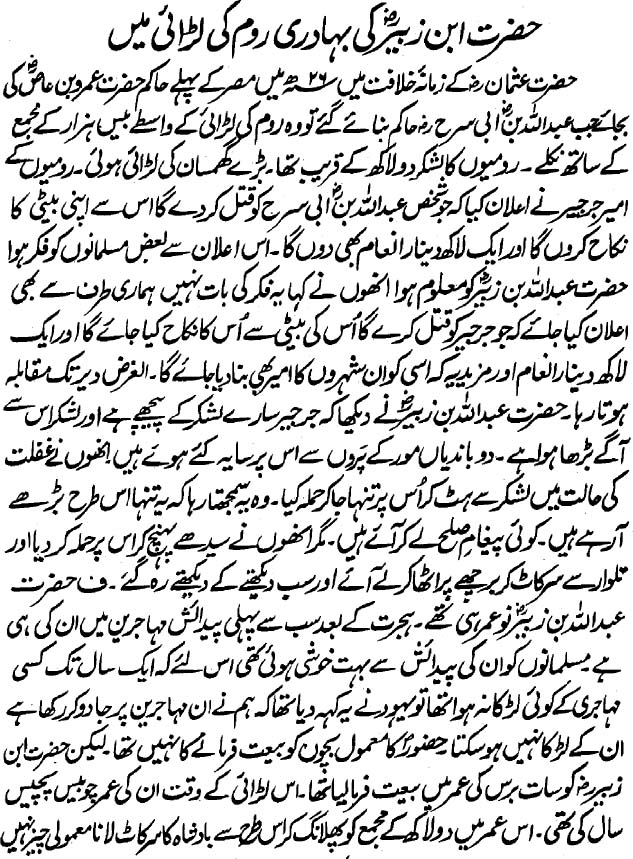
Hazrat Ibn Zubayr Ki Bahaduri Rome Ki Larai Mein
The Biography Of Prophet Muhammad (peace be upon him)
1. When was the Prophet Muhammad (peace be upon him) born?
He was born on Monday, 12th Rabi Al Awwal, 571 AC.
2. Where was the Prophet Muhammad (peace be upon him) born?
In Makkah
3. What is the name of the Prophet’s father?
Abdullah Ibn Abdul Muttalib.
4. What is the name of the Prophet’s mother?
Aminah Bint Wahhab Ibn Abd Manaf Ibn Zahrah.
5. When and where did his (prophet’s) father die?
He died in Makkah before Muhammad (peace be upon him) was born.
Rozay Rakhne Par Maghfirat
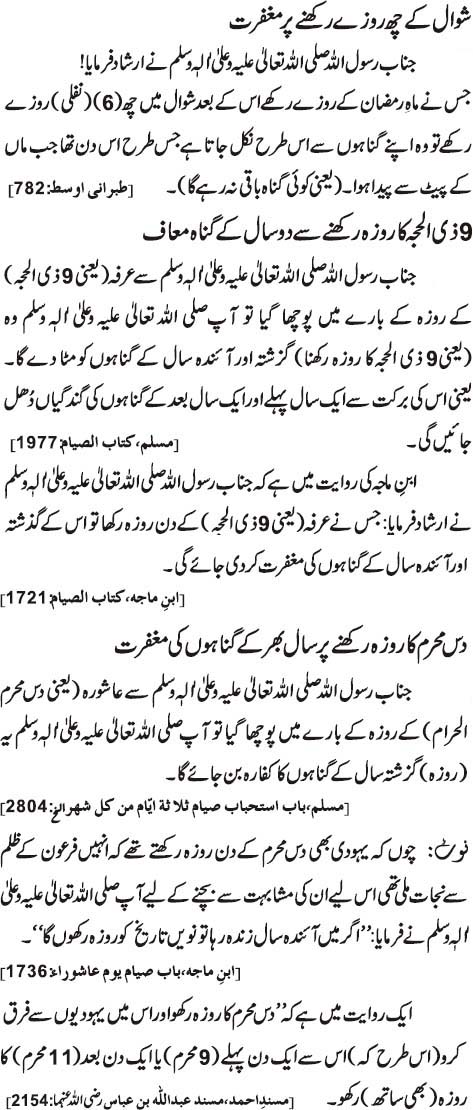
Shawwal, Zil-Hug, Aur Aashura Kay Rozay Rakhne Par Maghfirat
Burial Of The Martyrs
The Messenger of Allah (peace be upon him) supervised the martyrs’ burial and said: “I bear witness that anyone who is wounded in the way of Allah, Allah will resurrect him with his wound bleeding a liquid which is bloodlike in colour but musk-like in scent.”
Some of the Companions carried their men killed in the war to Madinah, but the Messenger of Allah (peace be upon him) ordered that they should be sent back to be buried where they were killed. He ordered that they should not be washed but buried as they were after stripping them of their armour and leather clothes. He used to bury every two or three martyrs together in one grave and even join two men in one garment while saying: “Who is the more learned of the Qur’an?” and he would commit him to earth first. He would say: “I bear witness to those on the Day of Resurrection.” He buried both ‘Abdullah bin ‘Amr bin Haram and ‘Amr bin Al-Jamuh in one grave due to the affection they used to possess for each other.
They missed the coffin of Hanzalah (radi Allahu anhu); they sought it and found that it was on a spot nearby with water dripping off it. The Messenger of Allah told his Companions that the angels were washing him and said, “Ask his wife”. They asked her, and she confirmed that he had been in a state of ceremonial impurity. That was why Hanzalah was called ‘Ghaseel Al-Mala’ikah’ (i.e. the one washed by the angels).