
Archives
What Do Muslims Believe About Allah?
What do Muslims believe about Allah?
- He is the one God, Who has no partner.
- Nothing is like Him. He is the Creator, not created, nor a part of His creation.
- He is All-Powerful, absolutely Just.
- There is no other entity in the entire universe worthy of worship besides Him.
- He is First, Last, and Everlasting.
- He is the All-Knowing, and All-Merciful, the Supreme, the Sovereign.
- It is only He Who is capable of granting life to anything.
- He sent His Messengers (peace be upon them) to guide all of mankind.
- He sent Muhammad (peace be upon him) as the last Prophet and Messenger for all mankind.
- His revealed the Qur’an – the only remaining authentic divine book in the world that has been kept without change.
- Absolutely nothing is hidden from Him. He knows what is in our hearts.
Some basic guidelines Muslims follow in their knowledge of God:
- Eliminate any anthropomorphism (human qualities) from their conception of Allah. His attributes are not like human attributes. His names and attributes suit His Majesty.
- Have unwavering faith in exactly what Allah and Prophet Muhammad (peace be upon him) described Allah to be, no more, no less.
- Believe totally in all the names and attributes of Allah; one cannot believe in some and disbelieve the others.
- Similarity in names (or meanings) does not imply similarity in what is being described (referents). His speech is nothing like human speech, etc.
Solution: Morals Of the Holy Qur’an
There are people who are persecuted and tortured to death: innocent babies, people who cannot even afford a loaf of bread, who sleep in cold weather, in tents and even on the streets, who cannot afford medical treatment, or who, despite being old and weak, have to wait for hours, or even days, for hospital care, people who are killed just for belonging to a certain race, women, children and old people who are thrown out of their homes because of their religion, enormous extravagance alongside poor people suffering from starvation and neglect, who are just left to die, children too young and defenseless to be able to look after themselves, children who leave school to work or beg for money to help their families survive, people who live with the constant fear of being slaughtered by their enemies.
Everybody is aware of the existence of such people as these. Almost every day we come across pictures of these helpless, miserable, homeless, and needy people in the papers or on TV. Many people see their plight and pity them. However, they then either turn off the channel they have been watching, or else they turn over the pages of the newspaper they have been reading and forget they exist once more.
Most people never think that they have to make an effort to save these people from the terrible conditions they live in. They ask, “Is it up to me to save these people when there are so many rich and powerful people in the world?” and leave the responsibility to others.
However, prosperity and power alone are not enough to save these people and to make this world a place where justice, peace, security, and well-being prevail. For instance, despite the existence of many rich and developed countries in the world, people in Ethiopia are still dying from hunger. That people are still going hungry despite the present advanced state of technology and the many resources in the world is a clear indication that wealth and power by themselves are not enough.
In order for wealth and power to be used for the well being of these poor and needy people, first of all, we have to be conscientious. The sole way of being conscientious is through belief. Only if people who believe consistently and act conscientiously can there be a solution to injustice, chaos, terror, massacres, hunger, poverty, and oppression. The one solution is the morals of the Qur’an.
When we look at the problems in the world in general, we see that they are all caused by feelings such as hatred, malice, antagonism, self-interest, selfishness, indifference, and cruelty. The way to finding a solution to these and eliminating them lies in love, compassion, mercy, pity, the zeal to serve without expecting anything in return, sensitivity, sacrifice, brotherhood, tolerance, reason, and wisdom. These traits are only found in those who fully live by the morals in the Qur’an. In one of His verses, Allah refers to the Qur’anic aspect of leading people out of darkness to light:
” . . . Indeed there has come to you from Allah a light (Prophet Muhammad, peace be upon him) and a plain Book (this Qur’an). Wherewith Allah guides all those who seek His Good Pleasure to ways of peace, and He brings them out of darkness by His Will unto light and guides them to the Straight Way (Islamic Monotheism).” (Al-Ma’idah 5:15-16)
In another verse, Allah states that everything which conflicts with the Qur’an will end in corruption and confusion:
“And if the truth had been in accordance with their desires, verily, the heavens and the earth, and whosoever is therein would have been corrupted! Nay, We have brought them their reminder, but they turn away from their reminder.” (Al-Mu’minun 23:71)
At the very moment you are reading this, millions of poor people are either suffering, or trying to avoid dying from hunger or cold. Or else they are being torn away from their homes, families and children, and forced to leave their homelands.
For this reason, conscientious people must think about all this and act as if these troubles, adversities, and hardships had befallen themselves or their loved ones. Or they must look for ways to help those who ask for spiritual or material help. In the following verse, Allah orders conscientious and faithful people with common sense to assume this responsibility:
What reason could you have for not fighting in the way of Allah – for those men, women and children who are oppressed and say, “Our Lord, take us out of this city whose inhabitants are wrongdoers! Give us a protector from You! Give us a helper from You!” (An-Nisa’ 4:75)
The most important thing for Muslims to do is to struggle in the intellectual domain so that the morals of the Qur’an prevail against lack of religion. The only salvation for the weak, helpless, homeless, and destitute is the widespread practice of the morals of the Qur’an by all the people of the world. For this reason telling people about the morals in the Qur’an and communicating the message is a very important and pressing way of worshipping for all Muslims. As is also stated in the Qur’an : “And Our duty is only to convey plainly (the Message).” (Ya-Sin 36:17).
Those who do not use their consciences, who behave indifferently and uninterestedly towards orphans, the poor, and the unhappy, who spend the possessions given to them on vain things in the life of this world, who coldly watch women, children and old people under oppression, who feel happy at the spread of all kinds of immorality and ugliness in the world, and who encourage this point of view, will certainly account for all that in the hereafter as Allah says in the following verses:
Have you seen him who denies the Recompense? That is he who repulses the orphan (harshly) and urges not on the feeding of Al-Miskin (the poor). So woe to those performers of Salat (prayers) (hypocrites). Those who delay their Salat. Those who do good deeds only to be seen (of men). And withhold Al-Ma’un (small kindnesses like salt, sugar, water). (Al-Ma`un 107:1-7)
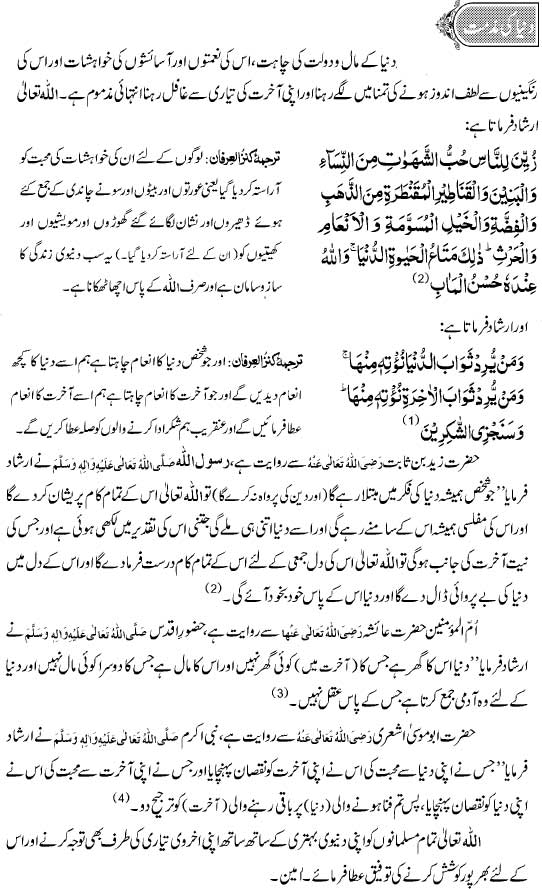
Dunya Ki Muzammat
Follow The Path Of Knowledge
[Quran – 19:76] “God strengthens in guidance those who have sought and found guidance. The righteous, good deeds of lasting merit are best in your Lord’s sight for reward, and best for returns.”
The Prophet (Peace Be Upon Him) has said:
[Anas bin Malik, Al-Hadis, 1:351] “Prophet Muhammad (peace be upon him) as reported by Anas bin Malik, “He that follows the path of knowledge shall find Allah easing the path to Paradise for him.”
[Muslim, Book #035, Hadith #6518] “Abu Huraira reported Allah’s Messenger (may peace be upon him) as saying: He who alleviates the suffering of a brother out of the sufferings of the world, Allah would alleviate his suffering from the sufferings of the Day of Resurrection, and he who finds relief for one who is hard pressed, Allah would make things easy for him in the Hereafter, and he who conceals (the faults) of a Muslim, Allah would conceal his faults in the world and in the Hereafter. Allah is at the back of a servant so long as the servant is at the back of his brother, and he who treads the path in search of knowledge, Allah would make that path easy, leading to paradise for him and those persons who assemble in the house among the houses of Allah (mosques) and recite the Book of Allah and they learn and teach the Qur’an (among themselves) there would descend upon them the tranquillity and mercy would cover them and the angels would surround them and Allah makes a mention of them in the presence of those near Him, and he who is slow-paced in doing good deeds, his (high) descent does not make him go ahead.”
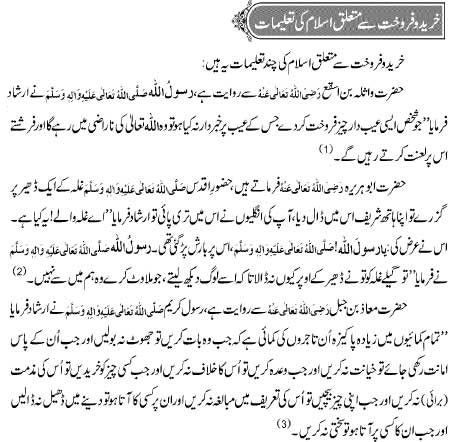
Khareed-o-Farokht Say Mutaliq Islam Ki Taleemat
Hazrat Abu Bakr Siddique(Radi Allah Unho)
Early Life
Sayyiduna Abu Bakr (radi Allahu anhu’s) real name was Abdullah, and he was given the title of “As Siddique” or”Testifier to the Truth.” His father, ‘Uthman, was known as Abu Quhafah and his mother, Salma, was known as Ummul Khair. He was two and a half years younger than Sayyiduna Rasulullah (sallal laahu alaihi wasallam).
He was the first among the Sahaba to accept Islam. He accompanied Sayyiduna Rasulullah (sallal laahu alaihi wasallam) during the Hijrah to Madinatul Munawwarah. Sayyiduna Abu Bakr (radi Allahu anhu) was a merchant. He freed many slaves, including Sayyiduna Bilal (radi Allahu anhu) and Sayyiduna Umayyah bin Qahaf (radi Allahu anhu). He participated in all the battles in which Sayyiduna Rasulullah (sallal laahu alaihi wasallam) had to fight the Kuffar.
Sayyiduna Abu Bakr (radi Allahu anhu) loved his faith more than anything else. At the Battle of Badr, his son, Sayyiduna Abdur Rahman (radi Allahu anhu), was fighting on the side of the Kuffar. After accepting Islam, Sayyiduna Abdur Rahman (radi Allahu anhu) said to his father, “O Father, at Badr, you were twice under my sword, but my love for you held my hand back.” To this, Sayyiduna Abu Bakr (radi Allahu anhu) replied, “Son, if I had you only once under my sword, you would have been no more.” He was so uncompromising in his faith.
At the time of the Battle of Tabuk, he donated all his wealth to the war effort, and when Sayyiduna Rasulullah (sallal laahu alaihi wasallam) asked him, “What have you left for your family,?” he replied, “Allah and His Rasool (sallal laahu alaihi wasallam).”
As A Caliph
After his election as the Caliph, Sayyiduna Abu Bakr (radi Allahu anhu) addressed the Muslims with these words:
“O People! I have been chosen by you as your leader, although I am no better than any of you. If I do any wrong, set me right. Listen, truth is honesty and untruth is dishonesty. The weak among you are the powerful in my eyes, as long as I do not give them their dues. The powerful among you are weak in my eyes, as long as I do not take away from them what is due to others.
“Listen carefully, if people give up striving for the Cause of Almighty Allah, He will send down disgrace upon them. If people become evil-doers, Almighty Allah will send down calamities upon them.
“Obey me as long as I obey Allah and His Rasul (sallal laahu alaihi wasallam). If I disobey Allah and His Rasul (sallal laahu alaihi wasallam), you are free to disobey me.”
Such was the first Caliph of Islam. Indeed, the world would be a better place to live in, if we had leaders like Sayyiduna Abu Bakr (radi Allahu anhu).
Sayyiduna Abu Bakr (radi Allahu anhu) now sent Sayyiduna Usamah (radi Allahu anhu) on the expedition to Syria to fight the Romans, even though he had to attend to all the internal problems of the Islamic State.
The news that Sayyiduna Rasulullah (sallal laahu alaihi wasallam) had passed away, made some new Muslims think that the Islamic State would crumble and they refused to pay the Zakaah. These new Muslims could not yet get used to their faith and its requirements until then. Sayyiduna Abu Bakr (radi Allahu anhu) declared, “By Allah! Even if a single thread is due from a man, he must give it. If he refuses, I will declare war against him.”
Passes Away
Sayyiduna Abu Bakr (radi Allahu anhu) fell ill at this time and passed away on the 21st of Jamadi-ul-Aakhir 13 A.H. (22 August 634). His rule lasted 2 years and 3 months. He was 63 years old.
One of the many contributions of Sayyiduna Abu Bakr (radi Allahu anhu) was the collection and compilation of the Holy Quran.
Personal Life
He lived a very simple, pious and upright life. He was a true servant of Almighty Allah and a meticulous follower of Sayyiduna Rasulullah (sallal laahu alaihi wasallam).
He wore ordinary clothes and his meals were very simple. He attended to house-hold work and would go out at night and seek the poor and destitute. Humility and modesty were the keynotes of his character. He felt embarrassed when people showered praises on him or showed him immense respect. He often fasted during the day and spent the whole night in Salaah and meditation. He was a great orator and a master of genealogy (one who can trace a person’s family line). In personal life, he was a Saint. He used all his powers to promote the interest of Islam and the good of people.
Prophet Muhammad: Enjoying Being Loved By All
Zayd ibn Al-Dathinnah was a companion of the Prophet (peace be upon him) who was taken prisoner in a treacherous attack on a small band of Muslims.
His captors sold him to the Quraysh tribe. The buyer did not want to keep him as a slave, but wanted to kill him in revenge for the death of his own father in a battle with Muslims. He was tied to a pole in an open space and a large group of people came over to witness his killing. Abu Sufyan, the chief of the Quraysh, said to Zayd just before he was about to be killed: “Would you wish that you were now sitting in comfort with your family and Muhammad was here in your place and we would kill him in your stead?” Zayd answered: “I would not wish to be comfortable with my family if Muhammad (peace be upon him) were to have a prick of thorn in his side.” Abu Sufyan commented: “I have never known anyone who loves another as Muhammad’s companions love him.”
Such love was common to all those who knew him. We are not talking here about the love believers have toward the Prophet who guides them to the truth of faith. Such love is common to all believers in all generations. We are talking about the love of friendship. Those companions of the Prophet, men and women, loved him as no one was ever loved by those around him. His friends were of all types of people: some were great individuals, some were ordinary, and others were simple and naive. They were of different characters, temperaments and social positions. Yet he was the dearest of all people to every single one of them.
Thawban was a servant of the Prophet. He looked sad and as time went by, his sadness seemed to remain as strong as ever. The Prophet noticed that Thawban was even losing weight. He asked him what troubled him. He said: “Messenger of God, when I do not see you for a while, I miss you so badly. I remembered the life to come and thought that even if God grants me admission into heaven, I would not see you, because you will be in the highest position with other prophets. How can I bear that?” The Prophet assured him that he would see him in heaven. Thawban was very pleased and his sadness was over.
What this tells us is that a simple person considered a place in heaven insufficient to give him happiness unless he could see the Prophet. Only when he was assured that he would be seeing him that sadness left him.
This is not an individual case. Women showed the same sort of love. A woman would be told that two or three of her closest relatives were killed in a battle. She would express her sorrow and acceptance of God’s will, but she inquires first whether the Prophet was safe. When she is assured of his safety, she can bear her personal tragedy well.
In fact, several of the most distinguished companions of the Prophet believed in Islam because they knew Muhammad well and loved him because of his personal qualities, including his truthfulness. When he told them that he received revelations from on high, they had no hesitation in believing him. They immediately declared their belief in God’s oneness and in Muhammad’s message.
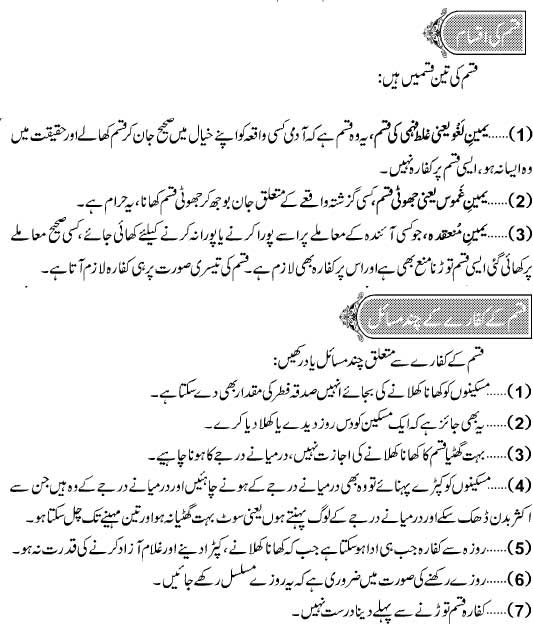
Qasam Ka Kaffara
Islam And Rationality
There is no one worthy to be worshiped but Allah, Muhammad is His (last) Messenger.
Islam and Rationality
Islam secures consistency and rationality of belief through its logical and rational principles. Islam is embraced strongly by its followers. Islam keeps the Muslim away from ideological confusion, because it has no illogical or irrational principles that are not consistent wrong with one another.
Clear concept of Allah
Islam does not cause confusion to the believer concerning Allah. Allah is one in Islam. Allah has no son or father. Allah has no parallel or equal.
According to Islam, Jesus (Peace Be Upon Him) is not the son of Allah. Jesus is Allah’s apostle. So is Moses and he so is Muhammad (Peace Be Upon Them). So are all Prophets and Apostles. Allah has no son or sons.
To believe that God is unique, and vastly superior to His creation, and yet has a son is inconsistent. This lowers God to a human, carnal level.
In today’s Christianity, it is said that God had His son killed in order to save humanity With all respect to our Christian friends, it is difficult to accept this, because it is against the justice and might of God. Why should God kill to save? It is unfair to kill an innocent person to save others. In addition, Allah does not need to kill anyone to save others. Allah can save without killing. Further, it is difficult to see the relationship between killing and saving. It is difficult to convince a person of how, if Allah kills his son, other men are saved. Further, it is difficult to convince people that Allah killed his only son, when he should protect him.
Allah Has No Son
In Islam, this issue is clear, logical, and rational. In Islam, Allah is one. Allah has no son. Allah does not kill. A person is not saved by God’s killing another person. In Islam, you are saved or doomed by yourself and your deeds. In Islam, Allah shows us the right path and the wrong path through the Noble Qur’an. Our responsibility is to choose either path. Each one of us is saved or doomed according to his choice and, consequently, according to his deeds.
Allah is one
Islam does not have the concept of the Trinity, or the concept of ” three in one.” It is very difficult for the mind to accept or understand how one being can be father, son, and Holy Spirit simultaneously. Furthermore, Allah has no son and does not need sons, because Allah is the owner of everything and the Creator of all beings.
No Mediation between Man and Allah
In Islam, there is no mediation between Allah and man. You do not need to visit a priest to confess or repent. In Islam, every Muslim has direct contact with Allah, no matter how weak, poor, or ignorant he is. In Islam, Allah is the God of all. Every Muslim decides by himself how near or how far he wants to be from God, depending on his own free will and deeds. In Islam, there are no mediators between man and Allah.
No Clergy
In Islam, there are no men of religion as in some other beliefs. In Islam, every Muslim is responsible for his own beliefs and for Islam in general. In Islam, there are scholars of religion, but there is no class of clergymen.
No Celibacy
In Islam, there is no celibacy, because celibacy is against human nature. Islam urges the Muslim to get ‘married as soon as he can, because it is difficult for-normal people to be religious and unmarried at the same time. Islam, as a rule, organizes human nature, but never destroys or goes against it.
Body-soul Balance
Islam establishes a wonderful harmony between the demands of the soul and the demands of the body. The religion that considers celibacy as necessary for purity goes against human nature and theoretically puts an end to the human race. Prophet Muhammad, (Peace Be Upon Him) says, “Your God has rights over you. Your body has rights over you. Your soul has rights over you. Give to each his due rights. ”
A Complete Code of Life
Islam is a religion, but not in the western meaning of religion. The western connotation of the term “religion” is something between the believer and God. Islam is a religion that organizes all aspects of life on both the individual and national levels. Islam organizes your relations with God, with yourself, your children, your relatives, your neighbors, your guests, and other brethren. Islam clearly establishes your duties and rights in all those relationships. Islam establishes a clear system of worship, civil rights, laws of marriage and divorce, laws of inheritance, code of behavior, what to drink, and what not to drink, what to wear, and what not to wear, how to worship God, how to govern, the laws of war and peace, when to go to war, when to make peace, the laws of economics, and the laws of buying and selling.
Islam is a complete code of life, and it is not for their mosque only. Islam is for life, daily life. Islam is a guide to life in all its aspects: socially, ethically, economically, and politically. Islam is a complete constitution. Islam keeps the Muslim away from confusion, because Islam is logical and rational. Allah is one and has no sons. Allah is not a trinity. Allah does not kill to save. No mediation is required between Allah and man. Islam organizes human nature, but does not go against it. There is no class of clergy in Islam nor is there celibacy. Islam is a complete code of human life.