
Shaheed-E-Minbar-O-Mehrab
Archives
Serving The Interests Of The Community
Among all the wives of the Prophet (peace be upon him), Umm Salamah (radiAllahu anha) was perhaps the one who was most sensitive to the interests of the community. She shared the hopes and difficulties of her fellow Muslims at both the individual and the community levels. We saw how she expressed their feelings to the Prophet when the Muslims were told that they could not go to Makkah for their worship rituals and had to return home. Her advice to the Prophet on that day took away all the strain and ensured their compliance with his orders.
After the Tabuk expedition, a few Muslims who did not join the Muslim army tied themselves up in the mosque, as a sign of repentance. They were untied when it was time for prayer, and then they tied themselves up again when the obligatory prayer had finished. They were uncertain about what judgment was to be made in their cases. Their self-imposed restraint was a gesture of their repentance. One of them was Abu Lubabah (Radi Allahu Anhu).
As the Prophet was at Umm Salamah’s home one night, just before the dawn prayer, he received revelations that included the Verse that says: “There are others who have acknowledged their sins, after having mixed righteous deeds with evil ones. It may well be that God will accept their repentance. God is Much-Forgiving, Ever-Merciful.” (9: 102)
The Prophet smiled and Umm Salamah (radiAllahu anha) asked him why he smiled. He said: “God has accepted Abu Lubabah’s repentance.” She asked him: “May I be the one who gives him the good news?”
She opened her door and looked inside the mosque. She said: “Abu Lubabah! Rejoice, for God has accepted your repentance.” Some people rushed to release him, but he refused, saying that he would beg them not to do so, for he wanted the Prophet to release him. We see how she was so pleased for someone who was totally unrelated to her. She shared his joy at the happy news.
Many years later, when the Muslim community went through the very difficult days that saw the assassination of the third Caliph, Uthman (Radi Allahu Anhu), and a serious split in the community, another wife of the Prophet, Ayesha (radiAllahu anha), was about to leave Madinah, marching at the head of an army that sought to gather support for their stand.
Umm Salamah objected to this attitude. She went to Ayesha (radiAllahu anha) and counseled her against going. She said it was wrong for a widow of the Prophet to embark on such a course of action.
As for her own position in those days, she was totally supportive of Ali (Radi Allahu Anhu), the fourth Caliph. She went to him and said: “I would have joined your army, but I know that such an action would be in disobedience of God’s orders and I believe you would not accept it from me. However, this is my son, Omar. He is dearer to me than my own life. He will join you and will fight for your cause.”
Her position then was characteristic of the great insight that enabled her to gauge what best served the interests of the Muslim community.
Umm Salamah (radiAllahu anha) lived long after the Prophet. In fact, she was the last of the Prophet’s wives to die. Her death took place in the year 61, and she was buried at Al-Baqee, the burial place of many of the Prophet’s companions in Madinah.
By: Adil Salahi
Life Without Tolerance
Life without tolerance becomes a living hell because everybody will be biased against other religions, races, nationalities, cultures, classes, and points of view. Islam has paid due attention to this issue realizing how vital it is in the life of any society. In this article, I shall try to shed some light on this issue in light of the Holy Qur’an and Sunnah.
Prophet Muhammad (peace be upon him) was the ideal example of tolerance. He taught his Companions to respect human beings regardless of their religion, race, color, language…etc. and this is one of the characteristics that made people embrace Islam through its long history.
One of those who recently embraced Islam said that what it so attractive about Islam is that it accepts the other, although the other does not usually accept it for no logical reason.
He noticed that Muslims are ordered to believe in all the Holy Books and all Prophets and Messengers and honor them, “The Apostle believes in what has been revealed to him from his Lord, as do the men of faith. Each one (of them) believes in God, His angels, His books, and His apostles. “We make no distinction (they say) between one and another of His apostles.” And they say: “We hear, and we obey: (We seek) Your forgiveness, our Lord, and to You is the return of all.” (Qur’an, 2:285)
When Prophet Muhammad (peace be upon him) migrated to Madina, he found the Jews inhabiting part of it, he did not expel them from the city. Instead, Prophet Muhammad (peace be upon him) signed a treaty with them giving them the right to live in it peacefully, but they as usual did not abide by the treaty. The Prophet (peace be upon him) also used to receive delegations belonging to other religions like Christianity, dealing with them with due respect and courtesy.
Also, we must realize that people are of different natures and backgrounds, cultures and languages and this is one of the norms of nature. This is clearly stated in the Holy Qur’an, “O mankind! We created you from a single (pair) of a male and a female, and made you into nations and tribes, that you may know each other (not that you may despise (each other). Verily the most honored of you in the sight of Allah is (he who is) the most righteous of you. And Allah has full knowledge and is well acquainted (with all things).” (Qur’an, 49:13)
Birr (Piety) Towards Parents After Death
Death brings an end to one’s ability to perform good deeds and it is a long journey that requires enough provisions and only three qualities can make this journey easier. Allah’s Messenger (sallallahu alaihi wa-sallam) said: “When a man dies all his good deeds end, except for three cases; the charity of continuous blessings, beneficial knowledge that he left behind, and a righteous child who prays for him.” [Saheeh Muslim (vol. 3, p.867, no. 4005)]
Allah’s Messenger (sallallahu alaihi wa-sallam) explained how a child can benefit his parents after their death. Narrated Abu Usayd Malik ibn Rabiah as-Saidi: “While we were with the Messenger of Allah (sallallahu alaihi wa-sallam), a man of Banu Salmah came to him and said: ‘O Messenger of Allah, is there any kindness left that I can do to my parents after their death?’ He replied: “Yes, there are four qualities to perform:-
1. Pray (to Allah to grant them mercy) and invoke (Him) to forgive them,
2. Fulfill their promises (or will),
3. Be generous to their friends,
4. Keep relations with the kindred, which you are kindred through your parents. This is what remains of the kindness that you could perform towards them after they die.” [Sunan of Abu-Dawood (5123)]
Note: The last wishes (wasiyah or will) expressed by the person should be fulfilled so long as they are in accordance with the Sharee’ah.
Performing Hajj on behalf of the Dead:
Another form of worship known from the Sunnah that can be performed on behalf of the dead is Hajj (Pilgrimage). Hajj can only be performed on behalf of the dead after completing one’s obligation of performing Hajj. It was narrated from Ibn Abbas that the Messenger of Allah (sallallahu alaihi wa-sallam) heard a man saying “Labbayka ‘an Shubrumah (At your service, O Allah, on behalf of Shubrumah).” The Messenger of Allah (sallallahu alaihi wa-sallam) asked: “Who is Shubrumah?” He said, “A relative of mine.” The Prophet (sallallahu alaihi wa-sallam) said, “Have you ever done Hajj before?” He replied: “No.” Allah’s Messenger (sallallahu alaihi wa-sallam) ordered him, “Do this Hajj for yourself, then do Hajj on behalf of Shubrumah.” [Abu Dawood (1811). The hadeeth is classed as Saheeh by Shaikh al-Albanee in Irwaa’ al-Ghaleel (4/171)]
Bemari Ka Bayan
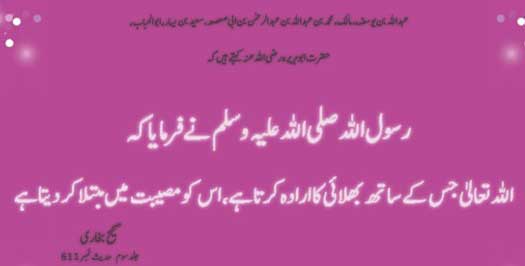
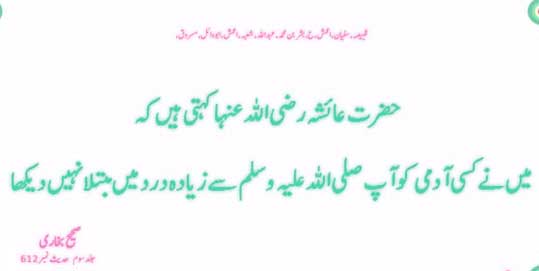
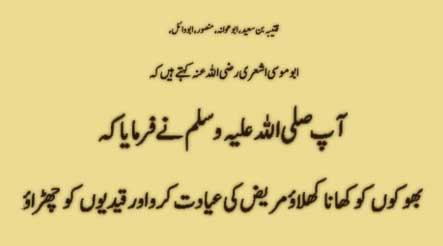
Bemari Ka Bayan
Five Things About The Holy Qur’an
1. The original usage of the word “Qur’an” itself, where it occurs about 70 times assuming various meanings. It is a verbal noun of the Arabic verb “Qara’a”, meaning “he heard” or “he recited”. Its liturgical context is seen in several passages, for example: “So that when Al Qur’an is recited, listen to it & keep silent“. The term also has closely related synonyms which are employed throughout the Qur’an. Each of the synonyms possesses its distinct meaning. Such terms include “kitab” (book); “ayah” (sign); & “surah” (chapter). Other related words are: “dhikr”, meaning “remembrance”, & “hikma” meaning “wisdom”.
2. The Qur’an consists of 114 chapters of varying lengths; each known as surah. Each chapter has a title: usually, a word is mentioned within the chapter itself. In general, the longer chapters appear earlier in the Qur’an, while the shorter ones appear later. As such, the arrangement is not connected to the sequence of revelation. Each chapter commences with “Bismillahir Rahmanir Rahim”, an Arabic phrase meaning “In the name of God, Most Gracious, Most Merciful”, with the exception of the ninth chapter.
3. Scribes wrote down the Qur’an, according to the order of the Prophet Muhammad (peace be upon him), on pieces of cloth, leather, bones, & stones. Its verses were ordered & arranged according to Allah’s inspiration. In the beginning, it was not gathered in one book. Some of the Prophet’s companions wrote parts & Surahs especially for themselves after they had memorized it from the Prophet. Zaid Ibn Thabit gathered the Qur’an in one book. He was tasked to do this by Abu Bakr Al-Siddiq, according to advice from Umar Ibn Khattab. Its resource was the parts written by the scribes; so he gathered all of it in one book, The Holy Qur’an.
4. Dots were put as syntactical marks by Abu Al-Aswad Al-Doaly, during the time of Mu’awiya Ibn Abi Sufyan (661-680 CE). The letters were marked with different dotting by Nasr Ibn Asem & Hayy Ibn Ya’amor, during the time of Abd Al- Malik Ibn Marwan (685-705 CE). A complete system of diacritical marks (damma, fataha, kasra) was invented by Al-Khaleel Ibn Ahmad Al-Faraheedy (d. 786 CE).
5. With the necessity to record the Holy Qur’an in the clear and readable text; the Arabic scripts developed into what is now considered the two most important classical styles of calligraphy: Kufic and Naskh. Kufic and Naskh are broad generic terms covering a plethora of magnificent styles in Arabic calligraphy, and are not, of course entirely inclusive of the numerous variations and nuances of the different styles of script, some of which were of key importance in the establishment of the classical trends and styles in the noble art of Arabic calligraphy.
Don’t Rush Through Prayer
We truly appreciate the value of something when we are deprived of it – either temporarily or irrevocably. Owing to a recent accident, I was compelled to say my prayers while sitting down, and like many others who are unable to bow down due to physical disabilities or old age, I realized the value of one of the pillars of prayer which many of us tend to rush through or neglect in ordinary circumstances: the Ruku’ (bowing/genuflection).
Obligation of Ruku
The acts of bowing and prostrating in prayer are commanded in the Qur’an and made obligatory upon the believers:
“O you who believe! Bow down and prostrate yourselves and serve your Lord.” (Qur’an, 22:77)
“Behold! The angels said: ‘O Mary! Allah has chosen you and purified you – chosen you above the women of all nations. O, Mary! Worship your Lord devoutly: Prostrate thyself, and bow down (in prayer) with those who bow down.’” (Qur’an, 3:42-43)
In a Hadith (narration) the Prophet (peace be upon him) advised “the one who prayed badly”, saying, “Indeed, the prayer of one of you is not complete until he makes an excellent ablution as Allah has commanded him to … then he celebrates Allah’s greatness, praises and glorifies Him, then recites the Qur’an as much as is easy for him from what Allah has taught him and allowed him, then says Takbeer (Allahu-Akbar) and makes Ruku’ (and places his hands on his knees) until his joints are at ease and relaxed.” (Abu Dawood and An-Nasai’)
In another narration, Abu Qatadah (may Allah be pleased with him) related that the Prophet (peace be upon him) said, “The worst people are the thieves who steal part of the prayer.” He was asked how this was done, and he replied, “The one who does not complete his bowings and prostrations,” or he said, “The one who does not straighten his back during his bowings and prostrations.” (Ahmad, At-Tabarani, Ibn Khuzaimah and Al-Hakim)
Abu Mas’ud Al-Badri (may Allah be pleased with him) reported that the Prophet (peace be upon him) said, “The prayer of one who does not straighten his back in his bowing and prostration is not accomplished.” [Narrated by “the five,’’ [narrators] and Ibn Khuzaimah, Ibn Hibban, at-Tabarani, and al-Baihaqi]
The Companion Hudhayfah Bin Yaman (may Allah be pleased with him) saw someone who did not straighten his back during his bowings and prostrations and told him, “You have not prayed. And if you were to die, you would not die on the way of Allah and His Messenger.” (Al-Bukhari)
Giving Sincere Advice To Muslims
Jareer, may Allah be pleased with him, said, “I pledged allegiance to the Prophet (peace be upon him) to establish the prayer, give the Zakat and advise every Muslim.” (Al-Bukhari and Muslim)
Ibn Hibban narrated (this Hadith) by way of Abu Zur’ah Bin Amru Bin Jareer on the authority of his grandfather (i.e Jareer) and added: So whenever Jareer used to buy or sell something he used to say, “Know that what I have taken from you is more valuable than what I have given you, so choose.” (Fath Al-Bari, 1/139)
Indeed Jareer honored his pledge to the Prophet (peace be upon him). He once asked his servant to buy a horse for him, so he bought one for 300 dirhams and brought it with its owner to Jareer. Jareer said to the owner, “Your horse is worth more than 300.” He then bought it from him for 800 dirhams. When Jareer was questioned about this, he said, “Indeed I pledged allegiance to the Prophet (peace be upon him) to give advice to every Muslim.” (At-Tabarani, Ad-Dibaj ‘Ala Muslim, 1/75)
Ziyad Bin ‘Ilaqah said: I heard Jareer Bin Abdullah speak on the day that Caliph Al-Mugheerah Bin Shu’bah died. He stood up (on the Minbar), praised Allah, and said:
“Have Taqwa of Allah alone and do not associate any partners with Him. Be solemn and calm until another leader is appointed to you, for indeed he will now come.” He then said: “Ask forgiveness for your leader (Al-Mugheerah) for indeed he loved forgiveness.” He continued, “Amma ba’d. Indeed I approached the Prophet (peace be upon him) and told him that I would pledge allegiance to him upon Islam. So he stipulated upon me that I advise every Muslim, so I pledged allegiance to him upon that (with these two hands of mine). By the Lord of this Masjid, indeed I am a sincere adviser to you all.” He then sought forgiveness from his Lord and descended (from the Minbar). (Al-Bukhari)
Imam Al-Bukhari concluded the “Book of Iman” with his advice to people to act upon authentic Ahadith instead of inauthentic Ahadith. He then finished the ‘Book of Iman’ with Jareer’s sermon which expresses his own state while authoring his book. (Fath Al-Bari, 1/140)
Method Of Eating And Science

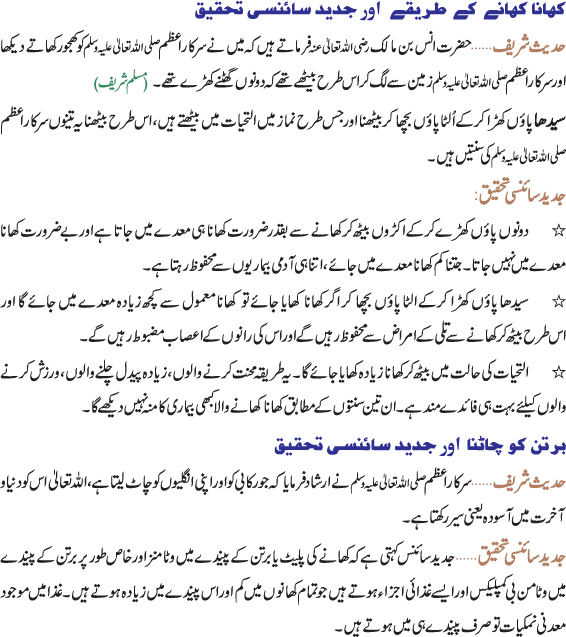
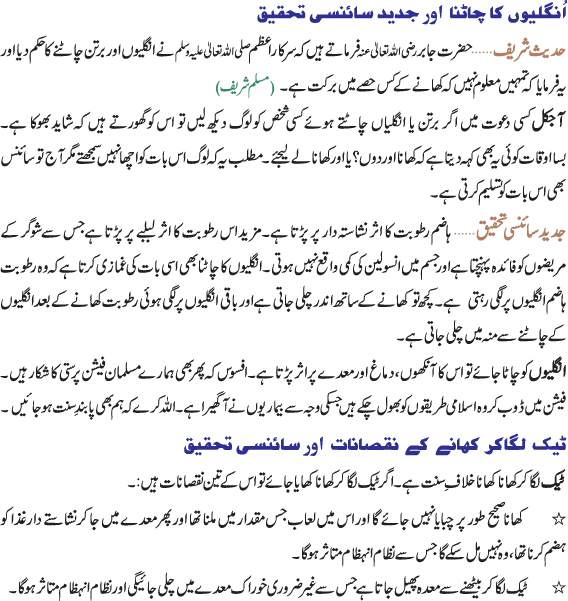
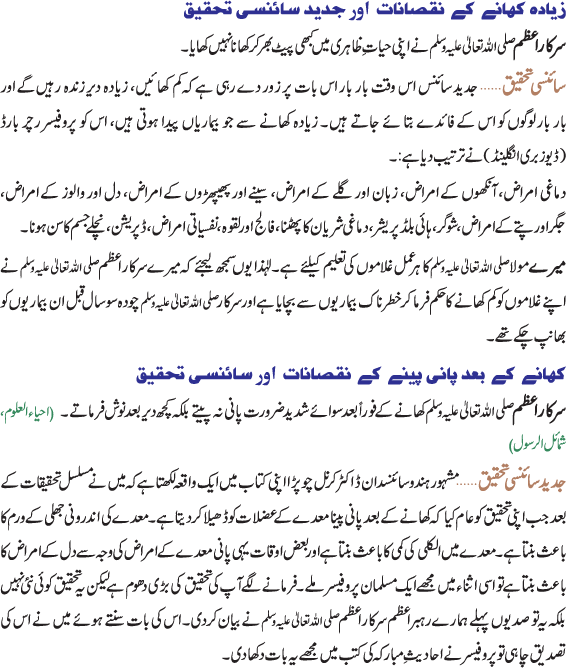
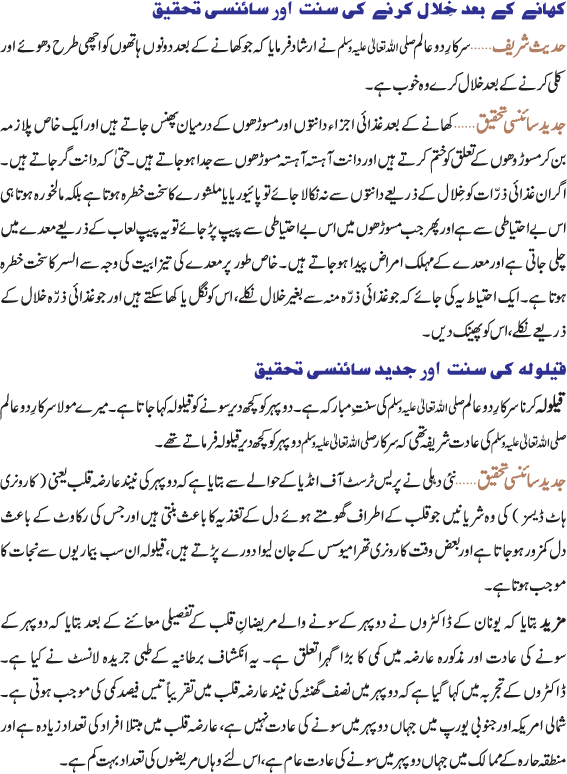
Method Of Eating And Science
Between Trial and Punishment
Almighty Allah makes it clear in the Qur’an that good and evil are part of life’s nature; He says: ” … We shall make a trial of you with evil and with good. And to Us you will be returned.” (21: 35) Trials are sometimes to punish those who violate Allah’s laws. But this is not always the case. Other times, trials are to test our faith in Allah and hence be given high ranks in Paradise.
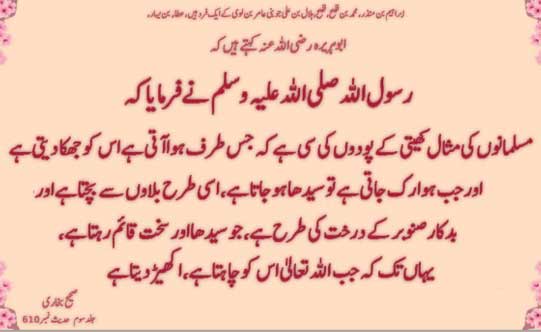
In this sense, a Muslim should always keep in mind that life is full of its ups and downs, and strives hard to battle against life’s vicissitudes. It should be borne in mind that whatever befalls man in life is a form of test and trial, so it behooves every true Muslim to remain patient at times of afflictions and trials, and this will earn him a great reward, as the Prophet (peace be upon him) says: “Great is the state of a believer, for he is winner at any rate. If he is given a blessing and thus shows gratitude, it is good for him. If he is struck with an affliction and then shows patience, it is good for him.”
Almighty Allah tests His servants with good and bad things, with adversity and prosperity. These tests may be a means to give them rewards and high ranks in Paradise. This happened in the case of many Messengers and Prophets and many righteous servants of Allah. Our Prophet (peace be upon him), is reported as saying: “The people most subject to afflictions are the Prophets, then come righteous and after them come the best people – all according to his goodness.” Sometimes, afflictions may be a result of one’s sins and his keeping away from the way of Allah. With this meaning comes the verse that reads: “And Whatever of misfortune befalls you, it is what your hands have earned. And He pardons much.” (42: 30)
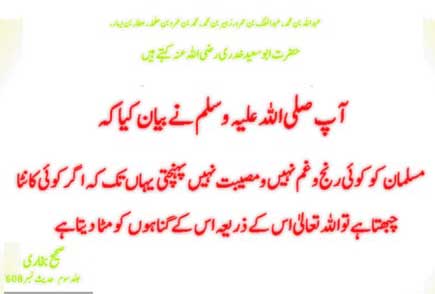
By and large, being afflicted with a misfortune may be a means of giving high ranks in Paradise as in the case of Prophets, Messengers, and righteous men. It may also be a means of removing sins and expiating mistakes. Stressing this meaning, our Prophet (peace be upon him) says: “Whatever befalls a Muslim of sorrow, grief, exhaustion, fatigue or harm, Allah will forgive him his sins for that. This is true even for a thorn that pricks his foot.” He (peace be upon him) is also reported as saying: “He whom Allah wants to bless in the Hereafter, He afflicts him with tribulations.” Al-Tirmidhi also quotes the Prophet (peace be upon him) as saying: “When Allah wants to bless someone, he hastens His punishments for him in this world. If He wants otherwise with a person, He defers the punishment for him till the afterlife.”
In light of the above-mentioned facts, it’s clear, that a great reward is in store for observing patience and perseverance at times of afflictions, which befall men as part of the nature of life, and in a form of test through which Allah distinguishes His true servants from all and sundry.