
Rahamdili
Archives
Merits Of Offering Five Daily Prayers
Let me start by saying that there are many passages in the Qur’an, which directly order us to obey Allah and His messenger. When we take Islam as our way of life, we are voluntarily surrendering to the commands of Allah and we are choosing to follow the practice (sunnah) of the prophet (peace be upon him).
In Surah Al-Isra verse 78, we are told:
Perform As-Salat (Iqamat-as-Salat) from mid-day till the darkness of the night (i.e. the Zuhr, Asr, Maghrib, and Isha prayers), and recite the Qur an in the early dawn. Verily, the recitation of dawn Qur an (i.e. the morning – Fajr prayer) is ever witnessed.
Then, from the time the sun declines, which is mid-day, until the darkening of the night, includes Zuhr (noon prayer), Asr (evening prayer), Maghrib (sunset prayer), and Isha (night prayer). These five prayers were revealed to Prophet Muhammad (peace be upon him) on the Isra a and Mi`raj and were performed by him in their specified number of rak’aas. He also taught them to Muslims, who performed them in that sequence and form ever since.
There is no secret in the number of prayers. It is simply that they are related to the course of the day and relevant to the different states of nature (day and night) that are linked to the biological clock of any Muslim. Thus, the Muslim is in continuous connection with God, throughout the different phases of the day. The day starts with Fajr (dawn) prayers, to renew the oath of worship and obedience. Then, the workday of a Muslim society should start after that. Zuhr is in the middle of the day, and Asr is a bit later. As for Maghrib, it is with sunset and Isha is when the night falls.
The prayer times are also related to the manners and times of rest in social life. There are verses in the Qur’an, which say that before Fajr, after Zuhr, and after Isha, Muslim parents are allowed a time of privacy and that other family members should respect that. Also, a Muslim is encouraged to perform prayers with a group of Muslims (jama a), these are also times of social gathering in mosques. Such gatherings are where people can simply meet and discuss their communal affairs and grass root lobbying, for societal causes. The number of prayers is simply appropriate for such social structures, relations, neighborhoods, and community ties. It is also suitable for the special structure of worship, which connects the Muslim to his Creator throughout the long day.
In a modern economy, where family members are located in different areas and where the workplace introduces new forms of communication and personal relations, the times of prayers re-formulate these relations. They remind people of their relation to Allah and to each other as well.
Hence, the competitive capitalist atmosphere of modern businesses is rendered milder. The embedded values of submission to Allah and remembering the hereafter and the socio-religious bond of Islam, keep the balance of the human self intact. One should read in our current global economy how the daily routine can result in the corrosion of character. Herein, the wisdom and philosophy of the five daily prayers in Islam, gain new meanings and implications.
Umar (radi allahu anhu) Accepts Islam
Evidently, both Said Ibn Zayd and Fatimah, daughter of al-Khattab, managed to conceal their acceptance of Islam from the Quraysh and especially from Fatimah’s family for some time. She had cause to fear not only her father but her brother Umar who was brought up to venerate the Kabah and to cherish the unity of the Quraysh and their religion. Umar was a headstrong young man of great determination. He saw Islam as a threat to the Quraysh and became most violent and unrestrained in his attacks on Muslims. He finally decided that the only way to put an end to the trouble was to eliminate the man who was its cause..
Goaded on by blind fury he took up his sword and headed for the Prophet’s house. On his way, he came face to face with a secret believer in the Prophet who seeing Umar’s grim expression asked him where he was going. “I am going to kill Muhammad…”
There was no mistaking his bitterness and murderous resolve. The believer sought to dissuade him from his intent but Umar was deaf to any arguments. He then thought of diverting Umar in order to at least warn the Prophet of his intentions.
“O Umar,” he said, “Why not first go back to the people of your own house and set them to rights?”
“What people of my house?” asked Umar.
“Your sister Fatimah and your brother-in-law Said. They have both forsaken your religion and are followers of Muhammad in his religion…”
Umar turned and made straight for his sister’s house. There he called out to her angrily as he approached. Khabbab ibn al-Aratt who often came to recite the Quran to Said and Fatimah was with them then. When they heard Umar’s voice, Khabbab hid in a corner of the house and Fatimah concealed the manuscript. But ‘Umar had heard the sound of their reading and when he came in, he said to them: “What is this gibbering I heard?”
They tried to assure him that it was only normal conversation that he had heard but he insisted: “Hear it I did,” he said, “and it is possible that you have both become renegades.”
“Have you not considered whether the Truth is not to be found in your religion?” said Said to Umar trying to reason with him. Instead, Umar set upon his brother-in-law hitting and kicking him as hard as he could and when Fatimah went to the defense of her husband, Umar struck her a blow on her face which drew blood.
“O Umar,” said Fatimah angrily. “What if the Truth is not in your religion? I bear witness that there is no god but Allah and I bear witness that Muhammad is the Messenger of God.”
Fatimah’s wound was bleeding, and when Umar saw the blood he was sorry for what he had done. A change came over him and he said to his sister:
“Give me that script which you have that I may read it.” Like them, Umar could read, but when he asked for the script, Fatimah said to him:
“You are impure and only the pure may touch it. Go and wash or make ablutions.”
Thereupon Umar went and washed, and she gave him the page on which was written the opening verses of Surah Ta-Ha. He began to read it and when he reached the verse, ‘Verily, I alone am God, there no deity but me. So, worship Me alone, and be constant in Prayer so as to remember Me,’ he said: “Show me where Muhammad is.”
Umar then made his way to the house of al-Arqam and declared his acceptance of Islam and the Prophet peace be upon him and all his companions rejoiced.
The Soul Of Hajj
No annual event on the face of the earth, religious or non-religious, compares to Hajj in terms of the sheer number of participants, duration of the event, and the breadth of the agenda. In spite of this fact, it has always remained equally fascinating and mysterious to not only non-Muslims, who are barred from entering the holy city, but also to millions of Muslims, who had not performed Hajj.
What then is Hajj? In essence, Hajj is man’s evolution toward Allah; his return to Him. It is a symbolic demonstration of the philosophy of the creation of Adam, the first man. To further illustrate this, it may be stated that the performance of Hajj is a simultaneous show or exhibit of many things. It is a show of creation. It is a show of history. It is a show of unity. It is a show of Islamic ideology. It is a show of Ummah, the community of Muslims. That is why it is said in the Qur’an: “And proclaim unto mankind the Hajj. “… That they may witness things that are of benefit to them ….” (22:28)
Hajj is a duty unto Allah for mankind, for “…. those who can afford the expenses …” (3:97). It is not a tax on your wealth, but a duty. Thus, to qualify, you must be sane and wise to understand what you are getting into, and able-bodied to go through this task, and lastly, have the means or resources to perform Hajj.
The pillars of Hajj are five :
- Assuming Ihram
- Attendance at Arafat
- Tawaf of the Ka’ba
- Sa’i or running between the Safa and the Marwa (5) cutting or trimming of hair.
- Cutting or trimming of hair.
Others are not pillars, although some may require kaffara or a penalty, if not done. The person who puts on the Ihram or cloth for either Umrah (lesser pilgrimage) or Hajj (greater pilgrimage) is called a Muhrim.
Hajj and Umrah are performed in three ways — ifrad, tamattu, and qiran. Ifrad involves first performing Hajj and then Umrah. Tamattu is when one first performs Umrah and then Hajj, both in the same year with some break in between the two.
Qiran is when one puts on the ‘Ihram with the intention of combining both Hajj and Umrah without any break in between the two.
The 10 etiquette of Hajj are:
- Requite all wrongdoings and seek forgiveness from all those who have a grudge against you.
- Make provision for Hajj from one’s lawful means.
- Learn the pillars of Hajj and its observance.
- Be kind and bear with others with patience, lest the reward is nullified.
- Observe the obligations of prayers and their rulings.
- Be generous, support the poor, and spend as much as he/she is able to.
- At the station of Arafat, remember the Day of Judgment.
- Should not miss visitation of the Prophet’s (peace be upon him) Mosque in Madina.
- After returning from Hajj, one should turn oneself toward praying for Akhirah (Hereafter).
- One should remember parents and other close relatives who have passed away with humble prayers and make-up for them if they could not fulfill their obligations of Hajj.
Protect Your Look – Nazar Ki Hifazat

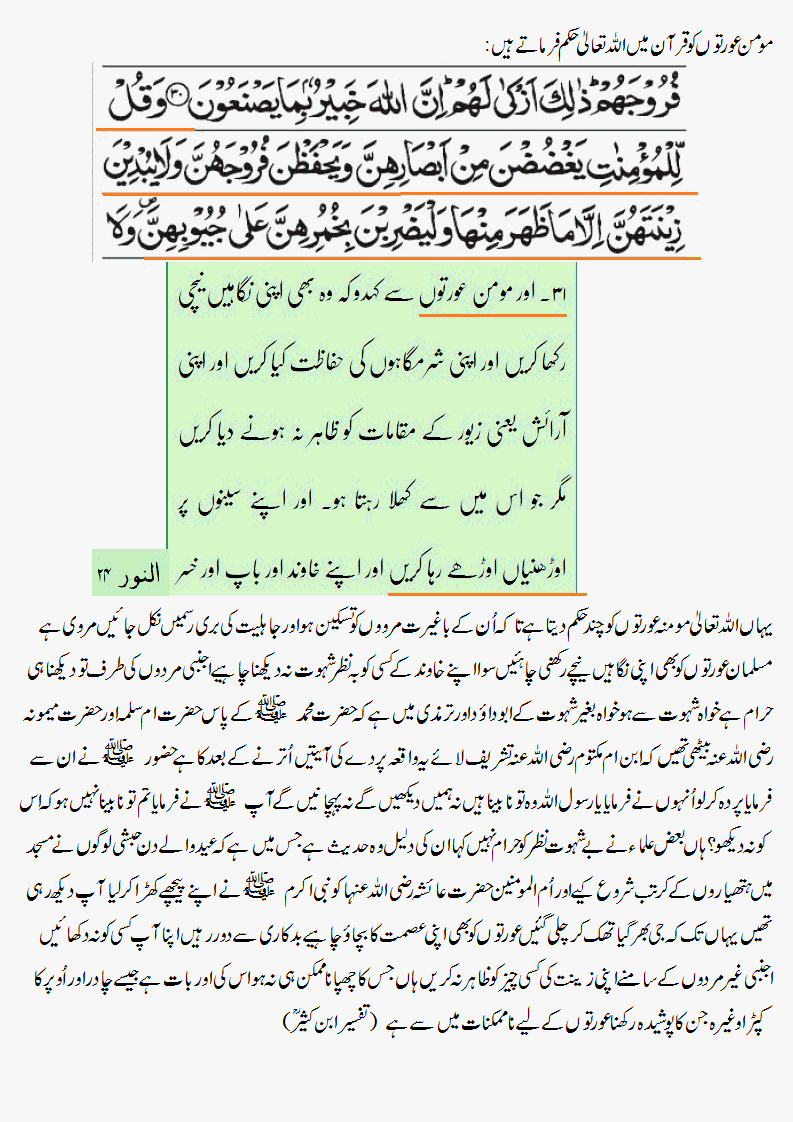

Protect Your Look – Nazar Ki Hifazat
No Reason To Fear Satan
“It is only Satan that suggests to you the fear of his allies. So, do not fear them, and fear Me if you are believers.” (Qur’an, 3:175)
Ibn Taymiyyah commented on the verse: “This verse proves that Satan makes his allies sources of fear, and he causes people to be afraid of them. And the verse shows that it is not permissible for the believer to fear the allies of Satan, and he should not fear people, as (Allah) said: ‘So, do not fear the people, and fear Me…’ (Qur’an, 5:44)
So, we are commanded to fear Allah, and we are prohibited from fearing the allies of Satan. He also said: ‘Those who convey the message of Allah and fear Him and fear none except Allah…’ (Qur’an, 33:39)
“And some people say: ‘O Lord! I fear You and I fear those who don’t fear You.’ These are nonsensical words, and it is not allowed to say them. Rather, one should fear Allah alone and not fear any person, since whoever does not fear Allah is too low to be feared, as he is a wrong-doer and is from the allies of Satan. So, Allah has forbidden us from having fear of such a person.
“The fact that someone is given power over you is the result of your sins and your fear of that person. So, if you fear Allah and repent from your sins and seek His Forgiveness, nobody can overpower you.” (Majmoo Al-Fatawa; 1/77-78)
Ibn al-Qayyim said: “From the plots of the enemy of Allah (Satan) is that he makes the believers afraid of his soldiers and allies. So, they do not strive against them, they do not enjoin what is good, and do not forbid what is bad.”
Qatadah explained: “He makes them great and powerful in his heart. The stronger your faith becomes, the weaker the fear in your heart will be of Satan’s allies; and the weaker your faith becomes, the stronger the fear in your heart will be of them.” (Ighathat Al-Lahfan, 1/94).
Journey Of A Lifetime
Hajj is performed from the 8-13 of Dhul-Hijjah. The Manasik (rites) of Haj At-Tamattu’ is described below and has been summarized on the right. Early on the morning of 8th Dhul Hijjah, the Day of Tarwiyah, the pilgrim assumes Ihram for Hajj as he did for Umrah, but says “Labbayk Allahumma Hajjan” and begins reciting the Talbiyyah. All the rules of Ihram which applied to Umrah also hold for Hajj. He then proceeds to Mina where he spends the day in worship and performs Dhuhr, Asr, Maghrib, and Isha shortened but not joined. He spends the night there.
After Fajr on 9th Dhul Hijjah, the Day of Arafah, he leaves for `Arafah. At the time of Dhuhr, he prays Dhuhr and `Asr shortened and combined with one Adhan and two Iqamah. He remains there until Maghrib, standing with hands raised in supplication anywhere within the boundaries of Arafah.
After sunset, he proceeds to Muzdalifah where he performs Maghrib and Isha shortened and combined with one Adhan and two Iqamah. He then goes to sleep until Fajr. After performing Fajr at its earliest time on the 10th Dhul Hijjah, the Day of Sacrifice, he leaves Muzdalifah before sunrise and returns to Mina. He continues reciting the Talbiyah.
He collects seven pebbles and does a stoning of the Big Jamarah sometime between sunrise and night, standing with Makkah to his left and Mina to his right. He says “Allahu Akbar” with each stone throw. The slaughter must be done and then he may partially come out of the state of Ihram by shaving the head or cutting the hair for men and trimming the hair for women.
Perform Tawaf Al-Ifadah walking normally, then do Sa`ee. One is now completely out of Ihram. On the 11th-13th Dhul Hijjah, the Days of Tashreeq, one stays in Mina and performs stoning of the three Jamarat each day between Zawal (the sun is at its peak) and night – 21 pebbles must be collected for this. The smallest Jamarah is stoned first, then the medium, then the big one. After stoning at the first two, one may face the Qiblah and supplicate to Allah. On the 13th after stoning the Jamarat one leaves Mina.
One must perform the Farewell Tawaf prior to leaving Makkah. This completes the Manasik of Hajj. May Allah grant all pilgrims Hajj Mabroor (an accepted Haj, the reward of which is nothing but Jannah).
Family Life In Islam
Your Lord has decreed that you worship none but Him. And that you be dutiful to your parents. If one of them or both of them attain old age in your life, say not to them a word of disrespect, nor shout at them but address them in terms of honor. And lower unto them the wing of humility through mercy, say: My Lord! Bestow on them Your Mercy as they did bring me up when I was young. (17:23-24).
In the West, most children can’t wait to reach the legal age and move out of the house. Parents are seen as a hindrance to one’s freedom. Aged parents are seen as a burden that should be shoved onto the shoulders of a nursing home.
For a Muslim, being kind to parents is much more than remembering them on their birthdays or Mother’s or Father’s Day. Being kind to them means listening respectfully to their opinion and obeying them in everything that is not disobedience to God. For an adult child it means to see that they have the necessities of life and whatever more one can afford; to keep them under one’s roof when they are elderly without grudge; to never speak unkindly to them or physically abuse them.
Nursing homes are almost unheard of in many Muslim countries. (Alzheimer’s disease is also rare.) In an Islamic society, parents are respected for their wisdom and experience. Adult children might move out in search of work, but they still turn to their parents for advice and visit or communicate with them as much as possible. It is a Muslim’s honored duty to lovingly care for his or her parents in their old age. Parents sacrifice so much for their children when they are small; a Muslim is happy to return that sacrifice when his or her parents can no longer care for themselves. It is not a burden but a means of winning a great reward in Paradise.
In many Muslim societies, the extended family lives together. As parents become grandparents, they may help in looking after or educating young children. And even when they are no longer “productive”, they continue to be loved and respected for their humanity, and for their wisdom and experience.
A Muslim’s duties to his or her parents do not end when they die, for one thing, that benefits the dead is the prayers of their righteous children.
A man asked the Prophet Muhammad (peace be upon him), “Whom should I honor most?” The Prophet (peace be upon him) said, “Your mother.” “And who comes next?” asked the man. He replied, “Your mother.” “And who comes next?” asked the man. He replied, “Your mother.” “And who comes next?” asked the man. The Prophet (peace be upon him) replied, “Your father.” (Reported by Al-Bukhari and Muslim)
Allah Ki Rahmat Say Mahroomi
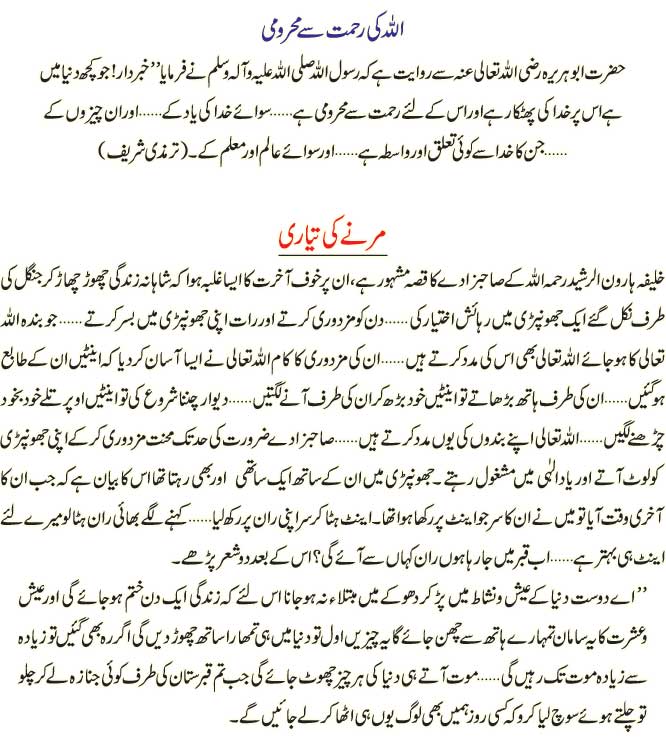
Allah Ki Rahmat Say Mahroomi
Repent Before You Regret
Why should Allah punish you if you have thanked (Him) and have believed in Him? And Allah is Ever All-Appreciative (of good), All-Knowing. (An-Nisaa‚ 4:147)
People are created with many weaknesses and imperfections. Throughout our lives, we forget many things and make countless mistakes. However, through repentance, which Allah grants us as a great favor, it is always possible in this world to correct our mistakes. Indeed, the world is created just for this purpose: We are trained, put to test, and purified of our mistakes in this world. It is likely that we may deeply regret our mistakes or the way we have led our lives. However, it is always possible to make up for this regret. After having lived through this regret, we can ask for repentance and hope for Allah’s forgiveness.
In the Qur’an, Allah gives the glad tidings that He will forgive any sin provided one repents sincerely. Allah knows our inner thoughts and every word we keep to ourselves. He knows whether we are true to Him or not. Allah, in the Qur’an, describes His closeness to His servants:
Your Lord knows best what is in your inner selves. If you are righteous, then, verily, He is Ever Most Forgiving to those who turn unto Him again and again in obedience, and in repentance. (Al-Israa‚ 17:25)
Yet, another important fact surfaces here: After death, it is not possible to make up for the mistakes and sins committed in this world unless Allah wills otherwise. So not a single moment do we have to lose. Minutes pass by in a blink of an eye and with every moment passing, we draw even closer to death. Furthermore, we can never foresee when death will confront us. Its date, hour, and minute can never be known. We all will certainly die one day and will give an account of our deeds in the presence of Allah.
For this reason, man must always bear in mind that he may soon die. If he is not to regret in the Hereafter, he must reconsider his life. If it were the time to meet the angels of death right now, would you be able to give an account of all the years you have spent in this world? What have you done so far to earn the consent of Allah? Have you been meticulous enough in fulfilling Allah‚s commands?