
Hajj Sharait, Ahmeat Aur Fazeelat
Archives
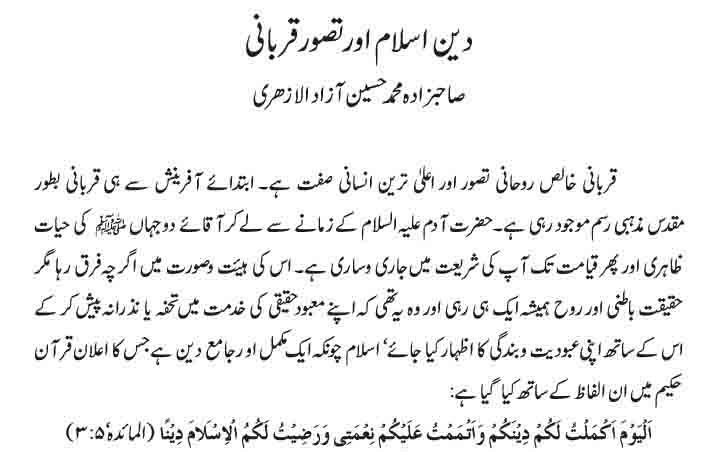
Deen-e-Islam Aur Tasawur Qurbani
Reward Of 10 Days of Dhu’l Hijjah
Among the great seasons of worship are the first ten days of Dhu’l-Hijjah, which Allah has favored over other days. It was narrated from Ibn ‘Abbaas (may Allah be pleased with him) that the Prophet (peace and blessings of Allah be upon him) said: “There are no days on which righteous deeds are more beloved to Allah than these ten days.” They said: “Not even jihad for the sake of Allah?” He said: “Not even jihad for the sake of Allah unless a man goes out himself for jihad taking his wealth with him and does not come back with anything.” Narrated by al-Bukhaari, 2/457
It was also narrated from Anas (may Allaah be pleased with him) that the Prophet (peace and blessings of Allah be upon him) said: “There is no deed that is better before Allah or more greatly rewarded than a good deed done in the (first) ten days of al-Adha.” It was said: “Not even jihad for the sake of Allaah?” He said: “Not even jihad for the sake of Allah unless a man goes out himself for jihad taking his wealth with him and does not come back with anything.” Narrated by al-Daarimi, 1/357; its isnaad is hasan as stated in al-Irwa’, 3/398.
These texts and others indicate that these ten days are better than all other days of the year, with no exception, even the last ten days of Ramadaan. But the last ten nights of Ramadaan are better than the first ten nights of Dhu’l-Hijjah, because they include Laylat al-Qadr, which is better than a thousand months. See Tafseer Ibn Katheer, 5/412.
So the Muslim should start these days with sincere repentance to Allah, then he should do a lot of righteous deeds in general, then he should pay attention to doing the following deeds:
1 – Fasting
It is Sunnah for the Muslim to fast on the first nine days of Dhu’l-Hijjah because the Prophet (peace and blessings of Allah be upon him) encouraged us to do righteous deeds in the first ten days of Dhu’l-Hijjah, and fasting is one of the best of deeds, which Allah has chosen for Himself as it says in the hadeeth Qudsi: “Allaah says: ‘All the deeds of the son of Adam are for him, except fasting, which is for Me and I shall reward for it.” Narrated by al-Bukhaari, 1805.
The Prophet (peace and blessings of Allaah be upon him) used to fast on the first nine days of Dhu’l-Hijjah. It was narrated from Hunaydah ibn Khaalid from his wife, that one of the wives of the Prophet (peace and blessings of Allah be upon him) said: The Prophet (peace and blessings of Allah be upon him) used to fast on the first nine days of Dhu’l-Hijjah and the day of ‘Ashoora’, and three days each month, the first Monday of the month and two Thursdays. Narrated by al-Nasaa’i, 4/205 and by Abu Dawood; classed as Saheeh by al-Albaani in Saheeh Abi Dawood, 2/462.
2 – Reciting tahmeed, tahleel and takbeer a great deal
It is Sunnah to recite takbeer (saying Allaahu Akbar (Allah is most great)), themed (saying al-hamdu Lillah (praise be to Allaah)), tahleel (saying Laa ilaaha ill-Allah (There is no god but Allah)) and tasbeeh (saying Subhaan-Allah (Glory be to Allah)), during the first ten days of Dhu’l-Hijjah, saying these words out loud in the mosques, homes, streets and every place in which it is permissible to remember Allah, to perform this act of worship openly and proclaim the greatness of Allah. Men should recite out loud and women should recite quietly.
Allaah says (interpretation of the meaning):
“That they may witness things that are of benefit to them (i.e. reward of Hajj in the Hereafter, and also some worldly gain from trade), and mention the Name of Allah on appointed days, over the beast of cattle that He has provided for them (for sacrifice)” [al-Hajj 22:28]
The majority are of the view that the “appointed days” are the first ten days of Dhu’l-Hijjah, because it was narrated from Ibn ‘Abbaas (may Allaah be pleased with him) that the appointed days are the first ten days of Dhu’l-Hijjah.
It was narrated from ‘Abd-Allaah ibn ‘Umar (may Allah be pleased with him) that the Prophet (peace and blessings of Allah be upon him) said: “There are no days that are greater before Allah or in which good deeds are more beloved to Him, than these ten days, so recite a great deal of tahleel, takbeer and tahmeed during them.” Narrated by Ahmad, 7/224; its isnaad was classed as Saheeh by Ahmad Shaakir.
The takbeer is as follows:
Allah akbar, Allaahu akbar, laa ilaaha ill-Allaah, Allaahu akbar, wa Lillaah il-hamd (Allah is Most Great, Allah is Most Great, there is no god but Allaah; Allaah is Most Great and to Allaah be praise).
And there are other versions.
This takbeer has become a forsaken Sunnah nowadays, especially at the beginning of these ten days. You can hardly hear it except a few. It should be recited out loud, so as to revive the Sunnah and remind the heedless. It was proven that Ibn ‘Umar and Abu Hurayrah (may Allah be pleased with them both) used to go out to the marketplace during the first ten days of Dhu’l-Hijjah, reciting the takbeer our loud, and the people would recite takbeer when they heard them, i.e., the people would remember the talkbeer and each one would recite it by himself; it does not mean that they recited in unison – that is not prescribed in shari’ah.
Reviving Sunnahs that have been forgotten brings a great deal of rewards, as is indicated by the words of the Prophet (peace and blessings of Allah be upon him): “Whoever revives one of my Sunnahs that has died out after I am gone, will have a reward like that of everyone who does it, without that detracting from their reward in the slightest.” Narrated by al-Tirmidhi, 7/443; this hadeeth is hasan because of corroborating reports.
3 – Doing Hajj and Umrah
One of the greatest deeds that can be done during these ten days is Hajj to the sacred House of Allah. Whoever Allah helps to go on Hajj to His House and do the rituals in the required manner will – in sha Allaah – be included in the words of the Messenger of Allaah (peace and blessings of Allaah be upon him): “An accepted Hajj brings no less a reward than Paradise .”
4 – Udhiyah (sacrifice)
One of the righteous deeds that bring a person closer to Allah in these ten days is to slaughter the sacrifice and to look for a good, fat animal, and to spend money on it for the sake of Allah.
Let us hasten to make the most of these great days, before the negligent regrets what he did, and before he asks to go back and receives no response
All praises and thanks be to Allah, Lord of everything that exists. The most Gracious, the Most Merciful.Master of the Day of Judgment You (alone) we worship, and You (alone) we ask for help. Guide us to the Straight Way The Way of of those on whom You have bestowed Your Grace, not (the way) of those who earned Your Anger, nor those who went astray. Ameen
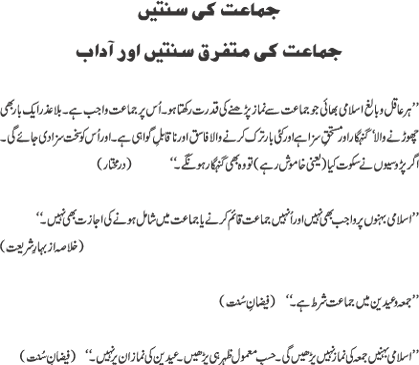
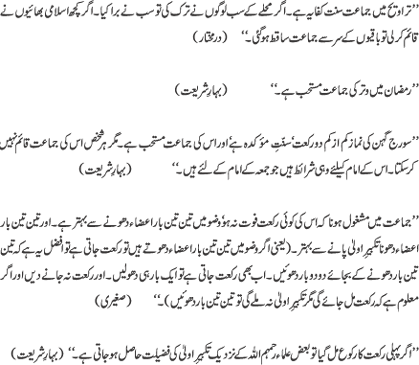
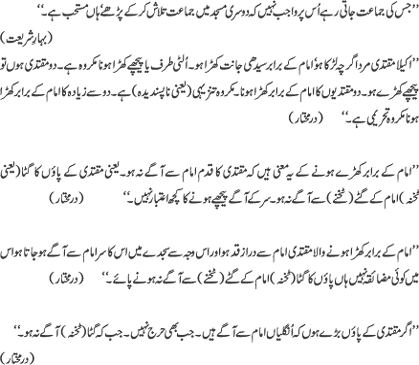
Pehli Saf Main Namaz Perhna
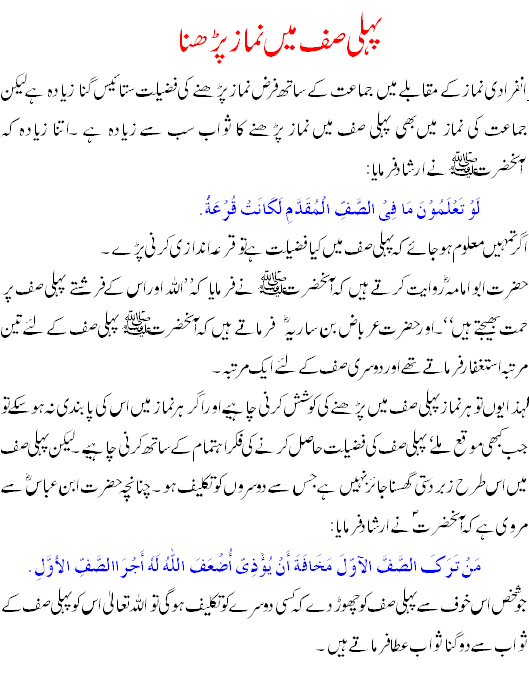
Pehli Saf Main Namaz Perhna
The Power of Imaan
The famous general of Islam, Taariq Bin Ziyaad on receiving the command of the Khalifah, set off with a naval force of 7,000 Mujahideen to attack Spain. In the year 92 A.H., he landed at a place that now bears his name, viz. Jablut Taaariq or Gibral-ter.
During the voyage to Spain, he saw in a dream Rasulullah (sallallahu alayhi wasallam) giving him the glad tidings of him being the Conqueror of Spain. The first act executed by Taariq was to issue an order to set alight all the ships which had brought them to the shores of Spain. After having burnt out all the ships, he addressed his men: “In front of you is the enemy and behind you is the see.” In view of the glad tidings he had received from Rasulullah (sallallahu alayhi wasallam), he was confident of victory over the Christians. The Christian king Roderick confronted Taariq’s relatively small band of Mujahideen with a powerful army of 100,000.
The two armies – the army of Islam vastly outnumbered — met on the banks of the Guadalete River. The ferocity with which Taariq and his men fought routed the enemy resulting in a magnificent victory for the Muslims.
The act of setting ablaze the naval ships will undoubtedly be viewed as an act of insanity. Be it as it may. The power of Imaan is inexplicable to the people of the world. It was this power that drove Taariq to bum the ships and push on to victory.
The state of Taariq’s Yaqeen in Allah Ta’ala can be gauged from this episode which no one can ever accomplish. The state of the obedience of his troops also testifies to their degree of Taqwa. The troops readily submitted to the command. There was no fear and no mutiny. It was such states of Yaqeen and Taqwa that resulted in victory upon victory against overwhelming odds.
[By Hazrat Maulana Ahmad Sadeq Desai]
Jawahir Paare
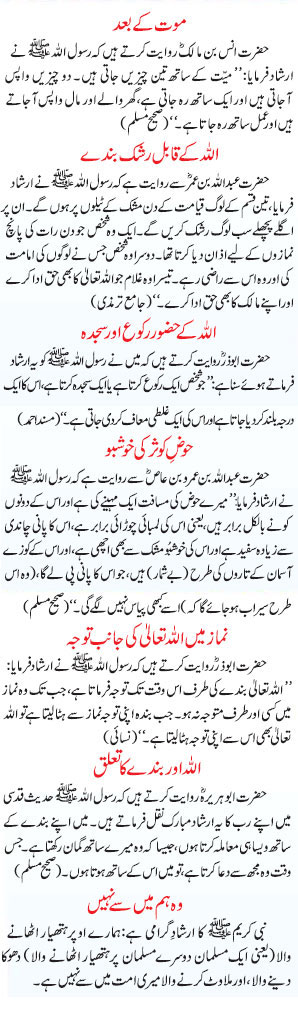
Jawahir Paare
Did You Know – Hazrat Umar Farooq May Allah Be Pleased With Him
Allah Almighty we begin with His Name.
Choicest and countless Blessings and Salutations upon our beloved, the final Prophet Muhammad – may Allah Almighty send Peace and Blessings be upon him – and upon his noble offspring and illustrious companions.
Did You Know – Hazrat Umar Farooq may Allah be pleased with him
Q: What is the name of the second rightly guided Caliph of Islam?
A: Hazrat ‘Umar Ibn Khattaab – may Allah be pleased with him.
Q: What was his title?
A: Farooq Al-A’zam
Q: Which Caliph used to be awake at night to look after his people?
A: Hazrat Umar Farooq – may Allah be pleased with him.
Q: Which Caliph’s era is known as the era of victories?
A: None other than his.
Q: What was the duration of his Caliphate?
A: 10 years, 6 months.
Q: When did he become a Caliph?
A: Jumaad Al-Ukhra 13 A.H.
Q: Who was the first to make the Masjids bright with lamps?
A: Hazrat Umar – may Allah be pleased with him.
Q: In whose Caliphate was the Taraweeh Salah of 20 Rak’ats commenced?
A: In his Caliphate.
Islami Tareekh Kay Jharooko Sey
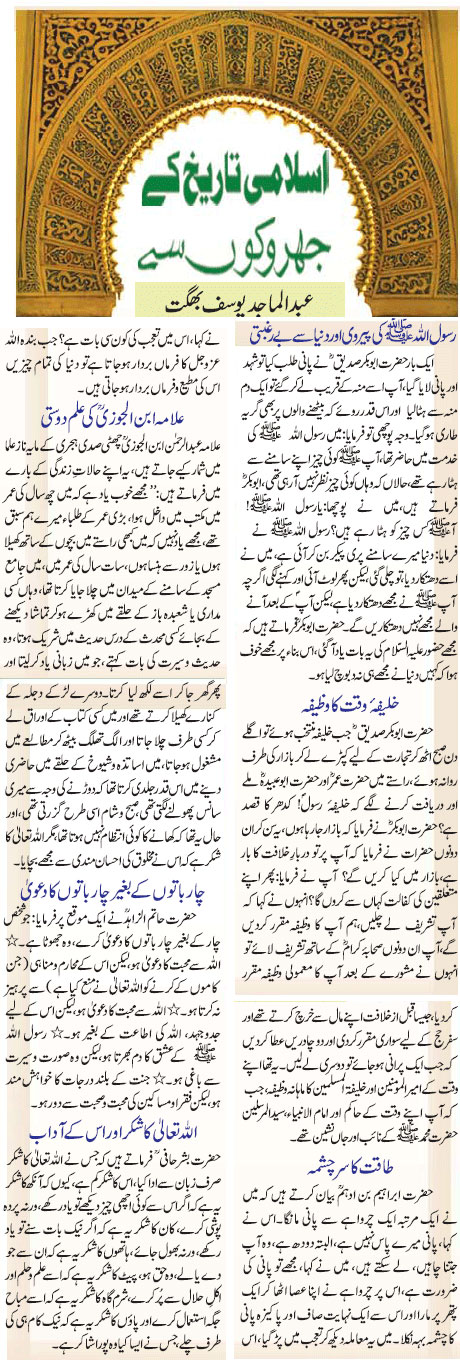
Islami Tareekh Kay Jharooko Sey
Anger Management According To Qur’an And Sunnah
How To Control Anger?
1 – Seeking refuge with Allaah from the accursed Shaytaan when feeling angry.
Al-Bukhaari (3282) and Muslim (2610) narrated that Sulaymaan ibn Surad said: I was sitting with the Prophet (peace and blessings of Allaah be upon him) and two men were trading insults, One of them was red in the face and his veins were standing out. The Prophet (peace and blessings of Allaah be upon him) said:
“I know a word which, if he said it, what he is feeling would go away. If he said, ‘I seek refuge with Allaah from the Shaytaan,’ what he is feeling would go away.”
2 – Changing one’s posture when feeling angry.
Abu Dawood (4782) narrated that Abu Dharr (may Allaah be pleased with him) said: The Messenger of Allaah (peace and blessings of Allaah be upon him) said to us:
“If one of you gets angry when he is standing, let him sit down; if his anger disappears, all well and good, otherwise let him lie down.”
Classed as saheeh by al-Albaani in Saheeh Abi Dawood.
3 – Bring to mind the reward for patience, forbearance, and restraining your anger,
for that is the characteristic of the pious who are promised Paradise,
as Allaah says (interpretation of the meaning):
133. Be quick in the race for forgiveness from your Lord, and for a Garden whose width is that (of the whole) of the heavens and of the earth, prepared for the righteous,–
134. Those who spend (freely), whether in prosperity, or in adversity; who restrain anger, and pardon (all) men;- for Allah loves those who do good;–
[Aal ‘Imraan 3:133-134]
The Prophet (peace and blessings of Allaah be upon him) said:
“Whoever restrains his anger when he is able to act upon it, Allaah will fill his heart with pleasure on the Day of Resurrection. ”
Narrated by Ibn Abi’l-Dunya; classed as hasan by al-Albaani in Saheeh al-Targheeb, 2623.
Cures for Anger
When talking about cures for anger, it’s important to think about why we get angry in the first place.
A lot of the time, people get angry because they lose control of a situation. Anger is their attempt to regain control, but in actuality, does not help at all. It actually makes it worse because when a person is angry, he has shown weakness. He puts himself at a disadvantage both in dealing with people (in a debate, for example), and also in dealing with shaitan. He becomes a much weaker prey for shaitan.
This is why our beloved Prophet saws said,
“The strong is not the one who is physically powerful, but indeed, the one who controls himself when angry.”
If anger is a problem for you, it may be helpful for you to write down all the times that you can remember that you got angry…then look for a common factor that made you angry, or rather made you act on your anger.
Feeling anger is normal, and the act of being angry is not in and of itself necessarily sinful. It’s what you do with that anger that makes it a problem.
And while we’re on the subject, there’s an amazing lecture (As always mA) by brother Nouman about the characteristics of the people of Jannah, as taken from verses in Surah aal Imraan.
One of them is that they swallow their anger. Brother Nouman analyzes why the word ’swallow’ is used, and not ‘control’, etc.
When we are eating something, and let’s say someone is coming, and we don’t want them to know we were eating, so we quickly swallow the food.. will the person know we were eating? No, right? If there are no signs, like chewing, etc, the person will not even suspect that we were eating.
So in the same way, Allah SWT tells us that the people who shall enter Jannah swallow their anger, or make it completely go away…to the point where the people around them do not even suspect that the person is angry. Subhan Allah.
Usually, when someone is angry, and they’re trying to control themselves, you’ll see them shaking, or turning red, or holding themselves back. And then someone will go and ask them if they’re ok.
So the best thing to do is when you feel anger coming up from inside you, quickly swallow it and make it disappear. Of course, it won’t be that easy, but if you make it your habit, it will become easier and easier to do. And it’s important to note that Allah SWT tells us that the people of Jannah swallow their anger, not that they don’t have anger.
Jamaat ki Sunnatain