
How To Pray Salatul Tasbih
Many of us know that it is a prayer that we should pray at least once in our lifetimes, although we should make a regular habit of praying it as it is a prayer full of many virtues and benefits. May Allah ta’ala reward every person that benefits from reading and learning from this article….Ameen.
Pray Salatul Tasbih as follows:
This salaat (namaz) is offered by reading four rakaats. At a time and can be read in any part of the day and night beside the three makrooh times, keeping in mind the forbidden times for performing Salat. The Tasbih to be read in Salaat-Ul-Tasbeeh is the third kahalimah:
” Subhaan Allahi Wal Hamdulillahi Wa Laa ilaha illal Laahu Wallahu Akbar ”
Method: The above Tasbih is to be read 300 times in the four Rakaats. In the first rakaat, after reading Sana “Subhaana Kallahumma…”, read the above tasbih 15 times. Now recite Aaoz and “Bismillah…”, Then read sura Fatiha and a Surah then read the tasbih again 10 times. (this will total 25 times) Go into ruku saying Takbeer (Allah Hoo Akbar), after reciting “Subhaana Rabbiyal Azeem” a minimum of three times read the tasbih 10 times in Ruku. (Total 35) Saying “Samee Allahu Liman Hamidah Rabbana Lakal Hamdh” get up from ruku. Now read the tasbih 10 times again. (Total 45) Go into Sajdah saying Takbeer (Allah Hoo Akbar) and after reciting “Subhaana Rabbiyal A’la” minimum of three times read the tasbih 10 times in the first Sajdah. (Total 55) Now sit up from the first Sajdah and sit in the “At-tahiyah” position (sitting position) saying Takbeer (Allah Hoo Akbar). Sitting in this position read tasbih 10 times (total 65) Go into the second sajdah and again read Takbeer (Allah Hoo Akbar) and after reciting “Subhaana Rabbiyal A’la” a minimum of three times read the tasbih 10 times in the second Sajdah again. (total 75)
Get up to begin 2nd Rakat saying Takbeer (Allah Hoo Akbar). Do rakah #2 in the same fashion, but before reading Bismillah “Bismillah…”, and Surah Fatiha, read the tasbih 15 times. Follow the rest as you did in the first Rakat. After the second Sajdah of the Second Rakat sit in Qaidah Oola (first sitting) read Attahiyat, Durood, and Dua then get up for 3rd rakaat without saying, Salam. Begin the third Rakat, just like the first Rakat, with Sana “Subhaana Kallahumma…”, and read the above tasbih 15 times.
Follow the rest as you did in the first Rakat until you sit for Qaidah Akihra (last sitting) after the second sajdah of the fourth Rakah. In Qaidah Akihra Attahiyat (the last sitting position of namaz), Durood, Dua finish Salah with Salam.
Special notes for Salat-Ul-Tasbih:
1) Do not count loudly. It will break your namaz
2) Do not count on fingers or by holding a Bead Tasbih in hand.
3) You may count by pressing the fingers as a reminder. For example, if you are in Ruku. You press the pinky of your right hand first for the first count, then the finger next to it for the second count, then the middle finger for the third count, following this method until you reach the pinky of your left hand will give you an exact count of ten. Use the same method in Qayam, Sajdah, and Jalsa.
4) If missed a count then make it up in the next posture. For example, if forgot to recite Tasbih after Surah in Qayam. Then you may recite Tasbish 20 times instead of 10 in Rukuh after “Subhaana Rabbiyal Azeem”. Missed Tasbih cannot be recited in Qayam after ruku and Jalsa between Sajdah. If you missed the Tasbih in Ruku then recite 20 in the first Sajdah instead of the Qayam after rukuh. Similarly if missed the Tasbih in the first Sajdah then do not make it up in Jalsa. Instead, recite missed tasbih in the second Sajdah. If Tasbih has been missed in the last sajdah of the second or fourth Rakah then you can recite the missed ones before Attahiyat in Qaidah.
5) If you miss a wajib in Salah and have to do Sajdah Sahaw. You don’t have to recite Tasbih in Sajdah sahoo, since the 300 count has been established. But if you missed Tasbih in any of the postures and remember it later, then you may recite the missed Tasbih in Sajdah Sahaw now.
6) It is preferable to recite after Surah Fatiha Sura Takathuur in the first raka’, Surah Wal A’sr in the second raka’, Surah Kaferoon (qul ya aiyuhal Kafiroon) in the third and Surah Akhlas (Qul hu Allah-hu ahd) in the fourth raka’. If one does not remember these surahs they can recite the ones they prefer.
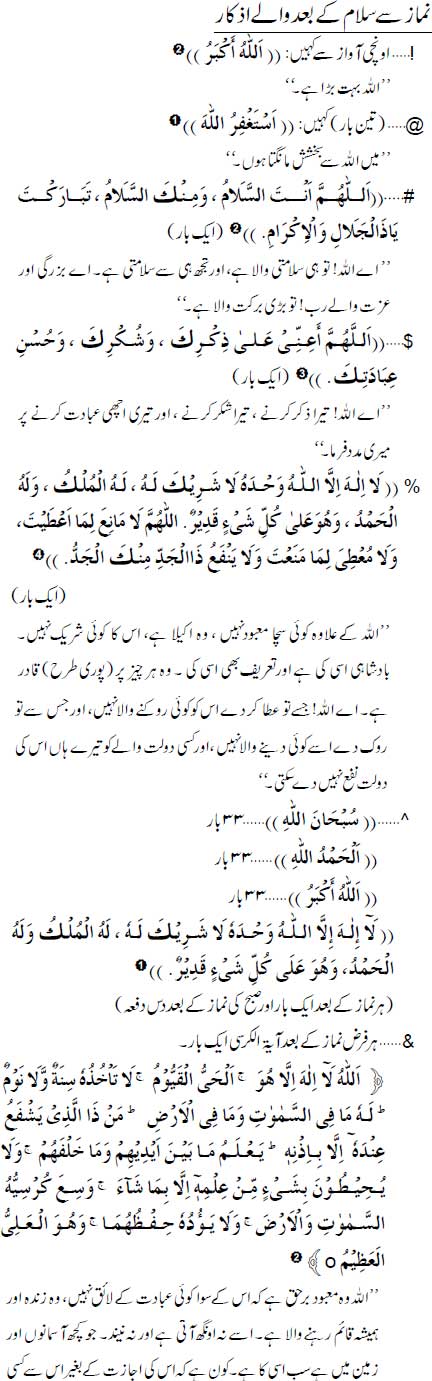
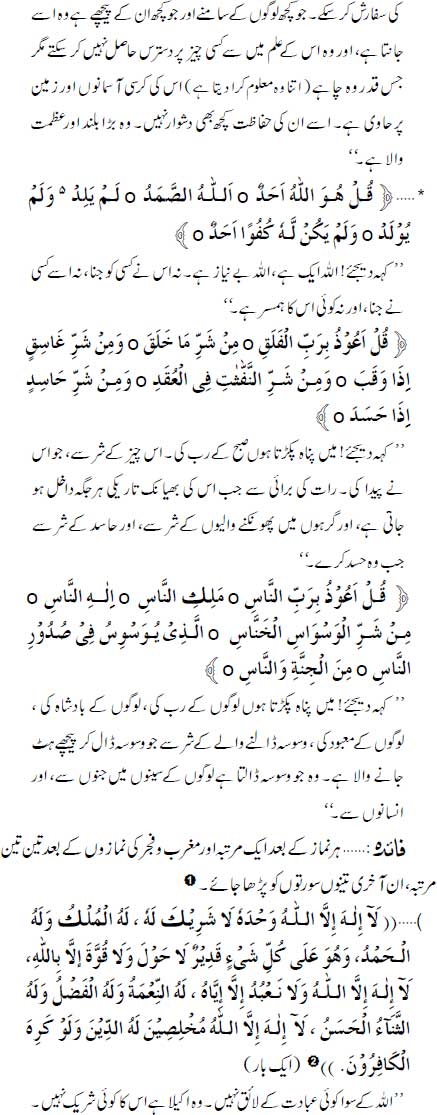
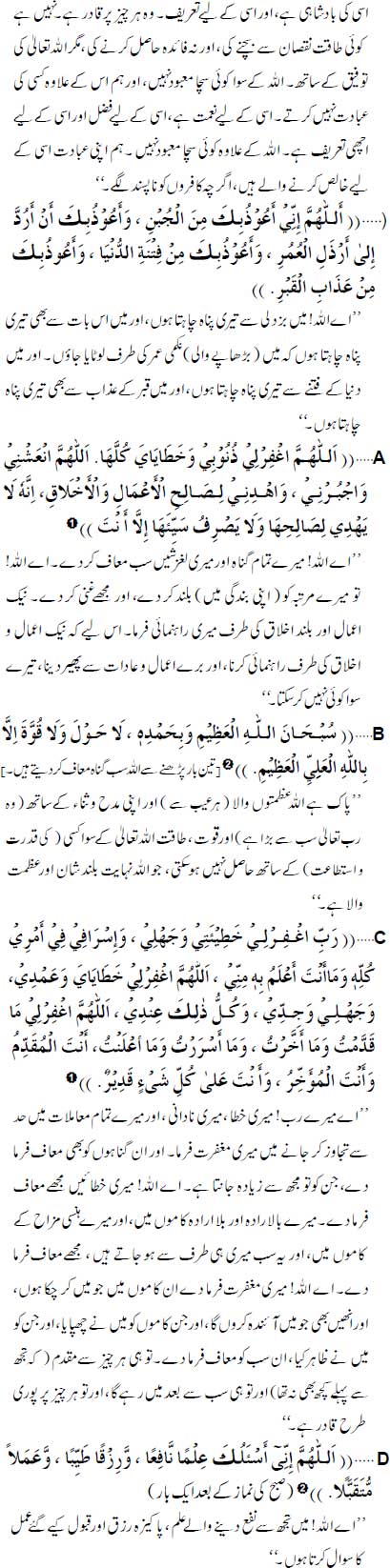
Namaz Say Salam Kay Baad Ki Duaain Aur Azkar
Sincerity In Obedience
Ikhlas (Sincerity)
Sincerity in obeying Allah is among the obligations of the heart. It is also one of the good characteristics. Sincerity in obeying Allah is doing good deeds for the sake of Allah only. It is not doing them to seek the praise and respect of people. Allah made sincerity a condition for the acceptance of good deeds.
Allah, Ta’ala, said in the Qur’an:
Ayah 110 of Surah Al-Kahf means: “Let the one who believes in the Day of Judgment do good deeds without seeking the praise of the people by doing so.”
The sincere person is the one who performs good deeds be it praying, fasting, Hajj, Zakah, or reciting the Qur’an seeking the reward from Allah, and not for the sake of people praising and mentioning him.
The one who is praying should be performing obedience for the sake of Allah only, not so that the people will say: “So and so prays, he does not miss any obligation.”
Also, the one who is fasting should be fasting for the sake of Allah only. The same applies to, the case of the one who is giving Zakah, sadaqah, reciting the Qur’an, or anyone who is performing a good deed.
The Prophet, sallallahu Alayhi wa Sallam, said: “Certainly, Allah loves for one of you when performing a deed to perform it properly.”
Someone said: “How is that, O Messenger of Allah?”
He (sallallahu alaihi wasallam) replied: “One does it only for the sake of Allah and according to the rules of the Religion.”
(Narrated by As-Suyutiyy.)
Riya (Insincerity)
Is the opposite of sincerity. It is doing good deeds, such as fasting, for the praise of the people and their admiration.
Insincerity nullifies the reward of the deed. The performer of any deed that is done with insincerity receives no reward, whether it was done for the praise of people only or coupled with seeking the reward. Moreover, such a person commits an enormous sin.
Priding oneself in obeying Allah
After performing certain types of obedience, some people feel conceitedly proud of these actions. They feel they have high status because of performing these actions, forgetting that Allah is the One Who inspired and enabled them to do these good deeds.
Insincerity and priding oneself on obeying Allah are two sins of the heart. They are also two bad characteristics that the pubescent person must avoid. One should be sincere while obeying Allah to earn the reward from Allah.
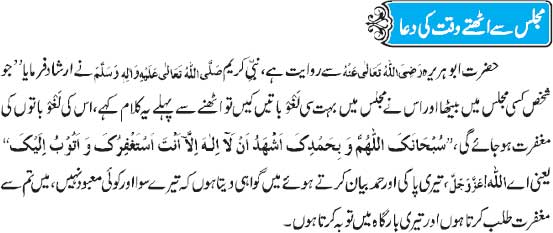
Majlis Say Uthtay Waqt Ki Dua
The Prophet’s Inexhaustible Patience
The source of the Prophet’s courageous determination in the face of all the traumatic experiences he suffered was his strong faith in God. One of the marvelous qualities of the beloved Prophet Muhammad (peace be upon him) was his infinite patience.
God was with Muhammad, as He is always with those who patiently persevere: {God is indeed with those who patiently persevere.} (2:153)
The Quranic word used for patience is sabr, and there is no English equivalent for it.
We can convey the idea of sabr only by phrases such as endurance against afflictions, patience with delay, perseverance against hardships, steadfastness in the face of setbacks, courage against hostilities, self-restraint against provocations, will power against temptations, and equanimity or calmness of mind as regards fortunes and misfortunes.
Persecution against the Prophet
In all the meanings indicated by the above expressions, the Prophet was a perfect model to his followers.
Indeed his life presents the shining example of a man of extraordinary endurance: His father died before his birth; his mother died when he was only six years old, and his grandfather who took up his guardianship also died soon. Then it was his uncle Abu Talib who protected him.
And when God appointed him His last Prophet, he faced the most brutal persecution and hostility from his own people. But these harsh experiences of life did not make him a cynic; on the contrary, they perfected his faith in God, making him all the more strongly committed to his God-given mission.
The records of the Prophet’s life by his contemporaries bear testimony that during the 13 years of his life in Makkah as the messenger of God, he faced all forms of abuse, boycott, expulsion, and threats of physical violence. And yet the Prophet did not budge an inch away from his mission. And all the while, he was gentle, considerate, and sympathetic even to his enemies.
During the early days of his preaching, the people of Makkah had approached him through his uncle Abu Talib and made very tempting offers to him, such as the leadership of the City of Makkah, the most beautiful girl in marriage, and wealth of immense proportions.
The Prophet spurned all these offers and said: “I swear by the name of God, O Uncle, that if they place the sun in my right hand and the moon in my left hand in return for giving up this matter (calling people to Islam), I will never desist until either God makes it triumph or I perish defending it.”
This steadfastness and constancy against temptations were unusual in an Arab of those days.
Grieve Not, God is with Us
And imagine the day when the Prophet had to leave his home, his city, and his people and emigrate to another place! The Hijrah, as the emigration of the Prophet from Makkah to Madinah, is known, was a great sacrifice and a painful decision for the Prophet at the time when he undertook it. But his personal comforts, likes, and dislikes had no value in the face of the immense task before him.
One remembers the time when he and his Companion Abu Bakr were almost overcome by their pursuers in the Cave of Thawr. When Abu Bakr in dismay told the Prophet that they were only two persons against the enemy, he told him with unflinching faith in the Almighty not to grieve, as God was with them. God in the Quran admonishes the Muslims:
{If you will not aid him [Prophet Muhammad], God certainly aided him when those who disbelieved expelled him, he being the second of the two, when they were both in the cave when he said to his companion: Grieve not, surely God is with us. So God sent down His tranquility upon him, strengthened him with hosts that you did not see, and made lowest the word of those who disbelieved; and the word of God, that is the highest; and God is Mighty, Wise..} (9:40)
In the matter of complete reliance on God and faithful submission to Him, the Prophet was an unparalleled model to all Muslims. For he taught his followers:
“When you ask for anything, ask it from God, and if you seek help, seek the help of God. Know that if the people were to unite to do you some benefit, they could benefit you only with what God had recorded for you and that if they were to unite to do you some injury, they could injure you only with what God had recorded for you. The pens are withdrawn and the pages are dry.” (At-Tirmidhi, 1515)
The source of the Prophet’s courageous determination in the face of all the traumatic experiences he suffered was his strong faith in God and his dependence on Him. The Prophet’s conviction that God was with him when he was struggling with adverse circumstances, is evident from this teaching:
“Strange are the ways of a believer for there is good in every affair of his, and this is not the case with anyone else except in the case of a believer; for if he has an occasion to feel delight, he thanks (God); thus there is a good for him in it, and if he gets into trouble and shows resignation (and endures it patiently), there is a good for him in it.” (Muslim, 2999)
Do Patience and Gentleness Go Hand in Hand?
The Prophet was always considerate and understanding, even towards those who were ignorant and arrogant towards him. Indeed his gentleness and patience with them earned their love and respect, as God says in the Quran:
{Thus it is due to mercy from God that you deal with them gently, and had you been rough and hard-hearted, they would certainly have dispersed from around you.} (3:159)
An incident at the Prophet’s mosque in Madinah demonstrates how lenient and kind the Prophet was to ignorant people. Abu Hurairah reports: “A bedouin urinated in the mosque and some people rushed to beat him. The Prophet said, ‘Leave him alone and pour a bucket of water over it. You have been sent to make things easy and not to make them difficult’ (Al-Bukhari,6025)
Once a man approached the Prophet seeking advice, and the Prophet said: “Do not get angry.” The man asked for advice several times and the Prophet replied every time, “Do not get angry” (Al-Bukhari, 48)
The questioner was probably one disposed to a quick temper, and so the Prophet was stressing the need to control his anger. The Prophet also said: “He who is deprived of forbearance and gentleness is, in fact, deprived of all good” (Muslim, 638)
The Prophet of Islam announced forgiveness and amnesty to all his former enemies
We may remember the day of Makkah Victory: The Prophet reentered the city after 10 long years of living in Madinah, and practically there was no opposition as he was accompanied by an overwhelming number of Muslims. The whole of Makkah lay at his feet as he marched in. His enemies stood in surrender awaiting his verdict, and he could very well have cried “havoc” or “let slip the dogs of war” as the triumphant commanders of those days used to do.
Instead, in a historic break from the old tradition, the Prophet of Islam announced forgiveness and amnesty to all his former enemies. He told them simply: “You may go. You are a free people.” (Authenticated by al-Albani)
Such kindness and generosity could not have been in vain, as the whole of the community of Makkah thereafter embraced Islam, a feat that could never have been achieved by the use of force. And certainly, this superb act of forgiveness was in keeping with the Quranic injunction: {Let there be no compulsion in religion.} (2:256)
Unfaltering loyalty to the cause of God is the virtue of prophets. Prophet Muhammad was a brilliant example of a man committed to his divinely appointed mission. So it is no wonder that he stood firm against all opposition and finally succeeded in winning over the hearts and minds of millions.
Living in a fast-moving, high-tech environment of “instant nirvana” and “preemptive redemption,” most people of this postmodern world are programmed to brush aside a religion that insists on a slow-paced, meditative, prayerful form of worship five times a day (salah), as well as on a rigorous form of fasting during the daytime for a whole month (sawm).
Also, zakah and Hajj are indicative of the importance of practicing sabr in our daily life. And it is no exaggeration to say that our beloved Prophet has amply demonstrated through his own life that Islam (submission) is sabr itself; sabr with the fortunes and misfortunes our Creator has apportioned to us in this world.
For those who practice sabr in Islam, there is always the unfailing promise and prospect of a never-ending world of felicity.
By Shahul Hameed
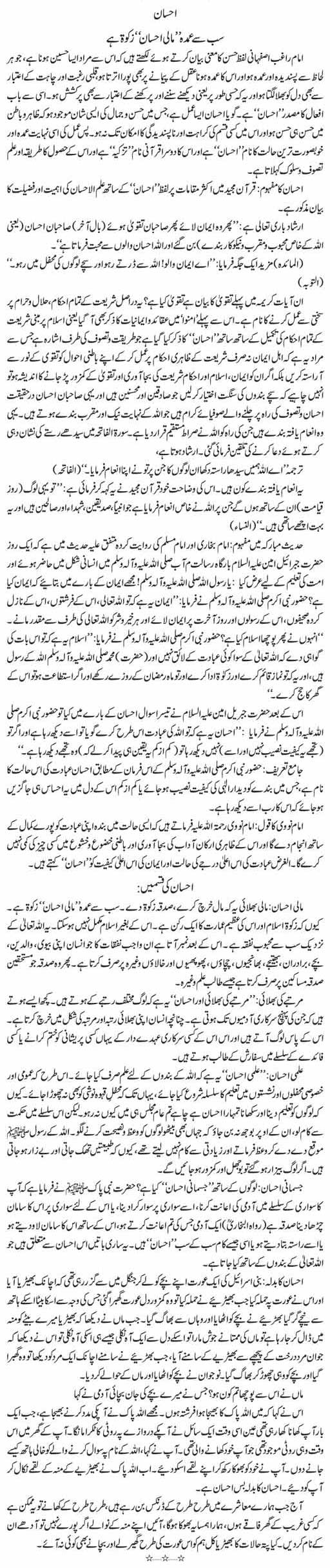
Ehsan Kya Hai?
Emphasis On Blood Relations
The Prophet (peace be upon him) has more claim on the believers than they have on their own selves, and his wives are their mothers. Blood relatives have, according to God’s decree, a stronger claim upon one another than other believers (of Madinah) and those who have migrated (for God’s sake). Nonetheless, you are to act with kindness toward your close friends. This is written down in God’s decree. (The Confederates, Al-Ahzab: 33: 6)
This surah revealed toward the end of the fifth year after the Prophet’s emigration to Madinah begins with important legislation in family matters. It seeks to put these on the right footing. It starts with the abolition of the practice that some Arabs used to resort to when they wanted to punish their wives causing them lasting damage. A man would say to his wife that she was to him like his mother’s back, which meant that all marital relations between them were ended. Yet she was not divorced so as to be able to marry someone else. Islam put an end to this practice, imposing a heavy penalty on anyone who resorts to it. The surah then moved on to abolish adoption. This does not mean a prohibition of looking after an orphan child, or a child in need of care. What is abolished is to attach that child to one’s family as if it was born to the adopting couple, giving it the same surname.
The surah then moves on to put an end to the brotherhood institution, established by Islam following the migration of the Muslims from Makkah to Madinah. This was a practical measure to address the situation of those immigrants who had abandoned their relations and property in Makkah, and the situation of Muslims in Madinah whose relations with their families were severed as a result of their embracing Islam. At the same time, the Prophet’s personal authority over all believers is emphasized and given a higher position than all blood relations, while his wives are to be seen as the spiritual mothers of all believers: “The Prophet has more claim on the believers than they have on their own selves, and his wives are their mothers. Blood relatives have, according to God’s decree, a stronger claim upon one another than other believers (of Madinah) and those who have migrated (for God’s sake). Nonetheless, you are to act with kindness toward your close friends. This is written down in God’s decree.”
When the Muhajirin, i.e. the Muslims from Makkah, left for Madinah, they had to leave everything behind, preferring their faith to their relatives, clans, property, livelihood, friends, and life memories. They abandoned all this for their faith. Their migration in this way, abandoning all that was dear, including their own families, provided an example of how faith grips one’s whole being. They provided a practical example of the integrity of the Islamic personality, confirming the Qur’anic statement: “Never has God put two hearts in one man’s body.”
A different situation, however, arose in Madinah as Islam began to infiltrate homes. The result was that some members of a family became Muslims while others did not. Relations between people were often severed; family bonds became shaky, and there was an even greater disruption of social bonds. The Muslim society was still in its infancy and the Muslim state was still more of an idea than a solid regime with lasting roots
This gave a new faith a strong moral impetus that superseded all emotions, traditions, social institutions, and bonds, making faith the only bond that unites hearts. At the same time, it united the small units that separated from their natural roots in the family and the clan, thus replacing the ties of blood, family, interest, friendship, race, and language. It united these Muslim units into a well-knit and coherent block that showed a high degree of solidarity, cooperation, and mutual care. This was not initiated by legislative texts or government orders; instead, it was based on an inner impetus that was stronger than anything that was familiar in ordinary human life. This provided the basis for the rise of the Muslim community, which could not be otherwise established.
The Muhajirin (i.e. the migrants from Makkah) were welcomed in Madinah by its Muslim residents, the Ansar. The Ansar opened their hearts and homes to them and gave them shares in their property. In fact, they were so keen to make the Makkan Muslims feel welcome in their new abode that the Ansar drew lots to decide who would take each of the Muhajirin: this because there were only a few of the latter as compared with the great many Ansar who were keen to host them. They, in fact, shared with the Muhajirin everything they had, willingly and with warm hearts that betrayed no trace of avarice or showing off.
The Prophet established a bond of brotherhood between individuals of the Muhajirin and individuals of the Ansar, naming every two brothers, thereby giving rise to a unique bond in the history of mutual solidarity between believers in the same ideology. Indeed this brotherhood superseded the blood relationship, as it included rights of inheritance and other commitments between relatives. The resulting moral impetus was strong because the Prophet’s companions took to the new bond seriously, in the same way as their attitude toward everything Islam laid down. This impetus was essential to the rise of Islamic society and its protection, providing all, if not more than what could have been provided by a state that enjoyed stability and well-established laws. Thus, the bond of Islamic brotherhood was necessary to safeguard and consolidate the new Muslim community in its exceptional and highly complicated circumstances. A similarly strong impetus is essential for the rise of any community facing equally unusual circumstances until it begins to have a stable state with well-defined laws that give it normality.
Although Islam welcomes such a strong impetus, it nonetheless wants Islamic society to have a foundation that relies on the normal resources its people can give in ordinary situations, not on what people are ready to sacrifice in exceptional circumstances. This is essential because once an emergency is over, people should return to their normal and ordinary standards. Therefore, once circumstances in Madinah began to settle after the Battle of Badr when the new Muslim state became more stable, social conditions and means of livelihood improved, and all were able to earn their living, the Qur’an amended the system of brotherhood. It abrogated the commitments attached to it, which normally arise from family and blood relations, but retained it as a moral bond of brotherhood that can be reactivated in reality whenever needed. Thus, the Muslim community returned to a normal situation in which inheritance and other binding commitments are limited to blood relatives as they have always been in God’s original decree and natural law: “Blood relatives have, according to God’s decree, a stronger claim upon one another than other believers (of Madinah) and those who have migrated (for God’s sake). Nonetheless, you are to act with kindness toward your close friends. This is written down in God’s decree.”
Jinn Aur Insan ki Paidaish Ka Asal Maqsad

Jinn Aur Insan ki Paidaish Ka Asal Maqsad
The Ship That Will Never Sink
Let us board “the ship of Tawheed” at the beginning of the new year and sail safely from this world of trials and temptations to the eternal world of ultimate bliss and enjoyment. May Allah guide and assist us to achieve this goal with sincerity and we undertake this task solely for the pleasure of Allah, the Almighty.
Let us build this ship and move away from the destructive waves of polytheism and innovations by putting up the sails of ‘Kalimatus Ikhlas’. We are well aware of the story of Prophet Nuh and his ship. It was indeed the ‘ship of Tawheed’ and by the will of Allah, it reached its destination with success. To build and board this ship we all have to ask ourselves; why are we here? What is the purpose of our life? What will be our destination? The answer should be as follows: And I have not created the jinn and the men except that they should worship Me. (Qur’an, 51:56)
Here the word ‘worship’ means to single out Allah in each and every aspect of life. As for the specific meaning of worship, Sheik Al Islam Ibn Taymiyyah (may Allah have mercy on him) said, “Worship is a comprehensive term covering whatever Allah loves and is pleased with, both words and actions, the apparent or the hidden; such as love, hope, fear, dependence, seeking refuge, having awe, prayer, fasting, zakah and other duties prescribed by Islam.”
May Allah have mercy on us to enrich our knowledge. Let us conduct a brief study of our esteemed and beloved Prophet’s (peace be upon him) life in Makkah. In the first 13 years of his prophethood, we know that he was busy expounding the essentials of monotheism and eradicating the scourge of polytheism. Prophet Muhammed (peace be upon him) prepared the Sahabiyat (companions) for migration. Their hearts migrated from worldly riches and they desired for the sought world of the hereafter and strove for the pleasure of Allah, The All-Glorious. This led to building strong ties with Allah and His Messenger (peace be upon him). They coveted Jannah and continuously sought escape from the torments of the hellfire.
What is the first obligation and prohibition that Allah has prescribed for mankind?
The first obligation is to single out Allah in all worship, and the first prohibition is not to associate anything with Him as it is clear from many of the verses from the Noble Qur’an. “And your Lord has commanded that you shall not worship (any) but Him, and goodness to your parents. (Qur’an, 17:23) Allah has stated the prohibitions and the obligations with “none has the right to be worshipped but Allah” as is obvious from the verses below. “And worship Allah and do not associate anything with Him and be good to the parents and to the near of kin and the orphans and the needy and the neighbor of (your) kin and the alien neighbor, and the companion in a journey and the wayfarer and those whom your right hands possess; surely Allah does not love him who is proud, boastful. (Qur’an, 4:36)
Say, “Come I will recite what your Lord has forbidden to you (remember) that you do not associate anything with Him and show kindness to your parents and do not kill your children for (fear of) poverty. We provide for you and for them and do not draw nigh to indecencies, those of them which are apparent and those which are concealed, and do not kill the soul which Allah has forbidden except for the requirements of justice; this He has enjoined you with that you may understand.” (Qur’an, 6:151)
What is the right of Allah upon His slaves and what is the right of the slaves upon Allah?
The Prophet Muhammad (peace be upon him) said, “O Muadh! Do you know what Allah’s right is upon His slave ?” I said, “Allah and His Messenger know better.” The Prophet (peace be upon him) said, “They worship Him (Allah) Alone and do not associate any partner in worship with Him (Allah). Do you know what their right upon Him is?” I replied, “Allah and His Messenger know better.” The Prophet (peace be upon him) said, “He will not punish them (if they did so).” [Bukhari]
This shows the tremendous importance of the Tawheed (monotheism), and the wisdom behind the creation of the jinn and mankind. It is to worship Allah alone and reject all objects of worship besides Him. May Allah enable us to sail on this ship with guidance and success.
Let us set sail in “the ship of Tawheed” with our family and friends and attain security and guidance from Allah as He the Exalted says: It is those who believe in the Oneness of Allah and worship none but Him Alone and confuse not their belief with Zulm wrong i.e. by worshipping others besides Allah, for them (only) there is security and they are the guided. (Qur’an, 6:82)
It is Allah’s promise that the one who actualizes Tawheed and keeps his belief clear from the many shades of polytheism for him there will be complete security in five things; his religion, mind, health, wealth and offspring.
Not believing in Tawheed will result in a loss of security and guidance, the greatest loss a person can ever suffer. Even the Prophets were constantly reminded of Tawheed as Allah’s Messenger (peace be upon him) said, “ When Musa [Moses] said: “O my Rabb, teach me something by which I can remember You and supplicate to You.” Allah answered: “say, O Musa La ilaha illallah (none has the right to be worshipped).” Musa said: “O, my Rabb, all Your slaves say this.” Allah said: “O, Musa, if the seven heavens and all of their inhabitants besides Me, and the seven earths were in a pan (of a scale) and La ilaha illallah was in (another) pan La ilaha illallah would outweigh them.” (Al-Hakim)
This means that if the sins of the slaves of Allah reached the weight of the seven heavens along with all its inhabitants besides Him, and the weight of the earth, the statement La ilaha illallah would outweigh the weight of the sins. This is the greatest virtue of Tawheed and it is only for those in whose heart it is planted firmly with a strong belief and complete faith. He should be a sincere believer and should have no doubts relating to it. He should understand its value, seek pleasure in it and love its meaning. He must also not associate anything with Him in worship and that is when his heart will be strong and pure with the statement of Tawheed. The mere uttering of it enlightens him, and gives him peace apart from washing away his sins.
The Messenger of Allah said,” Allah says: O, son of Adam! If you came to Me with sins filling the earth, then you meet Me without associating anything in worship with Me, I would come to you with its (the earth’s) full of forgiveness.” (Al-Tirmidhi)
Now, why is it that the statement of Tawheed outweighs everything except Allah, the Highest? It is because the statement with its conditions has great value and virtue that no man or Jinn can imagine. The statement singles out Allah, the Highest, in a unique way. It contains negation of worship to anyone besides Him and affirmation of worship solely for Him. The pure essence of singling out can only be obtained through negation and affirmation. To ponder upon is the fact that if Prophets were in need of reminders then how is it that we are ignorant of such a great matter and to top it all most of us don’t even strive toward learning it.
Nowadays many of ignorant Muslims claim that one who utters the Kalimatul Ikhlas will enter paradise. Merely uttering the Kalima will not lead to the peace and blessings of paradise. One has to say the Kalima wholeheartedly, observe the five pillars of Islam, adhere to the teachings of the Prophet (peace be upon him), and read the Qur’an. Only then that he will be granted bounties and favors from Allah, the Highest. However, if he says the statement of Tawheed, but does not abstain from Shirk he will not be entitled to the promise mentioned in the Hadith above.
Thus, one’s heart must be filled with Allah’s greatness, praise, glory, magnificence, honor, and love. When it is totally suffused with these attributes of Allah, The Supreme, will forgive him and make the fire forbidden for him that is without any punishment.
For indeed Allah has forbidden hell for those people who say: “There is nothing worthy of being worshipped but Allah, thereby seeking the pleasure of Allah.” (Bukhari and Muslim)
May Allah, The All-Forgiving forgive us and admit us to paradise without reckoning, so that we may also be a part of His abundant favors, blessings and mercy.
-By Farzana Qamar