

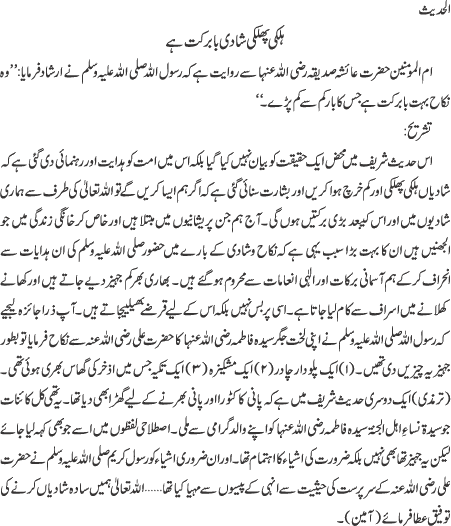
Halki Phulki Shadi Babarkat Hai
Do Not Be The Camel Of The Masjid
In the name of Allah, the Most Merciful, the All-Compassionate
“May the Peace and Blessings of Allah be Upon You”
Praise be to Allah, we seek His help and His forgiveness. We seek refuge with Allah from the evil of our own souls and from our bad deeds.
Whomsoever Allah guides will never be led astray, and whomsoever Allah leaves astray, no one can guide. I bear witness that there is no god but Allah, and I bear witness that Muhammad is His slave and Messenger.
Changing Ground Positions after praying a Fardh prayer to pray a Sunnah Prayer.
You know, sometimes when you are in the Masjid and have just finished praying a Farz Salah, you notice people around you moving to different parts of the Masjid to pray their Sunnah. Have you ever wondered why? Well, the answer is that these people are implementing a forgotten Sunnah, Masha’Allah.
Umar ibn Ata bin Abi Al-Khuwar narrated that Nafi bin Jubair sent him to As-Saib bin Yazid,the maternal nephew of Namir, asking him regarding something Muawiyah had seen him do in the prayer. He said, “I prayed Jumuah with Muawiyah in his enclosure, and when he finished, I stood up in my place and prayed. When he went inside, he sent for me and said,” Do not repeat what you have just done. If you pray Jumuah, do not join it with another prayer until you speak (made duaa) or exit the masjid”.
The Prophet (peace and blessings be upon him) ordered us to separate between prayers. One prayer must not be joined with another until you speak or exit. Collected by Muslim (883)
and Imaam an-Nawawee explains this, saying: “In this hadeeth there is evidence for what the scholars say that It is preferred to pray the optional prayers in another place than where one prayed their obligatory prayer. And the best place for that is the house, but any other place inside the masjid is also valid. “ [Taken from Saheeh Muslim, The book of Jumuah p. 409-410]
Shaikhul Islam Ibn Taymiyyah said: “‘The Sunnah is to separate between performing the obligatory and optional Salat in Jumuah Salat and other Salawaat as was narrated in the “Sahih” that he (sallallahu alayhi wa sallam) prohibited that any [obligatory] Salat be followed immediately by [optional] one; one should separate between them with speech or changing one’s place’”
Taken from: The Clarified Ruling of Mistakes Done in Salat – Mashhoor Hasan Aal Salmaan
Do Not be the Camel of the Masjid
It is detested for any muslim, to the exclusion of the Imam, to stick to one place in the mosque to do the obligatory Salat.
Abdur Rahman Ibn shibl said: Allah’s (SWT) Rasul (pbuh) forbade that a muslim does his Salat so fast like a crow when it eats, spreads his/ her arms [in prostration] as dogs do [when they sit], and sticks to one place in the mosque when doing Salat as camels stick to their resting places. Sahih” (no. 476)
Camels, if left free, will always go and sit in a particular resting place no matter what. Meaning we should avoid praying at one particular place every time we pray.
On the Day of Judgment, the ground will testify that you used it to pray on…the more amount of ground you pray on, the more that the ground will testify and witness your prayers…the higher the chance of getting into higher levels of Jannah.
Adil Khan
Tib-e-Nabvi: Zaitoon Ka Tail

Tib-e-Nabvi: Zaitoon Ka Tail
HIMA Of Allah On Earth Are His Illegal Forbidden Things
Narrated An-Nu’man bin Bashir:- I heard Allah’s Apostle, Muhammad, Peace Be Upon Him, saying:- ‘Both legal and illegal things are evident, but in between them, there are doubtful (suspicious) things, and most people have no knowledge about them. So whoever saves himself from these suspicious things saves his religion and his honor. And whoever indulges in these suspicious things is like a shepherd who grazes (his animals) near the Hima (private pasture) of someone else, and at any moment, he is liable to get in it.
O people! Beware! Every king has a Hima, and the Hima of Allah on the earth is His illegal (forbidden) things.
Beware! There is a piece of flesh in the body. If it becomes good (reformed), the whole body becomes good, but if it gets spoiled, the whole body gets spoiled, and that is the heart. [Source:-‘Bukhari’ Volume 1 Book # 2 Number # 49]
“By time, mankind is in loss, except for those who truly believe (and worship Allah alone), and do righteous deeds, (performing that which is obligatory upon them and avoiding that which they are forbidden), and enjoin one another upon obedience to Allah and enjoin one another with patient perseverance (in facing harm and trials.”) [Source:-Surah al ‘Asr (103)]
Namaz e Tahajjud

Namaz e Tahajjud
18 Sources Of Blessing/ Barakah!
If you ever feel distant from Allah, don’t despair, just put your forehead to the ground and ask the Most Merciful from His bounties.
18 sources of Barakah! If we were to look for an Islamic definition of Productivity, it can probably be summarised in the word “barakah” or Blessing. Being able to achieve more with few resources, doing much in little time, and generating a lot with little effort is surely a blessing from Allah (Subahanahu Wa Ta’ala). Yet Barakah has somehow become a lost treasure these days; everyone’s looking for it, but no one seems to find it! You always hear people complaining that there’s no barakah in their time, no barakah in their sleep, no barakah in their money, and the rest of it. In this article, we’ll solve this mystery inshaAllah: we’ll find out what Barakah is and where you can find it! What is Barakah? A Well-known daee explains it as follows:
“Barakah is the attachment of Divine goodness to a thing, so if it occurs in something little, it increases it. And if it occurs in something much, it benefits. And the greatest fruits of Barakah in all things is to use that barakah in the obedience of Allah (Subahanahu Wa Ta’ala)”
Sources of Barakah
I’m a firm believer that Barakah is not a lost treasure; rather, it’s right in front of our eyes! This treasure is only available and ready to be handed over to the one who works for it. Below, I list some of the sources of Barakah. It’s not an exhaustive list; therefore, I do hope you can contribute to it with your comments inshaAllah so we can all share and extend our understanding of this great treasure.
1. Good Intentions
If you want something to have barakah attached to it, have good intentions for it. More specifically, make sure that the deed is intended for the sake of Allah (Subahanahu Wa Ta’ala). Looking again at the definition of Barakah, you may guess that without us intending what we have or do for the Sake of Allah, the “Divine goodness” won’t be found in our deeds.
2. Piety and Belief in Allah
Allah says in the Quran: “If the people of the towns had but believed and feared Allah, We should indeed have opened out to them (All kinds of) blessings from heaven and earth…”(Surah Al-A’raf, Verse 96). And He says in the Quran: “And for those who fear Allah, He (ever) prepares a way out. And He provides for him from (sources) he never could imagine” (Surah Al-Talaq, Verses 2-3).
Buray Khatmay Kay Asbab: Quran Ka Bayan

Buray Khatmay kay Asbab
How To Be Romantic With Your Spouse
As the days come closer to one’s marriage, excitement, ecstasy, and elation pump through the bride and groom. The build-up to marriage is an experience of thrill and jubilation. When the marriage is solemnized, one’s happiness and delight is on the verge of brimming and tipping over. When the newlywed couple meets for the first time, words cannot describe the sweetness, bliss, serenity, pleasure, and elation experienced by the two.
If every day of the marriage mirrors the first day of marriage, and every night reflects the first night of marriage, then the marriage will be a euphoric experience in this world.
The first couple of months are always a “honeymoon”. Once the couple settles down, then reality begins. Many couples fail at this point. The husband gets engrossed in his job. He comes home tired and late, feeling hungry and tired. He demands food and feels too lazy to do anything. He eats, puts the dirty plates in the sink, and lies down on the sofa. He might awaken to perform salah if he is conscious of salah. Otherwise, he wakes up later on towards the night, phones a few friends, watches TV, and keeps ordering the wife to get him x and y. When it is time to sleep, the husband, if he is feeling in a good mood, will have relations with his wife-but only to satisfy his needs. Once he is fulfilled, he stops and drops off to sleep. Whether the wife is satisfied or not does not even cross his mind. This becomes the routine of his life.
The wife, on the other hand, initially tries to please her husband. She slowly loses her enthusiasm as she does not receive enough attention from her husband. She cooks to please her husband. She will put effort into her food. She will try and perfect every detail in the food. The presentation, ingredients, and spices are put meticulously so they complement each other. After a while, she begins to tire from this as her husband does not comment or criticize her food. As soon as the husband goes to work, she is on the phone with her associates. She cooks, watches TV, cleans the house, and enjoys her day before her husband comes home. Once the husband comes, she becomes a slave again.
This style of marriage, where there is no affection shown, no real emotion transmitted from one party to the other, is heading towards destruction.
The husband needs to implement the romance that the Prophet salallahu alaihi wasallam displayed. We consider Romeo to be romantic but not the Prophet salallahu alaihi wasallam. If I were to say the Prophet salallahu alaihi wasallam was the most romantic individual, I would not be lying. Looking attentively at the biography of the Prophet salallahu alaihi wasallam, you will find that he was extending a great deal of respect to his wives and was displaying high attention, care, and love toward them.
He was the best example of ideal manners toward his wife. He was comforting for his wives, wiping their tears, respecting their emotions, hearing their words, caring for their complaints, alleviating their sadness, going on picnics with them, racing with them, bearing their abandonment, discussing matters with them, keeping their dignity, supporting them in emergencies, declaring his love to them, and was very happy with such love.
The husband and wife have to bond with one another psychologically, physically, and spiritually. Here are some attractive examples and points we need to adopt to achieve a marriage of romance:
1) Know their feelings
The Prophet salallahu alaihi wasallam was telling Sayyidah Aisha radiallahu anha: “I know well when you are pleased or angry with me. Aisha replied, “How do you know that?” He said: When you are pleased with me, you swear by saying ‘By the God of Mohammad’, but when you are angry, you swear by saying ‘By the God of Ibrahim’. She said: You are right, I don’t mention your name.”
The husband and wife should be aware of each other’s feelings. The husband should be able to gauge when his wife is upset or sad; likewise, the wife should be able to read her husband’s behaviour. Being conscious of one another’s feelings will help in resolving any differences. When your spouse is down or upset, be there to console him/her. Sit with them, speak with them, listen to them. Try and make them smile. If the husband is always conscious of his wife’s feelings, and the wife is always conscious of the husband’s feelings, then this will assist greatly in keeping the flicker alight.
2) Console her
Sayyidah Safiyah radiallahu anha was on a journey with the Prophet salallahu alaihi wasallam. She was late, so the Prophet salallahu alaihi wasallam received her while she was crying. The Prophet salallahu alaihi wasallam wiped her tears with his own hands and tried his utmost to calm her down.
This is another feature a marriage must have. Each spouse has to be there for the other in the good and bad times. The wife should find comfort and solace in the husband, and the husband should find warmth and love in his wife. Be gentle with one another.
Hazrat Asma RA Ki Sakhawat
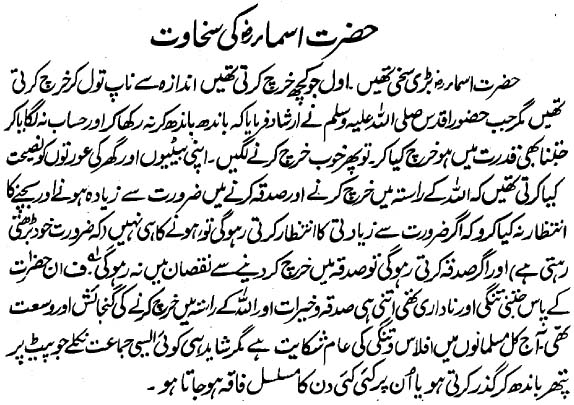
Hazrat Asma RA Ki Sakhawat
Greet Her On Behalf Of Her Lord
Narrated Abu Hurairah: Jibril (Gabriel) came to the Prophet (peace and blessings be upon him) and said: “O Allah’s Messenger! This is Khadijah, bringing you a dish with meat soup (or some other food or drink). When she reaches you, greet her on behalf of her Lord (Allah) and on my behalf, and give her the glad tidings of having a palace made of Qasab in Paradise, wherein there will be neither any noise nor any toil (fatigue, trouble, etc.).” [Source~ Al-Bukhari]
‘Abdullah bin ‘Abbas narrated that one day the Prophet (peace and blessings be upon him) drew four lines on the earth and asked his Companions if they understood what these lines stood for. They respectfully replied that he knew better. He then told them that these lines stood for the four foremost ladies of the universe. They were Khadijah bint Khuwaylid, Fatimah bint Muhammad, Maryam bint Imran, the mother of the Prophet Issa (peace and blessings be upon him), and ‘Asia bint Muzahim (the wife of the Pharaoh). She was the first person to have an abiding faith in the utterances of the Prophet (peace and blessings be upon him) and to accept Islam as her religion and her way of life. She was blessed with the distinction of having been greeted with Salam (greetings) by Allah and the Angel Jibril.
Khadijah (r.a.) was born in Makkah in the year 556 CE. Her mother’s name was Fatimah bint Zayd, and her father’s name was Khuwaylid bin Asad. He was a very popular leader among the tribe of Quraysh, and a very prosperous businessman who died while fighting in the famous battle of Fujjar. Khadijah thus grew up in the lap of luxury. She married Abu Halah Malak bin Nabash bin Zarrarah bin At-Tamimi and bore him two children, Halah and Hind. She wanted to see her husband prosper and financed him in setting up a big business. But unfortunately, he passed away. Sometime later, the young widow married ‘Atique bin ‘Aith bin ‘Abdullah Al-Makhzumi, and she had a daughter by him as well, named Hindah, but the marriage soon broke up on grounds of incompatibility.
After this, all her attention was devoted to the upbringing of her children and building up the business she inherited from her father. Her astuteness and business ability made her business one of the most widespread businesses among the Quraysh. Her policy was to employ hardworking, honest, and distinguished managers to deal on her behalf, as a lot depended on the integrity of the employees who travelled far and wide on her behalf. She exported her goods to faraway markets like Syria, and her managers bought goods from those markets to be sold at home.