
The Virtue Of Patience And Prayer
After Allah commanded that He be appreciated, He ordained patience and prayer. It is a fact that the servant is either enjoying a bounty that he should be thankful for, or suffering a calamity that he should meet with patience. A Hadith states:
(Amazing is the believer, for whatever Allah decrees for him, it is better for him! If he is tested with a bounty, he is grateful for it and this is better for him; and if he is afflicted with a hardship, he is patient with it and this is better for him.)
Allah has stated that the best tools to help ease the effects of the afflictions are patience and prayer. Earlier we mentioned Allah’s statement:
(And seek help in patience and As-Salah (the prayer) and truly, it is extremely heavy and hard except for Al-Khashi`in [i.e., the true believers in Allah]) (2:45)
There are several types of Sabr ? patience: one for avoiding the prohibitions and sins, one for acts of worship and obedience. The second type carries more rewards than the first type. There is a third type of patience required in the face of the afflictions and hardships, which is mandatory, like repentance.
`Abdur-Rahman bin Zayd bin Aslam said, “Sabr has two parts: patience for the sake of Allah concerning what He is pleased with (i.e., acts of worship and obedience), even if it is hard on the heart and the body, and patience when avoiding what He dislikes, even if it is desired. Those who acquire these qualities will be among the patient persons whom Allah shall greet (when they meet Him in the Hereafter; refer to Surat Al-Ahzab 33:44), Allah willing.”
“Say, “O Allah, Owner of Sovereignty, You give sovereignty to whom You will and You take sovereignty away from whom You will. You honor whom You will and You humble whom You will. In Your hand is [all] good. Indeed, You are over all things competent. You cause the night to enter the day, and You cause the day to enter the night; and You bring the living out of the dead, and You bring the dead out of the living. And You give provision to whom You will without account.” (3: 26-27)
Valentine’s Day


Qur’an Wants Faithful To Be Caring And Compassionate
All Muslims must embrace the moderate, gentle, compassionate, calm and kind style Allah depicts in the Qur’an.
Radicalism means supporting sudden revolutionary destructive changes in any sphere and applying a strict uncompromising policy in order to achieve them. Radicals are characterized by their desire for revolutionary change and the stern, sometimes aggressive attitude they adopt.
In this, as in every sphere of life, the guide for the Muslim is the Qur’an. When we look at radicalism in light of the Qur’an, we see that it has nothing to do with the way in which Allah commands the believers to behave. When Allah describes a believer in the Qur’an, He depicts him as a loving, soft-spoken person, shunning conflicts and arguments, approaching even the most hostile people with warmth and friendship.
An example to guide us in this matter is the command given by Allah to Moses and Aaron to go to Pharaoh and speak gently to him: “Go to Pharaoh; he has overstepped the bounds. But speak to him with gentle words so that hopefully he will pay heed or show some fear.” (Qur’an, 20:43-44)
Pharaoh was one of the most cruel and rebellious unbelievers of his time. He was a despot who denied Allah and worshipped idols; moreover, he subjected believers (the Israelites of the time) to terrible cruelties and murder. But Allah commanded His Prophet to go to such a hostile man and speak to him gently.
You will notice that the way shown by Allah was the way of friendly dialogue, not the way of conflict with sharp words, angry slogans and agitated protests.
If we examine the Qur’an you will see that a warm, gentle and compassionate disposition characterized all the prophets. Allah describes Abraham (peace be upon him) as “tender-hearted and forbearing.” (Qur’an, 9:114); and in another verse, the Prophet Muhammad’s (peace be upon him) moral principles are described in this way: “It is a mercy from Allah that you were gentle with them. If you had been rough or hard of heart, they would have scattered from around you. So pardon them and ask forgiveness for them, and consult with them about the matter. Then when you have reached a firm decision, put your trust in Allah. Allah loves those who put their trust in Him.” (Qur’an, 2:159)
An obvious characteristic of radicalism is its anger. This disposition can be clearly seen in the speeches, writings and demonstrations of radicals. However, anger is not an attribute of Muslims. When Allah describes believers in the Qur’an, he describes, “those who give in times of both ease and hardship, those who control their rage and pardon other people, Allah loves the good-doers.” (Qur’an, 3:134)
Therefore, it is the duty of a Muslim only to explain the facts and to invite people to accept them. Whether or not people accept the invitation is completely up to their own conscience. Allah reveals this truth in the Qur’an when He says that there is no compulsion in religion.
There is no compulsion where deen is concerned. Right guidance has become clearly distinct from error. (Qur’an, 2:256)
Therefore, there is no coercion to make people believe and become Muslims, or to make Muslims perform prayers and beware of sin. There is only advice. Allah reveals in a few verses addressed to the Messenger (peace be upon him) that Muslims are not oppressors: “We know best what they say. You are not a dictator over them. So remind, with the Qur’an, whoever fears My threat.” (Qur’an, 18:45)
Muslims are responsible only for explaining their religion, they apply no pressure or coercion on anyone and are enjoined to speak gently to even the most tyrannical deniers. Such persons cannot be radicals.
There is no radicalism in Islam, which commands to be moderate, temperate and compassionate, and prohibits extremism. In one verse Allah relates thus: “Say: ‘People of the Book! Do not go to extremes in your religion, asserting other than the truth, and do not follow the whims and desires of people who were misguided previously and have misguided many others, and are far from the right way’.” (Qur’an, 5:77)
When the social phenomena, depicted as “radicalism,” are examined, it will be seen that they are actually a compilation of the methods and statements formerly employed by communists.
Muslims must refrain from a harsh, angry, and challenging approach, for these are contrary to the Qur’an’s method and essence. Instead, Muslims must adopt the accepting, moderate, calm and rational approach described in the Qur’an. In other words, they must be role models for humanity and earn people’s admiration for the morality of Islam and themselves. Muslims should also make great progress and produce superb works of science, culture, art, and aesthetics, as well as live Islam in the best way, and thus represent it to the world.
– Excerpts from Harun Yahya’s book: ‘Justice and Compassion in the Qur’an’
Jannat Aur Jahannam
The Evils Which Will Befall the Muslim Ummah During The Last Days
‘Abdullah ibn ‘Umar said, “The Prophet – sallallahu ‘alayhi wa sallam – came to us and said, ‘O Muhajirun, (emigrants from Makkah to al-Madînah) you may be afflicted by five things; God forbid that you should live to see them. If fornication should become widespread, you should realize that this has never happened without new diseases befalling the people which their forebears never suffered. If people should begin to cheat in weighing out goods, you should realize that this has never happened without drought and famine befalling the people, and their rulers oppressing them. If people should withhold Zakat, you should realize that this has never happened without the rain being stopped from falling; and were it not for the animals’ sake, it would never rain again. If people should break their covenant with Allah and His Messenger, you should realize that his has never happened without Allah sending an enemy against them to take some of their possessions by force. If the leaders do not govern according to the Book of Allah, you should realize that this has never happened without Allah making them into groups and making them fight one another.’ ” (Ibn Majah).
‘Alî ibn Abi Talib said, “The Prophet said: ‘If my Ummah bears fifteen traits, tribulation will befall it.’ Someone asked, ‘What are they, O Messenger of Allah?’ He said, ‘When any gain is shared out only among the rich, with no benefit to the poor; when a trust becomes a means of making a profit; when paying Zakat becomes a burden; when a man obeys his wife and disobeys his mother; and treats his friend kindly whilst shunning his father; when voices are raised in the mosques; when the leader of a people is the worst of them; when people treat a man with respect because they fear some evil he may do; when much wine is drunk; when men wear silk; when female singers and musical instruments become popular; when the last ones of this Ummah curse the first ones – then let them expect a red wind, or the earth to swallow them, or to be transformed into animals.'” (at-Tirmidhî)
‘Alî ibn Abi Talib said, “The Prophet led us in praying Salat al-Fajr (the morning prayer). When he had finished, a man called to him: ‘When will the Hour be? The Prophet reprimanded him and said ‘Be quiet!’ After a while he raised his eyes to the sky and said, ‘Glorified be the One Who raised it and is taking care of it.’ Then he lowered his gaze to the earth and said, ‘Glory be to the One Who has outspread it and has created it.’ Then the Prophet said, ‘Where is the one who asked me about the Hour?’ The man knelt down and said, ‘I asked you.’ The Prophet said, ‘The Hour will come when leaders are oppressors, when people believe in the stars and reject al-Qadar (the Divine Decree of destiny) when a trust becomes a way of making a profit, when people give to charity (Sadaqah) reluctantly, when adultery becomes widespread – when this happens, then your people will perish.'”
‘Imran ibn Husayn said, “The Prophet said, ‘Some people of this Ummah will be swallowed up by the earth, some will be transformed into animals, and some will be bombarded with stones.’ One of the Muslims asked, ‘When will that be, O Messenger of Allah?’ He said, ‘When singers and musical instruments will become popular, and much wine will be drunk.'” (Narrated by at-Tirmidhî)
[Note: “The main body of the Muslims (al-Jama’ah) means the people of the Qur’an, Hadîth, Fiqh and other sciences, who have agreed to follow the Traditions of the Prophet in all circumstances without introducing any changes or imposing their own confused ideas.]
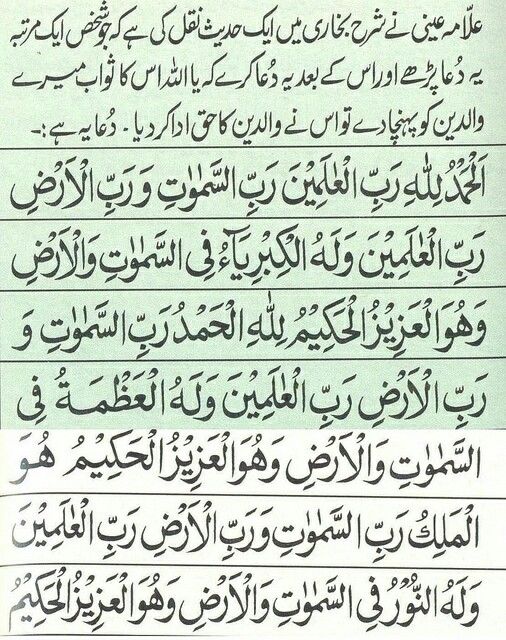
Waldain Kay Liya Dua
Prophet Muhammad (peace be upon him): A Keen Sense Of Fairness
When a family of high status experiences hard times and loses much of its wealth, it either works hard to maintain its social standing through observing fine values and moral standards, or it may be unscrupulous in attempting to regain its material losses. Prophet Muhammad’s (peace be upon him) family was of the first type. It continued to attach much importance to all the fine qualities all human societies approve, such as sincerity, truthfulness, fidelity, courage, kindness to others, readiness to help in any good cause. Prophet Muhammad (peace be upon him) followed this line from his early years and developed a keen sense of upright behavior. Hence, his community gave him the nickname Al-Amin, which means ‘the trustworthy’. They always declared that they never experienced him telling a lie in any situation, for any reason.
This quality enhanced Prophet Muhammad’s (peace be upon him) standing with all those who were close to him. His paternal aunts loved him dearly. They always tried to help him achieve the best in life. His uncles recognized in him a young man of great potential. None more so than Abu Talib, his uncle who took him into his own home after Abd Al-Muttalib’s death. Hence, we see Abu Talib taking his teenager nephew on a trip to Syria. A few years later, he arranges for him to work as a shepherd, then as he approaches adulthood, he encourages him to work as a trade agent, traveling with a trade caravan.
The upright attitude and moral code of behavior that Prophet Muhammad (peace be upon him) adopted from an early age endeared him to all around him, and earned him a high standing among his people. Hence, when they had a dispute concerning the replacement of the Black Stone at the corner of the Kaabah, after it had been renovated, they could find no way of preventing the dispute from developing into a bloody fight other than arbitration. They agreed to put their dispute to the first person entering the Sacred Mosque. When it was Prophet Muhammad (peace be upon him) that came forward, they were delighted and readily declared their acceptance of his judgment. His ruling showed maturity and recognition of the considerations that led people to take extreme measures. Hence, he was keen to ensure that no hard feelings remained and everyone was satisfied. He gave them a method of replacing the Black Stone in which they all shared that honor, and none could feel left out. He told them to bring a sheet of cloth and place the Black Stone on it. Then a man from each clan held the edge of the sheet and they all lifted it at the same time, bringing the Black Stone close to its position. He then helped them to put it in place.
Although this incident took place several years before Prophet Muhammad (peace be upon him) started to receive divine revelations, his ruling shows a keen sense of justice. The people in dispute placed no condition on the process of arbitration. They declared their acceptance of his ruling in advance. Had he wished, he could have argued that since the exercise of putting the Black Stone back in place was an exercise of honor, it belonged to the most honorable family or clan in Makkah. That would have given it to his own family. He, however, did not wish to exploit the situation in order to give his own people some advantage. Instead, he was keen to keep the whole community happy. Hence, he ruled that they all should share in the honor and he provided the way to ensure that.
Needless to say, when Prophet Muhammad (peace be upon him) started to receive his revelations, and became a Prophet and a messenger of God, his sense of justice was placed on a much higher level.
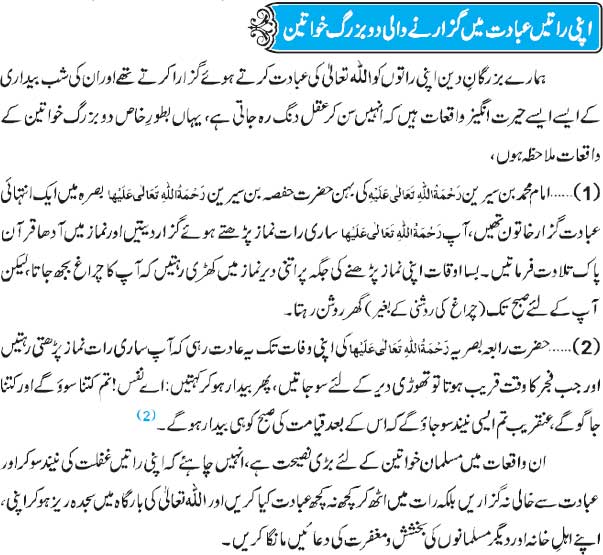
Apni Raatein Ibaadat Mein Guzarney Wali khwateen
O You Who Spreads Corruption In The Land!
In the name of Allah, the Most-Merciful, the All-Compassionate
“May the Peace and Blessings of Allah be Upon You”
Praise be to Allah, we seek His help and His forgiveness. We seek refuge with Allah from the evil of our own souls and from our bad deeds. Whomsoever Allah guides will never be led astray, and whomsoever Allah leaves astray, no one can guide. I bear witness that there is no god but Allah, and I bear witness that Muhammad is His slave and Messenger.
O You Who Spreads Corruption In The Land!
Allah says to the people
“Do not forget your share in this world. Do good, as Allah has been good to you, and do not corrupt in the land, Allah does not love those who corrupt.”(Surah al-Qasas: 77)
Yet, you spread corruption on Earth every where you go.
You spread corruption by lying , slandering, sowing the seed of dissension between people.
You are ready to believe the worst about your brother, without verifying it. You twist innocent actions and words, just to make your brother look bad.You do all that and more…much more.
And, yet, you deny it. You think it is not you. You think it is others who are spreading corruption…but in fact, it is you.
“And when it is said to them: Make not mischief on the earth,
they say: We are only peacemakers.
Verily, they are the ones who make mischief, but they perceive not”
[al-Baqarah :11-12]
So What Exactly Is Corruption?
It is corruption if you readily believe everything you hear!
“O you who have believed! If there comes to you a disobedient one with information, INVESTIGATE, lest you harm a people out of ignorance and become, over what you have done, regretful.” (Al-Hujuraat: 6).
It Is Corruption If You Falsely Accuse A Muslim Without Proof
Abu Dharr said: “I heard the Messenger of Allah (pbuh) say: No man accuses another of an immoral deed or kufr, but it will come back on him, if the person he accuses is not as he says he is.’” (Bukhari).
It is corruption if you distort the truth !
In a Sahih Hadith the Prophet (pbuh) said: “A man may utter a word without his being on a clear ground regarding it (i.e., without considering its being truthful or not or its being good or evil) which causes him to slip down into the Fire (in a depth) greater than the distance between east and west.”
It Is Corruption If You Gossip And Spread Rumors
“Woe to every slanderer and backbiter.” (Surah al-Humazah:1)
“And obey not everyone who swears much, and is considered worthless. A slanderer going about with calumnies.” (Al-Qalam: 10-11)
The Prophet (pbuh) said: “Whoever believes in Allah and the Last Day, let him say something good or else remain silent.” (Bukhaari, Muslim)
It Is corruption If You Spread Enmity Between Muslims
Shall I not inform you of the wickedest among you?
His companions said, Yes, O Messenger of Allah!
He said, They are those who go about gossiping and causing enmity among those who have love for each other.
It Is Corruption If You Insinuate Racism, When There is None
“As for those who break the covenant of Allah after accepting it, who cut what He has commanded to be united and worked corruption in the land, a curse shall be laid on them, and they shall have an evil abode.” (Surah ar-Rad: 25)
“And cause not corruption upon the earth after its reformation. And invoke Him in fear and aspiration. Indeed, the mercy of Allah is near to the doers of good.”
(Al-Araaf: 56).
It Is Corruption When You Backbite
“… neither backbite one another. Would one of you like to eat the flesh of his dead brother? You would hate it. And fear Allah. Verily, Allah is the One Who accepts repentance, Most Merciful.” [al-Hujuraat :12]
It is corruption when you harbor envy in your heart !
“Iman and hasad (envy) do not gather together in the heart of a slave [of Allah].”
(al-Nasai- sahih)
It Is Corruption When You Don’t Stand Up For The Truth And Support Falsehood
“(They are) swaying between this and that, belonging neither to these nor to those; and he whom Allah sends astray, you will not find for him a way (to Islam)”
[al-Nisaa:143)
It Is Corruption When You Are Pleased That Your Brother Is Dishonored
“If good befalls you (O Muhammad), it grieves them, but if a calamity overtakes you, they say: We took our precaution beforehand’ and they turn away rejoicing”
[al-Tawbah:50]
“If one of you defends the honor of his brother, Allah the Almighty, will keep the hellfire away from his face in the Hereafter.” (Muslim).
Read these ayaat carefully and see if they apply to you.
Do You Realize That These Are Signs Of A Hypocrite
“The hypocrites, men and women, are one from another; they enjoin (on the people) Al-Munkar (all that Islam has forbidden), and forbid (people) from Al-Maroof (all that Islam orders one to do), and they close their hands (from spending in Allah’s Cause). They have forgotten Allah, so He has forgotten them. Verily, the hypocrites are the Faasiqoon (rebellious, disobedient to Allah)”[al-Tawbah:67]
When Will You Learn?
When will you realize that it is You that is causing the corruption?
When will it dawn on you that You are the cuuplrit
“If you ask them (about this), they declare: We were only talking idly and joking.
Say: Was it at Allah, and His Ayaat and His Messenger that you were mocking?
Make no excuse; you disbelieved after you had believed” [al-Tawbah:65- 66]
Shape up now before it is too late….
For you have been warned….
“The recompense of those who make war against Allah and His Messenger and spread corruption in the land is that they are to be killed or crucified, or have their hand and a foot cut off on opposite sides, or be expelled from the land. For them is shame in this world and a great punishment in the Everlasting Life.”
(Surah al-Maidah:33)
“…and Allah does not love those who corrupt.”
(Surah al-Maidah: 64)