


Qiyam Al Layl Ki sunnatain
Heroes Of Islam: Imam Malik
Malik ibn Anas Al-assbahi, the founder of the Maliki school of thought, was born in Madinah in 93 A.H, corresponding to 712 A.D. His parents were Arabs of Yemeni descent. His tribe, Assbah, still lives in Yemen. His grandfather, who bore the same name, Malik, arrived in Madinah to complain to the Caliph against the governor, but decided to settle in Madinah, where he met a number of the Prophet’s companion, and learnt from those who were known for their scholarly standing, such as Umar ibn Al-Khattab, Uthman ibn Affan, Aisha, Talha and many others. Thus, he became well-known as a scholar. He taught the young grandson, Malik, with the best platform to pursue his natural inclination to study.
Malik first sought to memorise the Quran, which he soon did. He then suggested to his family that he should attend scholars’ circles to write down the Hadith (sayings/doings of the Prophet Mohammed, pbuh) and Fiqh (Islamic law). They welcomed that, particularly his mother, who took extra care of his appearance, helping him to dress in his best attire, and directing him to whom he should study. She encouraged him to attend the circle of Rabi’ah ibn Abdurrahman, who was renowned for exercising scholarly discretion. Malik learnt from him this highly commendable approach, particularly because it was restrained with commitment to the hadith and the Quran.
Malik provided a great example of a student eager to improve his knowledge and achieve a standard of excellence in his scholarship. He would go to Nafi’, one of his teachers, waiting for him until he came out of his house; he would wait outside in very hot temperatures, having no shade. When Nafi’ came out, Malik would follow him, without accosting him at first, until he had walked some distance. He would then greet him and keep quiet. When he approached his destination, he would ask him one or two questions, learn the answers and memorise them.
Malik was very selective in his choice of teachers. He was keen to study under Az-Zuhri, the first specialised scholar of hadith who had studied under Saeed ibn Al-Mussayib and other celebrated scholars of the Tabi’een generation that succeeded the Prophet’s (pbuh – peace be upon him) companions. Malik reports that on one Eid day, he thought that Az-Zuhri would be free, so he went to his home and waited at his door. He heard him asking his maid to find out who was at the door. When she told him that it was Malik, he told her to let him in. He asked him: “I see that you have not gone home yet……Would you like to have something to eat?” Malik said, “No. I would only like you to teach me some hadith.” Az-Zuhri told him to take out his sheets and dictated to him 40 hadiths. Malik requested more, but the teacher said, “That should be enough for you. If you learn these well, you are a great learner.”
Rabi’ah ibn Abdurrahman was one of Malik’s teachers, as we have already mentioned. He was nicknamed Rabi’ah Ar-rai, which means ‘the-point-of-view’. This is a reference to the fact that he exercised scholarly discretion to a much greater extent than many scholars in Madinah would have liked. In Islamic scholarship, there have always been two trends. The first limits all efforts to learning the texts of the Quran and hadith, understanding their meanings, and stopping at that. The other trend tries to go deeper into the texts to understand their wider applicability and to reconcile what may appear to be a conflict between the two texts.
Tanhai Mein Pakeezgi Ikhtiar Karien

Tanhai Mein Pakeezgi Ikhtiar Karien
Your Sustainer Has Willed Upon Himself The Law Of Grace And Mercy
[Quran – 6:12] “Say: “Unto whom belongs all that is in the heavens and on earth?” Say: “Unto God, who has willed upon Himself the law of grace and mercy. He will assuredly gather you all together on the Day of Resurrection, [the coming of] which is beyond all doubt: yet those who have squandered their own selves-it is they who refuse to believe [in Him],”
The Prophet (Peace Be Upon Him) has said:
[Bukhari, Book #54, Hadith #416] “Narrated Abu Huraira: Allah’s Apostle said, “When Allah completed the creation, He wrote in His Book which is with Him on His Throne, ‘My Mercy overpowers My Anger.”
[Muslim, Book #037, Hadith #6626] “(2) Abu Huraira reported that Allah’s Messenger (may peace be upon him) said: When Allah created the creation as He was upon the Throne, He put down in His Book: Verily, My mercy predominates My wrath”
[Sunan Abudawud, Book #41, Hadith #4923] “Narrated Abdullah ibn Amr ibn al-‘As: The Prophet (peace be upon him) said: The Compassionate One has mercy on those who are merciful. If you show mercy to those who are on the earth, He Who is in the heaven will show mercy to you.”
[Al-Tirmidhi, Hadith # 1011] The Prophet Muhammad (peace be upon him) said: “It is better for a leader to make a mistake in forgiving than to make a mistake in punishing.”
Tarbiyat-E- Aulad Kay Chalis Nukaat

Tarbiyat-E- Aulad Kay Chalis Nukaat
Allah’s Command To Believers: Don’t Backbite
[ALLAH’S Quran – 49:12] “O ye who believe! Shun much suspicion; for lo! Some suspicion is a crime. And spy not, neither backbite one another. Would one of you love to eat the flesh of his dead brother? Ye abhor that (so abhor the other)! And keep your duty (to Allah). Lo! Allah is Relenting, Merciful.”
The Prophet (Peace Be Upon Him) has said:
[Muslim, Book #032, Hadith #6265] “Abu Huraira (ra) reported Allah’s Messenger (may peace be upon him) as saying: Do you know what is backbiting? They (the Companions) said: Allah and His Messenger know best. Thereupon, he (the Holy Prophet) said: Backbiting implies you are talking about your brother in a manner that he does not like. It was said to him: What is your opinion about this, that if I actually find (that failing) in my brother which I made a mention of? He said: If (that failing) is actually found (in him) what you assert, you in fact backbited him, and if that is not in him it is a slander.”
Khalifa e Awwal: Janasheen Rasool Hazrat Abu Bakar (RA)
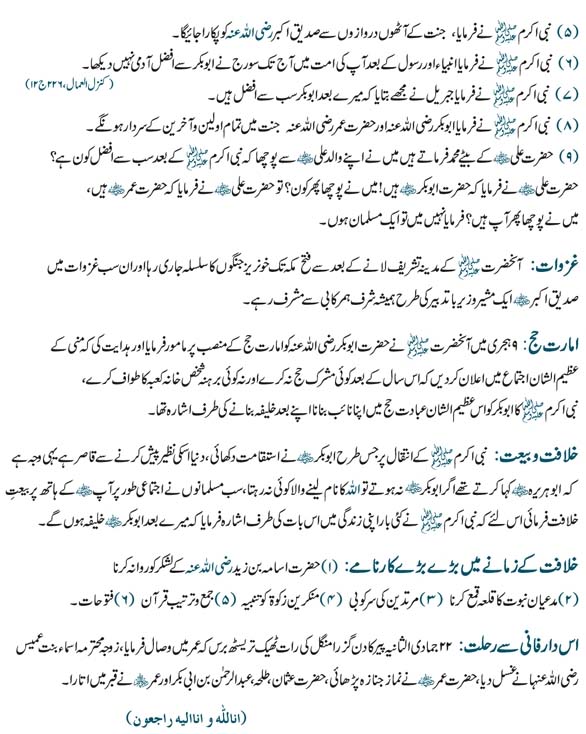
Khalifa e Awwal: Janasheen Rasool Hazrat Abu Bakar (RA)
Charity Is Due Everyday
Abu Dharr (May Allah be pleased with him) reported: Messenger of Allah (PBUH) said, “When you get up in the morning, charity is due from every one of your joints. There is charity in every ascription of glory to Allah; there is charity in every declaration of His Greatness; there is charity in every utterance of praise of Him; there is charity in every declaration that He is the only true God (worthy of worship); there is charity in enjoining good; there is charity in forbidding evil. Two Rak’ah of Duha (Forenoon prayer) is equal to all this (in reward)”. [Muslim].
Commentary:
There are three hundred and sixty joints in the human body. It is these joints which enable us to work and make all kinds of movements. If man’s body did not have these joints, it would have been impossible for him to sit, stand, lie, move, and use different organs of his body. Thus, every joint is a blessing for which one must express gratitude to Allah. It is yet another Blessing of Allah that He has also told man a very easy way of Thanksgiving, which can be practiced even by the poorest man in the world.
This means of Thanksgiving is recitation of Tasbih (Subhan Allah), Tahmid (Al-hamdu lillah), Takbir (Allahu Akbar), Tahlil (La ilaha illallah), and to preach virtue and forbid wrong/ unlawful, etc. If one is unable to do even this, then he should perform at least two Rak’ah prayer at any time between sunrise and sunset.
Khatma Bil Khair: Allah Aur Rasool (SAW) Ki Muhabat

Khatma Bil Khair: Allah Aur Rasool (SAW) Ki Muhabat