
Anger: 10 ways to defeat it
1 – Seek refuge with Allah from the Devil:
Sulayman bin Sard narrated:
“I was sitting with the Prophet, when two men began slandering one another. One of them was red in the face, and the veins on his neck were standing out. The Prophet said: “I know a word which, if he were to say it, what he feels would go away. If he said: “I seek refuge with Allah from the Devil,” what he feels would go away.'”
[‘Fath al-Bari’; 6/337]
The Messenger of Allah said:
“If a man gets angry and says: “I seek refuge with Allah,” his anger will go away.”
[‘Sahih al-Jami’; # 695]
2 – Remain silent:
The Messenger of Allah said:
“If any of you becomes angry, let him keep silent.”
[‘Sahih al-Jami’; # 693]
3 – Sit down or lie down:
“Abu Dharr was taking his camels to drink at a trough that he owned, when some other people came along and said to one another: “Who can compete with Abu Dharr in bringing animals to drink and make his hair stand on end?” A man said: “I can.” So, he brought his animals and competed with Abu Dharr and ended up breaking the trough.Abu Dharr was standing when he saw this, so, he sat down, then he laid down. Someone asked him: “O Abu Dharr, why did you sit down then lie down?” He said: “The Messenger of Allah said: “If any of you becomes angry and he is standing, let him sit down, so that his anger will go away. If sit does not go away, let him lie down.”””
[Reported in the ‘Musnad’ of Ahmad (5/152) and ‘Sahih al-Jami’ (694)]
al-Imam al-Khattabi said: “One who is standing is in a position to strike and destroy, while the one who is sitting is less likely to do that, and the one who is lying down can do neither. It is possible that the Prophet told the angry person to sit down or lie down so that he would not do something that he would later regret, and Allah Knows best.”
[‘Ma’alim as-Sunan’; 5/141]
Necessary vs Unnecessary Speaking
Assalaamualaykum wa rahmatullahi wa barakatuhuh:
The following are hadith regarding unnecessary talking. We should heed the sayings of our Holy Prophet (peace and blessings be upon him). He also mentioned occasions when we should SPEAK. Please note these hadith and examples as well.
When to Speak:
- In Matters of Justice
- Speaking the Truth
- Remembering Allah
- Speaking Out Against Oppression & Evil
When and What not to Speak
- Excessive Talking
- Talking what does not concern oneself
**Therefore, one must control one’s tongue**
Prophetic Hadith on Speaking:
In Matters of Justice
Abu Hurairah, may Allah be pleased with him, narrated the Messenger of Allah (may peace be upon him) said:
Charity is due on every joint of a person, every day the sun rises. Administering of justice between two men is also a charity. And assisting a man to ride upon his beast, or helping him load his luggage upon it, is a charity; and a good word is a charity; and every step that you take towards the Prayer is a charity, and removing of harmful things from the pathway is a charity.
[Sahih Muslim: 1677]
Speaking the Truth
Bayhaqi from Jabir (Allah be pleased with him) from the Messenger of Allah (Allah bless him and give him peace) with the words,
“There is no charity more beloved to Allah from speaking the truth.”
This was declared rigorously authentic by Ibn Hibban.
The Sinners Among the Believers Will Enter Paradise
(i) They will be brought forth from Hell and will enter Paradise by means of intercession.
Muslim reports from Abu Sa’eed that the Messenger of Allah (saw) said:
“The people of Hell will remain there, never dying, and never living. But there are people who will enter Hell because of their sins, and will be killed therein, so that they become like coals. Permission will be granted for intercession to be made, and they will be brought forth in groups and spread on rivers of Paradise, and it will be said, “O people of Paradise, pour water on them. Then they will grow like seeds in the silt left by a flood”. [Muslim, Kitaab al-Imaan, Baab as-Shafa’ah wa Ikhraaj al-Muwahiddin min an-Naar, 1/172]
Muslim also reports from Jaabir ibn ‘Abdullaah that the Messenger of Allah (saw) said, “Some people will be brought out of the Fire, having been burnt all over except for their faces, and they will enter Paradise”. [Muslim, Kitaab al-Imaam, Baab adna Ahl al-Jannah Manzilatan, 1/178]
The people of Paradise will call these people who are brought out of Hell and admitted to Paradise, al-Jahannamiyyoon. al-Bukhaari reports from ‘Imraan ibn Husayn (ra) that the Prophet (saw) said, “Some people will be brought out of Hell through the intercession of Muhammad (saw). They will enter Paradise and will be known as al-Jahannamiyyoon.” [Sahih al-Bukhaari, Kitaab ar-Riqaaq, Baab Sifaat al-Jannah wan-Naar, Fath al-Baari, 11/418. They are also mentioned in a hadith narrated from Jaabir by Muslim, 1/179 and al-Bukhaari from Anas, Fath al-Baari 11/416]
According to another sahih hadith narrated by Jaabir: “The Prophet (saw) said, “They will be brought out of the Fire through intercession, as if they are tha’areer”. I asked, “What are tha’areer?” He said, “Daghabis [snake cucumbers]”. [al-Bukhaari, Kitaab ar-Riqaaq, Baab Sifaah al-Jannah wan-Naar, Fath al-Baari, 11/416]
Muslim reports a lengthy hadith from Abu Hurayrah, in which the Prophet (saw) describes the Hereafter, and in which he says: “…When Allah (swt) has finished judging mankind, and wants to bring whomever He wills out of Hell by His Mercy, He will order angels to bring forth those upon who He wishes to bestow His mercy of the people who never associated anything in worship with Allah (swt), and who said, “Laa ilaaha illaah Allah”. The angels will recognize them in Hell, and will known them by the mark of sujood on their foreheads. The Fire will consume all of a man except the mark of sujood which Allah (swt) has forbidden the Fire to consume. They will be brought forth, having been burned in the Fire, the water of life will be poured on then, and they will grow like seeds left by still after a flood”. [Saheeh Muslim, Kitaab al-Imaan, Baab ar-Ru’yah, 1/299, no. 182]
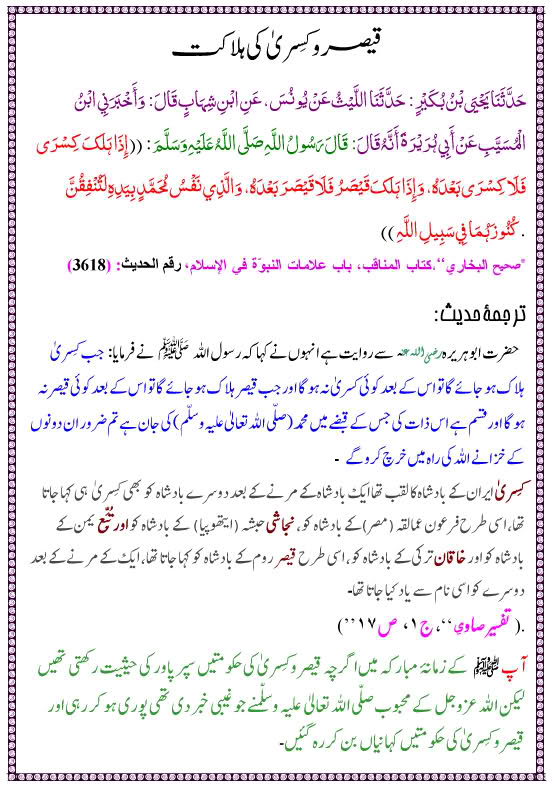
Qaisar-o-Kisra Ki Halakat
Al-Hadith al-Nabawi (s.a.w)
Hadith:Haj for another
Yahya related to me from Malik from Ibn Shihab from Sulayman ibn Yasar that Abdullah ibn Abbas said, “Al-Fadl ibn Abbas was riding behind the Messenger of Allah, may Allah bless him and grant him peace, when a woman from the Khathama tribe came to him to ask him for a fatwa. Al-Fadl began to look at her, and she at him, and the Messenger of Allah, may Allah bless him and grant him peace, turned Fadl’s face away to the other side. The woman said, ‘Messenger of Allah, Allah’s making the hajj obligatory finds my father a very old man, unable to stay firm on his riding-beast. Can I do hajj for him?’, and he said, ‘Yes.’ This was during the farewell hajj.”
(Malik’s Muwatta, Book 20, Number 20.28.98)
Hadith: Love of the Sunnah
Narrated Anas ibn Malik
Allah’s Messenger (peace be upon him) said to me: My son, if you are in a position to pass your morning and evening keeping your heart free from malice against anyone, then act according to it (this high ideal). He then said: My son, and that is my Sunnah and he who loves my Sunnah, in fact loves me and he who loves me, will be with me in Paradise.
Transmitted by Tirmidhi.
Hadith: Charity
Abu Hurairah, may Allah be pleased with him, narrated:
There came a person to the Messenger of Allah (may peace be upon him) and asked: Messenger of Allah, which charity is the best? Upon this he said: That you should give charity (in a state when you are) healthy, closefisted, haunted by the fear of poverty and hoping to become rich (charity in such a state of health and mind is the best). And you must not defer (charity to such a length) that you are about to die and would be saying: This is for so and so, and this is for so and so. Lo, it has already come into (the possession of so and so).
(Hadith number in Sahih Muslim [Arabic only]: 1713 )
Hadith :Friendship
Narrated Abu Said Al Khudri
The Prophet delivered a sermon and said, “Allah gave a choice to one of (His) slaves either to choose this world or what is with Him in the Hereafter. He chose the latter.” Abu Bakr wept. I said to myself, “Why is this Sheikh weeping, if Allah gave choice to one (of His) slaves either to choose this world or what is with Him in the Hereafter and he chose the latter?” And that slave was Allah’s Apostle himself. Abu Bakr knew more than us. The Prophet said,”O Abu Bakr! Don’t weep. The Prophet added: Abu Bakr has favored me much with his property and company. If I were to take a Khalil from mankind I would certainly have taken Abu Bakr but the Islamic brotherhood and friendship is sufficient. Close all the gates in the mosque except that of Abu Bakr.
(Bukhari Vol 1 Number 455)
Gratefulness To Allah
BEING grateful is to render one’s thanks to someone who has shown favor, to express gratitude and to appreciate.
The concept of being grateful to Allah, on the other hand, is to grasp and express that every kind of grace and favor is granted exclusively by Allah.
In the Qur’an, the opposite of being grateful is defined by the term “disbelief,” which is synonymous to being ungrateful.
Only this definition indicates the importance attached to being grateful as a worshiper and the detrimental consequences it (ungratefulness) may have for a believer.
Gratefulness to Allah is one of the concepts mostly emphasized in the Qur’an. In almost 70 verses, the importance of rendering thanks to Allah is stated, the examples of those who are grateful and ungrateful are given and the end they face is described. The reason why so much importance is given to this concept is simply because it is a mere indication of one ‘s faith and affirmation of the unity of Allah. In one of the verses “being grateful” is described as “worship only to Allah”:
O you who believe! Eat of the good things that We have provided for you, and be grateful to Allah, if it is Him you worship. (Al-Baqarah, 172)
In another verse giving thanks to Allah is described as the opposite of idolatry:
But it has already been revealed to you, as it was to those before you , “If you were to join (gods with Allah), truly fruitless will be your work (in life), and you will surely be in the ranks of those who lose (all spiritual good)”.
Nay, but worship Allah, and be of those who give thanks. (Qur’an, Az-Zumar, 65-66)
The following statement of The Evil One (Iblis) emphasizes the importance of giving thanks to Allah :
He (Iblis) said: “Because you have thrown me out of the way, lo! I will lie in wait for them on Your straight way: Then will I assault them from before them and behind them, from their right and their left: Nor will You find, in most of them, gratitude (for Your mercies).” (Al- Araf, 17)
As stated in the verse above, Satan devoted his life to mislead people due to his envy. His ultimate aim is to make people be ungrateful to their Creator. When this ultimate purpose of Satan is considered, it becomes more comprehensible how a man goes astray when he does not render thanks to Allah.
The Real Significance Of Prayer
If a person really believes in Allah (God), how will he show it? And how will it affect his life? For a Muslim, his faith is first demonstrated by the five daily ritual prayers called Salah. These prayers are so important that they are the second pillar of Islam after the Testimony of Faith (There is no god but Allah and Muhammad is His Messenger), obligatory for all, and they are the first thing the Muslim will be asked about on Judgment Day.
Five times a day a Muslim is asked to stop whatever he is doing — be it sleep, work, or play — and make a ritual ablution before facing his Lord in Prayer.
No matter what his actions, the most important thing to a Muslim is his relationship with Allah. This relationship is demonstrated and put into practice, as well as improved and increased, by the ritual prayers.
Only if the prayers are sound and proper will the deeds be sound and proper.
In the Prayer, the Muslim faces toward the Ka’bah in Makkah, the symbol of the Oneness of Allah and the unity of Muslims. He stands, bows, and prostrates to his Lord while praising Him, reciting some of the words He revealed in the Qur’an, and asking for His forgiveness and mercy. In doing so, the Muslim reminds himself of his position in the universe as a humble servant of Allah and of his total dependence on his Creator, Cherisher and Sustainer.
When the prayer is performed properly — with due humility and remembrance of Allah — it has a lasting effect on the person. It fills his heart with the remembrance of Allah, and with fear of and hope in Him. He will not want to move from that lofty position by disobeying Allah.
The Prophet compared this experience of making ablution and praying five times a day to having a river running in front of one’s house.
If one bathed in that river five times a day, would any filth remain on his body? Likewise, the ablution and prayer five times a day removes one’s sins and also prevents him from sinning.
Prayers also affect the life of the Muslim by encouraging him to schedule his activities around their fixed times.
There is some flexibility, for each time is actually a span of one hour or more.
But the Muslim who is conscious of Allah will strive to schedule his life in such a way that he does not miss any of the prayers — for example, by postponing a shopping trip until after a Prayer, or by taking a break from work, or by sleeping earlier so as to be able to rise for the dawn prayer.
Therefore, if one really believes in Allah, he will show it by his commitment to the five daily Prayers, and these, in turn, will help him to live righteously.
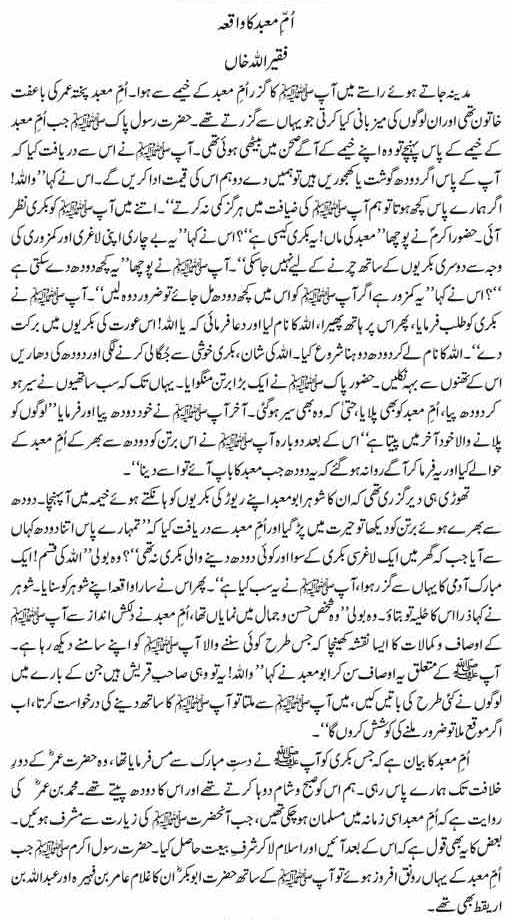
Hazrat Umm e Mabad
Worship Allah Alone, Who Created Us
[ALLAH’S Quran – 2:21 ] “O mankind, worship no one but your Lord. The one who created you and people who lived before you; so that you may become righteous and get salvation.”
[Bukhari, Book #23, Hadith #441] “Narrated Abu Huraira : Allah’s Apostle said, “Every child is born with a true faith of Islam (i.e. to worship none but Allah Alone) but his parents convert him to Judaism, Christianity or Magainism, as an animal delivers a perfect baby animal. Do you find it mutilated?” Then Abu Huraira recited the holy verses: “The pure Allah’s Islamic nature (true faith of Islam) (i.e. worshipping none but Allah) with which He has created human beings. No change let there be in the religion of Allah (i.e. joining none in worship with Allah). That is the straight religion (Islam) but most of men know, not.” (30.30)