
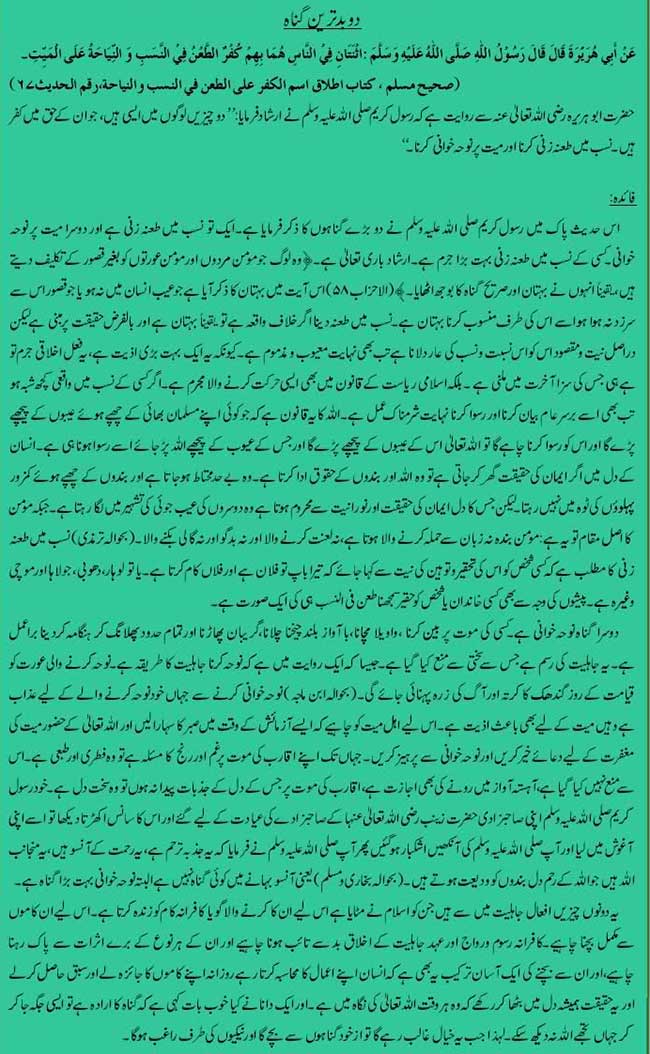
Clashes Among Family Members
Prophet Muhammad (peace be upon him) says: “The Muslim man after Islam, didn’t achieve any extra advantage over his wife; a wife who when her husband looks upon her feels cheerful, follows her husband’s instructions and in his absence, protects her chastity and her husband’s property.” The family has always been one of the most valuable institutions of the society. In the foundation of social life, the family has been the focal point, putting aside the responsibilities related to the giving birth to and rearing of children which results in the continuation and perpetuity of mankind. Other responsibilities for example, the training and endorsing of societal awareness of an individual are also included. Family is a time-tested system which gives the individual a sense of belonging and being. This family system belongs to that group of systems, which have remained existent throughout history, and there are two main reasons for this:
1) The family environment secures the basic needs of a society and shoulders the responsibility of making individuals socially aware
2) The family is a strong and influential center, which brings about the feeling of closeness and emotional support in individuals. The family is also a medium, which plays an important role in the transfer of values, customs, and cultural heritage of the society.
Family disorders have many aspects, which may eventually lead to separation or divorce. One of the basic reasons for divorce is unwarranted expectations, which the two parties have of one another. These expectations are related to the status of the two parties ( i.e. husband and wife) in the society, sexual relations, physical health, financial security and the role that both the man and woman plays in the marriage.
At the same time, it should be mentioned here that the above expectations may be very influential in the strengthening of the family foundation. For example, in the present society, it can be seen that before marriage the couple believes that as long as their love for one another doesn’t decrease, nothing can break the bond that exists between them. But after the marriage, they quickly come to the realization that the love that was abundant in their marriage, has lost some of its luster, or disappeared completely and in order to solve their family problems, they are forced to use more practical methods.
In the same way, children whose parents are not happy in their marriages but remain living together, become affected by the family disputes, which are a result of the relationship of the parents
The Vast Extent of Hell
Hell is huge and vast and immensely deep, as is proven by several things:
(1) Those who will enter Hell are innumerable, yet one of them will be so huge that his molars will be as big as Mount Uhud, and the distance between his shoulders will be equivalent to three days walking. Nevertheless, Hell will accommodate the huge number of Kuffaar and evildoers who have existed throughout history, in spite of their huge size, and there will still be room for more, as Allah says in the Qur’an:
“On the Day when We will say to Hell: “Are you filled?” It will say: “Are there any more to come?” (50:30)
The Fire of Hell is like a mill to which are brought thousands upon thousands of tons of grain, which it grinds tirelessly until it is all done, then waits for more. In the hadith that describes the debate between Paradise and Hell, it says that Allah (swt) said to Hell, “You are My Punishment; I will punish in you whomsoever I will”. Both Paradise and Hell will be filled, but Hell will not be filled until Allah (swt) places His foot in it and it will say, “Enough, enough!”. Then it will be filled and its different parts will come closer to one another. Allah (swt) will not wrong any one of His Creation. Reported by al-Bukhaari and Muslim from Abu Hurayrah (ra) (Jaami’ al-Usool, 10/544). [See the narration from Anas in al-Bukhaari, Muslim and Mishkaat ul-Masaabeeh, 3/109 with a similar meaning].
(2) Another indication of its vast depth is the fact that a stone thrown from the top of Hell takes a very long time to reach the bottom. Muslim reports that Abu Hurayrah (ra) said:
“We were with the Messenger of Allah (saw) and we heard the sound of something falling. The Prophet (saw) said, “Do you know what that was?” We said, “Allah and His Messenger know best”. He said, “That was a stone that was thrown into Hell seventy years ago and it was falling through Hell until now”. (Muslim, Kitaab al-Jannah, Baab fi shiddat haar an-naar, 4/2184 no. 2844)
Haakim reports from Abu Hurayrah, and Tabaraani from Mu’aadh and Abu Umamah (ra) that the Prophet (Saw) said, “If there was a huge stone as big as seven khalifaat stones, and it was thrown from the edge of Hell it would fly through it for seventy years before it reached the bottom”. (Saheeh al-Jaami’ as-Sagheer, 5/58, no. 5124, Its isnaad is saheeh).
(3) The great number of angels who will bring Hell forth on the Day of Resurrection.
The Messenger (saw) described how Hell will be brought forth on the Day of Resurrection, concerning which Allah (swt) said,
“And Hell will be brought near that Day”. (89:23)
The Prophet (saw) said,
“Hell will be brought forth that Day by means of seventy thousand ropes, each of which will be held by seventy thousand angels.” (reported by Muslim from ‘Abdullaah ibn Mas’ud, 4/2184 no.2842)
We can only image the vastness of this terrifying creation that requires such a huge number of strong and powerful angels whose strength is known only to Allah!
(4) Another indication of the vastness of Hell is the fact that two great creations like the sun and moon will be two rolled-up bulls in Hell. at-Tahhaawee reports, in Mishkil al-Aathaar, that Salamah ibn ‘Abdur-Rahman said, “Abu Hurayrah told us that the Prophet (saw) said:
“The sun and moon will be two rolled-up bulls in Hell on the Day of Resurrection” al-Bayhaqi also reported this in “al-Ba’th wal-Nushur”, as did al-Bazzaar, al-Isma’ili and al-Khattaabi, with an isnaad that is saheeh according to the conditions of al-Bukhaari, who reported in al-Saheeh al-Mukhtasar, with the wording “The sun and moon will be rolled up in Hell of the day of Resurrection”. (Sheikh Naasir ud-Deen al-Albaani narrated this hadeeth in Silsilah al-ahadeeth as-Saheehah, 1/32, hadith no:124)
Seeking Halal Earning
According to Abdullah ibn Masud (Allah be pleased with him), the Prophet Muhammad (peace be upon him), said: ‘Seeking halal earning is a duty after the duty.’ In other words working to earn a halal living is itself a religious obligation second in importance after the primary religious obligations like prayers, fasting and Hajj.
This brief Hadith contains three very important messages. First, it points to the Islamic way out of the apparent dichotomy between the material and the spiritual worlds. We often see them working in opposite directions. Indulgence in the material world does lead one away from the spiritual world. Spiritual uplifting seems to accompany a tendency to distance oneself from the material pleasures. There is a conflict, but is there a contradiction also? Is it possible to resolve the conflict in a way that one can take care of both? Or are they mutually exclusive? This has been a central question for all religions and many in the past suggested the second answer, making hermits as the ideal for the humanity. Unfortunately not much humanity is left when one moves too far in this direction. One can read today the horror stories of monks, among others, who tried to seek spiritual purification this way.
As a reaction, others took the other course, making material pleasures the goal of this life. The Western civilization today is the prime example of that. Its toll on human spirit and morality is well known and is a constant reminder that something is wrong here as well.
In between the two extremes Islam points out the Straight Path. Man is both a material and a spiritual being. The solution does not lie in denying the material needs and desires but in denying their claim to primacy. They are part of being but not the reason or goal of being. As long as they are kept in place, they are an important part of our life. The problem is not money but the love of it. Wealth itself is not bad. In fact Qur’an refers to it as ‘ … your property which Allah has made for you a means of support for you . ..’ [Al-Nisa, 4:5]. And another Hadith praises the merits of ‘the halal wealth of a pious person.’ The effort to earn a living is not only not against spirituality, it is a religious obligation!
But this earning must be through halal means. This is the second message of this Hadith. Our obligation is not just to make money but to make halal money. This is a broad statement that is the basis for Islamization of a society’s economic life. Not every business idea or possible business enterprise is good for the society. And the decision regarding right and wrong here cannot be left to the so-called market forces. Right and wrong in the economic life, as in all life, must be determined by a higher source. Shariah guides us as to the halal and haram business enterprises and practices, and at both individual and collective levels we must follow that guidance.
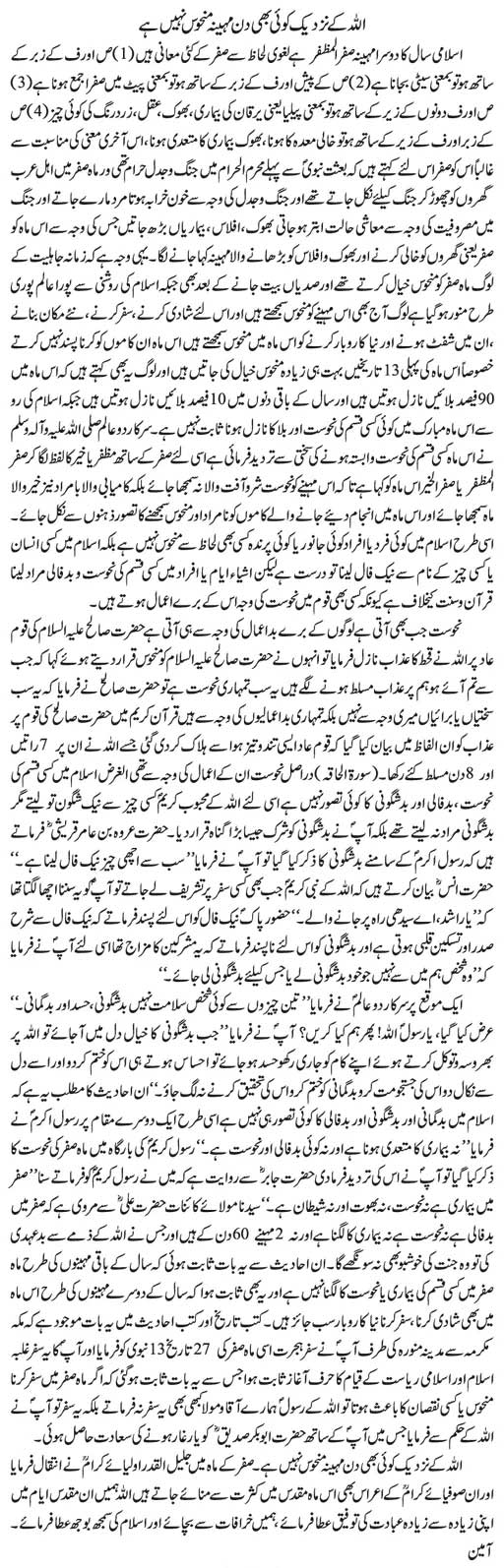
Allah Kay Nazdeek Koi Bhi Maheena Manhoos Nahi
What You And Me Can Do For Others
Imagine that you were witness to a gory hit-and-run accident: from your vantage point you can actually see the helpless, wounded victims, hear their groans of pain and their cries for help.
What would you do?
If you were a doctor or health-care worker, you would attempt to rescue, resuscitate and revive the victims. If you weren’t qualified/equipped to help them yourself, you would try and flag down other cars and get other people to help and carry the victims to the nearest hospital. At the very least, you would call an ambulance or emergency services so that they could be helped.
Only an individual with an exceptionally hardened heart would survey the scene and decide: “It’s not my problem,” avert his eyes and go away without trying to help in some way.
In my mind, this somewhat grisly analogy is apt for the state of our Ummah, and our inexcusable apathy towards it.
It’s almost as if we, the regular, average, and ordinary Muslims have abdicated our responsibility and conveniently look towards the scholars, students of knowledge, the rich and influential to do their bit – and hope it makes up for our reluctance/indifference.
Interestingly, our collective inertia is indicative of the state of our faith.
Ibn Al-Qayyim Al-Jawziyyah (may Allah have mercy upon him) says in his book Al-Fawaa’id: “There are different ways of supporting a fellow believer: with one’s wealth, with one’s position of authority or power, by means of physical service, by offering sincere advice and guidance, by du’a and asking for forgiveness for them, and by feeling their pain.
“The level of one’s support will be affected by the level of one’s faith. The weaker a person’s faith, the weaker his support will be; the stronger the faith, the stronger the support. The Messenger of Allah (peace and blessings of Allah be upon him) was the greatest of all people in his support for his companions, so the more closely his followers follow him, the greater will be their support for their fellow-believers.”
To the sincere do-gooder, every act of kindness – ranging from the big things to Al-Ma’oon (the smallest good deeds, that could consist of supplying ordinary provisions like sugar, salt and water to the needy) – is fuel in the “race towards forgiveness from the Lord, and towards Paradise.”
There’s the famous story of Abu Bakr and Umar (may Allah be pleased with them) which illustrates this best: “During the days of the Caliphate of Abu Bakr, in an out of the way street in Madina, there lived a blind old woman. Umar would go to her house everyday to see if she required help, but he always found that someone else had anticipated his visit and supplied all the needs of the old lady. One day Umar went to the house of the lady earlier than usual and found that the man who visited the old lady every morning and served her, was none other than Abu Bakr.
Before becoming the Caliph, Abu Bakr used to milk the goats in the neighborhood, and when he became the Caliph, he passed by some women in the street, one of whom remarked that now that he had become the Caliph he would no longer milk the goats for them. Abu Bakr heard these remarks and said that the caliphate made no difference to him, and that he would continue to milk their goats.”
We have seen numerous people here in the Kingdom of Saudi Arabia who seems to have inherited the same spirit of services: there are unknown brothers who visits the hospitals feeds the patients and tucked them in comfortably, made du’a for their speedy recovery– without divulging their name. Some brothers are regular visitor on weekends and just came around to help the patients.
A sister who used to make small packets of detergent powder to distribute to the pilgrims during Haj. She said she had never thought that a small gesture like this would be welcomed by them, but was pleasantly surprised when her little gift was appreciated and accepted gratefully.
It just goes to show that we are limited in our capacity to do good to our fellow Muslims only by our lack of imagination and will – not by a lack of material means.
Holy Qur’an: The Panacea for Mankind
And We send down of the Qur’an that which is a healing and a mercy o those who believe (in Islamic Monotheism and act on it), and it increases the Zalimun (polytheists and wrongdoers) in nothing but loss.
And when We bestow Our Grace on man (the disbeliever), he turns away and becomes arrogant (far away from the Right Path). And when evil touches him, he is in great despair.
Say (O Muhammad, peace be upon him, to mankind): Each one does according to his Shakilatihi (i.e. his way or his religion or his intentions), and your Lord knows best of him whose path (religion) is right. (Al-Israa , 17:82-84)
There is certainly a cure and a blessing for those whose hearts are full of faith. Such hearts brighten up and become ready to receive what the Quran imparts of grace, reassurance, and security. There is in the Quran a healing power that cures obsession, anxiety, and hesitation. It establishes a bond between believers hearts and God. This bond imparts inner peace to believers as they experience a feeling of security in God s protection. They are happy and satisfied with what they receive from God and contented with their lot in life. Anxiety, hesitation, and obsession are all terrible to experience. As the Qur an dispels all these, it is indeed a blessing for true believers.
In the Quran we have a cure from greed, envy, and evil thoughts. All these cause sickness of the heart and mind, leading to debility and utter ruin. As the Quran cures these, it is a tool of grace bestowed by God on those who truly believe in Him.
The Quran also provides a cure from deviant thoughts and feelings. It protects the mind from going far astray, while allowing it complete freedom within its fruitful pursuits. It stops the mind from wasting its energy over what is devoid of use. It lays down for it a sound approach that ensures good and useful results. The same principle applies to the human body, ensuring that its resources are utilized for what is useful and fruitful, steering human beings away from the suppression of natural desires or indulgence without restraint. Thus it ensures a healthy body. In this again we see that the Quran is a means of God s grace that is bestowed on believers.
There is also in the Quran a cure for social ailments that weaken the structure of society and destroy its peace and security. Under the social system established by the Quran, society enjoys perfect justice in peace and security. This is again a further aspect of grace bestowed through the Quran.
A Beautiful Advice To The People Of This World
Alluring to people is the love of women and sons, and mountains of gold and silver and fine horses and cattle and land. These are the glamours of the life of this world. The hereafter is best in ALLAH’s sight. Should I tell you about something which is better than these things? For those who believe and do right, there will be for them gardens of paradise, beneath which rivers will flow. I give you the good news of being there.
ALLAH has made a trade with the believers that in return for their wealth and their own selves, He will give them a home in His paradise, gardens of happiness beneath which rivers flow, to stay in there forever. A repayment from their Lord, for their good deeds. They will have therein pure friends, and ALLAH will make them enter cool shades. The promise of ALLAH is true, and whose word can be truer than ALLAH’s?
Whoever does good deeds whether male or female and is a believer — they will enter a garden whose width is the width of the sky and the earth. An excellent reward for the doers of right. ALLAH will be pleased with them and they will be pleased with ALLAH. ALLAH will remove whatever of ill-feeling that is in their hearts, and they will be as brethren, facing each other. They will say: O ALLAH! All Glory and thanks be to You, for guiding us to this. We would not have found the way had it not been that You had guided us. It will be said to them: This is the garden of which you are made heirs in return for what you did. Enter there in peace and comfort. Their greetings in it will be: Peace; and they will say: Praise be to ALLAH, the LORD OF THE WORLDS. They will enter there along with those who did good from their parents, spouses and children. The angels will come to them from every gate. They will stay in there by their Lord’s permission. They will be wearing bracelets of gold and pearls, and their clothes therein will be of silk. I give you the good news of entering there.
It has been reported by Abu Sa’id, AbdALLAH, and Omar b. Muhammad (May ALLAH be pleased with them) that ALLAH’s Messenger ( May peace and blessings be upon him ) had said: On the day of resurrection death would be brought in the form of a white colored ram, and placed between hell and heaven. Then it would be slaughtered, and it would be said : O people of paradise, no death for you. O people of hell, no death for you. (The people would stay in their dwelling places forever). This would increase the delight of the people of paradise, and increase the grief of the people of hell. ( Muslim – May ALLAH have mercy on him).
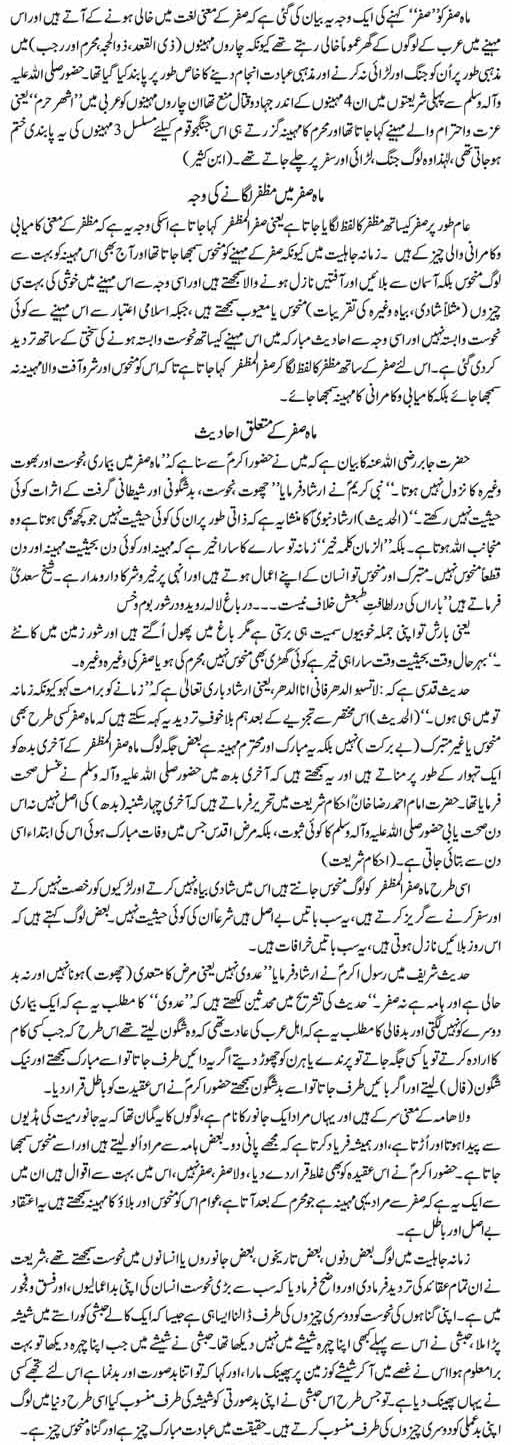
Mah-e-Safar
Prophet Muhammad: A Mercy To The Worlds
The Prophet’s Masjid in the city of Madinah Prophet Muhammad (peace be upon him) was unlettered but a wise and well-respected man, a member of the ruling Quraysh tribe, who was born in Makkah in the year 570 C.E. at a time when Christianity was not yet fully established in Europe. He was orphaned at an early age and then raised by his uncle Abu Talib. As Muhammad (peace be upon him) grew up, he became known for his truthfulness, generosity and sincerity, so that he was sought after for his ability to arbitrate in disputes. His reputation and personal qualities also led to his marriage at the age of 25 to Khadijah, a widow whom he had assisted in business. From then on, he became an important and trusted citizen of Makkah. Historians describe him as calm and meditative.
Muhammad (peace be upon him) never felt content to be part of his society whose values were devoid of true religious significance. He never worshiped idols and never drank alcohol, although drinking was widespread in Arabian society at that time. It became his habit to retreat from time to time to meditate in the cave of Hira’ near the summit of Jabal An-Nur, the “Mountain of Light”, near Makkah (now within Makkah city).
At the age of 40, while engaged in one such meditative retreat, Muhammad (peace be upon him) received his first revelation from Allah through the Angel Gabriel (Jibril). This revelation, which continued for 23 years, is known as the Qur’an.
His first convert was his wife Khadijah, whose support and companionship provided necessary reassurance and strength. He also won the support of some of his relatives and friends. The basic themes of the early message were the majesty of the One, Unique God; the futility of idol worship; the threat of judgment in the new life after being raised for grave; and the necessity of faith, compassion and morality in human affairs.
All these themes represented an attack on the crass materialism and idolatry prevalent in Makkah at the time. So when he began to proclaim the message to others, the Makkans rejected him. He and his small group of followers suffered bitter persecution. Muhammad (peace be upon him) and his followers drew comfort from the knowledge revealed to him about other Prophets, such as Abraham, Joseph, and Moses (peace be upon them all), each of whom had also been persecuted and tested.