
Building Successful Relationships
1. Correct the relationship between yourself and Allah and Allah will then correct the relationship between yourself and others.
2. Studies have proved that every individual has his own unique pattern of understanding and that patterns are usually one of the following:
• A visual pattern, i.e. one looks at the world and deals with it from a physical point of view.
• A hearing pattern, i.e. one looks at the world and deals with it based on the words that one hears (one better understands by hearing).
• An emotion-based pattern, i.e. one looks at the world through one’s emotions and inner feelings.
If you succeed in understanding how a particular individual perceives things (i.e., which pattern one emphasizes), then you can more easily achieve harmony and understanding between the two of you, as well as achieve confidence in your relationship.
3. Put yourself in the place of others and let them hear from you what you like to hear from them, and behave with them the way you like them to behave with you.
4. Always keep smiling, especially during difficult situations and incidents.
5. Keep your calm and self control when provoked.
6. Always be sensitive to feelings of others, their rights and their needs.
7. Choose your words carefully, especially during the first encounter. Be cheerful when speaking and beware of dull facial expressions and tough looks even if your words are very nice.
8. When the atmosphere is not appropriate to talk about a particular subject, then it is better to end the talk about that subject in a courteous way and postpone it to a more appropriate time.
9. Decorate your talk with jokes and proverbs without making this overwhelming in your talk, and tell only the truth. This will induce an interactive discussion.
10. Give away gifts even if small ones and rush to help others even if in little ways, because these are means of winning hearts and of building relationships. It is related in Adab Al-Mufrad of Al-Bukhari that the Prophet (peace be upon him) said: “Give gifts as it will create love amongst you.”
11. Spread Salaam (Islamic greeting) and reply to a greeting with a better one. This is a key to winning others’ hearts, so be eager to own this key.
12. Keep your promises and be truthful in your talk. This will make others love you even when you cannot accomplish what they want.
13. Be generous within your means. Even whatever little that you may give will put you in a high position in the hearts of people. No one can win the hearts of others while he is described as stingy and not generous.
14. Be simple and spontaneous in dealing with others. Being organized in your life will make you win others’ respect, even that of your enemies.
15. Be clean in your body, mouth and clothing, be stylish without exaggeration, and put on a nice fragrance. All these will make others that are dealing with you more comfortable, instead of making them avoid you.
16. These principles can be applied under all circumstances and in all roles – at work, at home, with our husband or wife, our parents, our children, our friends, or strangers.
– Translated from an unknown Arabic author by Zayed Centre for New Muslims, UAE
Making The First Approach By Lady Khadija
When Lady Khadijah received Maysarah’s report of how Muhammad (peace be upon him) conducted her business on the trip to Syria, she realized that she discovered the ideal person to entrust with her business. She was a wealthy widow, with two young children from two marriages. Since business in Makkah was largely an international affairs, depending on the two annual trips, to Syria in summer and Yemen in winter, she had to rely on agents who traveled with the trade caravans on her behalf. Unless her agent was a model of honesty, this could be a risky adventure. Maysarah, however, had much to tell her about Muhammad’s honesty and affable manners that earned him the good will of his fellow travelers and facilitated good deals in both selling and buying. Moreover, Muhammad (peace be upon him) ensured that she made handsome profit.
Her thoughts began to concentrate on how to develop this relationship. Belonging to a very distinguished family in her clan, a pretty and wealthy woman like Khadijah had no shortage of suitors. She realized, however, that many of her suitors were attracted by her wealth. Now that she has had this business experience with Muhammad, a young man of refined manners and the noblest descent, she thought that she must do something to ensure the best of this association. The more she thought over the matter, one idea became more and more attractive to her: marriage.
We must not imagine that this thought was based only on brief encounters before and after the trip undertaken by Muhammad on Khadijah’s behalf. She could not have entrusted him with her business trip without having thoroughly interviewed him. There must have been several meetings between them before the trip, so that he would have a detailed brief of his mission. On his return, they must have had several meetings to settle accounts. Thus Khadijah made her mind on the basis of a good knowledge of the man she wanted to marry.
Khadijah realized that Muhammad (peace be upon him) was in no position to make the first move. He had no money of his own, apart from what she paid him for his agency. As such, he was unlikely to think of marriage for sometime to come. It was up to her to bring about such a marriage if she really wanted it. In the Arabian society, however, it was necessary for her to assign the task of approaching Muhammad to a tactful person.
Nufaysah bint Munyah, a close friend of Khadijah met Muhammad and said to him: “Muhammad, what is keeping you from getting married?” He answered: “I do not have enough to meet the expenses of marriage.” She said: “What if you are not called upon to meet such expenses? What would you say to a woman of beauty, wealth and position who is willing to marry you? Would you marry her?” He said: “Who is that woman?’ She answered: ‘Khadijah.” He asked: “Who can arrange such a marriage for me?” She said: “Leave that to me.” His response was: “I will do it, willingly.”
By: Adil Salahi
Virtue Of The People Of Badr
People came to the door of Umar Bin Al-Khattab (may Allah be pleased with him). Among them were Suhail Bin ‘Amr, Abu Sufyan Bin Harb and other chiefs of Quraish.
Umar went to let the people in and he began by giving permission to the people of Badr first (i.e. those who participated in the Battle of Badr), to the likes of Suhaib, Bilal and others from Ahl Al-Badr.
By Allah, Umar himself was a Badri, and he loved them and advised others regarding them. So Abu Sufyan said, “I have never seen the like of today before! He gives permission to slaves like these while we sit here and he does not even look at us?!”
So, Suhail Bin Amr (who himself was a notable among Quraish) said, “O people, by Allah, I can see what has come over your faces. If you are angry, then only be angry over your own selves.
The people were called (to Islam) and you were also called, they hastened to respond but you were slow. By Allah, what they have preceded you in of virtue, in matters that you don’t know, is more of a loss than your competition here in front of this door.”
Then he said, “O people, these people have succeeded you in what you can see, and so by Allah, there is no way for you to attain what they have succeeded you in.
Look to this matter of Jihad and adhere to it so that perhaps you may be granted martyrdom.” Then (Suhail) took hold of his garment and went off to Al-Sham (Greater Syria).
Al-Hasan said, “By Allah he was truthful. Allah will never allow a slave who hastens to Him, to be equal to a slave who is slow.” (Abdullah Bin Mubarak, Kitab Al-Jihad, no. 100, pg. 32)
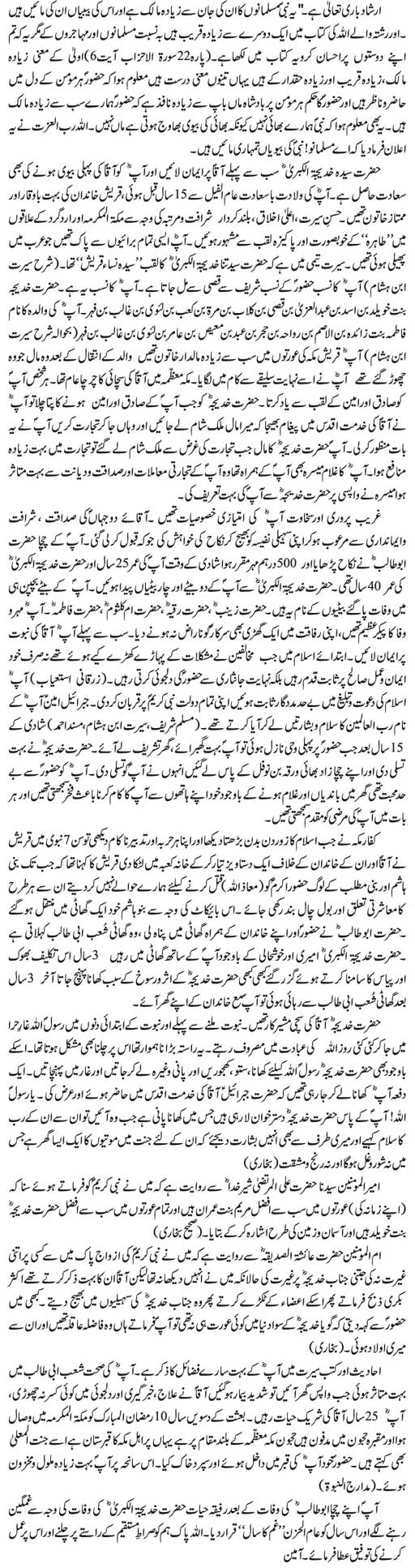
Sayeda Khadija tul Kubra
Prophet Muhammad (peace be upon him): Taking Care Of The Weak
Long before he started to receive his revelations, Muhammad (peace be upon him) was known for his noble characteristics. One of the most important of these was that he always cared for the weaker elements in society. In Arabia, where a tribal society flourished, the most vulnerable sections of the society were slaves and women. Muhammad looked after both, extending to them exemplary treatment. Perhaps the best example to illustrate this is the way he treated Zayd ibn Harithah, a young lad who was taken captive in a raid mounted by a tribe hostile to his tribe. According to the universal custom at the time, captives became slaves. Zayd was sold as a slave by his captors. He was then re-sold and brought to Makkah by an uncle of Khadijah, the Prophet’s first wife. On arrival in Makkah her uncle showed her the slaves he brought with him and told her to choose one as a gift. She took Zayd and gave him to her husband.
Zayd’s family continued to search for him until they learnt that he was in Makkah. His father and uncle traveled there and met Muhammad, requesting him to sell Zayd to them and to be kind when naming his price. Realizing that his interlocutors were Zayd’s own family, Muhammad felt for them. He, however, had a better offer for them. He told them that he would give Zayd a choice to go with them or to stay with him. If Zayd chose them, Muhammad would not ask them to pay any price. He would let them take him free of charge. But if Zayd chose to stay with him, he would not let anyone take him away, not even his own father. Both were very satisfied with this offer, feeling that when Zayd would be given the choice, he would not hesitate to choose to be free.
Zayd was duly called in, and he confirmed that the two men were his own father and uncle. Muhammad then told him of the offer he made to them, asking him to choose whether to go with them or to stay with him. Zayd unhesitatingly chose to remain with Muhammad. Stunned, his father asked him to explain why he would make such a choice. Zayd said: “I have seen from this man enough to make me prefer to stay with him to any other situation.”
At this point, Muhammad realized that the two men needed reassurance. He therefore took them, along with Zayd, to the Kaabah and declared to the nobles of Makkah gathering there that he had adopted Zayd as his own son. This was a relief to Zayd’s father and uncle who returned home realizing that Zayd would not come to any harm as long as he stayed with Muhammad. He was no longer a slave.
In order to appreciate the full significance of the affair, we need to remember that this took place several years before Muhammad was given his mission. Slaves were always maltreated, in all societies. Only under Islam slaves came to be treated like ordinary human beings, enjoying clearly defined rights. Prior to Islam, a slave could be tortured and killed by his master, without anyone even raising a question. To adopt a slave as one’s own son was unheard of. The fact that Zayd chose to stay with Muhammad, in preference to joining his own family and tribe, tells us much about the treatment he received from him. It was not surprising, therefore, that when Muhammad received his message; Zayd was the first man to declare his belief in Islam.
– By Adil Salahi
The Creation Of Man In The Qur’an
The Prophet Muhammad (peace be upon him) was born amid idolism and polytheism of Makkah. Since, childhood he kept himself away from the environment around him. He was very much perturbed over the idol worship of his kith and kin, and kept wandering in quest of truth. He often went to Cave Hera, which was nestled in the mountains of Makkah, to stay in seclusion.
It was there at the age of 40 that he received the first revelation from Allah, “Read in the name of your Lord Who has created. He has created man from a clot ‘Alaq’.” (Qur’an, 96:12)
This very first revelation invites our attention to the Lord and His creations. Another scientific fact to ponder upon is the creation of man. Man is created from a clot i.e. that clings in womb. Allah said, “We have created man from Nutfa of mixed semen, (of man and woman).” (Qur’an, 76:2)
And indeed We created man out of an extract of clay. Thereafter We made him as a Nutfa in safe lodging. Then We made Nutfa into a clot, then we made the clot into ‘Mudgha’(a little lump of flesh), then We made out of that ‘Mudgha’ bones, then We clothed the bones with flesh, and then We brought it forth as another creation. (Qur’an, 23:12-14)
Ibn Abbas explained the above verses: it means the semen of the man and woman is intermingled and then it passes through various stages. As Allah said, “He has created you in stages.” (Qur’an, 71:14)
The science has proved that the total semen ejaculated contains an average of 200 to 300 million of spermatozoa and only one spermatozoa fertilizes the ovum to form the zygote which grows into a baby. The Arabic word ‘Nutfa’ is singular, thus we can clearly say that male spermatozoa mixed with female cell causes fertilization to form zygotes.
Van Baden in 1883 proved that both male and female participate equally in the formation of the human zygote. The Qur’an describes the next stage as ‘Mudgha’ lump of flesh. In the early seventh century nobody knew the stages of embryo’s development, it was only in 20th century that scientists observed, researched and studied it, and called it the somite stage. After that the lump develops bones and the bones are clothed with flesh.
How one could know about the embroy’s development in the seventh century? All praise to Allah Who through His book, the glorious Qur’an, made it possible for us to know and learn about things which science is discovering now.
– by Ahmad Wahaj Al-Siddiqui
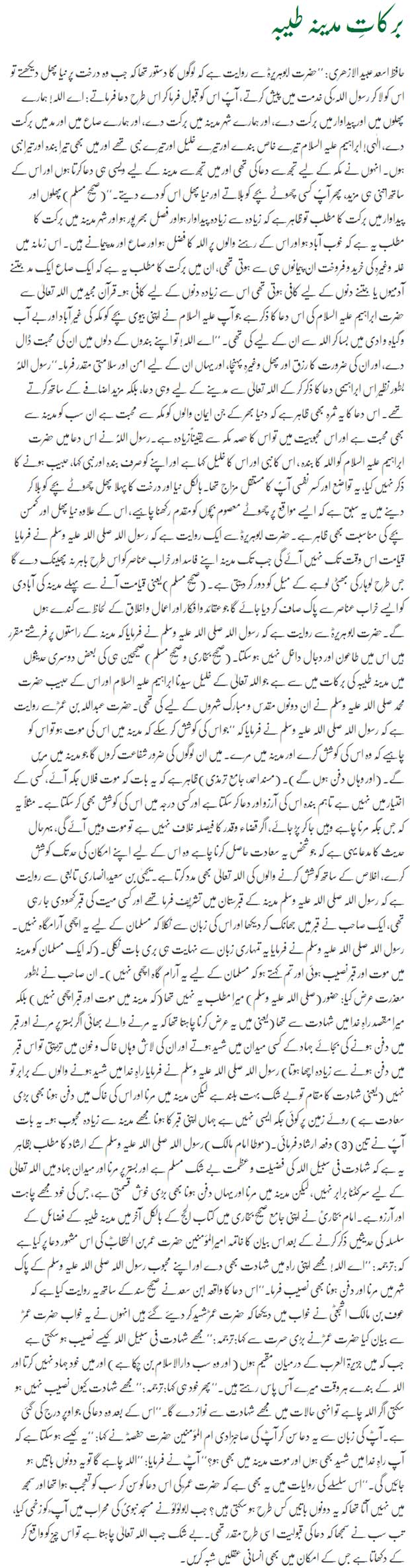
Muharram: Ethics And Significance
THE month of Muharram is one of the sacred months. A Muslim is supposed to gain the advantage of these months so as to draw nearer to Allah by offering voluntary religious deeds such as supererogatory prayers, voluntary fasting, charity, etc.
In the month of Muharram, we should remember the Hijrah of the Prophet (peace be upon him) from Makkah to Madina. There are many lessons in this story and it can help us understand the basic significance of the Hijrah calendar. It is good to remember that Hijrah was a significant move for the growth of Islam and throughout history, Islam has benefited from the Hijrah.
The presence and growth of Islam in America also came from the efforts of those who migrated to this land and worked for the cause of Allah.
It is also the Sunnah of the Prophet (peace be upon him) to fast on the 9th and 10th of Muharram. The Prophet (peace be upon him) used to fast on the 10th day (Ashura). When he came to Madina, he found out that the Jews of Madinah were also fasting on that day remembering Prophet Musa (peace be upon him). The Prophet (peace be upon him) admired this tradition and he said to the Jews, “We are closer to Musa than you are.” He fasted and also told his Companions to fast on this day. Later the Prophet (peace be upon him) told Muslims to add 9th day also. Thus, it is recommended to fast on both the 9th and 10th of Muharram.
It is also good to remember the great sacrifice of Al-Hussain and his family (may Allah be pleased with all of them). Theirs was the true Jihad for the cause of truth and justice. We should learn the lessons of courage, patience and perseverance from the episode of Karbala.
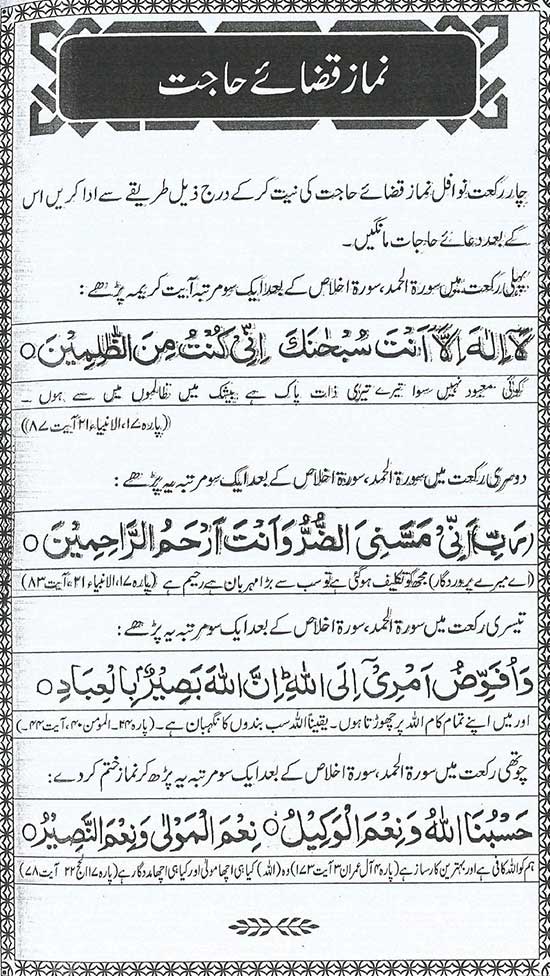
Namaz Qaza-e-Hajaat
Sincerity in Teaching Religion
Sufyan Al-Thawri used to say: “It is rare for a scholar who attracts a large crowd to his lessons not to become conceited.”
Al-Hasan al-Basri passed by Tawus as he was relating Prophetic traditions to a large gathering in the Sacred Mosque. Al-Hasan drew near to him and whispered into his ear: “If you are proud to have attracted such a large audience you should get up and leave.”
Tawus left immediately.
Sufyan Al-Thawri would usually only allow three people to sit in his circle. One day he noticed that the circle had grown quite large. He stood up, shaken, and exclaimed: We have been afflicted with pride! I swear by Allah! If the Commander of the Faithful, ‘Umar, had seen my likes seated in such a gathering he would have made me get up and leave, lamenting: ‘Your likes are not fit to teach.’ “When Sufyan would sit to relate Prophetic traditions, he would sit cross-legged in a fearful state. If a cloud passed overhead he would remain silent until it went by, saying: “I feared that it might be full of stones which it would unleash against me.”
Abu Huraira (may Allah be pleased with him), used to say: “Were it not for a single verse in the Qur’an I would not have taught you. [That verse is] Surely those who conceal what we have revealed of truth and guidance after We have expounded it to people in the Scripture, they are cursed by Allah and cursed by all entitled to curse.” (Qur’an 2:159)
When Sufyan Al-Thawri ceased teaching Prophetic tradition, Abu Huraira’s saying was related to him. He responded: “If I knew that even one student was seeking knowledge sincerely for the sake of God, I would go to his house to teach him, and not even burden him [to come to me].”