

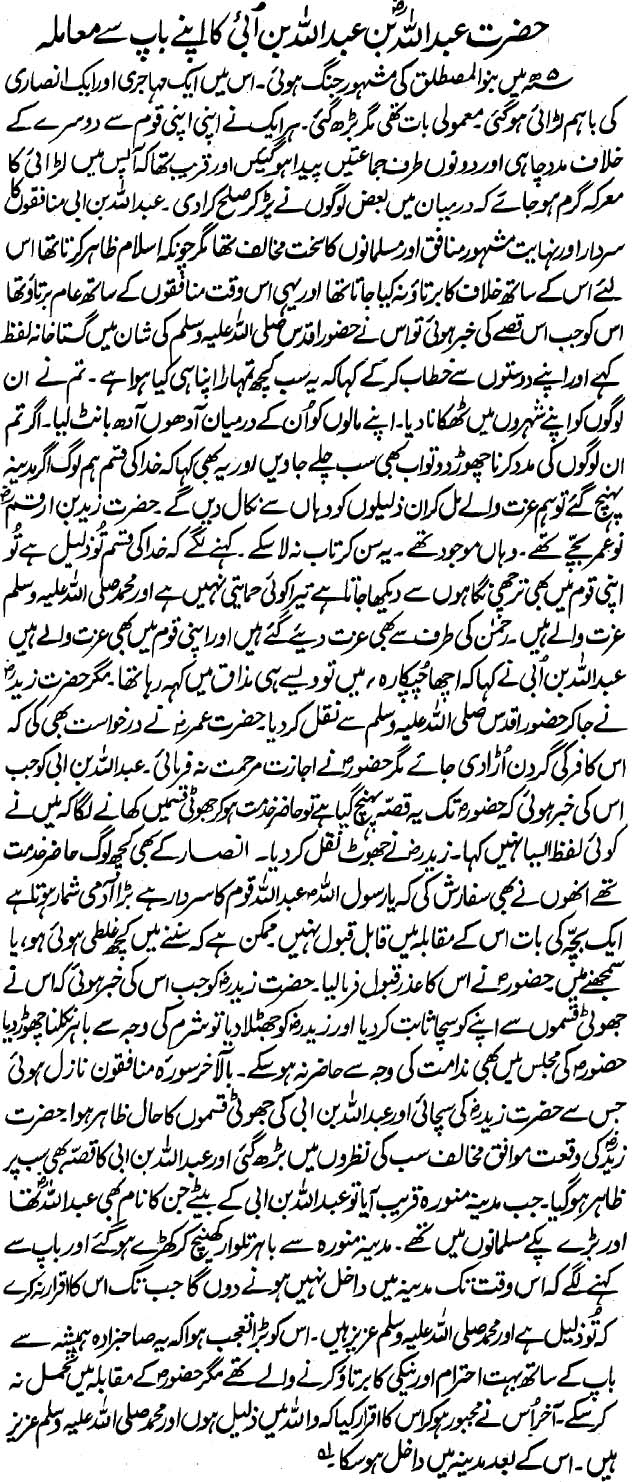
Hadrat Abdullah Bin Abdullah Bin Ubay (radi Allahu anhu) Ka Apne Baap Say Muamla
TAG: Abdullah
Does One Need To Change Name After Conversion
In the first place, we would like to stress that there is no specific injunction that requires a person to change his name after accepting Islam. The vast majority of the Prophet’s companions (may Allah be pleased with them all) did not change their names after accepting Islam. However, it is recommended if a name contradicts Islamic principles or values it should be changed to a better-meaning name. For example, the Prophet (peace be upon him) advised one of the companions, whose name was “Harb” which means “war” in English, to change his name to a better-meaning name.
It is not absolutely necessary for you to change your name if you are converting to Islam as long as your name does not have any taint of shirk, or as long as it does not suggest ideas that are repugnant to Islam.
If your name, however, contains or implies shirk (associating partners with Allah) as is the case with names such as servant of Muhammad, servant of Jesus, servant of Abraham, servant of Ka`bah, and so on, you must change them.
Abu Bakr, the first caliph of Islam, and the Prophet’s closest companion, before his conversion to Islam, was called `Abd al-Ka`bah (servant of the Ka`bah) and the Prophet (peace be upon him) changed his name to `Abdullah (servant of Allah).
Likewise, if your name contains ideas that are repugnant to Islam, then again, you ought to change it; hence the Prophet (peace be upon him) changed or objected to names suggesting unsavory ideas such as Flame of Fire, War, Bitter, Hard to deal with, King of kings, and so on. He also discouraged names implying: prosperity, success, profit-making, and so on; forbearers of these names may likely be taunted for not living up to their names. The Prophet (peace be upon him) loved names such as peaceful, lenient, gracious, noble, bearer of good news, fair, pure, and so on.
While prohibiting or discouraging people from naming with the above names, the Prophet (peace be upon him) encouraged them to use names that have good meanings or are inspirational; thus he loved names that are indicative of servitude to Allah (as is the case with names like `Abdullah (servant of Allah) or `Abd al-Rahman (servant of the Beneficent); he also loved naming children after the true role models of humanity such as prophets and righteous people. So he called his son Ibrahim.
Once the above considerations are taken into account, there is nothing wrong in keeping the previous name, as one is not obligated to change his/her name in order to become a Muslim.
In conclusion, in the Western context, names such as Devil’s angel, Wolf, and so on, are considered un-Islamic.
Joys And Sorrows Of Parenthood
The first marriage of Prophet Muhammad (peace be upon him) gave him six children. The first was a boy, named Al-Qasim. While most human societies, past and present, give preference to male offspring, the pre-Islamic Arabian society surpassed all others in this regard.
It was not uncommon for a father to bury a daughter alive, for fear of poverty or shame. To the Arabs at the time, a woman could neither earn her living nor fight in a tribal war. Thus she was a burden to be got rid of. A man with no male offspring was considered to be highly unfortunate because he would be forgotten soon after his death. He had no sons to bear his name.
As we know, Muhammad’s marriage took place 15 years before he became God’s Prophet and messenger. His was a happy marriage and both he and his wife were very delighted to have a boy for their first child. Muhammad was a very caring husband and a father who doted on his children. Moreover, he did not share the Arabian view of female offspring. While an Arab would receive the birth of a daughter with much gloom and would be greatly depressed by the news, Muhammad felt that a daughter could be the source of great joy and happiness. Therefore, when Khadijah, his wife, gave birth to a daughter, he felt overjoyed. He gave her the name Zaynab, which meant “her father’s adornment.” This was an implicit response to the Arabian gloomy reception of baby girls.
Yet the joy of having both son and daughter together did not last long. The tragedy was to strike shortly afterward. Al-Qasim died before he reached two years of age. This caused Muhammad much sorrow, but infant mortality was a frequent occurrence in all societies at the time.
Khadijah was still in her prime, and she was to give her husband four more children: three daughters and a son. It never occurred to Muhammad that having daughters was anything but a blessing. While his society would consider him greatly unfortunate to have four daughters, he had no such feelings. On the contrary, he loved his daughters better than most Arabs would love their sons. He doted on them and ensured that they received the best upbringing he could give them. Their mother was a wise woman, and she was certain to make their life a comfortable one.
His second son was called Abdullah, but nicknamed Al-Tahir (i.e. the pure). Yet this second son of the Prophet did not live long either. He died very young, perhaps not getting beyond his first birthday. His daughters lived until they were married. Three of them had children. However, only one of them, Fatimah, survived the Prophet. The other three, Zaynab, Ruqayyah, and Umm Kulthoom died before him.
The Prophet had no children by any of his wives, although three of them had children by earlier marriages. However, he had one more son born to him late in his life by Maria, the Coptic slave sent to him as a gift by Al-Muqawqis, the ruler of Egypt. He named that son Ibraheem, which is the Arabic form of Abraham. Again, Ibraheem lived only 18 months. Thus, the Prophet, who was a most loving and caring father, experienced the death of six of his seven children. Fatimah, who survived him, died six months after he had passed away.
Edited by – Adil Salahi
Significance Of Nikah
Alqama reported: While I was walking with Abdullah (Radi Allah Anhu) at Mina, Uthman (Radi Allah Anhu) happened to meet him. He stopped there and began to talk with him. Uthman (Radi Allah Anhu) said to him: Abu Abd al-Rahman (Radi Allah Anhu), should we not marry you to a young girl who may recall to you some of the past of your bygone days; thereupon he said: If you say so, Allah’s Messenger (sal-allahu-alleihi-wasallam) said: O young men, those among you who can support a wife should marry, for it restrains eyes from casting (evil glances). and preserves one from immorality, but those who cannot devote themselves to fasting for it is a means of controlling sexual desire.
[Sahih Muslim: Volume 8, Book ‘Kitab Al-Nikah’, Number 3231]
Abdullah (b. Masud) (Radi Allah Anhu) reported that Allah’s Messenger (sal-allahu-alleihi-wasallam) said to us: O young men, those among you who can support a wife should marry, for it restrains eyes (from casting evil glances) and preserves one from immorality; but he who cannot afford It should observe fast for it is a means of controlling the sexual desire.
[Sahih Muslim: Volume 8, Book ‘Kitab Al-Nikah’, Number 3233]
