
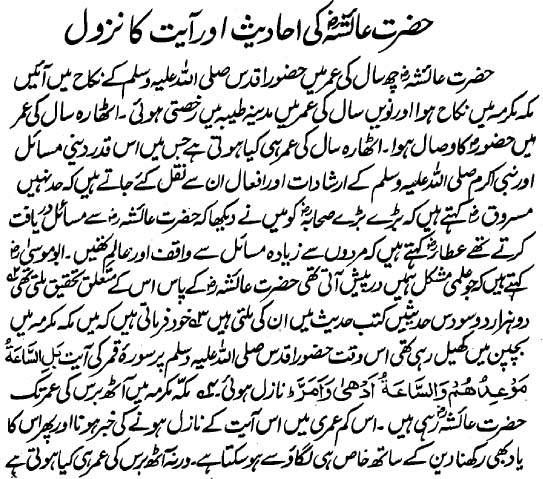
Hazrat Aisha (radi Allahu anha) Ki Ahadith Aur Ayat Ka Nuzool
TAG: Aisha
Aishah Bint Abu Bakr (May Allah Be Pleased With Her) The Teacher Of The Whole World
The life of Aishah (RA) is proof that a woman can be far more learned than men and that she can be a teacher of scholars and experts. Her life is also proof that a woman can exert influence over men and women and provide them with inspiration and leadership. Her life is also proof that the same woman can be totally feminine and be a source of pleasure, joy, and comfort to her husband.
She did not graduate from any university there were no universities as such in her day. But still, her utterances are studied in faculties of literature, her legal pronouncements are studied in colleges of law, and her life and works are studied and researched by students and teachers of Muslim history as they have been for over a thousand years.
The bulk of her vast treasure of knowledge was obtained while she was still quite young. In her early childhood, she was brought up by her father who was greatly liked and respected for he was a man of wide knowledge, gentle manners, and an agreeable presence. Moreover, he was the closest friend of the noble Prophet (SAW- may the peace and blessings of Allah be upon him) who was a frequent visitor to their home since the very early days of his mission.
In her youth, already known for her striking beauty and her formidable memory, she came under the loving care and attention of the Prophet (SAW) himself. As his wife and close companion, she acquired from him knowledge and insight such as no woman has ever acquired.
Aishah (RA) became the Prophet’s (SAW) wife in Makkah when she was most likely in the tenth year of her life but her wedding did not take place until the second year after the Hijrah when she was about fifteen years old. Before and after her wedding she maintained a natural jollity and innocence and did not seem at all overawed by the thought of being wedded to him who was the Messenger of God (SAW) whom all his companions (RA- may Allah be pleased with them all), including her own mother and father, treated with such love and reverence as they gave to no one else.
About her wedding, she related that shortly before she was to leave her parent’s house, she slipped out into the courtyard to play with a passing friend: “I was playing on a see-saw and my long streaming hair was disheveled,” she said. “They came and took me from my play and made me ready.”
They dressed her in a wedding dress made from fine red-striped cloth from Bahrain and then her mother took her to the newly-built house where some women of the Ansar were waiting outside the door. They greeted her with the words “For good and for happiness may all be well!” Then, in the presence of the smiling Prophet (SAW), a bowl of milk was brought. The Prophet (SAW) drank from it himself and offered it to Aishah (RA). She shyly declined it but when he insisted she did so and then offered the bowl to her sister Asma (RA) who was sitting beside her. Others also drank of it and that was as much as there was of the simple and solemn occasion of their wedding. There was no wedding feast.
Marriage to the Prophet (SAW) did not change her playful ways. Her young friends came regularly to visit her in her own apartment. “I would be playing with my dolls,” she said, “with the girls who were my friends, and the Prophet (SAW) would come in and they would slip out of the house and he would go out after them and bring them back, for he was pleased for my sake to have them there.” Sometimes he would say “Stay where you are” before they had time to leave, and would also join in their games. Aishah (RA) said: “One day, the Prophet (SAW) came in when I was playing with the dolls and he said: ‘O Aishah (RA), what game is this?’ ‘It is Solomon’s horses,’ I said and he laughed.” Sometimes as he came in he would screen himself with his cloak so as not to disturb Aishah (RA) and her friends.
Aishah’s (RA) early life in Madinah also had its more serious and anxious times. Once her father and two companions (RA – may Allah be pleased with them) who were staying with him fell ill with a dangerous fever which was common in Madinah at certain seasons. One morning Aishah (RA) went to visit him and was dismayed to find the three men lying completely weak and exhausted. She asked her father how he was and he answered her in verse but she did not understand what he was saying. The two others also answered her with lines of poetry that seemed to her to be nothing but unintelligible babbling. She was deeply troubled and went home to the Prophet (SAW) saying:
“They are raving, out of their minds, through the pangs of the fever.” The Prophet (SAW) asked what they had said and was somewhat reassured when she repeated almost word for word the lines they had uttered which made sense although she did not fully understand them then. This was a demonstration of the great retentive power of her memory which as the years went by was to preserve so many of the priceless sayings of the Prophet (SAW).
Of the Prophet’s (SAW) wives (RA- may Allah be pleased with them all) in Madinah, it was clear that it was Aishah (RA) that he loved most. From time to time, one or the other of his companions would ask:
“O Messenger of God (SAW), whom do you love most in the world?” He did not always give the same answer to this question for he felt great love for many for his daughters and their children, for Abu Bakr (RA- may Allah be pleased with him) for Ali (RA), for Zayd (RA) and his son Usamah (RA). But of his wives (RA) the only one he named in this connection was Aishah (RA). She too loved him greatly in return and often would seek reassurance from him that he loved her. Once she asked him: “How is your love for me?”
“Like the rope’s knot,” he replied meaning that it was strong and secure. And time after time thereafter, she would ask him: “How is the knot?” and he would reply: “Ala haaliha in the same condition.”
As she loved the Prophet (SAW) so was her love a jealous love and she could not bear the thought that the Prophet’s (SAW) attention should be given to others more than seemed enough to her. She asked him:
“O Messenger of God (SAW), tell me of yourself. If you were between the two slopes of a valley, one of which had not been grazed whereas the other had been grazed, on which would you pasture your flocks?”
“On that which had not been grazed,” replied the Prophet (SAW). “Even so,” she said, “and I am not as any other of your wives (RA). “Everyone of them had a husband before you, except myself.” The Prophet (SAW) smiled and said nothing. Of her jealousy, Aishah (RA) would say in later years:
“I was not, jealous of any other wife of the Prophet (SAW) as I was jealous of Khadijah (RA), because of his constant mentioning of her and because God had commanded him to give her good tidings of a mansion in Paradise of precious stones. And whenever he sacrificed a sheep he would send a fair portion of it to those who had been her close friends. Many a time I said to him: “It is as if there had never been any other woman in the world except Khadijah (RA).”
Once, when Aishah (RA) complained and asked why he spoke so highly of “an old Quraysh woman” i.e. Khadijah (RA), the Prophet (SAW) was hurt and said: “She was the wife who believed in me when others rejected me. When people accused me of lies, she affirmed my truthfulness. When I stood forsaken, she spent her wealth to lighten the burden of my sorrow.”
Despite her feelings of jealousy which nonetheless were not of a destructive kind, Aishah (RA) was really a generous soul and a patient one. She bore with the rest of the Prophet’s (SAW) household poverty and hunger which often lasted for long periods. For days on end, no fire would be lit in the sparsely furnished house of the Prophet for cooking or baking bread and they would live merely on dates and water. Poverty did not cause her distress or humiliation; self-sufficiency when it did come did not corrupt her style of life.
Once the Prophet (SAW) stayed away from his wives for a month because they had distressed him by asking of him that which he did not have. This was after the Khaybar expedition when an increase of riches whetted the appetite for presents. Returning from his self-imposed retreat, he went first to Aishah’s (RA) apartment. She was delighted to see him but he said he had received Revelation which required him to put two options before her. He then recited the verses:
“O Prophet! Say to your wives: If you desire the life of this world and its adornments, then come and I will bestow its goods upon you, and I will release you with a fair release (divorce). But if you desire God and His Messenger and the abode of the Hereafter, then verily God has laid in store for you an immense reward for such as you who do good.”
Aishah’s (ra) reply was: “Indeed I desire God and His Messenger (SAW) and the abode of the Hereafter,” and her response was followed by all the others.
She stuck to her choice both during the lifetime of the Prophet (SAW) and afterward. Later when the Muslims were favored with enormous riches, she was given a gift of one hundred thousand dirhams. She was fasting when she received the money and she distributed the entire amount to the poor and the needy even though she had no provisions in her house. Shortly after, a maidservant said to her: “Could you buy meat for a dirham with which to break your fast?”
“If I had remembered, I would have done so,” she said. The Prophet’s (SAW) affection for Aishah (RA) remained to the last. During his final illness, it was to Aishah’s (RA) apartment that he went at the suggestion of his wives (RA). For much of the time he lay there on a couch with his head resting on her breast or on her lap. She it was who took a toothstick from her brother, chewed upon it to soften it, and gave it to the Prophet (SAW). Despite his weakness, he rubbed his teeth with it vigorously. Not long afterward, he lost consciousness and Aishah (RA) thought it was the onset of death, but after an hour he opened his eyes.
Aishah (RA) it is who has preserved for us these dying moments of the most honored of God’s creation, His beloved Messenger (SAW) may He shower His choicest blessings on him.
When he opened his eyes again, Aishah (RA) remembered Iris having said to her: “No Prophet is taken by death until he has been shown his place in Paradise and then offered the choice, to live or die.”
“He will not now choose us,” she said to herself. Then she heard him murmur: “With the supreme communion in Paradise, with those upon whom God has showered His favor, the Prophets, the martyrs, and the righteous…” Again she heard him murmur: “O Lord, with the supreme communion,” and these were the last words she heard him speak. Gradually his head grew heavier upon her breast, until others in the room began to cry, and Aishah (RA) laid his head on a pillow and joined them in crying.
On the floor of Aishah’s (RA) room near the couch where he was lying, a grave was dug which was buried the Seal of the Prophets (SAW) amid much bewilderment and great sorrow.
Aishah (RA) lived on for almost fifty years after the passing away of the Prophet (SAW). She had been his wife for a decade. Much of this time was spent in learning and acquiring knowledge of the two most important sources of God’s guidance, the Quran and the Sunnah of His Prophet (SAW). Aishah (RA) was one of three wives (the other two being Hafsah (RA) and Umm Salamah (RA) who memorized the Revelation (the Quran). Like Hafsah (RA), she had her own script of the Quran written after the Prophet (SAW) had died.
So far as the Ahadith or sayings of the Prophet (SAW) are concerned, Aishah (RA) is one of four persons (the others being Abu Hurayrah (RA), Abdullah ibn Umar (RA), and Anas ibn Malik (RA) who transmitted more than two thousand sayings. Many of these pertain to some of the most intimate aspects of personal behavior which only someone in Aishah’s (RA) position could have learned. What is most important is that her knowledge of hadith was passed on in written form by at least three persons including her nephew Urwah (RA) who became one of the greatest scholars among the generation after the Companions (RA- may Allah be pleased with them all).
Many of the learned companions of the Prophet (SAW) and their followers benefitted from Aishah’s (RA) knowledge. Abu Musa al-Ashari once said: “If we companions (RA – may Allah be pleased with them all) of the Messenger of God (SAW) had any difficulty on a matter, we asked Aishah (ra) about it.”
Her nephew Urwah (RA) asserts that she was proficient not only in fiqh (Islamic law) but also in medicine (tibb) and poetry. Many of the senior companions (RA) of the Prophet (SAW) came to her to ask for advice concerning questions of inheritance which required a highly skilled mathematical mind. Scholars regard her as one of the earliest fuqaha (Islamic jurists) of Islam along with persons like Umar ibn al-Khattab (RA), Ali (RA), and Abdullah ibn Abbas (RA). The Prophet (SAW) referring to her extensive knowledge of Islam is reported to have said: “Learn a portion of your religion (din) from this red-colored lady.” “Humayra” meaning “Red-coloured” was an epithet given to Aishah (RA) by the Prophet (SAW).
Aishah (RA) not only possessed great knowledge but took an active part in education and social reform. As a teacher she had a clear and persuasive manner of speech and her power of oratory has been described in superlative terms by al-Ahnaf who said: “I have heard speeches of Abu Bakr and Umar, Uthman, and Ali (RA- may Allah be pleased with them all) and the Khulafa up to this day, but I have not heard speech more persuasive and more beautiful from the mouth of any person than from the mouth of Aishah (RA).”
Men and women came from far and wide to benefit from her knowledge. The number of women is said to have been greater than that of men. Besides answering inquiries, she took boys and girls, some of them orphans, into her custody and trained them under her care and guidance. This was in addition to her relatives who received instruction from her. Her house thus became a school and an academy.
Some of her students were outstanding. We have already mentioned her nephew Urwah (RA) as a distinguished reporter of hadith. Among her women, pupils is the name Umrah bint Abdur Rahman (RA). She is regarded by scholars as one of the trustworthy narrators of hadith and is said to have acted as Aishah’s secretary receiving and replying to letters addressed to her. The example of Aishah in promoting education and in particular the education of Muslim women in the laws and teachings of Islam is one which needs to be followed.
After Khadijah al-Kubra (the Great) and Fatimah az-Zahra (the Resplendent), Aishah as-Siddiqah (the one who affirms the Truth) is regarded as the best woman in Islam. Because of the strength of her personality, she was a leader in every field in knowledge, in society, in politics, and in war. She died in the year 58 AH in the month of Ramadan and as she instructed, was buried in the Jannat al-Baqi in the City of Light, beside other companions of the Prophet.
Good Life OF The Hereafter
[Allah’s Quran – 33:28-29] “O PROPHET! Say unto thy wives: “If you desire [but] the life of this world and its charms – well, then, I shall provide for you and release you in a becoming manner; but if you desire God and His Apostle, and [thus the good of] the life in the hereafter, then [know that], verily, for the doers of good among you God has readied a mighty reward!”
The Prophet (peace be upon him) has said:
[Muslim, Book #009, Hadith #3498] “’A’isha (Allah be pleased with her) reported: When the Messenger of Allah (may peace be upon him) was commanded to give an option to his wives, he started it from me saying: I am going to mention to you a matter which you should not (decide) in haste until you have consulted your parents. She said that he already knew that my parents would never allow me to seek separation from him She said: Then he said: Allah, the Exalted and Glorious, said: Prophet, say to thy wives: If you desire this world’s life and its adornment, then come, I will give you a provision and allow you to depart a goodly departing; and if you desire Allah and His Messenger and the abode of the Hereafter, then Allah has prepared for the doers of good among you a great reward She is reported to have said: About what should I consult my parents, for I desire Allah and His Messenger and the abode of the Hereafter? She (‘A’isha) said: Then all the wives of Allah’s Messenger (may peace be upon him) did as I had done.”
When Was The Last Time You Raced With Your Wife?
You might mockingly or disapprovingly smile, yet the question remains, for it bespeaks an invitation to you to follow the Sunnah of the Prophet, sallallaahu alayhi wa sallam, in his kind attitude toward his wives.
If you claim to follow and love the Noble Messenger of Allah, sallallaahu alayhi wa sallam, Sunnah, in keeping a beard, cleaning your teeth with a Siwaak (tooth stick), and shortening your clothes to reach above the ankle, you are likewise required to emulate him in the way he treated his spouses.
Moreover, the leniency, mercy, and patience of the Prophet, sallallaahu alayhi wa sallam, with his wives is not merely his tradition, but an obligation confirmed by many Quranic verses, among which is the one in which Allah The Almighty Says (what means): {And live with them in kindness.} [Quran 4:20]
He (PBUH) said: “He is the best amongst you who is the kindest towards his wives and I am the kindest amongst you towards my wives.”
Thus, racing was a compassionate gesture of the Prophet, sallallaahu alayhi wa sallam, in order to be friendly and open with his wives.
Aaishah [Allah be pleased with her] narrates that as a young and thin girl, she was once accompanying the Prophet, sallallaahu alayhi wa sallam, on one of his journeys. He, sallallaahu alayhi wa sallam asked his Companions to move ahead of them, which they did. He, sallaallahu alayhi wa sallam, then asked to race with her; she did and won.
Sometime later, after she had forgotten about this, she was with the Prophet, sallallaahu alayhi wa sallam, on another of his journeys and he wanted to race her. She wanted to excuse herself, by telling him she could not, since she had gained some weight, but he, sallallaahu alayhi wa sallam, insisted. They raced and this time he (PBUH) won; so the Prophet, sallallaahu alayhi wa sallam, laughed and said; “This [is] for that.”
Some husbands content that they do not race with their wives because they are too busy and have many responsibilities. Our retort is that by no means can they be busier than the Prophet, sallallaahu alayhi wa sallam, who bore the responsibility of conveying the Message of Islam to the entire world.
He also led the army in combat alongside running errands for his family and doing household chores. Nevertheless, all this did not stop him from twice racing with his wife Aaishah[RA].
Other husbands might argue that the streets are not a suitable place for racing; so, they can surely take their wives away from people, on a picnic.
Moreover, competition is not just in running.
One can compete to win in a permissible electronic game or general knowledge quiz, in which one can ask each other questions and keep score.
The third group of husbands believes that such competitions may cause their wives to become too bold and eventually challenge them.
This is not true, because the Prophet, sallallaahu alayhi wa sallam, raced with his wife, so this is an act to be followed, for copying his behavior with his wives can bring nothing but good.
Also, modern research has established that being kind and easygoing with one’s wife makes it easier for her to be mindful of you.
There are lessons to be learned from the aforementioned incident related by Aaishah concerning the Prophet’s, sallallaahu alayhi wa sallam, kindness toward his wives.
1- The Prophet, sallallaahu alayhi wa sallam, was the one to ask for a race both times.
This teaches husbands that they should take the initiative in such competitions. Wives may be too busy with housework or fear rejection or, as is the generally innate nature of women, be too shy to propose such an idea.
However, on their part, they should try to urge their husbands when they see they are free and in a good mood.
2- A husband should not incessantly brag of superiority over his wife.
We notice that the Prophet, sallallaahu alayhi wa sallam, outran Aaishah after she had already outrun him the first time.
3- Alternately, a husband should neither always deliberately lose for the sake of his wife or the competition would be meaningless.
The factor that decided the winner of Aaishah the first time was her youth and fitness, and when she put on some weight, the Prophet, sallallaahu alayhi wa sallam, outran her.
4- A husband should remember that such competitions are just for amiability and fun.
Neither of the spouses should get worked up or a row could ensue and the activity would lose its desired aim. This can be understood from the reaction of the Prophet, sallallaahu alayhi wa sallam, who only cheerfully referred to his win to counter that of Aaishah’s.
Verily in the noble way of the Prophet, sallallaahu alayhi wa sallam is there a recipe for happiness
Wfe Of Abu Bakr Siddique And The Mother Of ‘Aishah
She was the wife of Abu Bakr Siddique and the mother of ‘Aishah. Thus she was the Prophet’s [sallallahu Alayhi wa sallam] mother-in-law. Her son, ‘Abdur-Rahman bin Abu Bakr Siddique, was an excellent horseman, and master strategist in war. It was she who taught him the meaning of valor and courage. Her real name was Zainab, but she came to be known by her family name. She was a patient and tolerant lady who did not jump to hasty conclusions but gave matters deep thought. This was evident in the way she handled the incident when people of loose tongues and small minds accused ‘Aishah of adultery. When her husband explained to her the teachings of Islam she did not linger with doubts about giving up the religion of her forefathers. She immediately saw the greatness of Islam and accepted it.
She was brought up in an area of Arabia known as Sarat. When she grew up she married a young man from her tribe named ‘Abdullah bin Harith bin Sakhbarah Azdi. She had a son by him, who was named Tufail bin ‘Abdullah. They then moved to Makkah, where he became the partner and companion of Abu Bakr Siddique. However, soon after this, ‘Abdullah bin Harith passed away, and his widow and son were left with no support. Seeing her precarious condition Abu Bakr Siddique married her. Umm Rooman was very happy in her marriage and soon, a son, ‘AbdurRahman, and a daughter, ‘Aishah was born. Before he came into the fold of Islam, Abu Bakr Siddique was married to Qateelah bint Abdul-‘Uzza by whom he already had a daughter Asma’ and a son, ‘Abdullah.
Umm Rooman had accepted Islam in its earliest days. It is written in Tabaqat Ibn Sad that Umm Rooman accepted Islam in the very early days in Makkah. She swore allegiance at the hand of the Prophet [sallallahu alayhi wa sallam] himself and then migrated with the blessed group of immigrants.
When she witness the terrible atrocities committed by the Quraish against the Muslims she would suffer and weep for the innocent victims, but she gained courage when she saw the moral strength and exemplary sacrifice of her husband for the cause of Islam. She drew inspiration from him and found peace in his presence.
The Prophet [sallallahu Alayhi wa sallam] also used to exhort his faithful followers not to waver, but to be patient and hold steadfast to their faith, for they would surely in the Hereafter be rewarded with Paradise.
During this long period, Umm Rooman remained an image of patience, forbearance, courage, and bravery. Most of her time was spent in earnest supplications and prayers to Allah. When she saw her husband’s devoted efforts for the propagation of Islam she expressed her admiration and gave him moral support. She devoted her time to the nurturing of her children in the traditions of Islam. The Prophet [sallallahu Alayhi wa sallam] often used to visit the house of his illustrious follower, Abu Bakr Siddique. He would advise Umm Rooman to keep encouraging and instilling the love of goodness in ‘Aishah. Khadijah passed away three years before the migration of the Prophet [sallallahu alayhi wa sallam] to Madinah. The Prophet [sallallahu alayhi wa sallam] spent a year as an unmarried person He then married Aisha at the command of Allah as delivered by the Angel Jibril, that on three consecutive nights he saw her in his dreams. The Angel Jibril brought a picture of hers wrapped in a silken cloth and told him that this was an image of his bride. When he removed the cover he saw that it was her image. ‘Aishah was elated to hear that she was chosen to be the Prophet’s [sallallahu alayhi wa sallam] wife by Allah himself. Khawlah bint Hakim told him there were two proposals for him, that of ‘Aishah bint Abu Bakr Siddique and Saudah bint Zam’ah. He accepted both, and thus Umm Rooman’ had the honor of becoming his mother-in-law.
When the Prophet [sallallahu alayhi wa sallam] was ordered by Allah to migrate to Madinah he went to the house of his closest friend and Companion, Abu Bakr Siddique. Without any questions or hesitation, he prepared to accompany the Prophet [sallallahu alayhi wa sallam]. He packed a few things and took all the cash there was in the house. He left his father, wife, and children in the trust and care of Allah and set off for an unknown and unseen destination.
It was a very tough time for Umm Rooman she was separated from her husband; and there was a lack of money for household expenses since he had taken all the available cash with him. But what predominated all other thoughts in her mind were supplications to Allah and for the safe arrival of the Prophet [sallallahu alayhi wa sallam] and her husband in Madinah. On reaching their destination safely, she and her family were told to follow Madinah.
When they reached Al-Madinah they stayed at the house of Abu Bakr Siddique arranged for his family. And it was from this house that ‘Aishah left as a bride to the Prophet’s [sallallahu alayhi wa sallam] house. Thus this house became the focal point for the revelations of Allah. Umm Rooman expressed great happiness at the thought that her daughter would be one of those who joined the ranks of the blessed.
The Prophet Married Aisha For The Benefit Of Islam And Humanity
1. The Prophet married Aisha primarily for three reasons:
- To reinforce the friendly relations already existing with Abu Bakr (his closest companion).
- To educate and train Aisha for the purposes of Islam.
- To utilize her capabilities for the sake of Islam.
2. Her Marriage with the prophet was a Wahy (Divine Revelation). She, herself relates from the Prophet. “He said, ‘I saw you in dreams three times. The angel brought you to me and you were clad in white silk. He (the angel) said that it was your consort and he (angel) showed me by opening your face. You are just like that…” Sahih Muslim, Vol.2, p. 285.
3. Aisha (r.a.) was born after her parents had embraced Islam. Therefore, she was free from the defilement of polytheism right from her birth.
4. In her youth, already known for her striking beauty and her formidable memory, she came under the loving care and attention of the Prophet himself. As his wife and close companion, she acquired from him knowledge and insight such as no woman has ever acquired.
Aisha lived on almost fifty years after the passing away of the Prophet. She had been his wife for a decade. Much of this time was spent learning and acquiring knowledge of the two most important sources of God’s guidance, the Qur’an and the Sunnah of His Prophet. Aisha ( r.a.) was one of the three wives (the other two being Hafsa (r.a.) and Umm Salama (r.a.) who memorized the Revelation. Like Hafsa (r.a.), she had her own script of the Qur’an written after the Prophet had died.
So far as the Hadith or sayings of the Prophet is concerned, Aisha ( r.a.) is one of four persons (the others being Abu Hurayra, Abdullah ibn Umar, and Anas ibn Malik) who transmitted more than two thousand sayings. From her, 2210 Hadith have come, out of which 174 Hadith are commonly agreed upon by both Bukhari and Muslim.
Many of her transmissions pertain to some of the most intimate aspects of personal behavior which only someone in Aisha’s position could have learnt. What is most important is that her knowledge of Hadith was passed on in written form by at least three persons including her nephew Urwah who became one of the greatest scholars among the generation after the Companions.
It is the claim of the Scholars of Islam that without her, half of the Ilm-I-Hadith [knowledge, understanding of the Hadith (and Islam)] would have perished.
5. Many of the learned companions of the Prophet and their followers benefited from Aishah’s knowledge.
Abu Musa al-Ash’ari once said: “If we companions of the Messenger of God had any difficulty on a matter, we asked Aisha about it.”
“Yahya related to me from Malik from Yahya ibn Said from Said ibn al-Musayyab that Abu Musa al-Ash’ari came to Aisha, the wife of the Prophet, may Allah bless him and grant him peace, and said to her, “The disagreement of the companions in a matter which I hate to bring before you has distressed me.” She said, “What is that? You did not ask your mother about it, so ask me.” He said, “A man penetrates his wife, but becomes listless and does not ejaculate. “She said, “When the circumcised part passes the circumcised part ghusl is obligatory.” Abu Musa added, “I shall never ask anyone about this after you.” Al-Muwatta of Imam Malik, Hadith 2.75.
Arwa Bin Zubair says, “I did not find anyone more proficient [than Aisha (r.a.)] in the knowledge of the Holy Qur’an, the Commandments of Halal (lawful) and Haram (prohibited), Ilmul-Ansab and Arabic poetry. That is why even senior companions of the Prophet used to consult Aisha ( r.a.) in resolving intricate issues”. Ibn Qayyim and Ibn Sa’ad, Jala-ul-Afham, vol. 2, p. 26.
Abu Musa al-Ash’ari says: “Never had we (the companions) had any difficulty for the solution of which we approached Aisha and did not get some useful information from her”.
Sirat-I-Aisha, on the authority of Trimidhi, p. 163.
6. As a teacher she had a clear and persuasive manner of speech and her power of oratory has been described in superlative terms by al-Ahnaf who said: “I have heard speeches of Abu Bakr and Umar, Uthman and Ali and the Khulafa up to this day, but I have not heard speech more persuasive and more beautiful from the mouth of any person than from the mouth of Aisha.”
The Prophet said, “The superiority of ‘Aisha to other ladies is like the superiority of Tharid ( i.e. meat and bread dish) to other meals. Many men reached the level of perfection, but no woman reached such a level except Mary, the daughter of Imran and Asia, the wife of Pharaoh.” Sahih Al-Bukhari Hadith, Narrated by Abu Musa Al-Ash’ari Hadith 4.643.
Musa Ibn Talha (r.a.) says, “I did not see anyone more eloquent than Aisha (r.a.)”. Mustadrak of Hakim, vol.4, p.11.
7. Men and women came from far and wide to benefit from her knowledge.
Aisha’s great interest in the study of the Qur’an is understandable. She was an eye-witness to a number of revelations and had therefore a clear idea of the circumstances in which they were revealed. It was on her bed alone (and no other consort’s) that the Prophet received Wahy (Divine Revelations) several times. This helped her in interpreting the verses.
8. At the time of the Prophet’s death, the Prophet’s head was on her lap. It was in her quarters that the Prophet was buried.
The life of Aisha (R) is proof that a woman can be far more learned than men and that she can be the teacher of scholars and experts. Her life is also proof that a woman can exert influence over men and women and provide them with inspiration and leadership. Aisha (R) is a continuing inspiration and role model to today’s youth who are diligently searching for an example amongst pop stars, movie actresses, and sports stars. May the memory of her’s life forever in the heart of the Muslim Ummah and may Allah grant her the highest abode in Paradise…Ameen.
Conclusion
It was the aforementioned qualities of Aisha ( r.a.) and the Prophet’s guidance in molding these capabilities for the service of Islam, were the main reasons, why the Prophet Married young Aisha (r.a.), and not the perverted reasons brought forth by misguided orientalists.
Muslims invite all sincere humans to study the life of Prophet Muhammad (peace be upon) in the light of the authentic sources of the Qur’an and the Sunnah (exemplary sayings and deeds of the Prophet) and judge for themselves where the truth lies. Indeed, by recognizing the truth of Islam as the final and complete Guidance sent by our Creator can humanity find lasting peace in this world and a means of salvation from the hellfire in the hereafter.
“I have studied him – the wonderful man and in my opinion far from being an anti-Christ, he must be called the Saviour of Humanity. I believe that if a man like him were to assume the dictatorship of the modern world, he would succeed in solving its problems in a way that would bring it the much-needed peace and happiness: I have prophesied about the faith of Muhammad that it would be acceptable to the Europe of tomorrow as it is beginning to be acceptable to the Europe of today.”
George Bernard Shaw, The Genuine Islam, vol. 1, no. 81936.
Though the Prophet is not among us in his flesh, his exemplary life has been preserved for all humanity to follow.
When Truth comes Falsehood disappears, Islam came, now Shirk (polytheism) must clear.
Welcome to Islam…
Aisha Radhi Allahu Anha
The Prophet Sallallahu Alaihi Wasallam said: “The superiority of Aisha over other women is like the superiority of Tharid (a special gravy dish) to other meals.” (Bukhari)
During the final illness of the Prophet Sallallahu Alaihi Wasallam he used to repeatedly ask, “Where will I be tomorrow?”, in the hope that he could spend his last days in the home of Aisha Radhi Allahu Anha. (Bukhari)
Once the Prophet Sallallahu Alaihi Wasallam said to Aisha Radhi Allahu Anha: “O Aisha, Jibraeel sends salaams to you.” Aisha replied: “Upon him be salaams also together with the mercy and blessings of Allah.” (Bukhari)
The sublime character of Aisha Radhi Allahu Anha, her devotion to the Prophet Sallallahu Alaihi Wasallam, her virtue, intelligence, and eloquence were unparalleled in history. She was a perfect symbol of Islamic womanhood. She was only eighteen years of age when the Prophet Sallallahu Alaihi Wasallam passed away. However, she related 2210 ahaadith.
There has been no woman like her in the whole history of Islam who understood the teachings of Islam so well and convincingly explained juristic issues to others. It is said that about a quarter of all the laws of Shariah are narrated
from her. (Fathul Baari)
Even the most eminent and learned Sahabah of the Prophet Sallallahu Alaihi Wasallam consulted her on intricate legal issues.
Imam Zahabi, one of the most eminent scholars of the science of hadith, writes about Aisha Radhi Allahu Anha in his Tazkiratul Huffaaz: “Among the Sahabah of the Prophet who were knowledgeable in jurisprudence she was the most prominent for even the leading jurists referred intricate questions of law to her for advice. Abu Musa says that if any companion of the Prophet Sallallahu Alaihi Wasallam amongst us had any difficulty in finding out the real understanding of any Hadith, he used to ask Aisha Radhi Allahu Anha because she invariably knew about it.”
The Prophet Sallallahu Alaihi Wasallam left this world while he was in the home of Hazrat Aisha Radhi Allahu Anha. Aisha mentions that the Prophet Sallallahu Alaihi Wasallam breathed his last while he lay between her chest and neck.
(Muslim)
She was fortunate to have the saliva of the Prophet Sallallahu Alaihi Wasallam mixed with her own a few moments before he left this world. Allah Ta’ala so willed that she had the honor of softening the miswaak which the Prophet
Sallallahu Alaihi Wasallam used just prior to him breathing his last.
The Gate Of Iman- Hazrat Abu Bakr Siddique radiallahu taala anhu
Sahih Bukhari Volume 1, Book 8, Number 455
Narrated by Abu Said Al-Khudri
The Prophet delivered a sermon and said, “Allah gave a choice to one of (His) slaves either to choose this world or what is with Him in the Hereafter. He chose the latter.” Abu Bakr wept. I said lo myself, “Why is this Sheikh weeping, if Allah gave choice to one (of His) slaves either to choose this world or what is with Him in the Here after and he chose the latter?” And that slave was Allah’s Apostle himself. Abu Bakr knew more than us. The Prophet said, “O Abu Bakr! Don’t weep. The Prophet added: Abu- Bakr has favored me much with his property and company. If I were to take a Khalil from mankind I would certainly have taken Abu Bakr but the Islamic brotherhood and friendship is sufficient. Close all the gates in the mosque except that of Abu Bakr.
The way of Love , Ishq E Rasool is the gate of the way to Allah , All who achieved communion with Allah , came through the way of love , this is way of Abu Bakr Siddique radi allahu taala anhu and the way of Success ,
He was among the first person to endorse and accept the Apostleship of the Holy Prophet Muhammed Salalaahu Alaihi wasallam.
His deep love and reverence for the Holy Prophet Muhamed Salalaahu Alaihi wasallam earned him some of the highest honors
He Always led the prayer in the absence of The Holy Prophet Muhammed Salalaahu Alaihis wasallam
Sahih Bukhari Volume 1, Book 11, Number 633 :
Narrated by Al-Aswad
“We were with ‘Aisha discussing the regularity of offering the prayer and dignifying it. She said, ‘When Allah’s Apostle fell sick with the fatal illness and when the time of prayer became due and Adhan was pronounced, he said, ‘Tell Abu Bakr to lead the people in prayer.’ He was told that Abu Bakr was a soft-hearted man and would not be able to lead the prayer in his place. The Prophet gave the same order again but he was given the same reply. He gave the order for the third time and said, ‘You (women) are the companions of Joseph. Tell Abu Bakr to lead the prayer.’ So Abu Bakr came out to lead the prayer. In the meantime the condition of the Prophet improved a bit and he came out with the help of two men one on each side. As if I was observing his legs dragging on the ground owing to the disease. Abu Bakr wanted to retreat but the Prophet beckoned him to remain at his place and the Prophet was brought till he sat beside Abu Bakr.” Al-A’mash was asked, “Was the Prophet praying and Abu Bakr following him, and were the people following Abu Bakr in that prayer?” Al-A’mash replied in the affirmative with a nod of his head. Abu Muawiya said, “The Prophet was sitting on the left side of Abu Bakr who was praying while standing.”
Aishah: Wife Of The Prophet, The Greatest Muslim Woman Scholar
The life of Aishah (may Allah be pleased with her) is proof that a woman can be far more learned than men and that she can be the teacher of scholars and experts. Her life is also a proof that a woman can have influence over men and women and provide them with inspiration and leadership. Her life is also a proof that the same woman can be totally feminine and be a source of pleasure, joy and comfort to her husband.
She did not graduate from any university, as there were no universities as such in her day. But still her utterances are studied in faculties of literature, her legal pronouncements are studied in colleges of law and her life and works are studied and researched by students and teachers of Muslim history as they have been for over a thousand years.
The bulk of her vast treasure of knowledge was obtained while she was still quite young. In her early childhood, she was brought up by her father who was greatly liked and respected for he was a man of wide knowledge, gentle manners and an agreeable presence. Moreover he was the closest friend of the Noble Prophet who was a frequent visitor to their home since the very early days of his mission.
In her youth, already known for her striking beauty and her formidable memory, she came under the loving care and attention of the Prophet himself. As his wife and close companion, she acquired from him knowledge and insight such as no woman has ever acquired.
Aishah lived on, almost 50 years after the passing away of the Prophet. She had been his wife for a decade. Much of this time was spent in learning and acquiring knowledge of the two most important sources of God’s guidance, the Qur’an and the Sunnah of His Prophet. Aishah was one of three wives (the other two being Hafsah and Umm Salamah) who memorized the Revelation. Like Hafsah, she had her own script of the Qur’an written after the Prophet had died.
Good Character
Good conduct and noble character are the most valuable and precious assets of any human society. They are the treasures of pride for any individual. Courtesy is a virtue, because a refined mind cultivates good habits, performs good deeds, and avoids all that is bad and corrupt.
Prophet Mohammed’s (Sallallahu-A’layhi-Wasallam’s) Character
1) Allah, the Exalted, says:”And verily, you (O Muhammad (PBUH)) are on an exalted (standard of) character.” (Quran Surah 68/4)
2) The Holy Quraan states: “Surely there is for you the best example in the Messenger of Allah (Muhammad Sallallahu-Alayhi-Wasallam), for whoever seeks the pleasure of Allah and the Last Day, and remembers Allah often (much).” (Surah Al-Ahzaab 33/21)
3) Anas (May Allah be pleased with him) reported: The Messenger of Allah (PBUH) was the best of all the people in behavior.
[Al-Bukhari volume 8/221 book 73 and Muslim]
4) Anas (May Allah be pleased with him) reported: I never felt any piece of velvet or silk softer than the palm of the Messenger of Allah (PBUH), nor did I smell any fragrance more pleasant than the smell of Messenger of Allah (PBUH). I served him for ten years, and he never said ‘Uff’ (an expression of disgust) to me. He never said ‘why did you do that?’ for something I had done, nor did he ever say ‘why did you not do such and such’ for something I had not done.
[Al-Bukhari volume 8/64 book 73 and Muslim Chapter 13-Book 030 #5720].
Which Type of Conduct Is Desired From Human Beings
1) “The Jannah is prepared for those who spend during ease and hardship, who repress anger, and who pardon the people.” (3/133-134)
2) Abdullah bin ‘Amr mentioned Allah’s Apostle saying that he was neither a Fahish nor a Mutafahish. Abdullah bin ‘Amr added, Allah’s Apostle said, ‘The best among you are those who have the best manners and character.’ (Bukhari 8/56 Book 73)
3) Narrated Jarir bin ‘Abdullah: The Prophet said, “He who is not merciful to others, will not be treated mercifully. (Bukhari 8/42 Book 73)
4) Narrated Anas bin Malik: Allah’s Apostle said, “Do not hate one another, and do not be jealous of one another, and do not desert each other, and O, Allah’s worshipers! Be brothers. Lo! It is not permissible for any Muslim to desert (not talk to) his brother (Muslim) for more than three days.” (Bukhari 8/73 Book 73)
5) Narrated ‘Aisha: The Prophet said “Gabriel continued to recommend me about treating the neighbors kindly and politely so much so that I thought he would order me to make them as my heirs. (Bukhari 8/43 Book 73)
6) Nawwas bin Sam’an (May Allah be pleased with him) reported: I asked Messenger of Allah (PBUH) about virtue and sin, and he said, “Virtue is noble behavior, and sin is that which creates doubt and you do not like people to know about it.”[Muslim Bk 032 #6195].
