
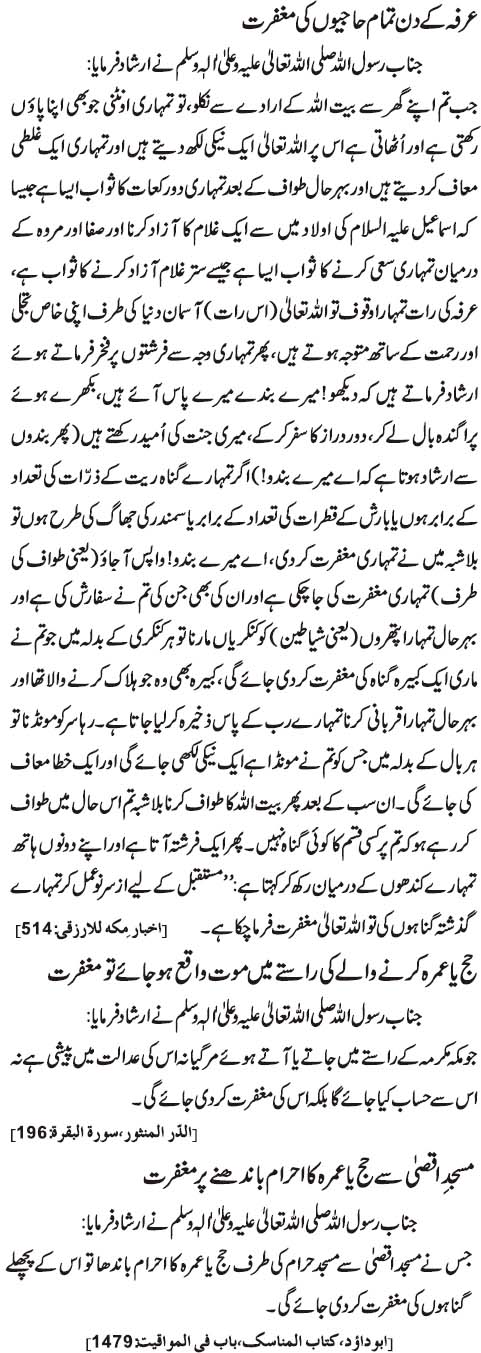
Arfa Kay Din Hajion Ki Maghfirat, Hajj Ya Umrah Kerne Wale Ki Agar Raste Mei Moat Ho Jae Tu Maghfirat, Masjid Aqsa Say Hajj Ya Umrah Ka Ihram Bandhne Par Maghfirat
TAG: Al-Aqsa Mosque
Masjid Al Aqsa Mein Namaz Parhne Par Maghfirat
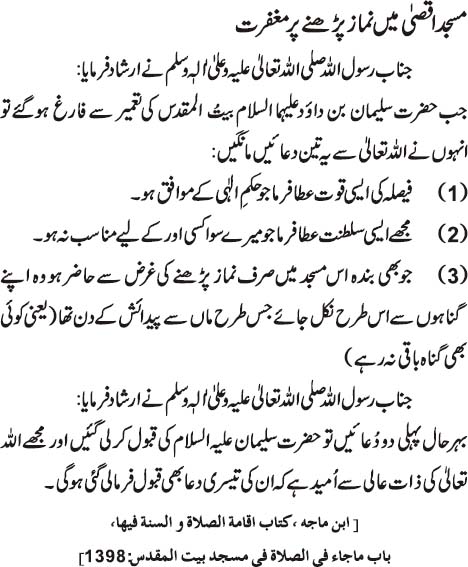
Masjid Al Aqsa Mein Namaz Parhne Par Maghfirat
The Prophet’s Night Journey: Incidents And Significance
AS far as the issue of the Prophet’s (peace be upon him) night journey (Al-Israa’ and Al-Mi’raj) is concerned, we’d deal with it from the following dimensions:
1. Its time and incidents
As for its exact date, it is still controversial and no consensus has been reached. However, the majority of scholars are in favor of a date between 16-12 months prior to the Prophet’s (PBUH) migration to Madina.
It was during this period that the Prophet (PBUH) was made to undertake a night journey from the Kaaba to Al-Masjid Al-Aqsa in Jerusalem. Then he was borne to the celestial regions where he witnessed the seven Heavens, met the Prophets (of yore and saw the remarkable signs of divine majesty about which the Qur’an says: “The sight (of Prophet Muhammad, peace be upon him) turned not aside (right or left) nor it transgressed beyond the limit (ordained for it). Indeed he (Muhammad, peace be upon him) did see of the Great Signs, of his Lord.”(Surah 53: 17-18)
The occurrence of the event at that time was meant to confer honor upon the Prophet (PBUH). It signified something like viands of higher regale in order to console and alleviate the feelings of distress caused to him by the persecution of the pagans at Taif. After the incident of Al-Israa’ and Al-Mi’raj, the Prophet (PBUH) told the people about his nocturnal journey, but the Quraysh mocked him and shook their heads in disbelief stating that it was inconceivable and beyond the bounds of reason. When Abu Bakr (Allah be pleased with him) saw the Quraysh accusing the Prophet (PBUH) of falsehood, he said, “What makes you wonder about it? If he said this, then it must be true. By Allah, he tells me that the revelation is sent down to him from Heaven in a flash or in an instant during the day or night and I believe him. This is even more unimaginable and difficult than what seems to astound you.”
2. Real significance of Al-Israa’ and Al-Mi’raj
The journey of Al-Israa’ and Al-Mi’raj did not occur in a routine or ordinary run of things. It was only to demonstrate the profound phenomena of the Kingdom of Allah in the Heavens and the earth to the Prophet (PBUH) of Islam. More than that, such a prophetic journey of tremendous importance alludes to a number of other significant and complex realities of far-reaching concern to humanity.
The two Qur’anic chapters (Surahs) of Al-Israa’ and An-Najm revealed in connection with this Heavenly journey indicate that Muhammad (peace be upon him) was charged with the office of prophethood for both the Houses of Allah, those in Jerusalem and Makkah, and was sent as the leader of the East and the West or the entire human race until the end of time.
As the inheritor of all the Prophets (peace be upon them all) of old, he represented the fulfillment and consummation of mankind’s religious development. His nightly journey from Makkah to Jerusalem expresses, in a figurative way, that his personality conformed and alluded to the oneness of Al-Masjid Al-Haram at Makkah and Al-Masjid Al-Aqsa at Jerusalem. That all the Prophets (peace be upon them all) arrayed themselves behind him in Al-Masjid Al-Aqsa shows that the doctrine of Islam, preached by him, was final, universal and all-comprehensive, meant for every class and section of human society throughout the ages.
The event is, at the same time, indicative of the comprehensiveness of the prophethood of Muhammad (PBUH) and the place accorded to his followers in the great task of humanity’s guidance and the distinctive character of his message.
Frankly speaking, the incident of Al-Israa’ and Al-Mi’raj represents a demarcation line between the regional, limited, and variable rules of divine guidance entrusted to the Prophets of old and the global, comprehensive, and abiding principles of faith conferred on the universal leader of the human race. Had the Prophet (peace be upon him) been a sectional or regional guide, a national leader, the savior of any particular race or the restorer of the glory of any particular people, there would have been no need to honor him with the ascension to the Heavens nor would he have been required to perceive the hidden phenomena of the Heavens and the earth. Nor would it have been necessary to create a new link between the celestial and the earthly boundaries of the Divine Kingdom; in that case, the confines of his own land, his surroundings environs, and the times would have been sufficient enough and there would have been no need for him to divert his attention to any other land or country. Neither his ascension to the most sublime regions of the Heavens and to the “Lote-Tree of the Farthest Limit” or even the nocturnal journey to the far-away Jerusalem, then in the grip of the powerful Christian Empire of Byzantium, would have been necessary at all.
The Journey of Al-Israa’ and Al-Mi’raj of the Prophet (PBUH) was a divine proclamation that he had nothing to do with the category of national or political leaders whose endeavors are limited to their own country and nation, for they serve the nations and races to which they belong and a product of their time, they serve the need of a particular juncture. The Prophet (PBUH) of Islam, on the contrary, belonged to the luminous line of the Messengers of Allah (peace be upon them all) who communicate the inspired message of Heaven to the earth. They are links between Allah and His creatures.
3. The prescription of prayer
On this occasion, Allah made 50 prayers a day obligatory for the Prophet (PBUH) and his followers. The Prophet (PBUH) constantly implored Allah for the reduction of the prayers until the Lord was also pleased to limit these to only five times daily. The Lord was also pleased to declare that whoever properly performs these five-times daily prayers would be recompensed for all the 50 daily prayers enjoined earlier.
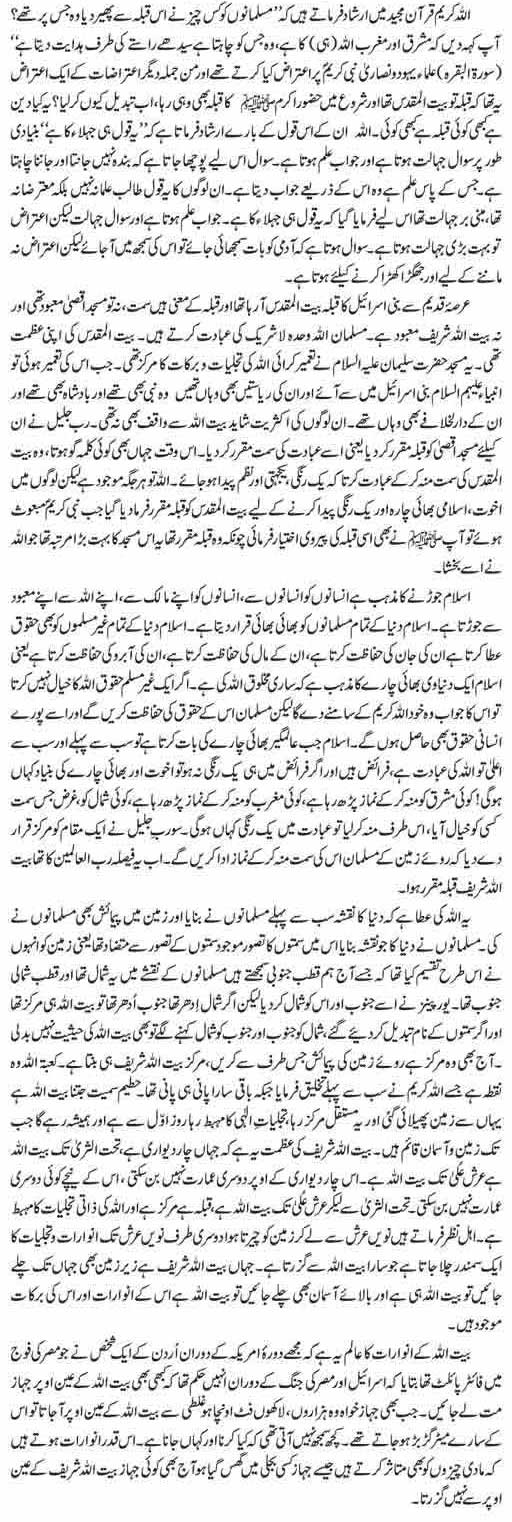
Bayt Allah Dunya Ka Markaz
Al-Isra’: The Prophet’s Unique Journey
GLORIFIED (and Exalted) is He (Allah) Who took His slave (Muhammad, peace be upon him) for a journey by night from Al-Masjid Al-Haram [at Makkah] to Masjid Al-Aqsa [in Jerusalem], the neighborhood whereof We have blessed, in order that We might show him (Muhammad, peace be upon him) of Our Ayat (proofs, evidence, lessons, signs, etc). Verily, He is the All-Hearer, the All-Seer. (17:1)
Surah Al-Israa’ begins with glorifying Allah, the most fitting action to confirm the bond between Allah and His servants in the atmosphere of compassion and friendliness imparted by the mention of the night journey. The Surah emphasizes the position of man as Allah’s servant. The emphasis here is needed in the context of the Prophet’s ascension to heaven where no human being had gone before.
It is important in this context that the status of man’s servitude to Allah should always be remembered.
There must be no confusion of status similar to that which happened in the case of Jesus on account of his birth, his being raised to heaven at the end of his life on earth, and the powers that were given to him during life. All these caused some people to confuse his status and to claim that he had a divine nature. In its simplicity and purity, Islam insists that no similarity could ever exist between Allah and any creature.
The Arabic text of this opening verse uses the verb Asra, which denotes “traveling during the night.” It is sufficient then to use this verb to denote the time of the action. Yet the verse adds the word laylan or “by night” to give an added sense of the still night and the ease of travel.
The journey from the Grand Mosque to Al-Aqsa Mosque was one chosen by Allah, the Compassionate Who knows everything. It provided a link between all monotheistic faiths from the time of Abraham and Ishmael to the time of the last Prophet, Muhammad (peace be upon them all). It also established a link between the holy places in all these religions. It seems that this unusual journey served as an announcement that the Last Messenger was the heir to the heritage of all former Messengers. His message staked a claim to all these holy places. Thus it becomes a journey that goes beyond the scope of time and place.
The opening verse describes Al-Aqsa Mosque as one with blessed environs. This description shows the blessings surrounding the mosque and flowing in abundance. This impression could not have been given with a direct description such as “the mosque which We have blessed.”
This is another example of the refined use of language characteristic of the Qur’an.
The Prophet’s night journey was a telling sign, and it was accompanied by others, as the opening verse says in stating its purpose : “…. in order that We might show him of Our Ayat…”. Covering the distance between the Grand Mosque in Makkah and Al-Aqsa Mosque in Jerusalem in a very short period that did not allow the Prophet’s bed to become cold is a sign of Allah’s power, whatever the means used to accomplish it. It opens our minds to new horizons in the universe and reveals latent potentials within mankind.
It shows that those human beings chosen by Allah to be the bearers of His message have the latent ability to receive whatever greater powers He wishes to give them. It is Allah Who has honored man, giving him a favored position among His creation, and endowed him with such potentials.
“Verily! He is the All-Hearer, the All-Seer.” He indeed hears and sees all that is beyond the reach of our hearing and seeing faculties.
It is especially impressive that the opening verse of this Surah starts with glorifying Allah: “Glorified (and Exalted) is He (Allah) Who took His slave for a journey by night.”
After defining the purpose of this journey, the Surah finishes with highlighting two of Allah’s attributes, perfect hearing and seeing that encompass all things.
This quick movement across purposes reflects the finest points of the expression used. The glorification is addressed to Allah Himself, and the statement about the purpose of the night journey comes from Him, while the description of Allah’s powers is made in the form of an indisputable statement. All these forms are combined in one verse so as to give their different imports.
Al-Israa’ and Al-Mi’raj: Everlasting Lessons
ONE of the most important lessons of the journey of Al-Israa’ and Al-Mi’raj (Night Journey and Ascension) is that it highlights the high status that Al-Aqsa Mosque has in the Muslim Ummah. It was to Al-Aqsa Mosque that the Night Journey of the Prophet (peace be upon him) was made and it was from it that the Prophet’s ascension to the Heavens took place.
The journey of Al-Israa’ was a sign that the leadership of the world would pass on to the Muslim Ummah. Such leadership was based on mercy and justice, not on oppression and aggression.
Another significant lesson of Al-Israa’ and Al-Mi’raj is knowing the importance of prayer; it is through prayer that one can directly communicate with his Almighty Lord.
Al-Israa’ was a land-to-land journey that Allah Almighty caused His Prophet (peace be upon him) to make from Makkah to Jerusalem, that is, from Almighty Allah’s Sacred House to Al-Aqsa Mosque.
Mind that Allah Almighty had blessed Al-Aqsa Mosque and its neighborhood and referred to it even before the Prophet’s Mosque was built, as the Prophet’s Mosque was established after his immigration to Madina.
Mind also that when prayer was ordained on the Muslims, Al-Aqsa Mosque was the Qiblah to which they were to turn during prayer. They would turn their faces in prayer toward it for three years in Makkah, and for 16 months in Madina before the Qiblah was changed to Allah’s Sacred House.
Besides, Al-Aqsa Mosque is one of the three mosques to which Muslims are to dedicate time for visiting; the other two mosques are the Sacred Mosque in Makkah and the Prophet’s Mosque in Madina. Allah Almighty wanted to establish and emphasize the significance and sacredness of Al-Aqsa Mosque in Muslims’ hearts so that they do not cede it for anything. They are to hold it as sacred as both Allah’s Sacred House and His Prophet’s Mosque.
That was why the Muslims [when they were strong] were zealous to keep Al-Aqsa Mosque under their rule and protection.
Hence, Muslims must realize the importance of Jerusalem in their history and the significance of Al-Aqsa Mosque in their religion and life.
Allah Almighty wills that we remember the importance of Al-Aqsa Mosque when we celebrate the anniversary of Israa’ and Mi’raj.
This is to remind us of the gravity of the circumstances in which Al-Aqsa Mosque is in this age. We must not give up our responsibility in defending Al-Aqsa Mosque and Jerusalem. This is a sacred issue to fight for. Brothers and sisters, we should not, under any circumstances, give up our duty in that regard.
We must believe that Allah Almighty is with us and that He will grant us victory and make Islam prevail, as He, Most High, always supports the true believers.
The second most important lesson that we are to learn from Israa’ and Mi’raj is concerning prayer (Salah). It is known that prayer was ordained on that great night.
It is because of the great importance of prayer that Allah Almighty ordained it in Heaven. Allah sent for His Messenger (pbuh) to mankind and caused him to go on a night journey and ascend to Heaven and the Lote Tree to inform him (peace be upon him) of the command of prayer.
Mind that all other commandments were decreed on the earth. This indicates how important prayer is in Islam. It symbolizes ascension to Heaven; it is the Muslim’s spiritual ascension to Heaven. Thus, prayer is the gift that the Prophet (pbuh) brought with him from that journey for all Muslims so that they can worship Allah Almighty through it.
Prayer therefore has much to do with Al-Aqsa Mosque. Al-Aqsa Mosque was the first Qiblah in Islam. If it is true that Israa’ took place in the tenth year of the Prophet’s mission, this would mean that the Muslims’ Qiblah in prayer was toward Al-Aqsa Mosque for three years before the Hijrah to Madina and 16 months after it.
The Jews spread rumors that the Muslims’ prayer [to the first Qiblah] was invalid and so would not be rewarded. Allah Almighty refuted their claims as He, most High, says: (And We appointed the Qiblah, which you formerly observed only that We might know him who follows the Messenger from him who turns on his heels. In truth it was a hard (test) save for those whom Allah guided. But it was not Allah’s purpose that your faith should be in vain, for Allah is full of pity, Merciful toward mankind.)
To sum up, prayer is the spiritual means through which Muslims can ascend to their Lord. If the Prophet (pbuh) ascended to Heaven (once), we, brothers and sisters, could spiritually ascend to that as much as we can through prayer.
Allah Almighty says in a Qudsi (divine) Hadith : “I have divided the prayer into two halves between Me and My servant, and My servant will receive what he asks for. When the servant says, ‘Praise be to Allah, the Lord of the universe,’ Allah the Most High says, ‘My servant has praised Me.’ And when he (the servant) says, ‘The Most Compassionate, the Merciful,’ Allah the Most High says, ‘My servant has lauded Me.’ And when he (the servant) says, ‘Master of the Day of judgment,’ He Almighty remarks, ‘My servant has glorified Me.’ And when he (the worshiper) says, ‘Thee do we worship and of Thee do we ask help,’ He Almighty says, ‘This is between Me and My servant, and My servant will receive what he asks for.’ Then, when he (the worshiper) says, ‘Guide us to the straight path, the path of those to whom You have been Gracious not of those who have incurred Your displeasure, nor of those who have gone astray,’ He (Allah Almighty) says, ‘This is for My servant, and My servant will receive what he asks for.'”
The Exalted Status Of Al-Aqsa Mosque
AL-AQSA is the first Qiblah (direction of prayer) of Muslims, and the land of Al-Israa’ and Al-Mi’raj. Our hearts bleed for all the sacrilegious acts been perpetrated against Al-Aqsa. The status of Al-Aqsa is clearly explained in the Hadith that reads: “People are not to travel except to three mosques: The Sacred Mosque (in Makkah), Al-Aqsa Mosque (in Jerusalem), and my Mosque (in Madinah).” (Reported by Muslim)
The city of Jerusalem was chosen at the command of Allah by Prophet Dawud (David, peace be upon him), in the 10th century B.C. After him his son Prophet Sulayman (Solomon, peace be upon him) built a mosque in Jerusalem according to the revelation that he received from Allah. For several centuries this mosque was used for the worship of Allah by many Prophets and Messengers. It was destroyed by the Babylonians in the year 586 B.C., but it was soon rebuilt and was rededicated to the worship of Allah in 516 B.C.
It continued afterwards for several centuries until the time of Prophet Isa (Jesus, peace be upon him). After he departed this world, it was destroyed by the Romans in the year 70 C.E. Prophet Muhammad (peace be upon him) was taken there in his miraculous journey of Al-Israa’ and from there he went for Al-Mi’raj. When Muslims took the city of Jerusalem in 636 C.E. during the caliphate of Umar he ordered for the building of this mosque again and it stands until now as a Masjid for the worship of Allah as it was originally built by our Prophet Sulayman (peace be upon him).
The significance of Jerusalem is that it is the city of many Prophets of Allah as Makkah is the city of Prophets Ibrahim (Abraham), Isma’il (Ishmael) and Muhammad (peace be upon all of them). The Mosque of Al-Aqsa is one of the ancient mosques and in the Qur’an Allah called it and its land “… the neighborhood whereof We have blessed…” (17: 1)
When Prophet Muhammad (peace be upon him) was in Makkah and also for about 17 months after his Hijrah to Madinah, he and his followers used to pray toward the direction of Al-Aqsa Mosque. This was to establish in the minds of Muslims the link between the teachings of Prophet Muhammad and other Prophets of Allah (peace be upon them all). When this principle was established in their minds then Allah ordered Muslims to turn to the Ka’bah and pray toward its direction.
Now, we are not allowed to pray to the direction of Jerusalem and Al-Aqsa Mosque, but we must respect and honor the city of Jerusalem and its blessed mosque. It is also the duty of all Muslims to guard and protect this mosque from any harm and damage, for the mosque belongs to those who believe in all the Prophets and Messengers of Allah.
Israa And Miraaj
Israa and Miraaj – Dr. Bilal Philips
Masjid Al-Aqsa and The Dome of the Rock
Israa literally means a journey by night and Miraaj literally means an elevator, i.e., an instrument which lifts something up.
But, in Islaam, Israa refers to a miraculous night journey made by the last Prophet (sallallaahu alayhi wa sallam) from Makkah to Jerusalem, and Miraaj refers to the vehicle which took the Prophet (sallallaahu alayhi wa sallam) from Jerusalem, up and out of the universe, through the seven heavens, and into the direct presence of Allaah.
Towards the end of a calm night, one year before the Hijrah, the roof of Prophet Muhammad’s (sallallaahu alayhi wa sallam) house split open and angel Jibreel (Gabriel) descended into the Prophets (sallallaahu alayhi wa sallam) room. He went over to the Prophet (sallallaahu alayhi wa sallam), opened his shirt, and cut open his chest.
He then removed his heart and washed it inside with Zam Zam water. After he had completed washing it, he then brought a gold dish filled with Eemaan (faith) and Hikmah (wisdom), emptied it into the Prophets (sallallaahu alayhi wa sallam) chest, and then closed it all up.[1]
Jibreel then nudged the Prophet (sallallaahu alayhi wa sallam) until he awoke. When the Prophet (sallallaahu alayhi wa sallam) got up, Jibreel took a hold of his hand and lead him outside of his house to the gate of Kabah.
There the Prophet (sallallaahu alayhi wa sallam) found a strange unearthly animal. It was smaller than a mule but larger than a donkey, white in color and having a wing on either of its hind legs. He was informed that its name was Buraaq, a name taken from the Arabic word Barq which means a flash of lightning.
Jibreel helped the Prophet (sallallaahu alayhi wa sallam) mount it and they set off to the north. Each stride of the Buraaq took it to the horizon, and, in no time they reached Jerusalem. There the Prophet (sallallaahu alayhi wa sallam) dismounted and tied the animal to the same ring on the door of al-Masjid al-Aqsa used by the prophets.
The Prophet (sallallaahu alayhi wa sallam) entered the Masjid and prayed two Rakahs. When he finished he noticed a group of other prophets also making Salaah there. He saw among them Prophet Moosaa, Prophet Eesaa, and Prophet Ibraaheem.
Prophet Muhammad (sallallaahu alayhi wa sallam) was then told to lead them all in Salaah. When the Prophet (sallallaahu alayhi wa sallam) finished this Salaah, someone said to him, This is Maalik, the guardian of the Hellfire, so give him Salaams. When he turned around to greet him, the angel gave him Salaams before he had time to do so.[2] Jibreel then brought two vessels and presented them to the Prophet (sallallaahu alayhi wa sallam). One was filled with wine and the other was filled with milk. The Prophet (sallallaahu alayhi wa sallam) chose the vessel filled with milk and drank from it.
Jibreel then said You have been guided to the Fitrah.[3]