

TAG: Eid prayer
The Day Of Eid-ul-Adha
The Day of Eid ul Adha (Day of Sacrifice) is an important occasion celebrated by Muslims globally on the 10th of Dhul Hijjah to honor the willingness of Ibrahim (Abraham)(peace be upon him) to sacrifice his son Ismael (Ishmael)(peace be upon him) as an act of obedience to Allah Ta’ala before Allah Ta’ala intervened to provide him with a ram to sacrifice instead.
It reminds us how obedience to our Lord Allah Ta’ala is the answer to everything. This means surrendering your life, your whole being, all that you are, all that you have, and all that you identify with to and only for Allah Ta’ala.
When you sacrifice everything that you identify with to Allah Ta’ala, He gives to you your authentic and eternal self. That is the spiritual secret so many of us seek. Both Eid-ul-Adha and Hajj serve as special occasion that definitely gets one in touch with this secret.
Eid-ul-Adha is a day on which a Muslim should bring himself or herself even closer to Allah Ta’ala by means of doing good deeds such as Prayers, Qurbani(sacrifice), caring for the poor and the needy, visiting the sick people, helping those who are in need and refraining from evil practices such as harming people and severing ties of kinship.
In short, `Eid Al-Adha is a model for the Muslim community which maintains love, care, brotherhood and sisterhood, beauty, and solidarity. `Eid has significant social, educational, devotional, and spiritual messages that Muslims should grasp and translate into a complete way of life.
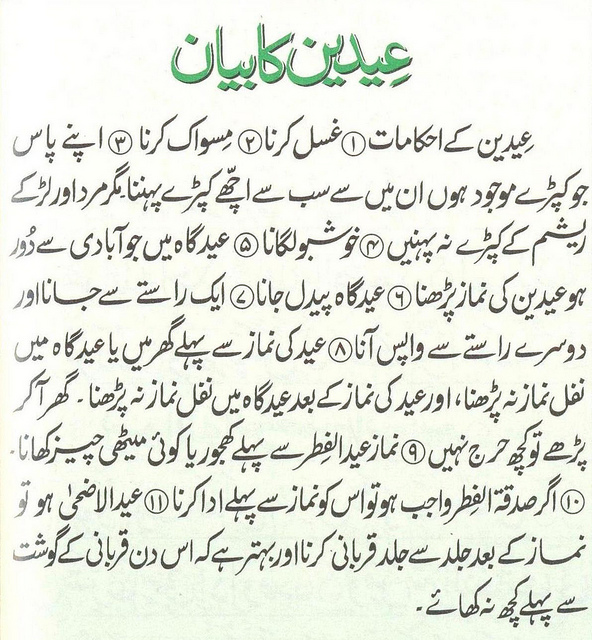
Excellence Of Eidayn And Method Of Performing The Eid Prayer
I. Hadrat Anas reported that when the Holy Prophet came to Madinah, the people had two days in which they used to entertain and amuse themselves. He asked: What are these two days? They said: We used to amuse ourselves and take pleasure in these two days during the Days of Ignorance (jahiliyyah). The Messenger of Allah said Allah has substituted for you something better than these two; the Eid of Adha (sacrifice) and the Eid of Fitr. [Sunan Abi Dawood – Book on Prayer, Vol 1, Page 162]
II. Hadrat Abu al-Huwairith reported that the Messenger of Allah wrote to Hadrat Amr ibn Hazm, when he was in Najran, asking him to observe the prayer early on the Eid of Adha (sacrifice) and late on the Eid of Fitr, and admonish the people. [Mishkaat – Book on Prayer, Vol 1, Page 127]
III. Hadrat Jabir ibn Samurah reported, I prayed with the Messenger of Allah the two Eid prayers more than once or twice, without an Adhan or Iqamah. [Sahih Muslim – Book on the two Eid Prayers, Vol 1, Page 290]
IV. Hadrat Anas reported that the Messenger of Allah did not go (to the place of prayer) in the morning on the day of Eid-ul-Fitr till he ate some dates, and he used to eat an odd number. [Sahih Bukhari – Book on the two Eid Prayers, Vol 1, Page 130]
V. Hadrat Buraidah reported that the Holy Prophet did not go out on the day of Eid-ul-Fitr till he had eaten some food; and that he did not eat any food on the day of Eid-ul-Adha (sacrifice) till he had prayed. [Sunan Tirmidhi – Book on the two Eid Prayers, Vol 1, Page 120]
VI. Hadrat Jabir reported that on the day of Eid the Holy Prophet used to return by a different route from the one he had taken when going out. [Sahih Bukhari – Book on the two Eid Prayers, Vol 1, Page 134]
Important Notes:
1. To greet, embrace and shake hands with one another, after the Eidayn prayer is an act of reward; which is also a means of increasing love and affection between Muslims and a way of expressing one’s joy and happiness.
2. It is not permissible for females to perform the Eidayn prayers, as there shall be mixing between the men and the women in the Eidgah (the place where the Eid prayer is performed). This is why it is not permissible for females to go to the Masajid to perform salaah with the congregation; whether they go in day or at night; whether for Jum’ah or for Eidayn; whether they are old or young. [This has been stated in Tanwir al-Absar and al-Durr al-Mukhtar Page 114]
Yes, however, before Zawal women can perform the 2 or 4 rak’ats Chasht (Salatud Duha) prayer at home after the Eidayn prayer has finished. [Bahar-e-Shariat Vol. 1, Chapter 4, Page 94]
3. If only the women have their own congregation for salaah, then this is also not permissible, as the congregation held by women between themselves (to perform salaah) is not allowed, in fact, it is strictly disliked (Makruh-e-Tehrimi). [This has been stated in Fatawa-e-Alamgiri Vol. 1 Page 80, also in al-Durr al-Mukhtar Page 77]