
TAG: Eid
Surah Al-Maidah Kay Fazail

How To Do Eid-ul-Adha Prayer
Eid is a special occasions and one of the things which makes it so is the Eid-ul-Adha congregational prayer.
Since this prayer comes only once a year, there is often confusion about how to perform this prayer. Here is how to do it:
In general, when praying any Salah, always follow the Imam in prayer. Do not make your movements (i.e. bowing, prostrating, etc.) before he does or different from him.
Eid prayer consists of two units (Rakat in Arabic, singular is Raka). The main difference in the way this prayer and any other prayer of two Rakat is performed is the number of Takbirs that are done.
Takbirs is an the Arabic word referring to when “Allahu Akbar” is said and the hands are raised to the ears.
Step 1: Make an intention of doing two Rakat behind the Imam for Eid prayer along with six additional Takbirs.
The First Raka
Step 2: After the Imam has said “Allahu Akbar” the first time, you should raise your hands and follow. This is the first Takbir of the prayer.
Step 3: There will be 3 Takbirs before the Imam starts reciting Quran. Each time the Imam says “Allahu Akbar”, you should follow by raising your hands, then putting them on your sides.
After the third Takbir, the Imam will begin reciting the Quran. At that point, you should put your hands below the navel (or on your chest), with your right hand on top of the left.
Step 4: Listen to the recitation of the Holy Quran. The Imam will recite Surah Al Fatiha (the first Surah of the Quran) and then another Surah.
Step 5: When the Imam says “Allahu Akbar” go into Ruku (the bowing position).
Step 6: Stand up straight when he says Sami Allahu liman Hamidah (Allah hears those who praise Him), and say “Rabbana lakal Hamd” (our Lord praise be to You) in a low voice.
Step 7: When the Imam says “Allahu Akbar” go into Sujud (prostration). You will do two prostrations as in normal prayer.
The Second Raka
Step 8: The Imam will first recite from the Holy Quran (first Surah Al Fatiha and another Surah.
Step 9: After the recitation, before going into Ruku, there will be 3 Takbirs. Follow the Imam. Raise your hands after each “Allahu Akbar”. After the third Takbir, go into Ruku (the bowing position).
Step 10: Stand up straight when the Imam says Sami Allah huliman Hamidah, and say “Rabbana lakal Hamd” in a low voice.
Step 11: When the Imam says “Allahu Akbar” go into Sujud. You will do two prostrations.
Step 12: After this, you sit for the complete Tashshahud.
Step 13: After the Imam ends the prayer by turning to his face to the right first and saying “Assalamu alaikum wa Rahmatullah” and then to his left and doing the same, you should follow.
Step 14: Do not get up right away. The Imam will give a short Khutbah (speech). Please stay still and listen. It is recommended to do so.
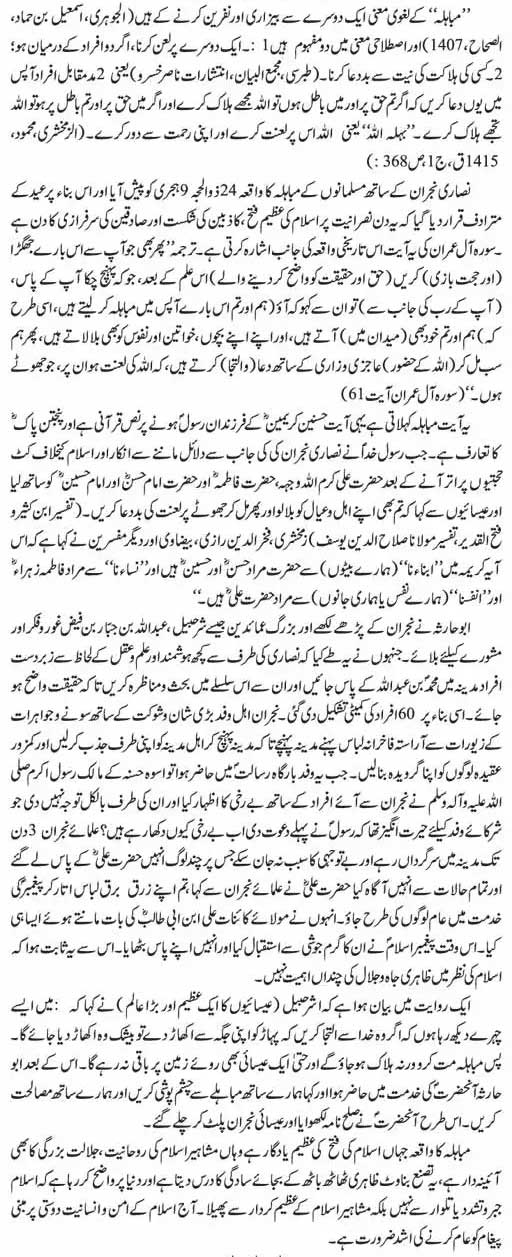
Youm-E-Mubahila

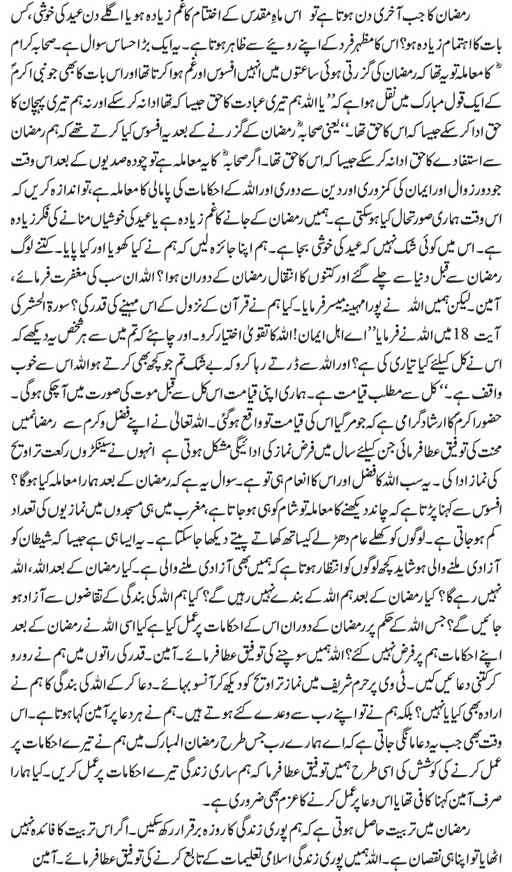
Ramadan Ke Baad Ki Zindgi

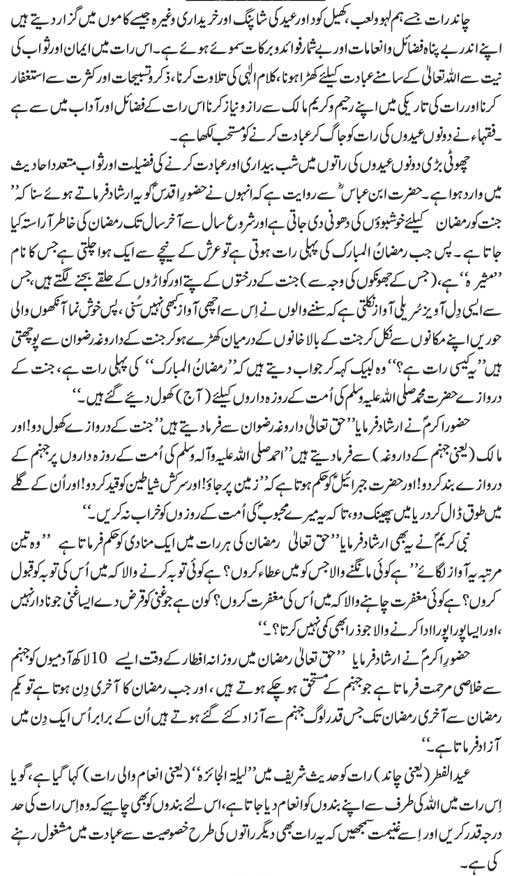
Eid Ka Maqsad
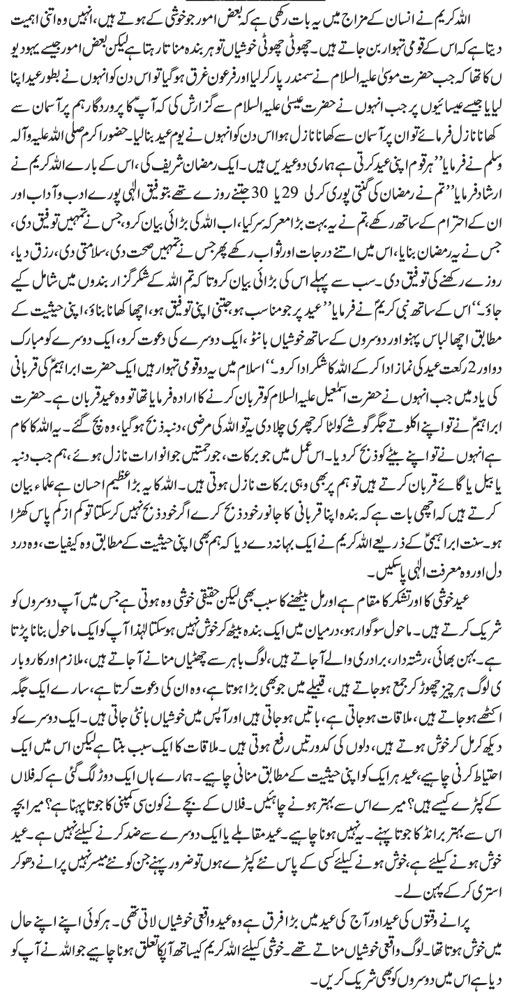
What Should One Do On EID Day
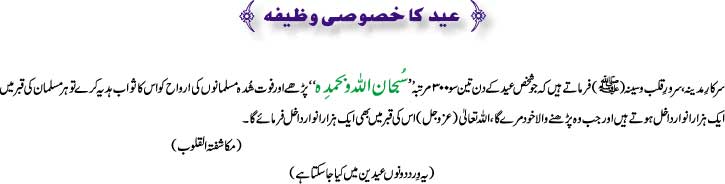
Our beloved Prophet say “The person who say Subhan-Allah-e-wa-bai Hamdehe 300 times on Eid day & conveying reward of this virtuous deed to all Muslims who have been died, then Allah will gave one thousand lights (Anwaar) in the grave of every Muslims and after death the person who say will also revive one thousand lights (Anwaar)”. (Mukashifat-alquloob by Imaam Ghazali)
EID MUBARAK
Anas (RA), a companion of prophet Muhammad (peace be upon him) reported that when the Prophet Muhammad (PBUH) migrated from Makkah to Madinah, the people of Madinah used to have two festivals. On those two days they had carnivals and festivity. Prophet Muhammad (PBUH) asked the Ansaar (the Muslims of Madinah) about it. They replied that before Islam they used to have carnivals on those two joyous days. The Prophet Muhammad (PBUH) told them: ‘Instead of those two days, Allah has appointed two other days which are better, the days of Eid-al-Fitr and Eid-al-Adha.’ (Hadith)
EID-UL-FITR is celebrated on the first day of Shaw’waal, at the completion of Ramadan. Shaw’waal is the 10th month of the Islamic calendar. The Eid-al-Fitr is a very joyous day; it is a true Thanksgiving Day for the believing men and women. On this day Muslims show their real joy for the health, strength and the opportunities of life, which Allah has given to them to fulfill their obligation of fasting and other good deeds during the blessed month of Ramadan.
Sunnah of Eid
- Wake up early.
- Prepare for personal cleanliness, take care of details of clothing, etc.
- Take a Ghusl (bath) after Fajr.
- Brush your teeth.
- Dress up, putting on best clothes available, whether new or cleaned old ones.
- Use perfume (men only).
- Have breakfast on Eid-al-Fitr before leaving for prayer ground. On Eid-al-Adha, eat breakfast after
Salaat or after sacrifice if you are doing a sacrifice. - Pay Zakaat-al-Fitr before Salaat-al-Eid (on Eid-al-Fitr).
- Go to prayer ground early.
- Offer Salaat-al-Eid in congregation in an open place except when whether is not permitting like rain, snow,
etc. - Use two separate route to and from the prayer ground.
- Recite the following Takbir on the way to Salaat and until the beginning of Salaat-al-Eid:
Allaho-Akber, Allaho-Akber. La ila-ha ill-lal-lah. Allaho-Akber, Allaho-Akber. Wa-lilahill hamd.(Allah is great, Allah is great. There is no god but Allah. Allah is great, Allah is great. And all praises
are for Allah).
How to offer Eid prayer:
Ibn Abbass (RA) reported: ” I participated in the Eid-ul-Fitr prayer with the Messenger of Allah (saw), Abu Bakr (RA), Umar (RA) and Uthman (RA), and all of them held Eid prayer before Khutbah, and then the
Prophet Muhammad (saw) delivered the Khutbah (sermon).” ( Muslim )
Who should go to the prayer ground & offer Eid Prayer:
Umm Atiyah (RA) reported: “The Messenger of Allah (saw) commanded us to bring out on Eid-al-Fitr and
Eid-al-Adha, young women, hijab-observing adult women and the menstruating women. The menstruating women stayed out of actual Salaat but participated in good deeds and Duaa (supplication). I (Umm Atiyah) said to the Holy Prophet (saw): Oh! Messenger of Allah, one does not have an outer garment. He replied: Let her sister cover her with her garment.” ( Muslim )
On the Eid day, every believing man, woman and child must go to the prayer ground and participate in this
joyous occasion.
Structure of Eid prayer:
Eid prayer is wajib (strongly recommended, just short of obligatory). It consists of two Rakaat (units) with
six additional Takbirs. It must be offered in congregation. The prayer is followed by the Khutbah.
(Note from Maqsud: Eid prayer is sunnah according to other Fiqahs, only Hanafi consider it as wajib)
The Khutbah is part of the worship and listening to it is Sunnah. During the Khutbah, the Imam must remind
the community about its responsibilities and obligations towards Allah, fellow Muslims and the fellow human beings. The Imam must encourage the Muslims to do good and ward off evil. The Muslim community must also be directed to the state of the community and the Ummah at large and the feelings of sacrifice and Jihaad should be aroused in the community. At the conclusion of the prayer the Muslims should convey greetings to each other, give reasonable gifts to the youngsters and visit each other at their homes. Muslims should also take this opportunity to invite their non-Muslims neighbors, co-workers, classmates and business acquaintances to Eid festivities to expose them to Islam and Muslim culture.
Nine Reasons Why We Must Plan For Ramadan
Have you noticed that each year, Ramadan goes by faster and faster?
This blessed month can’t be left to become a blur in our memories. It has to be more than that time of the year we squeeze in fasting amongst the other things we do daily.
One way to make the most of Ramadan is to plan beforehand. Here are ten reasons why you should plan for Ramadan:
Reason #1: To be in “Ramadan mode”
By planning for Ramadan before it arrives, you put your mind in “Ramadan mode”. If you plan, you will mentally prepare for it, and it will force you to see it as the special month it is outside of your regular routine the rest of the year.
Reason #2: To adjust your schedule
By planning in advance, you can adjust your work, sleep and meal schedules in such a way as to make time for Suhoor, Iftar, etc. That means, for instance, that if you normally go to bed at midnight, in Ramadan you would sleep earlier in order to get up early for Suhoor. Or if you usually study late, you can instead sleep earlier and start studying after Suhoor in the early morning hours. Planning in advance allows you the luxury to make time for the change in schedule that Ramadan brings.
Reason #3: You can plan Ramadan family time
Is dinnertime usually an individual affair in your home, as opposed to a time the whole family eats together? Are Friday evenings the time every family member goes off to his/her own social activities? Planning in advance can change this at least in Ramadan. Calling a family meeting about a month in advance, explaining the importance of Ramadan, its implications for the family and the need to eat Iftar together when possible as well as to attend Tarawih prayers, for example, will allow all family members to adjust their work and school schedules accordingly. That will, Insha Allah, make Ramadan a blessing not just to every person in the family, but to the family as a whole.
Reason #4: To make the menu
While Ramadan may mean extra Ibadah to some of the brothers, it usually means extra cooking for most of the sisters. Ramadan’s blessings are for men and women. Making a Ramadan menu for Iftar and meals, and working out when you want to invite relatives, neighbors and friends for Iftar will give sisters the opportunity to catch Tarawih and various other advantageous Ibadat instead of spending Ramadan’s 29 or 30 days stuck in the kitchen. (And by the way, brothers, helping out with cooking or cleaning was a practice of the Prophet, peace and blessings be upon him-maybe this is a way you can increase your Sawab [rewards] this month).
Reason #5 : You can plan a Iftar at your home
You may have eaten fantastic Iftars at friends’ homes last year. This year, open your doors. There is blessing in feeding a fasting person other than yourself and your family. Planning in advance gives you the luxury of calling friends over the month before and setting a date, so you can “grab” them before others get an opportunity to. Muchos Sawab, Insha Allah!
Reason #6: To make a travel schedule
Do you know a fellow Muslim in your neighborhood who wants to get to the mosque for Tarawih every night but doesn’t have a car? Or do you look at your work schedule and realize you have to work overtime near the end of Ramdan, so your family will miss out on Tarawih at the mosque the last ten nights of Ramadan? Planning in advance helps you work out your daily or weekly travel schedule to attend Tarawih prayers at the mosque, or even a trip for Iftar at a friend’s place who may life farther away. It also helps ease the burden of transportation in winter. Maybe you can start a car pool? Since you have the time before Ramadan begins, you can work this out with neighbors and friends.
Reason #7: To do good at high Sawab times
Being generous is definitely an Islamic merit, but being generous in Ramadan is even more highly rewarded. Match Ibadat with specific times that carry more reward. Prepare to do Itifkaf, increase asking Allah for forgiveness in the last ten nights of Ramadan. Plan to give increased Sadaqa this month. Plan to visit that relative you may have not seen for months, if not years. Thinking about and arranging to do these things and finding other ways of gaining the pleasure of Allah in Ramadan will Insha Allah help you benefit more from it.
Reason #8: You can squeeze in Eid shopping
Planning in advance helps you think about all of those things you wanted to do in time for the end of Ramadan or Eid last year but couldn’t. Maybe you wanted to go Eid shopping for gifts for family and friends in the last week of Ramadan but were too busy with the last ten nights of Ramadan. No problem. This year, you decide to go in the third week of Ramadan instead.
Reason #9: You can plan Dawa activities during Ramadan
Some Muslims have gone to soup kitchens and made meals during Ramadan, while they were fasting. Not only will, Insha Allah, they be rewarded, but this is a great Dawa opportunity to explain what Ramadan and Islam are about. Planning in advance for such an activity gives you the time to call up a soup kitchen in your area, explain what you want to do, and get your act together. You can also plan school Dawa activities in Ramadan by planning in advance, by meeting with the principal or teacher beforehand, preparing a presentation, etc.
Qurbani

The Greatest Day – Today Is The Day Of Hajj
Today is the day of Hajj. The climax of the journey, which pilgrims have been waiting for months, or even years. The Prophet (peace be upon him) said, “Hajj is Arafah.” (An-Nasaa’i)
Religion completed
Allah perfected His religion and completed His favor upon us on this day.
A Jew came to Umar Ibn Al-Khattab (may Allah be pleased with him) and said, “O Ameer Al-Mu’mineen, there is a verse in your Book which you recite; if it had come to us Jews, we would have taken that day as an Eid (festival).” Umar said, “Which verse?” He said:
“This day, I have perfected your religion for you, completed My Favor upon you, and have chosen for you Islam as your religion.” (Qur’an, 5:3).
Umar said, “We know on which day and in which place it was revealed to the Prophet (peace be upon him). It was when he was standing in Arafah on a Friday.”
Allah’s oath
Furthermore, Allah, Almighty, took an oath by the Day of Arafah in the Qur’an. Allah does not swear by anything except that it has a great virtue or importance.
“And by the witnessing day (i.e. Friday), and by the witnessed day (i.e. the Day of ‘Arafah)” (Qur’an, 85:3)
The Prophet (peace be upon him) said: “The promised day is the Day of Resurrection, the witnessed day is the Day of Arafah, and the witnessing day is Friday.” (Tirmidhi – classed as Saheeh by Al-Albani)
Fasting today
Fasting on this day is an expiation of sins of two years.
The Prophet (peace be upon him) was asked about fasting on the Day of Arafah. He said, “It expiates the sins of the previous year and of the coming year.” (Saheeh Muslim)
Fasting is recommended for those who are not performing Hajj. It is not Sunnah for the pilgrims to fast on the Day of Arafah, as the Prophet (peace be upon him) did not fast on this Day in Arafah. It was narrated that he forbade fasting on the Day of Arafah, while being in Arafah.
The covenant
Allah took the covenant from the progeny of Adam on the Day of Arafah.
The Prophet (peace be upon him) said: “Allah took the covenant from the loins of Adam in Na’maan, i.e., Arafah.
“And (remember) when your Lord brought forth from the Children of Adam, from their loins, their seed (or from Adam’s loin his offspring) and made them testify as to themselves (saying): ‘Am I not your Lord?’ They said: ‘Yes! We testify,’ lest you should say on the Day of Resurrection: ‘Verily, we have been unaware of this.’ Or lest you should say: ‘It was only our fathers afortime who took others as partners in worship along with Allah, and we were (merely their) descendants after them; will You then destroy us because of the deeds of men who practised Al-Batil (i.e. polytheism and committing crimes and sins, invoking and worshipping others besides Allah)?'” (Qur’an, 7:172-173)”
(Ahmad – classed as Saheeh by al-Albani)
There is no greater day than this and no greater covenant than this.
Freedom from Hell
Today is the day of forgiveness, freedom from the fire of Hell.
The Prophet (peace be upon him) said: “There is no day on which Allah frees more people from the Fire than the Day of Arafah. He comes close and expresses His pride to the angels, saying, ‘What do these people want?'” (Saheeh Muslim)
The Prophet (peace be upon him) said: “Allah expresses His pride to His angels at the time of Isha on the Day of Arafah, about the people of Arafah. He says, ‘Look at My slaves who have come unkempt and dusty.'” (Ahmad – classed as Saheeh by al-Albani