TAG: Haya
Valentine’s Day


Beauty, Virtue And Obligation Of Hijab
Our sisters in Islam are probably more enthusiastic in practicing and learning Islam than brothers. Women usually outnumber men in Islamic lectures and classes. They are active and may Allah reward them for their endurance. But sometimes they are not properly encouraged or guided when they begin to observe the Hijab. Perhaps she has reached the age of puberty and her Wali (guardian) has instructed her only without educating her about it. Perhaps she has recently reverted to Islam and her close sisters have told her of its obligation. A sister who does not truly know the excellence and virtue of Hijab will always remain envious of non-Muslim women. Why? Because they see them looking ‘beautiful’ for all to see. Hence, the Muslim woman then compares herself with them and feels ‘ashamed’ of her own Hijab.
This is, therefore, a reminder to our sisters about the superiority of Hijab. It is a reminder that Hijab will always reign supreme and that a true Muslim man will forever be dazzled by the beauty of the Muhijabah (woman who wears the Hijab).
Why Hijab?
1. Act of obedience
The Hijab is an act of obedience to Allah and to his Prophet (peace be upon him), Allah says in the Qur’an: “It is not for a believer, man or woman, when Allah and His messenger have decreed a matter that they should have an option in their decision. And whoever disobeys Allah and His Messenger, has indeed strayed in a plain error.” (Qur’an, 33:36)
After commanding men to lower their gaze, Allah said: “And tell the believing women to lower their gaze (from looking at forbidden things) and protect their private parts (from illegal sexual acts, etc) and not to show off their adornment except what must (ordinarily) appear thereof, that they should draw their veils over their Juyubihinna.” (Qur’an, 24:31)
Juyubihinna: Scholars have differed whether the veil cover of the body must include the hands and face or not. While some say it’s obligatory to cover the face and hands, others say it is recommended to do so.
2. Modesty
Allah made the adherence to the Hijab a manifestation for chastity and modesty. Allah says: “O Prophet! Tell your wives and your daughters and the women of the believers to draw their cloaks (veils) over their bodies (when outdoors). That is most convenient that they should be known and not molested.” (Qur’an, 33:59). In this verse there is an evidence that public display of a woman’s beauty is harmful to her. When the cause of attraction ends, the restriction is removed. This is illustrated in the case of elderly women who may have lost every aspect of attraction. Allah made it permissible for them to lay aside their outer garments reminding, however, that is still better for them to keep their modesty.
3. Purity and honor
Allah revealed us the Hikma (wisdom) behind the legislation of the Hijab: “And when you ask them (the Prophet’s wives) for anything you want, ask them from behind a screen, that is purer for your hearts and their hearts.” (Qur’an, 33:53)
The Hijab seeks greater purity for the hearts of believing men and women, because it screens the desires. Hijab blocks the sight, prevents Fitna and minimizes the chances of any ill thoughts and greed of sickened hearts.
“…Be not soft in speech, lest he in whose heart is a disease (of hypocrisy or evil desire for adultery, etc) should be moved with desire, but speak in an honorable manner.” (Qur’an, 33:32)
4. Shield
The Prophet (peace be upon him) said: “Allah, Most High, is Ha’yeii (Bashful), Sit’teer (Shielder). He loves Haya’ (Bashfulness) and Sitr (Shielding; Covering).” The Prophet (peace be upon him) also said: “Any woman who takes off her clothes in other than her husband’s house (to show off for unlawful purposes), has broken Allah’s shield upon her.”
Moreover, the Hijab fits the natural bashfulness as part of the nature of women.
5. Piety
Allah says in the Qur’an: “O children of Adam! We have bestowed raiment upon you to cover yourselves (screen your private parts, etc) and as an adornment. But the raiment of righteousness, that is better.” (Qur’an, 7:26) The widespread forms of dresses in the world today are hardly a cover and shield for the woman’s body. For Muslims dress is also an act of Taqwa (righteousness).
6. Gheerah (Sense of honor)Wome
Hijab also protects a man’s Gheerah. A normal man will not like others to gaze at his wife or daughter, because he is protective about them and has that feeling of protective jealousy. Gheerah is the emotion that drives a man to safeguard his womenfolk from strangers. A Muslim man has Gheerah for all Muslim women. But free intermingling of sexes and absence of Hijab destroys the Gheerah in men. Islam considers Gheerah an integral part of faith. The dignity of the wife or daughter or any other Muslim woman must be highly respected and defended.
Hazrat Usman Ghani (R.A)

Ishaat-e-Fahsha

Haya
Anas (RA) narrated: Allah’s Messenger (saw) said, “Every Deen has a distinctive quality, and the distinctive quality of Islam is Modesty.”
Abu Hurairah(RA) narrated: The Prophet (saw) said, “Iman (Faith) has more than sixty branches, and Al Haya (modesty) too is a branch of Iman.”
Abu Hurairah (RA) narrated : Allah’s Messenger (saw) said , “Modesty is from Iman and Iman leads to paradise and indecency is from the (useless) scum/froth and the (useless) scum/froth leads to the fire”
Salim bin Abdullah narrated from his father that once Allah’s Messenger (saw) passed by a man of the Ansaar who was admonishing his brother regarding Haya (modesty). Allah’s Messenger (saw) said, “Leave him for modesty is part of Iman.”
Abu Sawaar al- Addavi narrated that he heard Imran bin Husayn (RA) who said :The Prophet (saw) said, “Modesty does not bring anything but good.”
Imran (RA) narrated one day : The Messenger of Allah (saw) said, “Modesty is all good.”
Anas (RA) narrated : Allah’s Messenger (saw)said, “There is no indecency in anything except for it makes it defective, and there is no modesty in anything except for it beautifies it.”
Abu Saeed Al Khudri (RA) narrated : The Prophet (saw) was more shy than a virgin in her private room, and if he saw a thing which he disliked, we would recognize it on his face
Abu Masud(RA) narrated: The Prophet (saw) said, “One of the sayings of the early Prophets which was imparted to the people is, “If you do not feel shame, then do as you like.”
Lessons For Us In Haya
• The two women strove to prevent their sheep from mingling with those of the other shepherds. They were ready to wait, adding to their already difficult task of herding the sheep (a job usually performed by men), so that they would have more privacy and ease whilst watering their sheep. This shows to us modern-day Muslim women that places in which crowds of men are found thronging to get to something should be avoided till there’s a lull, in which we can achieve our objective without fear of being touched/shoved/pushed by the crowd of men.
• The women had the confidence of speaking to a non-Mehram man when he asked them a question about their situation. This shows us that when the need arises, women should possess the self-confidence to speak to a non-Mehram in a business-like, dignified manner.
• Neither of the women endeavored to stick around to chat with Musa after he did them a favor that saved them a lot of trouble and time. Rather, just as he shied away from them, and returned to the tree’s shade without asking for any compensation, they also likewise hurried back home to their father, after the errand for which he had sent them was done. This is a vital point to be noted, especially for the single youth of today. Even in situations when you need to interact with members of the opposite gender to get help with something, you should not hang around chit-chatting or flirting after the favor has been done.
• As the shyness of both the old man’s daughters and Prophet Musa (peace be upon him) (all three of whom were single) shows, Haya entails that we minimize any unnecessary communication with the opposite gender, even in situations when we are thrown together out of necessity and are unsupervised by elders or Mehrams.
• For Muslim women, this incident shows that returning home after outdoor errands have been done is something they should hurry in doing. Loitering around in public places without necessity goes against another Qur’anic command that was sent down by Allah, when addressing the wives of the Prophet Muhammad (peace be upon him): “And stay quietly in your homes…” (Qur’an, 33:33)
• When Prophet Musa (peace be upon him) was to be summoned, the daughter came walking with shyness. The word “Istihya” implies that her gait and demeanor was one “seeking Haya.” In Arabic grammar, words based on the structure of “Istif’al” imply the action of “seeking” in their meaning. (For e.g. “Istighfar” means seeking forgiveness). So her manner of approaching Musa was such that she sought Haya. This proves that when the need arises a woman can become an intermediary between men, especially for a noble/good cause, but she should seek the maximum possible Haya when she appears before a man who is not her Mehram.
• This daughter also advised her father after Prophet Musa finished telling his story. Furthermore, her father took her counsel and accepted her testimony. Women should not feel shy in sharing knowledge to their Mehrams, in consultation and decision-making, or when negotiating the terms of a contract. Haya should, by no means, negate self-confidence and elocution.
– Muslim Matters
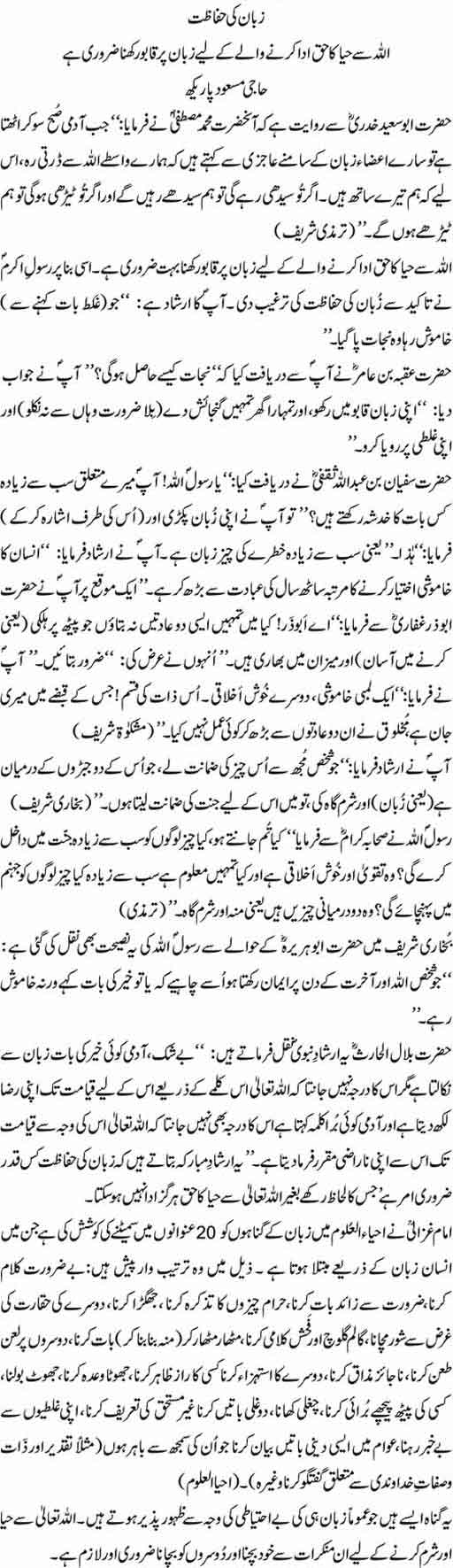
Zuban Ki Hifazat