

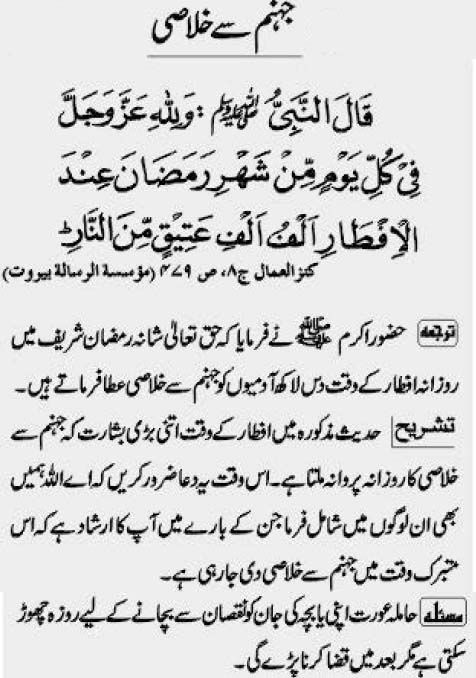
Ramadan: Iftar Kay Waqt Jahannam Say Khalasi
TAG: Iftaar
Breaking The Fast (Iftaar)
1. When does the Fasting person Break his Fast?
Allah, the Most High, says: “…then complete your Sawm (fast) till the nightfall…”[2]
Allah’s Messenger (peace be upon him) explained this to mean the approach of the night, the passing away of the daylight, and the disappearance of the sun below the horizon.[3]
Narrated Umar bin Al-Khattab (may Allaah be pleased with him): Allah’s Apostle (peace be upon him) said, “When night falls from this side and the day vanishes from this side and the sun sets, then the fasting person should break his fast.”[4]
Narrated Amr ibn Maimoon al – Awdee (may Allaah be pleased with him): The Companions of Muhammad (peace be upon him) were the earliest of people in beginning the Iftaar and the lastest in taking Suhoor.[5]
2. Hastening to Break the Fast
A Muslim should break the fast as soon as the sun sets and do not be bothered by the bright redness remaining upon the horizon. In this, he would be following the Sunnah of your Messenger (peace be upon him) and differing from the Jews and Christians since they delay breaking the fast until the stars start to appear.[6]
2.1 Hastening to Break the Fast brings about good.
Narrated Sahl bin Sad (may Allaah be pleased with him): Allah’s Apostle said, “The people will remain on the right path as long as they hasten the breaking of the fast.”[7]
Narrated Aboo Hurayrah (may Allaah be pleased with him): The Prophet (peace be upon him) said, “The Deen will not cease to be uppermost as long as the people hasten to break the fast since the Jews and Christians delay it.”[8]
2.2 Breaking the Fast before praying the Maghrib prayer
Narrated Anas (may Allaah be pleased with him): “The Prophet (peace be upon him) used to break his fast with fresh dates before Salaat al-Maghrib. If fresh dates were not available, he would eat dried dates and if dried dates were not available, he would break his fast by drinking a little water.”[9]
2.3 A Warning to Those who Break the Fast Before the Time of Iftaar
Although we should hasten to break the fast, breaking the fasting before the correct time is sinful. Even though only a part of the following hadith is relevant here, I thought I would add the full hadeeth so that we can reflect on some of the horrors of some of our actions.
Narrated Aboo Umaamah al – Baahilee (may Allaah be pleased with him): Allah’s Messenger (peace be upon him) said, “While I was sleeping, two men (angels) came to me, held my upper arms and took me to a rough mountain. They said,” Climb.” I said,” I cannot climb it.” They said, ” We will make it easy for you.”
He (peace be upon him) continued: “We moved on until I saw some people who were suspended by their Achilles’ tendons, their cheeks cut and gushing blood. I asked, “Who are those?” The replied, “Those are the ones who break their fast when it is not permissible.” 10]
3. With what should one break his fast?
Narrated Anas (may Allaah be pleased with him): “The Prophet (peace be upon him) used to break his fast with fresh dates before Salaat al-Maghrib. If fresh dates were not available, he would eat dried dates and if dried dates were not available, he would break his fast by drinking a little water.”[11]
Giving something sweet to an empty stomach leads to its acceptance and that the body takes benefit from it, especially a healthy body which will be strengthened by it. As for water, then the body becomes somewhat dehydrated through fasting and so if it is moistened with water then it can take completed benefit from the food. And know that the dates and water contain various blessings and specially qualities which have an effect upon the hearts and in purifying them, which will be known only to those who follow (the Sunnah).[12]
Consider how far our practice is from that of our Prophet (peace be upon him)! In our fast-breaking menu, there are all kinds of fruits and additional items. These items are fried or cooked with a lot of herbs and spices. This may result in causing an upset stomach, which may eventually result in ill health. Instead, we have to adopt a more moderate and comfortable way of breaking our fast by which a rich reward in the Hereafter and a physical advantage in this world will also be achieved.[13]
4. Times of Responding to the Supplication
Those believers who strive and control themselves, abstaining from those things restricted, such as food, drink, and sexual desire, all day long, to obtain the pleasure of Allah, will definitely have a special status with Allah. This responding to his invocation when breaking his fast is more likely to occur.[14] So seize this opportunity and call upon Allah being sure that it will be answered, and know that Allah does not respond to a heedless and inattentive heart. Call upon Him with supplications for anything good, and hopefully, you will attain the good of this like and the Hereafter.[15]
Narrated Abdullah ibn Amr ibn al – Aas (may Allaah be pleased with him): Allah’s Messenger (peace be upon him) said, “Indeed there is for the fasting person when he breaks his fast, a supplication which is not rejected.”[16]
5. What should a person say when breaking the fast?
There is a well-known invocation related in the hadith in this respect:
“Allaahumma laka sumtu wa – ala Rizqika Aftartu”
(O Allaah! For You I have observed fasting and with Your provisions do I break my fasting)
However, this hadeeth is NOT AUTHENTIC.[17] This shows you that you should not trust everything you find on things like Islamic calendars. As much as we hope that the people printing these would do some research on what they put, it seems like they are more concerned with advertising products than anything else! And to make things worse, some people turn a blind eye to the truth and ignorantly follow the unauthentic hadith over the authentic!
The authentic hadith is as follows:
“Dhahaba adh – dhamau wab – tallatil – urooqa wa thabatal – ajru in shaa Allaah”
(The thirst has gone, the arteries are moist, and the reward is set, Allaah willing)[18]
6. Providing food for the fasting person to break his fast.
The Prophet (peace be upon him) said: “Whoever gives food to a fasting person with which to break his fast, will have a reward equal to his, without it detracting in the slightest from the reward of the fasting person.”[19]
The rich reward of helping others break their fast can be achieved to one’s best ability and is not required for people to overburden themselves in this regard.[20]
And It is Only Allah Who grants success. May Allah Exalt the mention of His slave and Messenger Muhammad (peace be upon him), and render him, his household and companion safe from Evil.
Compiled by Imran Ayub[1]
References:
× Fasting In Ramadaan by Sheikh Saleem al – Hilaalee and ‘Alee ‘Abdul Hameed, al – Hidaayah Publishers, 1999
× Islamic Studies Book 3, by Dr. Abu Ameenah Bilal Philips, IIPH publishers, 2005
× Ramadaan: Rules and Related Issues, by Hafiz Salah – ud – Din Yusuf, Darussalam publishers, 199
× The Fragile Vessels – Rights and Obligations between the Spouses in Islam, by Muhammad Mustafaa al – Jibaaly, al – Kitaab and as-Sunnah Publishing, 2005
[1] From, ‘Fasting in Ramadaan’, p. 56 – 67 and ‘Ramadaan: Rules and Related Issues’, p. 12 – 15
[2] The Noble Qur’an, Soorah Al-Baqarah 2:187
[3] ‘Fasting in Ramadaan’, p. 56
[4] (Agreed Upon); Saheeh Bukhaari, Volume 3, Book 31, Number 175; Saheeh Muslim, Book 006, Number 2421
[5] ‘Abdur – Razzaq, al – Musannaf, Number 7591; Declared Saheehvby Hafidh Ibn Hajaar in al – Fath, 4/199; and al – Haithumee in Majma’ uz – Zawaaid, 3/154; as quoted in ‘Fasting in Ramadaan’, p. 56
[6] ‘Fasting in Ramadaan’, p. 57
[7] (Agreed Upon); Saheeh Bukhaari, Volume 3, Book 31, Number 178; Saheeh Muslim, Book 006, Number 2417; Sunan Aboo Daawood, Vol. 2, Number 2346
[8] Sunan Aboo Daawood, 2/305; Ibn Hibaan; Its Isnaad is Hasan; as quoted in ‘Fasting in Ramadan’, p. 58
[9] Sunan at – Tirmithee, 3/70; Sunan Aboo Daawood, 2/306; Ahmad, 3/163; Saheeh Ibn Khuzaymah, 3/277, 278; through two chains from Anas, and its isnaad is Saheeh; as quoted in ‘Fasting in Ramadaan’, p. 61; Classed Saheeh by Sheikh al – Albaanee in al-Irwa’, Number 922; as quoted in ‘Ramadaan: Rules and Related Issues’, p. 13
[10] Saheeh Ibn Khuzaymah, Number 1986; Ibn Hibbaan and others. Verified to be Saheeh by Sheikh al – Albaanee in Saheeh ut – Targheeb, Number 991; as quoted in ‘Fasting in Ramadaan’, p. 91 – 92
[11] Sunan at – Tirmithee, 3/70; Sunan Aboo Daawood, 2/306; Ahmad, 3/163; Saheeh Ibn Khuzaymah, 3/277, 278; through two chains from Anas, and its isnaad is Saheeh; as quoted in ‘Fasting in Ramadaan’, p. 61; Classed Saheeh by Sheikh al – Albaanee in al-Irwa’, Number 922; as quoted in ‘Ramadaan: Rules and Related Issues’, p. 13
[12] ‘Fasting in Ramadaan’, p. 61
[13] ‘Ramadaan: Rules and Related Issues’, p. 13
[14] ‘Ramadaan: Rules and Related Issues’, p. 13 – 14
[15] ‘Fasting in Ramadaan’, p. 61
[16] Sunan Ibn Maajah, 1/557; al – Haakim, 1/422; Ibn as – Sunnee, Number 128; at – Tayaalisee, Number 299; through two chains of narration from him and al – Boosairee said: 2/81: This isnaad is Saheeh, its narrators are reliable; as quoted in ‘Fasting in Ramadaan’, p. 61. Classed Saheeh by Sheikh al – Albaanee in Saheeh Sunan ibn Maajah, Number 1432; as quoted in ‘Ramadaan: Rules and Related Issues’, p. 14
[17] It is rated as Da’eef by Sheikh al – Albaanee in Irwaa al – Ghaleel, Vol. 4, Number 919; as quoted in ‘Islamic Studies Book 3’, p. 198
[18] Sunan Aboo Daawood, Vol. 2, Number 2350; al – Baihaqee, 4/239; al – Hakakim, 1/422; Ibn Sunnee, an – Nasaa’ee in Amalul – Yawm, 269; Daraqutnee, who declared its isnaad to be Hasan, and it is as he said (as quoted in ‘Fasting in Ramadaan’, p. 62); Graded Hasan by Sheikh al – Albaanee in Saheeh Sunan Aboo Daawood, Vol. 2, Number 2066 (as quoted in ‘Islamic Studies Book 3’, p. 198) and in Irwaa al – Ghaleel, Number 920 (as quoted in ‘Ramadaan: Rules and Related Issues’, p. 15).
[19] Sunan at – Tirmithee, Number 804; Ahmad, 5/192; Sunan Ibn Maajah, Number 1746; ibn Hibbaan, Number 895; Imam Tirmithee declared it Saheeh and it is as he said; as quoted ‘Fasting in Ramadaan’, p. 62.
[20] ‘Ramadaan: Rules and Related Issues’, p. 15
Sehar o Iftar Kay Fazail

Mistakes During Ramadan
Too much stress on food and drink
For some people, the entire month of Ramadan revolves around food. They spend the ENTIRE day planning, cooking, shopping and thinking about only food, instead of concentrating on Salah, Qur’an and other acts of worship. All they can think of is FOOD. So much so that they turn the month of ‘fasting’ into the month of ‘feasting’.
Come Iftaar time, their table is a sight to see, with the multitudes and varieties of food, sweets and drinks. They are missing the very purpose of fasting, and thus, increase in their greed and desires instead of learning to control them. It is also a kind of waste & extravagance. ‘and eat and drink but waste not by extravagance, certainly He (Allah) likes not Al-Musrifoon (those who waste by extravagance)’ [al-A’raaf :31]
Spending all day cooking
Some of the sisters (either by their own choice or forced by their husbands) are cooking ALL day and ALL night, so that by the end of the day, they are too tired to even pray Ishaa, let alone pray Taraweeh, Tahajjud or read Quran, etc.
Eating too much
Some people stuff themselves at Suhoor until they are ready to burst, because they think this is the way to not feel hungry during the day and some people eat at Iftaar, like there is no tomorrow, trying to ‘make up for the food missed.’ However, this is completely against the Sunnah. Moderation is the key to everything.
The Prophet (pbuh) said: ‘The son of Adam does not fill any vessel worse than his stomach; for the son of Adam a few mouthfuls are sufficient to keep his back straight. If you must fill it, then one-third for food, one-third for drink and one-third for air.’ (Tirmidhi, Ibn Maajah. Classed as saheeh by al-Albaani).
Too much food distracts a person from many deeds of obedience and worship, makes him lazy and also makes the heart heedless. It was said to Imam Ahmad: Does a man find any softness and humility in his heart when he is full? He said, I do not think so.
No It’s Not Feasting, It’s Fasting
HOW often have we seen it? A beautiful table laid with all the exotic foods you can think of. Dates of a thousand kind, drinks that have been concocted from fruits you’ve never heard of. Well, this is all too common when people are invited to open their fast in the holy month of Ramadan.
I clearly remember attending one such occasion and was amazed by the plethora of foods visible on the table. I thought to myself “how many people have they invited?” The dates alone would have been enough to feed an army. As I sat and observed the people, I just couldn’t understand how this food would be finished. As the call to prayer was announced, we opened our fast. The concentration was intense – ‘Try this one’, ‘what about that one’, were the reoccurring words as plates were placed in front of me. As we ate I looked up at the clock and thought we should go to the mosque, but the food kept on coming. We were like overstuffed balloons on the verge of bursting when we went for prayer after opening the fast. Upon returning, it was really amazing that I was even expected to eat dinner.
It’s these kind of situations that we need to take care of because fasting is all about abstaining from food and not indulging in it. Some people eat so much food at dawn they are not at all hungry during the day. This defeats the whole objective of fasting, as we should experience the hunger felt by so many around the world and be thankful to Allah for what we have.
Feeding people is a virtuous act that leads to reward, but how many times have we invited the poor to come and eat with us? They too fast and we should spare a thought for the poor and needy as they are rarely invited to open their fasts with people. They shouldn’t be forgotten in this great month. The Prophet (peace be upon him) said, “Whoever gives iftaar to one who is fasting will have a reward like the fasting person, without detracting from the fasting person’s reward in the slightest.” – Tirmidhi and Ibn Maajah – classed as saheeh by Al-Albani
If we look at the life of our noble Prophet Muhammad (peace be upon him) we see that he would break his fast with fresh dates. If none were available, he would have old dates. If no dates were available then he would just drink some mouthfuls of water. We should keep this in mind and try our level best to follow the example of the Prophet (peace be upon him).
Some Common Mistakes In Ramadhan
Taking Ramadhan as a ritual
For many of us Ramadan has lost its spirituality and has become more of a ritual ( Stereotyped behavior) than a form of Ibadah. We fast from morning to night like a zombie (living dead) just because everyone around us is fasting too. We forget that its a time to purify our hearts and our souls from all evil. We forget to make Dua, forget to beseech Allah to forgive us and ask Him to save us from the Fire. Sure we stay away from food and drink but that’s about all ?
Too much stress on food and drink
For some people, the entire month of Ramadan revolves around food. They spend the ENTIRE day planning, cooking, shopping and thinking about only food, instead of concentrating on Salah, Quran and other acts of worship. All they can think of is FOOD so much so that they turn the month of ‘fasting’ into the month of ‘feasting’.
Spending all day cooking
Some of the sisters (either by their own choice or forced by their husbands) are cooking ALL day and ALL night, so that by the end of the day, they are too tired to even pray Ishaa, let alone pray Taraweeh or Tahajjud or even read Quran. This is the month of mercy and forgiveness. So turn off that stove and turn on your Iman!
Ramadhan Is Approaching! Are You Ready?
Success in whatever we do depends on how clear we are on the objectives we want to achieve and how well we plan for them. Even a recreational activity such as going on vacation takes much planning. It is not feasible for a person to simply just get up and depart to a vacation destination without planning, especially if one wants to have a good vacation or recreational activity. For example, if one is going to Disney World, usually planning is done months in advance of the trip. In addition to making traveling and accommodation arrangements, people consult friends, read literature, and research how to get the most benefit while there. Time and effort are spent deciding beforehand as to which rides should be given preference, which shows should be watched and which sites or theme parks should be visited, in what order, and at what times of the day so that one can get the maximum benefit at minimum cost in a reasonable time. People make significant efforts to plan the trip because it means so much to them to make such a trip.
What does Ramadhaan mean to you? Does it mean more to you than going on a vacation? Are you mentally and psychologically ready to attain all the goodness and blessings Ramadhaan has to offer? Are you then spending enough time and taking pains to plan how can you get the most benefit from the opportunity Ramadhaan affords you?
Some people do plan for Ramadhaan, but that planning is only to the extent of who to invite for Iftaar, where to go for one, what special foods to prepare, or how to get the best deal on dates and iftaar delicacies. But is this the type of outcome that is the objective of Ramadhaan?
The objectives of Ramadhaan are to:
- Increase our Taqwa
- Make us more charitable? both financially and in our social dealings
- Develop patience and willpower to resist temptations
- Prepare us for our life-long Jihaad to remain steadfast on the path of Allah’s obedience
- Strengthen our relationship with the Holy Qur-aan, celebrate its revelation; and
- Thank Allaah Subhaanahu wa Ta`aala for guiding us so kindly.