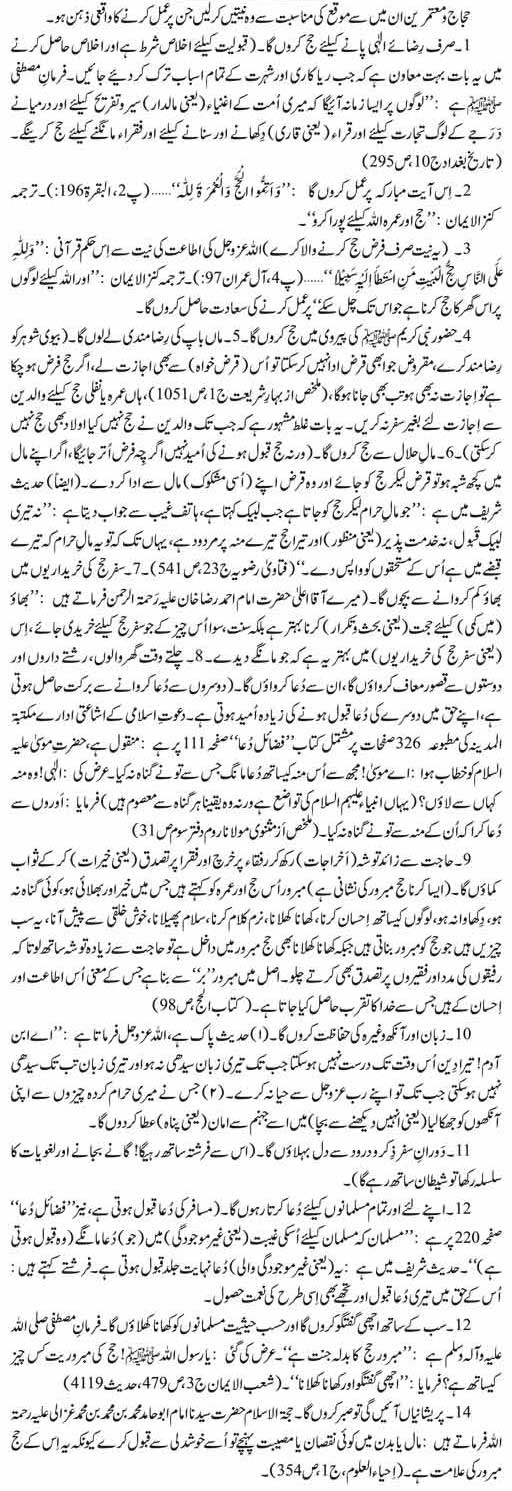


Ikhlas Kay Sath Kalam Perhne Ki Alamat
TAG: Ikhlas
Aik Sharabi Ka Waqia
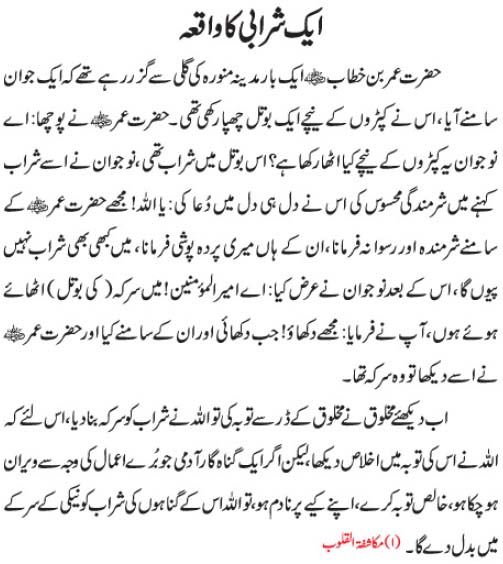
Aik Sharabi Ka Waqia
Today’s Hadith
Narrated Anas (Radi Allahu anhu): The Prophet (SalAllahu alaihi wasallam) delivered a Khutba (religious talk) the like of which I had never heard before. He said, ‘If you but knew what I know then you would have laughed little and wept much.” On hearing that, the companions of the Prophet (SalAllahu alaihi wasallam) covered their faces and the sound of their weeping was heard. A man said, “Who is my father?” The Prophet (SalAllahu alaihi wasallam) said, “So-and-so”, so this Verse was revealed:
O you who believe! Ask not about things which, if made plain to you, may cause you trouble. But if you ask about them while the Qur’an is being revealed, they will be made plain to you. Allah has forgiven that, and Allah is Oft-Forgiving, Most Forbearing. {Holy Qur’an Surat: 05 Al-Maeda Verses#101}
Sahih Al-Bukhari 6:145
O man! Verily, you are returning towards your Lord with your deeds and actions (good or bad), a sure return, and you will meet (the results of your deeds which you did). Then as for him who will be given his Record in his right hand, He surely will receive an easy reckoning, And will return to his family in joy! But whosoever is given his Record behind his back, He will invoke (for his) destruction, And he shall enter a blazing Fire, and be made to taste its burning. {Holy Qur’an Surat: 84 Al-Inshiqaq Verses#6-to-12}
Abdullah bin Mas’ud (Radi Allahu anhu) reported: The Allah’s Messenger (SalAllahu alaihi wasallam) said, “I know of the last of the inhabitants of the Hell to be taken out from there and the last one to enter Jannah. He is a man who will come out of the Fire, crawling on all fours. Allah, the Rabb of glory and honor will say to him: ‘Go and enter Jannah.’ He will go to it and think it is full up. He will return and say: ‘O my Rabb, it is full up.’ Allah will say to him: ‘Go and enter Jannah.’ He will again go to it and think it is full up. So he will turn back. Allah will again say: ‘Go and enter Jannah. For you have what is equal to ten times the world.’ He will say: ‘Are you making fun of me while You are the King?’ “At this, I (i.e. the narrator) saw the Allah’s Messenger (SalAllahu alaihi wasallam) laugh till his premolars were visible and he said, “Such a man will be the last dweller of Jannah in its lowest rank.” [Al-Bukhari – Muslim]
As Taken from Riyad-us-Saliheen
*The general habit of the Prophet (SalAllahu alaihi wasallam) was just to smile. But while telling about the gifts and honors of an ordinary person in Jannah, he could not help laughing in a manner that his molars became visible. The person on the lowest pedestal in Jannah will be given ten times better things and gifts than he could had on this earth. May Allah admit us into Jannah in His Mercy. Aameen.
Three important and beneficial things
1. Hazrat Muhammad salllahu alayhi wasallam says that “if a person recites ” Ayatal Kursi” after every Fard Namaz then there will be nothing between him and Heaven except Death”
2. There is a Hadith that says “La Haula Wala Quuatailla billahil aliyul azeem” is such a great medicine that it cures every disease and the most minor disease it cures is “Sorrow” (Gham).
3. Another Hadith says “If a person recites surah ikhlaas (Kul huwallahu ahad…) 10 times in a day then Allah build a palace for him in Heaven.(Subhaan Allah)” and last but not least Allah says ” spread the knowledge whatever you have.
Sincerity In Obedience
Ikhlas (Sincerity)
Sincerity in obeying Allah is among the obligations of the heart. It is also one of the good characteristics. Sincerity in obeying Allah is doing good deeds for the sake of Allah only. It is not doing them to seek the praise and respect of people. Allah made sincerity a condition for the acceptance of good deeds.
Allah, Ta’ala, said in the Qur’an:
Ayah 110 of Surah Al-Kahf means: “Let the one who believes in the Day of Judgment do good deeds without seeking the praise of the people by doing so.”
The sincere person is the one who performs good deeds be it praying, fasting, Hajj, Zakah, or reciting the Qur’an seeking the reward from Allah, and not for the sake of people praising and mentioning him.
The one who is praying should be performing obedience for the sake of Allah only, not so that the people will say: “So and so prays, he does not miss any obligation.”
Also, the one who is fasting should be fasting for the sake of Allah only. The same applies to, the case of the one who is giving Zakah, sadaqah, reciting the Qur’an, or anyone who is performing a good deed.
The Prophet, sallallahu Alayhi wa Sallam, said: “Certainly, Allah loves for one of you when performing a deed to perform it properly.”
Someone said: “How is that, O Messenger of Allah?”
He (sallallahu alaihi wasallam) replied: “One does it only for the sake of Allah and according to the rules of the Religion.”
(Narrated by As-Suyutiyy.)
Riya (Insincerity)
Is the opposite of sincerity. It is doing good deeds, such as fasting, for the praise of the people and their admiration.
Insincerity nullifies the reward of the deed. The performer of any deed that is done with insincerity receives no reward, whether it was done for the praise of people only or coupled with seeking the reward. Moreover, such a person commits an enormous sin.
Priding oneself in obeying Allah
After performing certain types of obedience, some people feel conceitedly proud of these actions. They feel they have high status because of performing these actions, forgetting that Allah is the One Who inspired and enabled them to do these good deeds.
Insincerity and priding oneself on obeying Allah are two sins of the heart. They are also two bad characteristics that the pubescent person must avoid. One should be sincere while obeying Allah to earn the reward from Allah.
Practical Tips For Praying Qiyam Al-Layl
Qiyam means standing and Qiyam Al-Layl means standing at night. In Islamic terminology, both words refer to the voluntary night prayer, whose time extends from after the Isha prayer until dawn.
Other common names for Qiyam Al-Layl are Salat-ul-Layl (the night prayer), Tahajjud (from hajada, meaning remained one who awake at night), and Taraweeh (resting).
A widespread misconception is that Tahajjud is a different night prayer than Qiyam or Taraweeh. It is important to clarify this misunderstanding and to make clear that the voluntary night prayer is known by different names.
1. Ikhlas (Sincerity)
Allah’s Help is required not only for worldly affairs but also for our worship. And Allah helps those who are sincere in their hearts. The Messenger of Allah (peace be upon him) said: “If you are truthful with Allah, then Allah will deliver to you what you wish for.” (An-Nasa’i, Al-Hakim and Sahih Al-Jami’’)
Therefore, one should have a sincere intention to pray Qiyam Al-Layl. One should seek the pleasure of Allah alone and avoid any desire for praise or fame. Allah says: “And they were commanded not, but that they should worship Allah, and worship none but Him Alone…” (Qur’an, 98:5)
Imam Ibn Al-Qayyim said: “The degree to which a person is helped and aided by Allah depends on the degree of his intention, drive, aim, and hopes. Help from Allah comes to people in proportion to their drive, intention, hopes, and fears. Failure comes to them in a similar manner.”
2. Know the virtue
Knowing the virtues and rewards of worship encourages us to perform them. The virtue of praying at night during Ramadan supersedes the virtue of praying any other night during the year. Abu Hurairah (may Allah be pleased with him) reported: “Allah’s Messenger (peace be upon him) encouraged the people, without making it an absolute command, to perform Qiyam during Ramadan. He (peace be upon him) used to say: ‘Whoever stands (in Qiyam) in Ramadan out of faith and expectation (of Allah’s reward), all his previous sins will be forgiven.’ ” (Sahih Muslim)
3. Take a nap
Taking a nap before or after Zuhr Salah will reduce stress and give you sufficient energy to wake up late at night to stand in front of your Lord. The Messenger of Allah (peace be upon him) said: “Take a nap, for the Shayateen (pl. of Shaytan) do not take naps.” (At-Tabarani, Al-Sahihah, no. 2647)
4. Sleep as per the Sunnah
• Sleep early! It’s a healthy habit and it was the practice of Allah’s Messenger (peace be upon him). He would sleep immediately after performing the Isha prayer. Abu Barzah Al-Aslami said the Prophet (peace be upon him) used to prefer to delay Isha, and he did not like to sleep before it or talk after it.” (Al-Bukhari)
• Sleep in a state of taharah (cleanliness). Prophet Muhammad (peace be upon him) said: “Purify these bodies and Allah will purify you, for there is no slave who goes to sleep in a state of purity, but an Angel spends the night with him, and every time he turns over, (the Angel) says, ‘O Allah! Forgive Your slave, for he went to bed in a state of purity.’ ” (At-Tabarani, Sahih Al-Jami’, no. 3831)
• Choose a suitable bed. Extreme luxury and very soft mattresses provoke laziness. We tend to sleep more and become negligent. Ayesha (may Allah be pleased with her) narrated that the pillow of the Prophet (peace be upon him) was made of leather stuffed with palm fibers.” (Abu Dawood and Musnad Ahmad, Sahih Al-Jami’, no. 4714)
• Keep the bed clean and lie on your right side. The Prophet (peace be upon him) said: “When any one of you goes to bed, let him clear his bed by hitting it with his garment, for he does not know what may have come onto it. Then let him lie down on his right side…” (Al-Bukhari and Muslim)
• Recite the Adhkar (supplications) mentioned in the Sunnah before sleeping. Among the Adhkar are reciting the last two verses of Surah Al-Baqarah; reciting Surah Al-Falaq, Al-Nas, and Ikhlas and blowing in the palms and wiping as much of the body as possible – starting from the head, face, and then the front of the body – three times; and saying Subhan Allah 33 times, Alhamdulillah 33 times and Allahu Akbar 34 times. (Al-Bukhari and Muslim)
5. Don’t eat too much
Eating and drinking too much are the main obstacles that make one lazy and negligent of Qiyam Al-Layl. The Messenger of Allah (peace be upon him) said, “Man fills no vessel worse than his stomach. It is sufficient for the son of Adam to have a few mouthfuls to give him the strength he needs. If he has to fill his stomach, then let him leave one-third for food, one-third for drink, and one-third for air.” (Al-Tirmidhi and Ibn Majah, Sahih Al-Jami’, no. 5674)
Abu Juhayfah reported that the Prophet (peace be upon him) said to a man who burped in his presence: “Stop your burping, for the people who eat the most in this life will be the most hungry on the Day of Resurrection.” (Al-Hakim, Sahih Al-Jami’, no. 1190)
6. Exert yourself
Exert yourself to get up and pray. Rise above your desires. Allah says in the Qur’an: “And as for those who strive hard in Our Cause, We will surely guide them to Our Paths. And verily, Allah is with the Muhsinoon (good-doers).” (Qur’an, 29:69)
The Prophet (peace be upon him) said: “The Mujahid (one who strives in the Cause of Allah) is the one who strives against his own self for the sake of Allah.” (Al-Tirmidhi, Al-Sahihah, no. 549)
He (peace be upon him) also said: “When a man from my Ummah gets up to pray at night, striving against his own self to get up and purify himself, there are knots on him. When he washes his hands in wudu, one knot is undone. When he washes his face, another knot is undone. When he wipes his head another knot is undone. When he washes his feet, another knot is undone. Then Allah says to those who are veiled (in the Unseen): ‘Look at this slave of Mine, he is striving against his own self and asking of Me. Whatever My slave asks of Me shall be his.” (Musnad Ahmad, Sahih Al-Targheeb, no. 627)
7. Regret if you missed it
Qiyam Al-Layl is a great blessing of Allah. He has kept numerous spiritual benefits and rewards for the believer in this prayer. Therefore, one should regret if he misses this great opportunity of achieving rewards and the Pleasure of Allah. Allah says in the Qur’an:
“O you who believe! Fear Allah and keep your duty to Him. And let every person look to what he has sent forth for the morrow, and fear Allah. Verily, Allah is All-Aware of what you do.” (Qur’an, 59:18)
Imam Ibn Al-Qayyim said, “If the slave is responsible and accountable for everything, even his hearing, sight, and innermost thoughts, as Allah says, “…Verily, hearing, sight, and the heart of each of you will be questioned by Allah.” (Qur’an, 17:36), then he should check on himself before he is brought to account.” – As-Sunnah
Ref: ‘The Night Prayers’ by Muhammad Nasir-ud-Deen Al-Albani
How To Remove Depression And Worries
Introduction
Mankind comes across many afflictions and trials, sometimes in overwhelming sequences. Removing the darkness of these worries, distresses, depression and grief is a very important matter to which Islam gives serious attention…
Indeed the greatest darkness to envelope mankind and surely his greatest affliction is disbelief in Allah and associating partners with Him in any form (kufr and shirk).
Allah is the Protector of those who have faith He will lead them from the depths of darkness into light. . As for those who disbelieve, their patrons are the devils: from light, they will lead them forth into the depths of darkness. They will be companions of the fire, to dwell therein (forever). AL-BAQARAH 2.257
Whereby Allah guides him who seeks His good pleasure to paths of peace and safety. He brings them out of darkness unto light by His decree and guides them unto a straight path. AL-MAAIDAH 5.016
Those who deny Our revelations are deaf and dumb in darkness. Whoever Allah wills He sends astray, and whom He wills He places on a straight path. AL-AN’AM 6.039
The scholars of Islam have extracted from the Qur’an and the authentic Sunnah many remedies and cures to help us in our daily affairs and remove our problems.
At-Tawheed
Singling out Allah alone, Glory is to Him, for all types of worship and recognizing His Lordship and having faith in the unity of His Lofty Names and Attributes. There would be anarchy if there was more than one deity.
If there were, in the heavens and the earth, other gods besides Allah, there would have been confusion in both! But glory to Allah, the Lord of the Throne, (High is He) above what they attribute to Him! AL-ANBIYA’ 21.022
Allah strikes a comparison between a Muslim and a mushrik (disbeliever). The man with one master (i.e. upon Tawheed) has no worries as to who to obey, so he has no confusion or dilemmas. The second man is confused as to who to obey first, and in whom he must put his trust especially as they are quarreling amongst each other. The mushrik is left to Shaitaan and his desires to direct him out of his confusion. However the Muslim who recognizes his Lord as One, knows that Allah is the One who rescues His slave when he is in grief.
Allah puts forth a parable; a man belonging to many partners quarreling with each other, and a man belonging entirely to one master: are those two equal? Praise be to Allah! But most of them have no knowledge. AZ-ZUMAR 39.029
In the beautiful story of Yusuf (alayhe as-salaam) his fellow prisoners were in distress to know the meaning or interpretation of their dreams.
Now with him, there came into the prison two young men. Said one of them: “I see myself (in a dream) pressing wine.” The other said: “I see myself (in a dream) carrying bread on my head, and birds eating it.” (They said) “Tell us the meaning of the dreams, for we see that you are a good doer.” YUSUF 12.036
o what was the first thing that this noble prophet of Allah (alayhe as-salaam) said to his companions? What was his reply? He called them to that which will provide them with immediate relief – the b lief that there is no deity worthy of worship except Allah – at-Tawheed.
“O my two companions of the prison! (I ask you): are many lords differing among themselves better, or Allah, the Supreme, and Irresistible? ” YUSUF 12.039
Mankind without Tawheed is astray, captured by Shaitaan, and their lives in chaos as explained in Allah’s statement:
Don’t you see that We have set the devils on the disbelievers to confound them with confusion? MARYAM 19.083
So the one upon true Tawheed, Allah helps him and removes grief from him. There are many verses that elude to this but suffice us for the moment the story of Yunus (alayhe as-salaam). He (alayhe as-salaam) had lost hope in his people who were not responding to his call to Islam. So he (alayhe as-salaam) left them and eventually Allah caused him (alayhe as-salaam) to be in the belly of a large fish.
So wait with patience for the Command of your Lord, and be not like the Companion of the Fish, when he cried out in deep sorrow. AL-QALAM 68.048
In his sorrow and anguish, Yunus (alayhe as-salaam) cried out, but to whom? He (alayhe as-salaam) called his Lord.
And remember Dhun-Nun (Yunus), when he went off in anger: He imagined that We had no power over him! But he cried through the depths of darkness, “There is no deity worthy of worship except You, glorified and exalted be You, indeed I was from the wrong-doers! ” AL-ANBIYA’ 21.087
Darkness upon darkness enveloped him (alayhe as-salaam):
a) the darkness of the depths of the ocean,
b) the darkness of the belly of the fish,
c) the darkness of the night.
He (alayhe as-salaam) called upon Allah, the One who can remove all distresses, he called upon Him with correct at-Tawheed and Allah removed his worries immediately.
Responding and Complying (Istijaabah)
To accept and answer to the deen of Allah and His Messenger, Muhammad (SAAS) completely as the ayah says:
O you who believe! Respond to Allah (by obeying Him) and (His) Messenger (SAAS) when He calls you to that which will give you life, and know that Allah comes in between a man and his heart and that it is He to Whom you shall (all) be gathered. AL-ANFAL 8.024
The repercussion of rejecting the Call to His deen is grievous and its result is the greatest of sorrows in the Hereafter. The disbeliever will be raised and wail to His Lord (Whom he denied in the world):
He will say: “O my Lord! Why have You raised me up blind, while I had sight (before)? TA-HA 20.125
Allah will reply to him with complete justice:
He (Allah) will say: So (it must be). Our revelations came to you (in the world) but you did reject them. In like manner this Day you are forgotten (rejected). TA-HA 20.126
Not only will Allah reject the disbeliever but he will also be humiliated by Shaitaan who the mushrik took as his close companion and responded to his (Shaitaan’s) call.
And Shaitaan will say when the matter has been decided, “Verily Allah promised you a promise of truth. I too promised you but I betrayed you. I had no authority over you except that I called you and you responded to me. So blame me not, but blame yourselves. I cannot help you, nor can you help me. I deny your former act in associating me (Shaitaan) as a partner with Allah.” Verily, there is a painful torment for the transgressors. IBRAHEEM 14.22
So we urge you brothers and sisters to respond to and comply with Allah’s religion and enter it completely.
O you who believe! Enter into Islam whole-heatedly and follow not the footsteps of the Shaitaan, for he is to you an open, avowed enemy. AL-BAQARAH 2.208
Belief in the Divine Decree (Qadr)
Qadr is an established part of the religion and is included in our beliefs. In the famous “Hadeeth of Jibreel” (alaihe-as-salaam) when he asked the Messenger (SAAS) about Islaam, Eemaan and Ihsaan, he (SAAS) replied about Eemaan:
That you affirm your faith in Allah, in His angels, in His Books, in His Apostles, in the Day of Judgement, and you affirm your faith in Qadr, the good and the evil consequences of it… MUSLIM
We must accept and be content with Qadr, knowing that whatever Allah decrees he does so out of His all-encompassing Knowledge and Wisdom. With this belief in Qadr (the good and the evil of it) firm in our hearts Allah will guide our hearts:
No calamity befalls, but with the leave of Allah, and whoever believes in Allah, He guides his heart, and Allah is the All-Knower of everything. AT-TAGHAABUN 64:11
‘Abdullah Ibn ‘Abbas (radhiyAllahu anhu) related one day he was riding behind Allah’s Messenger (SAAS) who said,
“Young man, if you are mindful of Allah (of His commands and prohibitions), He will be mindful of you, and if you are mindful of Allah you will find Him before you. When you ask for anything ask it from Allah, and if you seek help, seek help from Allah. Know that if the people were to unite to do you some benefit they could benefit you only with what Allah had decreed for you and that if they were to unite to do you some injury they could injure you only with what Allah had recorded for you. The pens have been lifted and the pages are dry.” AHMAD, TIRMIDHI, AN-NAWAWI’S FORTY HADEETH
So with this knowledge that no harm or good can touch a servant of Allah except with the permission of the All-Knower and All-Wise, the hearts find tranquillity and contentment. This, therefore, encourages the Muslim to patient entry persevere during an affliction and motivates him to praise Allah when He bestows some portion of good upon him. Whatever his situation, if the Muslim acts accordingly he has only rewards to gain and nothing to lose.
Suhaib ibn Sinan al-Romi related that Allah’s Messenger (SAAS) said:
Strange are the ways of a believer for there is good in every affair of his and this is not the case with anyone else except in the case of a believer for if he has an occasion to feel delighted, he praises (Allah), thus there is a good for him in it, and if he gets into trouble and shown resignation (and endures it patiently), there is a good for him in it. MUSLIM
Sincerity (Ikhlaas)
‘Abdullah Ibn ‘Umar (radhiyAllahu anhu) said that the Prophet (SAAS) said,
“While three people were walking, rain began to fall and they had to enter a cave in a mountain. A big rock rolled over and blocked the mouth of the cave. They said to one another, `Invoke Allah (sincerely) with the best deed you have performed (so that Allah may remove the rock).’ One of them said, `O Allah! My parents were old and I used to go out to graze (my animals). On my return, I would milk (the animals) and take the milk in a vessel for my parents to drink. After they had drunk from it, I would give it to my children, family, and wife. One day I was delayed and on my return I found my parents sleeping, and I did not wish to wake them up. The children were crying at my feet (because of hunger). That state of affairs continued until it was dawn. O, Allah! If You think that I did it for Your sake, then please remove this rock so that we may see the sky.’ So the rock was moved a little. The second said, `O Allah! You know that I was in love with a cousin of mine, the deepest love a man may have for a woman, and she told me that I would not have my desire fulfilled unless I paid her one hundred dinars (gold pieces). So I struggled for it until I gathered the desired amount. When I sat between her legs, she told me to fear Allah and asked me not to deflower her except rightfully (by marriage). So I stood up and left her. O, Allah! If You think that I did it for Your sake, kindly remove this rock.’ So two-thirds of the rock was removed. Then the third man said, `O Allah! No doubt You know that once I employed a worker for one faraq (three sa’s) of millet, and when I wanted to pay him, he refused to take it. So I sowed it and from its yield, I bought cows and hired a herdsman. After a time the man came and demanded his money. I said to him: Go to those cows and the herdsman and take them for they are for you. He asked me whether I was joking with him. I told him that I was not joking with him, and all that belonged to him. O, Allah! If You think that I did it sincerely for Your sake, then please remove the rock.’ So the rock was removed completely from the mouth of the cave.” BUKHARI
So invoking Allah sincerely, and seeking His Pleasure is one of the ways of removing afflictions from us.
Supplication (Ad-Duaa)
O Ever Living, O Self-Subsisting and Supporter of all, by Your mercy I seek assistance. Rectify for me all my affairs and do not leave me to myself, even for the blink of an eye. AL-HAAKIM, SAHEEH AT-TARGHEEB WAT-TARHEEB, HISN-UL-MUSLIM (ENG. TRANS. P125)
Seeking refuge in Allah (Istiaadhah)
Anas ibn Malik (radhiyAllahu anhu) relates that the Prophet (SAAS) said to Abu Talha (radhiyAllahu anhu),
“Choose one of your servant boys to serve me on my expedition to Khaibar.” So Abu Talha took me, letting me ride behind him when I was a boy nearing the age of puberty. I used to serve Allah’s Messenger when he stopped to rest. I heard him repeatedly saying, “O Allah! I seek refuge with you from distress and sorrow, from helplessness and laziness, from miserliness and cowardice, from being heavily in debt, and from being overcome by men.” BUKHARI and HISN-UL-MUSLIM (P.157)
Detachment from this world (Az-Zuhd)
Anas ibn Malik and Zaid ibn Thabit (radhiyAllahu anhum) related that the Prophet (SAAS) said,
“For the ones whose concern is this world, Allah will scatter his affairs, place poverty between his two eyes and he will not get from the world except what is written for him. As for the one whose intention is the Hereafter, Allah will gather for him his affairs, place contentment in his heart and the world will come to him willingly” IBN MAJAH, SAHEEH-UL-JAAMI NO. 6386
Shaykh Saleem al-Hilaalee hafidhahullaah
Ponder And Practice
It is narrated that Imam Hussain (as), grandson of the Holy Prophet (saw), said to a man who was backbiting another before him,
‘O you, stop backbiting, for it is the daily meal of the dogs of Hell.’
A person asked Allah’s Messenger (may peace and blessings be upon him) who among Muslims were better. Upon this (the Holy Prophet) remarked: One from whose hand and tongue, Muslims are safe.
Commentary
Are others safe from your words (back-biting, comments, sarcasm, hurtful jokes, fitnah, etc) and your deeds (retaliation, plotting, etc)?
Angels stand by your side, recording your words. It is better to be silent than to comment. “Speak good, or else be silent,” says Rasulullah (saw). Busy yourself with finding your own faults, and you shall have little time to comment on others.
Angels stand by your side, recording your deeds. It is better to forgive than to retaliate. Busy yourself with seeking forgiveness for your own soul, and you shall have little time to plot revenge or to ponder about the deeds of others.
When others are safe from your words and deeds, it means that you are now safe from words and deeds that will destroy you on Judgement Day. On that Day, Man will regret what evil he has said and done. He will be filled with relief, for all the evil which was not said and done. So restrain yourself, for your own good.
Will you not then take heed?
Ponder and practice.
Rasulullah S.A.W said, “An intelligent person is one who is constantly thinking about and preparing for death.”
Think about it. How does one prepare for death?
1) By seeking knowledge of Islam. So study about Allah, his Prophet, of good deeds and evil deeds. But knowledge itself is useless without…
2) Practising it. Perform good deeds, small or big, and avoid all evil deeds. But all performance is useless unless you are…..
3) Sincere (Ikhlas). To do lillahi ta’ala. But you will never achieve sincerity, as long as you do not have…
4) True Faith (Iman). You must
- truly believe in Allah,
- truly be in awe of Allah,
- truly depend and ask only from Allah,
- truly hope from Allah,
- truly fear Allah,
- truly put your trust in Allah.
But such faith does not come from reading books or talking about Islam or listening to fiery speeches about Islam; it comes from…
5) Striving hard in Allah’s path (Jihad). This does not mean going around trying to convert the world to Islam; it does not mean waving a sword at disbelievers showing them the ‘terror’ that Islam can inflict. It means fighting hard to cleanse the evil in yourselves –
- the jealousy,
- the greed,
- the stinginess,
- the arrogance,
- the pride,
- the laziness,
- the hatred,
- the lack of faith,
- the stupidity,
- the blindness of the heart,
- the backbiting and
- all the terrible sins that we do day after day, year after year until death comes a calling.
That is jihad. As you can see, this is a full-time job, that will take all your life to complete. But you will never start to strive for all this until you begin to…
6) Realize…
- Realize that you will die soon.
- Realize that you will be shown all your deeds (good and bad) on Judgement Day.
- Realize that Allah watches you all your life and that no deed escapes His repayment.
- Realize that money, fame, and property cannot buy your way out of Hell.
- Realize that only iman and good deeds can.
- Realize that you live only once.
- Realize that you are responsible for yourself.
- Realize that in the end, you are the one who will gain or lose.
- So many people have realized, studied Islam, and yet have gone astray – becoming terrorists, extremists, and fundamentalists. Why?
They have forgotten the most important thing in Islam. Which is that…….
7) Islam is about yourself. Correcting yourself. Cleansing yourself. Not about fighting with people or proving other people wrong.
- In the grave, you will be asked about yourself.
- What you did.
- What you said.
- What was your intention?
Then Allah will tell YOU, what is your final destination.
“And do not be as those who forget Allah, then Allah makes them forget about themselves….”Al-Qur’an.
Have you thought of yourself lately? Every man who forgets about himself lands in Hell.
Ponder…and practice.
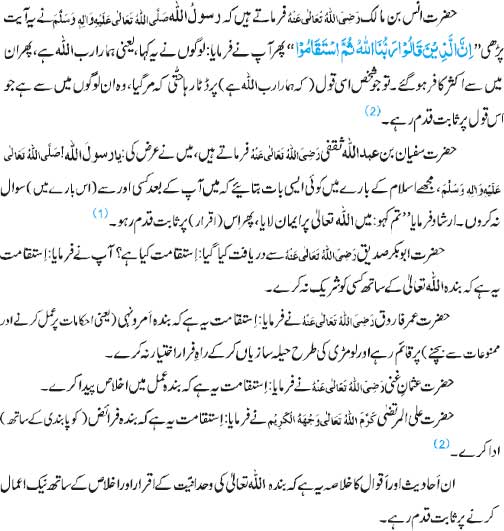
Istiqamat Kya Ha
12 Benefits Of Being Sincere To Allah
The scholar of Hadith Husayn Al-Awaishah mentions some of the benefits of practicing Ikhlaas in his book Kitab Al-Ikhlaas. Ikhlaas is sincerity to Allah in everything we do.
1. The Muslim Ummah will be victorious, for the Messenger of Allah (peace be upon him) said, which translated means, “Allah only gives victory to this nation because of its weak ones, because of their du’a, prayer and Ikhlaas.” (At-Targhib wa At-Tarhib)
2. Acquiring safety from Allah’s punishment and wrath in the Hereafter. Allah said about some people who observe Ikhlaas, which translated means:
“And they give food, in spite of their love for it (or for the love of Him), to the poor, the orphan, and the captive. (Saying), ‘We feed you seeking Allah’s Countenance only. We wish for no reward, nor thanks from you. Verily, we fear from our Lord a Day, hard and distressful, that will make the faces look horrible (from extreme dislikeness to it).’ So Allah saved them from the evil of that Day and gave them Nadhratan (a light of beauty) and joy. And their recompense shall be Paradise, and silken garments, because they were patient.” (Qur’an, 76:8-12)
3. Protection from falling into misguidance. Allah mentions how he protected Prophet Yusuf (peace be upon him):
“Thus it was, that We might turn away from him evil and illegal sexual intercourse. Surely, he was one of our Mukhlasin (chosen, guided persons who observe Ikhlaas with Allah).” (Qur’an, 12:24)
4. Being blessed with Hudaa (right guidance), as Allah said, which translated means:
“Truly! They were young men who believed in their Lord (Allah), and We increased them in guidance.” (Qur’an, 18:13)
5. Residents of the heavens and earth will love those who observe Ikhlaas. The Messenger of Allah (peace be upon him) said, which in translation means, “When Allah loves a slave, He summons Jibreel, saying, ‘Allah, the Exalted, loves Fulan (such and such person), so love him,’ and Jibreel will love him. Then he calls upon the inhabitants of the heaven, ‘Allah loves such and such person, so love him’, and the inhabitants of the heaven will love him. Then acceptance (honor, content, love, etc.) will be sent down (and spread up) on earth for him.” (Al-Bukhari and Muslim)
6. Achieving tranquillity in the heart and feeling joy, content, and elation, for Allah said, which in translation means, “Verily, in the remembrance of Allah do hearts find rest.” (Qur’an, 13:28)
7. Faith will be endeared to the sincere ones, while wickedness will be made hateful to them. Allah said, which in translation means:
“And know that among you there is the Messenger of Allah. If he were to obey you (follow your opinions and desires) in much of the matter, you would surely be in trouble, but Allah has endeared the Faith to you and has beautified it in your hearts, and has made disbelief, wickedness, and disobedience (to Allah and His Messenger) hateful to you. These! They are the rightly guided ones.” (Qur’an, 49:7)
We have mentioned before how Prophet Yusuf (peace be upon him) was made to hate illegal sexual intercourse, disbelief, and wickedness, and how Iman was made beautiful to him, that he preferred staying in jail rather than falling into illegal sexual intercourse and sin.
8. Insha Allah, Ikhlaas will guide one to choose the rightly-guided company of those who observe Ikhlaas. The best example for this subject is that the companions of the Messenger of Allah (peace be upon him) were friends with each other as they were friends with the Messenger, and who can find a better company than the Prophet and his companions?
9. Enduring all types of hardships in this life with patience. The Messenger of Allah (peace be upon him) and his companions were excellent in this type of behavior, for they endured and were patient in the face of all kinds of hardships, and the proof to this better behavior is detailed amply in their seerah.
10. Acquiring the good end, as is evident from the story of the man who had killed 99 people, but then sought to repent of his crimes. This person’s Ikhlaas in seeking forgiveness from Allah guided him until he died while his heart was returning back to Allah.
11. Du’a will be accepted, as is evident from the story of the young boy, the wizard, and the priest. Another example of this is the story of the three men trapped in the cave (who make du’a to Allah with deeds they did sincerely for His sake), This, indeed, is a vast subject with numerous examples testifying to the fact that Ikhlaas is an essential ingredient that ensures the acceptance of du’a.
12. Being rewarded in the grave, and receiving the glad tidings of the joy and happiness that those who had Ikhlaas will enjoy in the grave and in the Hereafter. The Hadith by Al-Baraa’ Bin Azib describes how one’s good deeds will come in the shape of a handsome man, wearing nice clothes and whose scent is pleasing, saying, “I am your good deeds.”
Hajj Aur Umrah Kernay Waloon Ki Niyatien