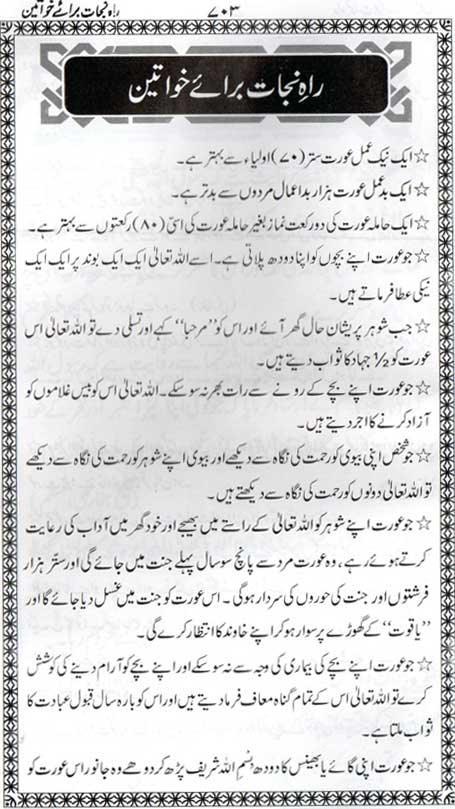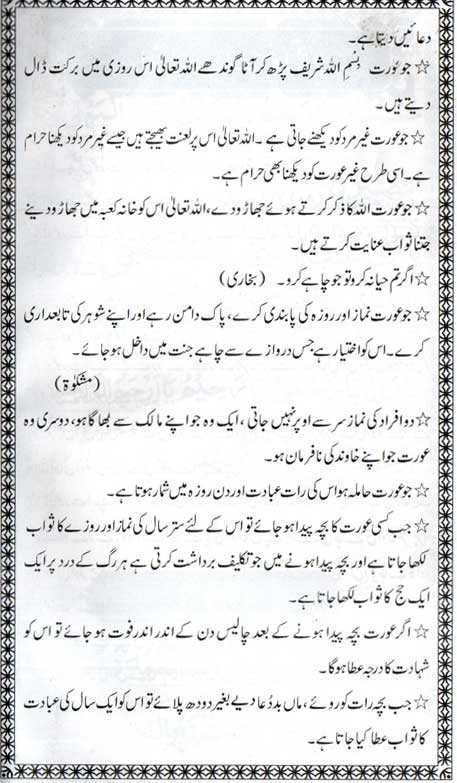

Rah-e-Nijat Baraye Khawateen
TAG: Islam
Al Sadaqat Al Jariyah
Al Sadaqat al Jariyah – The actions which outlive you!
1. Give a copy of the Quran to someone and each time they read from it, you will gain hasanaat.
2. Donate a wheelchair to a hospital and each time a sick person uses it, you will gain hasanaat.
3. Participate in the building of a mosque.
4. Help in educating a child.
5. Teach someone to recite a dua. With each recitation, you will gain hasanaat.
6. Share a dua or Quran DVD/CD.
7. Share constructive reading material with someone.
8. Place a water cooler in a public place.
9. Plant a tree. Each time any person or an animal sits under its shade or eats from the tree, you will gain hasanaat.
10. Share this with someone. If one person applies any of the above Inshallah you will receive your hasanaat until the Day of Judgment.
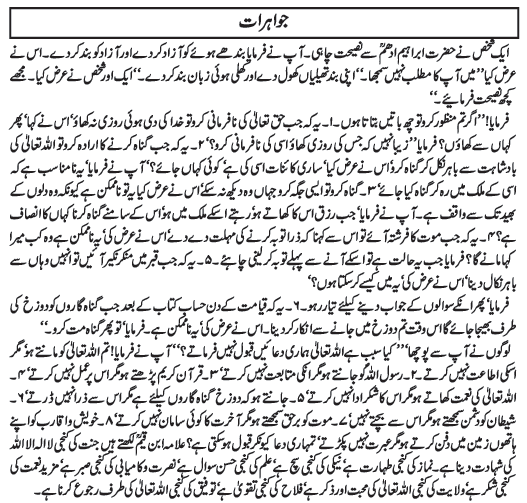
Jawharat

Jawharat
Universal Facts About Sayyiduna Rasool-Allah (Salallaho Alaihi Wasallam)
Sayyiduna Rasoolullah (sallal laahu alaihi wasallam) occupies an exalted, everlasting, and the most unique position in the religious history of mankind. Of all the Founders of Religion, only Sayyiduna Rasoolullah (sallal laahu alaihi wasallam) is the first and the last to claim that the Message that he brought from Allah Ta’ala to mankind is absolutely complete and final, that his dispensation shall remain in force till the end of the world, and after him, no Divine Messenger will come to modify, add, subtract or abrogate any of his teachings. In him, the institution of Prophethood attained its full, final, and most perfect form.
History shows that the world from the beginning has not produced any other man who can rival the Prophet of Islam (sallal laahu alaihi wasallam) in the field of his teachings, his actions, his deeds or practical way of life.
It was Hazrat Muhammad’s (sallal laahu alaihi wasallam) grandest contribution to the elevation of his fellow-men that he re-affirmed the sovereign principle of Monotheism and universal brotherhood of man transcending all barriers that people erect in ignorance and fear. Hazrat Muhammad (sallal laahu alaihi wasallam) arose in the midst of a society that was cruelly barbarous, which had no culture, no manners, no society, and no civilization. Humanity was coming very close to calamity. Imagine the same society is today the noble torch-bearer of a new and excellent civilization. This is one of the main miracles the Prophet of Islam (sallal laahu alaihi wasallam) performed and world history bears testimony to this truth. In a short span of 23 years, he brought under one banner a most barbarous tribe spread over 2 000 000 square miles of a very remote region of the world.
It is a universal fact that Hazrat Muhammad (sallal laahu alaihi wasallam) is the only Prophet in whose honor praises have been sung by all other religious leaders and some have rather recommended to their followers to follow the path of this great Prophet. People like Guru Nanak, the spiritual head of the Sikh sect, and George Bernard Shaw, the philosopher, are such personalities.
Sayyiduna Rasoolullah (sallal laahu alaihi wasallam) accomplished what he undertook in his own short span of life with limited means and all-round adversities, trials tortures, and tribulations. The task that he accomplished, the work that he did, the manners and the character that he exhibited, and above all, the way in which he completed this stupendous task, is itself clear proof of his being the last and the living Messenger of Allah whose religion is perfect, character blotless and complete, and teachings marvelous in all respects.
What he preached appealed to man’s reasons and rational faculties rather than to mere sentimentalism, fanaticism, irrationality, and superstition. He showed what was crystal clear.
Although he was an apostle, philosopher, reformer, religious head, statesman, orator, commander, soldier, administrator, and the head of state, he never sat an inch above the place where his followers used to sit or ate a morsel more than his Companions ate or wore what was superior than what others used to wear. He was a selfless and sincere friend, a perfect guide, a graceful companion, a loving teacher, an impartial judge, and above all a simple and straightforward person. He sat in such a simple attire and mixed up so freely and simply with all the common people that the foreign delegations visiting his capital used to inquire from others as to who the Prophet of Islam was. Can any head of the state or any religious head in any part of the world boast to possess such an amicable nature? Can any head of state be so courageous?
History has known many great and glorious civilizations. The main among them are the Chinese civilization, Greek civilization, Roman civilization, Marxism, and Imperialistic. None owes its origin and establishment to a single individual. Nor can it be counted as everlasting. Moreover, these civilizations of the world covered a certain field and certain parts of the world. All the civilizations were basically collective efforts of many, but Sayyiduna Rasoolullah (sallal laahu alaihi wasallam) gave Islamic civilization single-handedly for all times to come.
Over the hills of Makkah, there was a heavenly glow. The birth of our Prophet (sallal laahu alaihi wasallam) was an earth-shaking event in the year 570 A.D. Born in the most backward and uncivilized city of Makkah in the Middle East, lived only 63 years in this world, remained unlettered throughout, but changed the destiny of the entire humanity. The whole culture of humanity and the existence of the human race was revolutionized during these 23 years of his Prophethood and throughout the world, he was the only single person with multiple capacities who could successfully carry out this stupendous task in such a short span of time and amidst untold adversities. He was the Prophet who uprooted Polytheism once and for all.
His father, Hazrat Abdullah (radi Allahu anhu) and mother, Bibi Aaminah (radi Allahu anhu), passed away after his birth. His grandfather, Hazrat Abdul Mutallib (radi Allahu anhu), who took care of him, too soon passed away. He was thus an orphan. Dai Halimah (radi Allahu anha) took care of him for full five years in the desert. But no one knew at that time that this shy, sweet and sublime orphan will grow up to be the greatest and the last Prophet of Allah and show the world the real path to salvation in the most simple and straightforward style. They never knew that he is Mercy for them as well as for all the worlds and all the generations and all ages so long as the world lasts. Allah Ta’ala says in the Holy Quran: “We sent to you not but as a Mercy for all mankind“.
The personality of Sayyiduna Rasoolullah (sallal laahu alaihi wasallam) is the most perfect and profound in history. A personification of the moral code of life as enshrined in the Holy Quran, he created a moral society and a just State that blended the spiritual with the temporal in the most beautifully balanced synthesis. This was the only Prophet whose words and deeds were 100% alike. He preached what he and his Companions practiced, he treated the King and commoner alike. He was sweet, simple, civil, and kind to each and every one. He never hurt the feelings of even his deadliest enemy.
Avoid 7 Great Destructive Sins
Narrated Abu Huraira: The Prophet (PBUH) said, “Avoid the seven great destructive sins.” They (the people!) asked, “O Allah’s Apostle! What are they?” He said,
” (1) To join partners in worship with Allah;
(2) to practice sorcery;
(3) to kill the life which Allah has forbidden except for a just cause (according to Islamic law);
(4) to eat up usury (Riba),
(5) to eat up the property of an orphan;
(6) to give one’s back to the enemy and flee (running away / escaping) from the battle-field at the time of fighting
(7) and to accuse chaste women who never even think of anything touching chastity and are good believers.”
(Bukhari 8/840)
‘Abdullah b. Amr reported Allah’s Messenger (may peace be upon him) as saying: The whole world is a provision, and the best object of benefit of the world is the pious woman.
(Muslim 8/3465-Marriage Kitab Al Nikah)
The Best of Muslim
“The best of the Muslims is he from whose hand and tongue the Muslims are safe.” (Muslim)
“The best of people are those with the most excellent character.” (Tabarani, Sahîh)
“The best of marriages are the easiest ones.” (Abu Dâwûd, Sahîh)
“The best of you are those who feed others and return greetings.” (Abu Ya’la, Hasan)
“The best of that which you treat yourself with is cupping.” (Hakim, Sahîh)
“The best days that you should perform cupping are the 17th, 19th, and 21st of the month. I did not pass a single gathering of angels on the night of Isra’ except that they would say to me, ‘O Muhammad, perform cupping!’” (Ahmad, Sahîh)
“The most beloved of deeds according to Allah are the continuous ones, even if they are little.”(Agreed upon)
“The most beloved words according to Allah the Highest are four: Subhanallah, Alhamdulillah, La ilahaillallah and Allahu Akbar; there is no problem with which one you start with.” (Muslim)
“The best of provision is that which suffices.” (Ahmad in ‘Zuhd’, Hasan)
“The best of dowries are the easiest.” (Hakim, Sahîh)
“The most beloved word according to me is that which is most truthful.” (Bukhari)
“The best of dinars are the dinar spent by a man upon his dependents, the dinar spent by a man upon his horse in the path of Allah, and the dinar spent by a man upon his companions in the path of Allah, the Mighty, the Magnificent.”(Muslim)
“The best word of remembrance is: La ilaha illallah and the best supplication is:Alhamdulillah.” (Tirmidhî, Hasan)
“The best of all charity is that which is given to the relative that harbours enmity against you.”(Ahmad, Sahîh)
“The best prayer is that with the longest standing.” (Muslim)
“The best of all worship is supplication(dua).” (Hakim, Sahîh)
“The best deed is the prayer in its right time and Jihad in the path of Allah.” (Bayhaqi, Sahîh)
The Messenger of Allah (ﷺ) was asked: “Which of the believers is the most intelligent?” He (ﷺ) replied, “Those who remember death the most and are best prepared for what comes after it. Those are the intelligent ones.” (Reported by Tabraani, Ibn Majah, classed as Hasan)
Virtue Of Fasting The Day Of Ashura
Indeed, fasting on the day of `Ashura’ – the 10th of Muharram- is of great merit in Islam. The Prophet (peace and blessings be upon him) said, “Fasting the day of `Ashura’ (is of great merits), I hope that Allah will accept it as an expiation for (the sins committed to) the previous year” (Muslim).
Also, fasting on the 9th of Muharram is highly recommended by the Sunnah. Imam At-Tirmidhi reported that Ibn `Abbas (may Allah be pleased with them both) used to say: We should fast on two days: the 9th and 10th of Muharram to distinguish ourselves from the Jewish community. (At-Tirmidhi)
Explaining the virtue of fasting on the 9th and the 10th of Muharram, Dr. Muzammil H. Siddiqi, former President of the Islamic Society of North America, states:
It is the Sunnah of the Prophet (peace and blessings be upon him) to fast on the 9th and 10th of Muharram. The Prophet (peace and blessings be upon him used to fast on the day of ‘Ashura’. When he came to Madinah, he found out that the Jews of Madinah were also fasting on this day remembering Prophet Musa (peace and blessings be upon him). The Prophet (peace and blessings be upon him) admired this tradition and said to the Jews, “I am closer to Musa than you are.” He fasted and he also told his Companions to fast on this day.
Later, before the end of his life, the Prophet (peace and blessings be upon him) told Muslims to add the 9th day also. Thus, it is recommended to fast on both the 9th and 10th of Muharram.
Moreover, in his well-known book, Fiqh As-Sunnah, the late Sheikh Sayyed Sabiq states:
Abu Hurayrah (may Allah be pleased with him) reported: “I asked the Prophet (peace and blessings be upon him): ‘Which Prayer is the best after the obligatory Prayers?’ He (peace and blessings be upon him) said: ‘Prayer during the mid of the night.’ I asked: ‘Which fasting is the best after Ramadan?’ He (peace and blessings be upon him) said, ‘The month of Allah that you call Muharram” (Ahmad, Muslim, and Abu Dawud).
Mu`awiyyah ibn Abi Sufyan (may Allah be pleased with him) reported that he heard the Messenger of Allah (peace and blessings be upon him) say: “Concerning the day of ‘Ashura’, it is not obligatory upon you to fast on it as I do. Whoever wishes may fast and whoever does not wish to is not obliged to do so” (Al-Bukhari and Muslim).
It is noteworthy that Muslim scholars have stated that fasting of ‘Ashura’ is of three levels as follows:
- fasting for three days, i.e., on the 9th, 10th, and 11th of Muharram,
- fasting the 9th and 10th of Muharram, and
- fasting only on the 10th of Muharram.
There is a great reward in fasting on the day of ‘Ashura’. There are many hadiths that mention their blessings and virtues. It is good to fast on this day, although it is not obligatory.
Allah Almighty knows best.
Responsibilities Of A Muslim
The long-standing political and moral decline of the Muslim Ummah has resulted, among other things, in a serious distortion of our very concept of Islam itself. We have grown accustomed to viewing Islam as a mere “religion,” instead of using the original Qur’anic term “Deen.” This apparently minor change in semantics is actually a huge leap backward. This is because the word religion is commonly used in a rather narrow sense, its scope is limited to a set of dogmas, some rituals for worship, and a number of social customs to celebrate important life events. Deen, on the other hand, is a system of life in which human beings consciously surrender to the sovereignty of a higher authority, and live a life of total obedience to that higher authority. In this sense, the term Deen can be applied to monarchy, where the king is accepted as the final authority, or to democracy, where the people as a whole act as sovereign. Thus, when the term Deen is used for Islam, it obviously means a system of life where the Almighty God is worshipped and obeyed, not just in the narrow religious sense, but in a manner that includes all aspects of human of life.
A well-integrated set of beliefs describing the nature of existence as it really is (Iman), modes of worship including Salat, Zakat, Saum, and Hajj, as well as social customs and ceremonies all comprise indispensable and integral parts of Islam. However, in addition to these “religious” features, we are also provided by the Almighty God with all the relevant instructions regarding our social, economic, and political existence (generally considered to be the “secular” elements of life), and this is what really distinguishes Islam from other religions, say, Christianity or Buddhism. Unfortunately, the majority of our masses are simply, and perhaps blissfully, unaware of what it really means to be a Muslim; thus, their concept of religious duties is usually very narrow and limited. But, as Allama Iqbal has so correctly observed, you begin to shudder with the fear of accountability once you realize the tremendous responsibilities that come with being a Muslim.
When Islam loses its political authority, it is relegated and dethroned to the status of a mere religion — a private affair of the individual; and if any particular generation is to revive the teachings of Islam in the social, economic, and political spheres, then this is impossible without adopting the same methodology as was adopted by Prophet Muhammad (SAW). After the independence of the Muslim lands from direct subjugation by Western Imperialism, it was naively believed that since political authority now belongs to the Muslims, the next step, that of implementing Islamic values, won’t be all that difficult. However, it has been proved during the last half century or so that the ideal Islamic State is still very much a dream, and since no shortcuts are available, we have no alternative except to start at the very beginning. We must remind the Muslims of their responsibilities. The significance of this subject is quite clear: We cannot hope to achieve salvation in the Hereafter without fulfilling all our obligations. Moreover, we cannot even think about the revival of the Muslim Ummah and the Renaissance of Islam without first inculcating the true concept of our Divinely ordained obligations in a significant portion of the Ummah.
OUR FIRST OBLIGATION as Muslims is to develop real faith and true conviction (or Iman) in the teachings of the Qur’an as explained to us by Prophet Muhammad (SAW). Faith must not be a mere dogma that has little or nothing to do with the practical aspects of one’s life, but it must be a deeply-felt certitude that changes the whole system of values, ambitions, and behavior in favor of Islam. Iman can be gained by reading, comprehending, and pondering over the meaning of the Holy Qur’an with a genuine search for truth. Knowledge of the Arabic language is indispensable for this purpose.
Hajj Sharait, Ahmeat Aur Fazeelat

Hajj Sharait, Ahmeat Aur Fazeelat
The Power of Imaan
The famous general of Islam, Taariq Bin Ziyaad on receiving the command of the Khalifah, set off with a naval force of 7,000 Mujahideen to attack Spain. In the year 92 A.H., he landed at a place that now bears his name, viz. Jablut Taaariq or Gibral-ter.
During the voyage to Spain, he saw in a dream Rasulullah (sallallahu alayhi wasallam) giving him the glad tidings of him being the Conqueror of Spain. The first act executed by Taariq was to issue an order to set alight all the ships which had brought them to the shores of Spain. After having burnt out all the ships, he addressed his men: “In front of you is the enemy and behind you is the see.” In view of the glad tidings he had received from Rasulullah (sallallahu alayhi wasallam), he was confident of victory over the Christians. The Christian king Roderick confronted Taariq’s relatively small band of Mujahideen with a powerful army of 100,000.
The two armies – the army of Islam vastly outnumbered — met on the banks of the Guadalete River. The ferocity with which Taariq and his men fought routed the enemy resulting in a magnificent victory for the Muslims.
The act of setting ablaze the naval ships will undoubtedly be viewed as an act of insanity. Be it as it may. The power of Imaan is inexplicable to the people of the world. It was this power that drove Taariq to bum the ships and push on to victory.
The state of Taariq’s Yaqeen in Allah Ta’ala can be gauged from this episode which no one can ever accomplish. The state of the obedience of his troops also testifies to their degree of Taqwa. The troops readily submitted to the command. There was no fear and no mutiny. It was such states of Yaqeen and Taqwa that resulted in victory upon victory against overwhelming odds.
[By Hazrat Maulana Ahmad Sadeq Desai]