
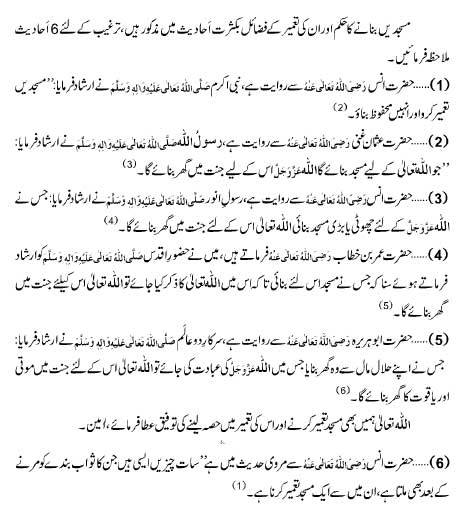
TAG: Mosque
Good Deeds That We Can Do Every Day To Increase Our Hasanaat
Praise be to Allah.
If Allah helps him to do righteous deeds, the Muslim can earn a great deal of reward.
There are many different kinds of righteous deeds that can be done by rich and poor, old and young, male and female, depending on each person’s circumstances, ambition and energy, after the help of Allah.
Allah says (interpretation of the meaning):
“Whoever works righteousness — whether male or female — while he (or she) is a true believer (of Islamic Monotheism) verily, to him We will give a good life (in this world with respect, contentment and lawful provision), and We shall pay them certainly a reward in proportion to the best of what they used to do (i.e. Paradise in the Hereafter)”
[al-Nahl 16:97]
It was narrated from Abu Hurayrah that the Messenger of Allah (peace and blessings of Allah be upon him) said: “Hasten to do good deeds before there come tribulations like pieces of a dark night, when a man will be a believer in the morning and a kaafir by evening, or he will be a believer in the evening and a kaafir by morning, selling his religious commitment for worldly gain.” Narrated by Muslim, 118.
The kinds of good deeds that a person can do every day include the following:
1 – Praying in congregation in the mosque
It was narrated from Abu Hurayrah that the Prophet (peace and blessings of Allah be upon him) said: “Whoever goes to the mosque in the morning and evening, Allah will prepare for him an honorable place in Paradise every time he goes and comes.”
Narrated by al-Bukhaari, 631; Muslim, 669.
2 – Attending funerals and offering the funeral prayer
It was narrated that Abu Hurayrah (may Allah be pleased with him) said: The Messenger of Allah (peace and blessings of Allah be upon him) said: “Whoever attends a funeral until he offers the (funeral) prayer will have one qiraat (of reward) and whoever attends until the burial is done will have two qiraats.” It was said: “What are the two qiraats?” He said: “Like two great mountains.”
Narrated by al-Bukhaari, 1261; Muslim, 945
The Exalted Status Of Al-Aqsa Mosque
AL-AQSA is the first Qiblah (direction of prayer) of Muslims, and the land of Al-Israa’ and Al-Mi’raj. Our hearts bleed for all the sacrilegious acts been perpetrated against Al-Aqsa. The status of Al-Aqsa is clearly explained in the Hadith that reads: “People are not to travel except to three mosques: The Sacred Mosque (in Makkah), Al-Aqsa Mosque (in Jerusalem), and my Mosque (in Madinah).” (Reported by Muslim)
The city of Jerusalem was chosen at the command of Allah by Prophet Dawud (David, peace be upon him), in the 10th century B.C. After him his son Prophet Sulayman (Solomon, peace be upon him) built a mosque in Jerusalem according to the revelation that he received from Allah. For several centuries this mosque was used for the worship of Allah by many Prophets and Messengers. It was destroyed by the Babylonians in the year 586 B.C., but it was soon rebuilt and was rededicated to the worship of Allah in 516 B.C.
It continued afterwards for several centuries until the time of Prophet Isa (Jesus, peace be upon him). After he departed this world, it was destroyed by the Romans in the year 70 C.E. Prophet Muhammad (peace be upon him) was taken there in his miraculous journey of Al-Israa’ and from there he went for Al-Mi’raj. When Muslims took the city of Jerusalem in 636 C.E. during the caliphate of Umar he ordered for the building of this mosque again and it stands until now as a Masjid for the worship of Allah as it was originally built by our Prophet Sulayman (peace be upon him).
The significance of Jerusalem is that it is the city of many Prophets of Allah as Makkah is the city of Prophets Ibrahim (Abraham), Isma’il (Ishmael) and Muhammad (peace be upon all of them). The Mosque of Al-Aqsa is one of the ancient mosques and in the Qur’an Allah called it and its land “… the neighborhood whereof We have blessed…” (17: 1)
When Prophet Muhammad (peace be upon him) was in Makkah and also for about 17 months after his Hijrah to Madinah, he and his followers used to pray toward the direction of Al-Aqsa Mosque. This was to establish in the minds of Muslims the link between the teachings of Prophet Muhammad and other Prophets of Allah (peace be upon them all). When this principle was established in their minds then Allah ordered Muslims to turn to the Ka’bah and pray toward its direction.
Now, we are not allowed to pray to the direction of Jerusalem and Al-Aqsa Mosque, but we must respect and honor the city of Jerusalem and its blessed mosque. It is also the duty of all Muslims to guard and protect this mosque from any harm and damage, for the mosque belongs to those who believe in all the Prophets and Messengers of Allah.
Etiquette Of Jumu’ah
1 . Every Muslim should make preparations for jumu’ah from Thursday. After the asr salaat of Thursday, he should make a lot of istighfaar. He should clean his clothes and keep them ready. If he does not have any perfume in his house, then if it is possible he should try and obtain some and keep it ready so that he will not get distracted with these things on jumu’ah. The pious people of the past have stated that the person to receive the most benefit on Friday will be that person who waits for it and who makes preparations for it from Thursday. The most unfortunate person will be he who does not even know as to when Friday will fall, so much so that he will ask the people in the morning as to which day this is. Some pious people used to go and stay in the jaame musjid from the night of jumu’ah in order to make full preparations for the following day. (Ihya aul-Uloom, vol. 1, page 161)
2 . On the day of jumu’ah, ghusl should be made and the hair of the head and the rest of the body should be thoroughly washed. It is also very virtuous to use the miswaak on this day.
3 . After making ghusl, a person should wear the best clothing that he possesses, and if possible he should also apply some perfume. He should also clip his nails.
4 . He should try and go very early to the jaame musjid. The earlier a person goes, the more reward he will receive. Rasulullah (Allah bless him & give him peace) said: “On the day of jumu’ah, the angels stand at the entrance of that musjid in which jumu’ah salaat is to be offered. They write down the name of the person who enters the musjid first, and thereafter the name of the person who follows, and they continue doing this . The person who entered first will receive the reward of sacrificing a camel in the path of Allah, the one who followed him will get the reward of sacrificing a cow, thereafter a chicken, thereafter the reward of giving an egg as charity in the path of Allah. Once the khutbahcommences, the angels close the register and begin listening to the khutbah. ” (Bukhari and Muslim)
In olden times, the roads and alleys used to be extremely busy in the mornings and at fajr time . All the people used to go so early to the jaame musjid and there used to be such a large crowd that it used to look like the days of Eid . Later, when this habit was given up, people began saying that this is the first innovation in Islam. After writing this, Imam Ghazali rahmatullahialayh says: “Aren’t the Muslims ashamed of themselves that the Jews and Christians go so early in the morning to their synagogues and churches on Saturdays and Sundays. Those who are businessmen go so early to the bazaars in order to do their buying and selling . Why don’t the Muslims do the same?” The reality of the situation is that the Muslims have totally reduced the value of this blessed day. They do not even know what day this is, and what a high status it has. How sad it is that the day which was more valuable than eid in the eyes of Muslims of the past, which Rasulullah (Allah bless him & give him peace) was proud of and the day which was not granted to the previous nations has become so dishonoured at the hands of Muslims today and it is such a great ingratitude to the favor of Allah Ta’ala that the consequence of all this can be seen with our very eyes.
5 . By going walking for the jumu’ah salaat, one gets the reward of fasting for one year for every step that he takes. (Tirmidhi)
6 . On Fridays, Rasulullah (Allah bless him & give him peace) used to recite Surah Alif Laam Meem Sajdah and Surah Hal Ataa, in the fajr salaat . These Surahs should therefore be occasionally recited in the fajr salaat on Fridays . Occasionally they should be left out so that people do not regard their recitation as wajib.
Finding Time For The Family
Today an average person spends more dedicated time with technological devices than with people. We do not even realize nowadays how for hours we are occupied with televisions, laptops, smartphones, and game consoles that we hardly spend time with our families. It’s time we woke up to reality: family members need to communicate more with each other.
Weekdays are a whirl of chores, activities, classes, errands, and deadlines; the morning’s whiz-by and the evenings provide a fleeting respite from the day’s drudgery. The family hopes for a “slower” weekend, one that’ll allow them to spend more time together. But with the presence of 24-hour Internet, weekend TV programs, and the washer waiting to be loaded with a pile of laundry, the weekend is gone before anyone can even say ‘Subhan Allah.’
However, there are creative ways of cashing in on must-do activities that can make family members enjoy each other’s company more.
Everyday Islamic gathering
“And warn your nearest family members.” (Qur’an, 26:214)
There’s nothing like Allah’s speech, the Qur’an, to bond its adherents together by true love, one that is for the sake of Allah. An hour before dinner or after Fajr, the family can sit around the dining table to read the Qur’an aloud to each other. This could be followed by a reading from Hadith books like Riyad-us-Saaliheen or stories from the Seerah.
Going to mosque
The mosque should be like a second home to a Muslim family. Everyone should try to attend the weekly Jumuah congregation together. If that’s not possible, try to go to mosques for lectures, as they are usually available to both men and women. Going with the family will give a sense of togetherness, Insha, Allah boosts everyone’s faith at the same time and keep up with the obligation to learn Islam.
Things To Do Before Friday Prayer
Friday prayer is very special. It is the only weekly prayer that must be offered in congregation at a mosque or a place known to the local community. As we pray five obligatory prayers every day, it is the only one in 35 prayers that has these conditions. It is at midday, so everyone is able to attend, even those who work night shifts. It is preceded by a speech delivered by the imam, who is required to remind his congregation of the Day of Judgment and to address some of the issues that are very important to the community.
Islam attaches particular importance to cleanliness and purity, both physical and spiritual. Since Friday prayer must be in the congregation, mosques are always full when it is offered. In order that people not to find at the mosque what makes them dislike attendance there, Islam requires that we observe certain rituals when attending Friday prayer. These are summed up in the following Hadith in which Salman Al-Farisi quotes the Prophet (peace be upon him) as saying: “Whoever takes a bath on Friday, purifying himself as much as he can, and then applies a touch of oil or uses some of the perfume of his household, then goes out to prayer, making sure that he does not separate two people, then prays whatever is assigned to him, then listens when the imam speaks, will have all his sins forgiven between that day and the other Friday.” (Related by Al-Bukhari).
The emphasis on cleanliness and good presentation is clear. The first thing one does on Friday is to take a bath or a shower before going out to the mosque. Then one applies oil or a similar product so as to make himself more presentable: his hair will be tidy and his appearance pleasant. He should also wear some perfume. The Prophet speaks of the “perfume of his household” to indicate that perfume should be in every Muslim’s home so that wearing it is common practice, done by everyone. In another version of this Hadith, the phrase used is “his wife’s perfume,” to indicate that if one does not normally use perfume, then he should borrow a touch of perfume from his wife. In the same version, reported by Abdullah ibn Umar, there is an added phrase: ‘then wears some of his better clothes’, which confirms the Quranic directive: “Dress well when you attend any place of worship.” (7: 31)
When one goes out, heading for the mosque, one should walk normally, without rushing or running. He must not engage in any heated argument or use vulgar language. When he arrives at the mosque, he must not go in between people sitting close to each other. The Prophet expresses this as “separating two people.” We all know that some people come late and yet try to move up to the middle of the front of the mosque, disturbing a few people as they walk through the rows. Instead, one should sit where there is a vacancy.
When the imam delivers his speech, everyone should listen attentively, trying to make the maximum benefit from the sermon. No side talk is permissible when the imam is speaking.
Observing all these simple instructions ensures good attendance at mosques and keeps mosques clean. What is more for the individual is forgiveness of sins for a week. Scholars say that the Hadith could be taken as indicating forgiveness of sins of the week that has already passed, or the forthcoming week. They also indicate that this applies to minor sins. Cardinal sins require more than attending Friday prayers to be forgiven. The first thing required is repentance and appealing for God’s forgiveness. Added to that is a firm resolve that one is not going to commit those sins again.
– By Adil Salahi
Supremacy Of Congregational Prayer
Narrated Abu Huraira (Radi Allah Anhu) Allah’s Apostle (sal-allahu-alleihi-wasallam) said:
The congregational prayer of anyone amongst you is more than twenty (five or twenty-seven) times in reward than his prayer in the market or in his house, for if he performs ablution completely and then goes to the mosque with the sole intention of performing the prayer, and nothing urges him to proceed to the mosque except the prayer, then, on every step which he takes towards the mosque, he will be raised one degree or one of his sins will be forgiven. The angels will keep on asking Allah’s forgiveness and blessings for every one of you so long as he keeps sitting at his praying place. The angels will say, O Allah, bless him! O Allah, be merciful to him! as long as he does not do Hadath or a thing which gives trouble to the other.
The Prophet further said, One is regarded in prayer so long as one is waiting for the prayer.
[Sahih Al-Bukhari: Volume 3, Book 34 Sales and Trade , Number 330]
Allah Says in The Holy Quran Chapter 29 Surah Ankabut Verse 45 Regarding Some Of The Wisdom Behind The Act Of Salaah :
O Prophet, Recite This Book (Al Quran) Which Has Been Revealed To You, And Establish The Salaat. Surely The Salaat Restrains From indecent And Evil Acts, And The Remembrance Of Allah is indeed The Greatest. And Allah knows Whatever You Do.
Basics Of Zakaah
Important Points on Zakaah
1. Zakaah is Fard upon all Muslim adults, who are free from debts and who have possessed wealth for the full 12 months. This wealth must be equal to the Nisaab.
2. The rate of Zakaah is 2.5 percent on wealth (money, gold, or silver).
3. It is Fard to make the Niyyah when giving Zakaah.
4. Zakaah is actually a “religious tax” that is paid by rich people to the poor.
5. By us paying Zakaah, we are actually cleaning our money.
6. Zakaah also teaches us to be honest in our earnings and business dealings.
7. Zakaah must not be seen as a burden or punishment, but as a form of Ibaadah.
8. Muslims can also help the poor by giving Sadaqa.
9. By giving Zakaah and Sadqa, wealth is being divided among all Muslims.
10. Zakaah became Fard during 2 A.H.
To whom can Zakaah be given?
Zakaah can be given to:
1. The poor and needy.
2. A person in serious debt.
3. A traveler who has run short on cash.
4. Students who are not able to pay for their education.
5. Muslims only.
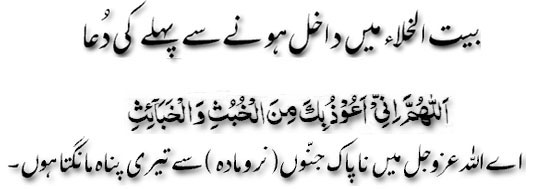
Important Duas – Part 1
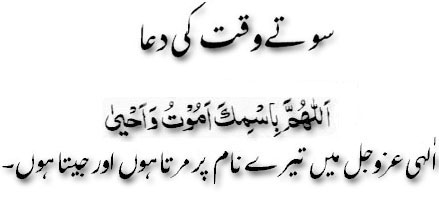
Soney Waqt ki dua
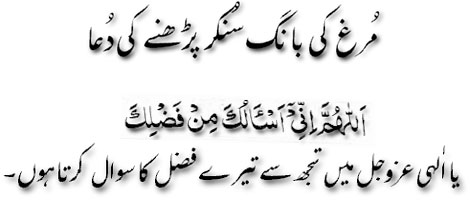
murgh bang dua
Beautiful One Liners
1. Give Allah what’s right, not what’s left.
2. Man’s way leads to a hopeless end Allah’s way leads to endless hope.
3. A lot of kneeling will keep you in good standing.
4. He who kneels before Allah can stand before anyone.
5. In the sentence of life, the devil may be a comma, but never let him be the full stop.
6. Don’t put a question mark where Allah puts a full stop.
7. Are you wrinkled with burden? Come to the mosque for a face-lift.
8. When praying, don’t give Allah instructions, just report for duty.
9. Don’t wait for six strong men to take you to the mosque.
10. We don’t change Allah’s message; His message changes us.
11. The mosque is prayer-conditioned.
12. When Allah ordains, He sustains.
13. Warning: Exposure to Allah may prevent burning.