

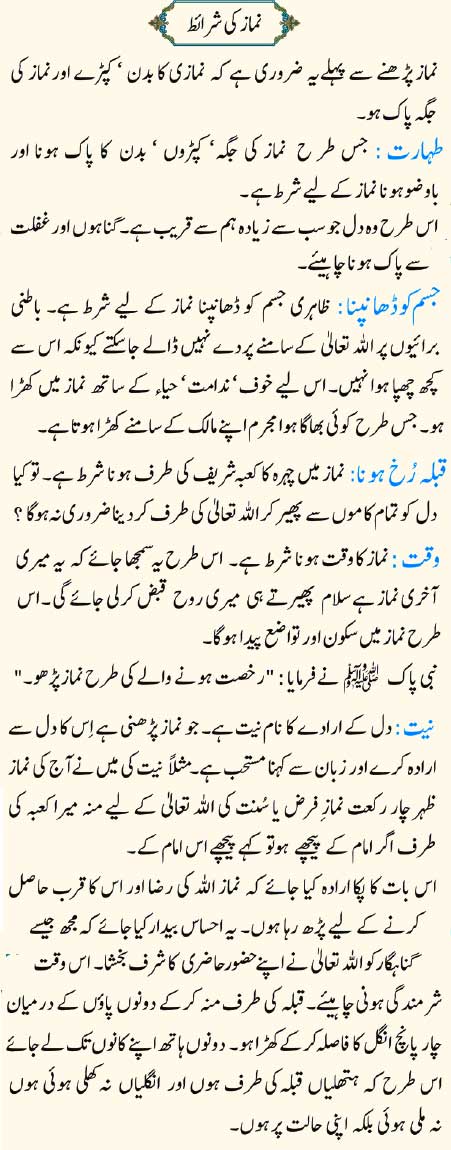
TAG: niyyah
The Meaning And Rules Of Fasting
Muslims all over the world wait eagerly for Ramadan, as it is a time of increased inner peace and well-being.
Fasting in the month of Ramadan is obligatory upon every Muslim, male or female, who is adult (i.e., has reached puberty) and sane and who is not sick or on a journey.
Sickness could be a temporary sickness from which a person expects to be cured soon. Such a person is allowed not to fast during the days of his/her sickness, but he/she must fast later after Ramadan to complete the missed days.
Those who are sick with incurable illness and expect no better health are also allowed not to fast but they must pay the fidyah, which is giving a day’s meals for each fast missed to a needy person. One can also give instead the money for meals to a needy person.
Women in their menses and post-natal bleeding are not allowed to fast, but they must make up later after Ramadan. If pregnant women and mothers who are nursing babies find it difficult to fast, they can also postpone their fasting to a later time when they are in a better condition.
A journey according to the Shariah is any journey that takes you away from your city of residence, a minimum of 92 kilometers. The journey must be for a good cause. It is a sin to travel in Ramadan in order to avoid fasting. A Muslim should try to change his/her plans during Ramadan to be able to fast and should not travel unless it is necessary. The traveler who misses the fasts of Ramadan must make up those missed days later as soon as possible after Ramadan.
Fasting according to the Sunnah
1) Take suhoor (pre-dawn meal). It is Sunnah and there is a great reward and blessing in taking suhoor. The best time for suhoor is the last half hour before dawn or the time for Fajr prayer.
2) Take iftar (breakfast) immediately after sunset. Shariah considers sunset when the disk of the sun goes below the horizon and disappears completely.
3) During the fast, abstain from all false talks and deeds. Do not quarrel, have disputes, indulge in arguments, use bad words, or do anything that is forbidden. You should try to discipline yourself morally and ethically, besides gaining physical training and discipline. You should also not make a show of your fasting by talking too much about it, or by showing dry lips and a hungry stomach, or by showing a bad temper. The fasting person must be a pleasant person with good spirits and good cheer.
4) During the fast, do acts of charity and goodness to others and increase your worship and reading of the Qur’an. Every Muslim should try to read the whole Qur’an at least once during the month of Ramadan.
I’tikaf – The Spiritual Retreat
The Messenger of Allah (blessings of Allah be upon him and his family) is reported to have said:
“The persons who seclude himself (for I’tikaf) in true faith and hope (of reward from Allah), all of his previous sins shall be forgiven.” (Kanzul Ummal, Hadith 24007)
The meaning of Itikaf is to seclude oneself in the Masjid with the express niyyah (intention) of Itikaf.
Allah has indeed in his perfect wisdom created humanity in a unique way. He has made it such that from time to time His creation needs a rest. We rest at night to give our bodies time to recover. Birds retire to their nests, horses to their stables, bees to their hives, etc. However, there comes a time when more intensive rest or retreat is required. Sometimes due to a person’s physical condition, he is admitted into the hospital’s intensive care unit allowing his or her body time to recover.
Likewise, the soul also needs to recover from the hustle and bustle of the world, the spiritual pollution caused by evil elements of society, the rat race of wanting, desiring, and acquiring more of this world, and the distractions that have diverted our mind, heart, and soul from the remembrance of Allah Ta’ala and His Beloved Messenger Muhammad (peace be upon him).
The Intensive Care Unit(ICU) for the soul is the Musjid and Itikaf is the facility within this ICU to allow the soul to not only recover but be spiritually rejuvenated!
Itikaf is indeed a Spiritual Retreat!
Inside each and every human being, a constant battle rages. It is like a battle between two wolves. One of the wolves is evil. It is full of hate, lust, and greed. His fangs drip with bitterness and strife. The other wolf is a good one. He is full of love, compassion, and honesty. He never betrays his brother.
These two wolves are constantly at war. Which wolf is going to win the battle?
The answer is quite obvious…. Whichever one you feed.
Our soul is being bombarded by forces of good and evil. We need to feed it good so that it overpowers the evil….and Itikaf is indeed an excellent opportunity to achieve this.
Since the life of the transient world keeps us busy for the whole year with studies, work, social functions, business, traveling, and other such things that cause us to be negligent of our souls and the next life, we may sometimes think that these things are the sole purpose in life and thus, we end up forgetting our true goal – Allah (Glory and Greatness be to Him). Thus, it is for this reason that I’tikaf is referred to as “The spring of life in a world struck with the drought of the negligence of Allah (Glory and Greatness be to Him).”
The period of I’tikaf is the best time to force one’s self to sit and think and reflect on the self and the world around; the period of the I’tikaf is the best time to forget the worries of the transient world and to return to nurturing the soul and linking oneself with the Creator of the soul; the period of the I’tikaf is the best time to return back to Allah (Glory and Greatness be to Him) in true repentance for our sins committed through the year and to give our souls the spiritual strength desperately needed to live a spiritual and pure life in this challenging world.