


Hadith Qudsi: Sila Rehmi
TAG: Rizq
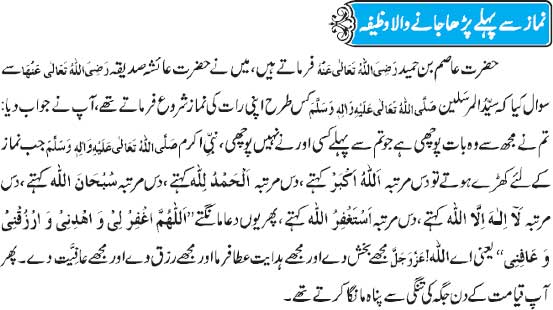
Namaz Se Pehle Parha Jane Wala Wazifa
Sarf e Daulat Mein Aitadal

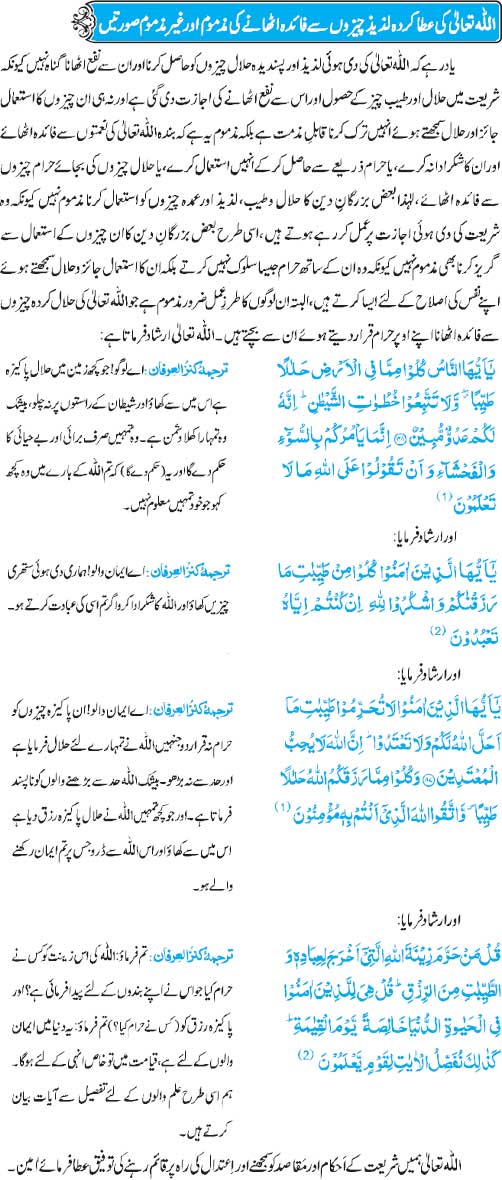
Allah Ki Atta Karda Laziz Cheezo Say Faida Uthane Ki Suratien
Jannat Mein Behisab Rizq Milay Ga

Love For Allah Ta’ala And Rasulullah
1. Hadhrat Anas (radiallahu anhu) narrates that Rasulullah (sallallahu alayhi wasallam) said:
“Whoever has in him three things, will experience the sweetness of Iman.”
(These are):
i) His love for Allah and His Rasool is more than that for all and everything.
ii) His love for another (person) is motivated by only the love of Allah. i.e. His love and friendship with people are not for worldly motives. He befriends people because they happen to be pious men of Allah).
iii) A man who, after having been saved by Allah from kufr, abhors returning to kufr as much as he abhors falling into a fire.” (Bukhari and Muslim)
2. Hadhrat Anas (radiallahu anhu) narrates that Rasulullah (sallallahu alayhi wasallam) said:
“You cannot have total Iman as long as you do not love me more than your father, children and all people.” (Bukhari, Muslim-Mishkaat)
3. Hadhrat Anas (radiallahu anhu) narrates that Rasulullah (sallallahu alayhi wasallam) said:
“A man cannot be perfect of Iman as long as his love for me is not more than his love for his whole family and for all people.” (Muslim)
Also in Bukhari Shareef, it is recorded that Hadhrat Umar (radiallahu anhu) said:
“O Rasulullah! Most assuredly, I love you more than all things, but my own life.”Rasulullah (sallallahu alayhi wasallam) said: ‘I swear by The Being in Whose Power is my life! One is not a perfect believer until one loves me more than one’s own life.” Hadhrat Umar (reflected and) exclaimed: “I now love you more than my own life.”
Rasulullah (sallallahu alayhi wasallam) replied: “Now you are a perfect Muslim.”
Initially, Hadhrat (radiallahu anhu) did not reflect and thought that since one is affected more by difficulty on oneself than difficulty on another, one’s life must be dearer than another’s. However, upon reflection, he realized that for the sake of Rasulullah (sallallahu alayhi wasallam) every Muslim will readily sacrifice his own life and the dignity and honour of Rasulullah (sallallahu alayhi wasallam), even the ordinary Muslim will be prepared to lay down his life at the altar of sacrifice. Hadhrat Umar (radiallahu anhu) thus realized that in actual fact his love for Rasulullah (sallallahu alayhi wasallam) was greater than his love for his own life. And, so it was and remained until the end Hadhrat Umar (radiallahu anhu) remained steadfast on the Deen never turning his face away from the Deen by the slightest degree.
4. Hadhrat Ibn Abbaas (radiallahu anhu) narrates that Rasulullah (sallallahu alayhi wasallam) said:
“Love Allah Ta’ala because He nourishes and sustains you; love me because Allah Ta’ala loves me.” (Tirmizi)
It is not to be inferred from this hadith that we have to love Allah Ta’ala only because He nourishes us. This hadith merely implies that should one be unable to comprehend the limitless and vast favours and bounties of Allah Ta’ala, then at least contemplate and understand this one great Ni’mat of nourishment (Rizq). No one can ever deny or ignore this obvious fact of Allah Ta’ala being the sole Nourisher and Sustainer. Hence, understanding even this single fact will induce one love for Allah Ta’ala.
5. Hadhrat Anas Rasulullah (sallallahu alayhi wasallam) narrates that a villager came to Rasulullah (sallallahu alayhi wasallam) and said:
“O Rasulullah! When will it be Qiyaamah?” Rasulullah (sallallahu alayhi wasallam) said: “What preparations have you made for it?” He replied: “I have no much Salaat nor Saum, but I have love for Allah and His Rasool.” Rasulullah (sallallahu alayhi wasallam) said: “On the Day of Qiyaamah every person will be with the one whom he loved.”
This meant that on the Day of Qiyaamah those who had loved Rasulullah (sallallahu alayhi wasallam) will be with him. Along with this great fortune, they will be in close proximity to Allah Ta’ala. Hadhrat Anas (radiallahu anhu) then commented:
“After having heard this good news, Muslims became exceedingly happy. After having embraced Islam nothing else (besides their embracing) made them as happy (as this statement of Rasulullah (sallallahu alayhi wasallam).” (Bukhari, Muslim)
The glad tidings conveyed in this hadith are of great significance. Even if one has no great stock of acts of Ibaadat, the love of Allah and His Rasool (sallallahu alayhi wasallam) will secure the treasure of Divine Proximity for one in the Aakhirah.
6. Hadhrat Abu Zarr Ghiffaari (radiallahu anhu) narrated that once Rasulullah (sallallahu alayhi wasallam) performed Salaat (Tahajjud). The whole night in his Salaat he recited a single aayat until the morning. The aayat is:
“O Allah! (If you punish them, they are your servants (i.e. You have all the authority over them). If You forgive them (it is within Your Power), for You are All-Powerful and the One of Wisdom.” (Nisaai and Ibn Majah)
Shaikh Dehlwi (rahmatullah alayh) commenting on this hadith, says that the Qur’aanic aayat which was recited the whole night by Rasulullah (sallallahu alayhi wasallam) is the statement of Nabi Isaa (alayhis salaam), which he will be making (on the Day of Qiyaamah) in regard to his Ummah. Rasulullah (sallallahu alayhi wasallam) presented his Ummah’s case for Maghfirat (forgiveness) to Allah Ta’ala in the same manner. This loving attitude of Rasulullah (sallallahu alayhi wasallam) bears testimony to his great love for his Ummah. For the sake of this love, he sacrificed the comfort of whole nights, petitioning and appealing to Allah Ta’ala to forgive his Ummah. It will only be a callous and a heartless one whose heart is not moved when he hears of the great love which Rasulullah (sallallahu alayhi wasallam) had for the Ummah.
7. Hadhrat Abu Hurairah (radiallahu anhu) narrates that Rasulullah (sallallahu alayhi wasallam) said:
“My similitude with you is like a man who strives to prevent moths falling into a fire. The moths plunge into the fire while the man makes great attempts to save them. In spite of his efforts, they continue to fall into the fire. Similarly, I relentlessly grab hold of you and divert you from the Fire (so that you do not plunge into Jahannum by commission of evil), but you continue with your plunge into the Fire.” (Bukhari)
This hadith too indicates the tremendous love and concern which Rasulullah (sallallahu alayhi wasallam) had for his Ummah. His profound concern to save his Ummah from the calamities of the Aakhirah is a manifestation of his love for the Ummah. Which Ummati can ignore this love?
8. Hadhrat Ibn Abbaas Mardas (radiallahu anhu) narrates that Rasulullah (sallallahu alayhi wasallam) made dua of Maghfirat (forgiveness) for his Ummah in the evening of Arafaat. The Divine Answer came: “Your Ummah has been forgiven, excepting huqooqul Ibaad (i.e. the rights of others which were usurped and plundered and for which no proper amends were made).”
Rasullullah (sallallahu alayhi wasallam) then petitioned Allah Ta’ala:
“O, Allah! If You wish, You can award the rights (which were plundered here) of the oppressors with Jannat and forgive the oppressed.”
However, this dua was not accepted on that night. During the morning at Muzdalifah, Rasulullah (sallallahu alayhi wasallam) repeated the dua. On this occasion, the request was granted. The acceptance of this dua induced Rasulullah (sallallahu alayhi wasallam) to laugh with delight Rasulullah (Sallallahu alayhi wasallam) then said to Abu Bakr and Umar (radiallahu anhumaa):
“When Allah Ta’ala accepted my dua and forgave my Ummah, Iblees rubbed hand in his face and cried in despondency and defeat. I laughed on seeing his discomfort.” (Ibn Majah, Baihaqi)
This hadith must not be misconstrued. The inference should not be drawn that usurped, plundered and unfulfilled rights of creation (Huqooqul Ibaad) will compulsorily at all times be waived, without any punishment nor does it mean that the performance of Hajj cancels out such rights. The interpretation of this hadith consists of two possibilities:
1. The possibility of remaining in Jahannum forever as punishment for the usurpation of huqooqul Ibaad.
2. Definite punishment for huqooqul ibaad although such punishment will not be everlasting residence in Jahannum.
When Rasulullah (sallallahu alayhi wasallam) made the due, two Divine Promises were the result:
1. Everlasting residence in Jahannum (the first possibility mentioned above) as compensation for plundering huqooqul ibaad was cancelled. After serving one’s sentence of punishment in Jahannum, one will emerge therefrom and attain salvation.
2. Certainty of punishment for huqooqul ibaad (the second possibility) cancelled. In fact, there will be cases where Allah Ta’ala will by the presentation of favours and ni’mat to the oppressed secure in return forgiveness for the oppressors. The oppressed will become pleased with the bounties and happily pardon the oppressors.
Once again we must reflect and realize the tremendous and deep love which Rasulullah (sallallahu alayhi wasallam) cherished for the Ummah. His concern for the Ummah was so great that he persisted in the supplication to secure forgiveness for even the oppressors of his Ummah. Is it yet possible that the heart of the Believer will not brim over with love for Rasulullah (sallallahu alayhi wasallam)?
9. Hadhrat Abdullah Bin Amr Bin Al-A’as (radiallahu anhu) narrates that once Rasulullah (sallallahu alayhi wasallam), after reciting those verses in which are mentioned the duaa of Hadhrat Ibraheem and Hadhrat Isaa (alahimus salaam) for their respective Ummats, raised his hands and supplicated to Allah Ta’ala as follows:
“O Allah! My Ummah, my Ummah.” Allah Ta’ala said: “Jibraeel, go to Muhammad (sallallahu alayhi wasallam) Your Creator is aware (of all things) and ask him the reason for his grief.”
Jibraeel (alayhis salaam) enquired the reason from Rasulullah (sallallahu alayhi wasallam) for his grief and tears. Rasulullah (sallallahu alayhi wasallam) informed Jibraeel (alayhis sallam) of his concern for the Ummah. Jibraeel (alayhis sallaam) then brought the following message from Allah Ta’ala: “We shall please you in regard to your Ummah and We shall not let you grieve.” (Muslim)
According to Hadhrat Ibn Abbas (radiallahau anhu), Rasulullah (sallallahu alayhi wasallam) said that he will never be happy as long as there remains a single member of his Ummah in the Fire. (Durrul Manthur). In terms of this Divine Promise to Rasulullah (sallallahu alayhi wasallam), Insha’ Allah, Ta’ala will not leave a single Ummati in Jahannum.
O Muslims! The wonderful treasures of the Aakhirah which you will be acquiring will be through the auspicious agency of Rasulullah (sallallahu alayhi wasallam). If, therefore, you cannot love him, for who will you ever love.
10. Hadhrat Umar (radiallahu anhu) narrated that there was a man by the name, Abdullah and was known as Himaar. Rasullullah (sallallahu alayhi wasallam) had punished him for having consumed liquor. After having been punished he was once again brought to Rasulullah (sallallahu alayhi wasallam) for the same crime. Rasulullah (sallallahu alayhi wasallam) ordered him to be punished. Someone cursed him (Himaar) for repeatedly committing the crime. Rasulullah (sallallahu alahi wasallam) commented: “Do not curse him. I swear by Allah that I know he has love for Allah and His Rasool.” (Abdu Dawood)
One can from this incident realize the honour and love which Rasulullah (sallallau alayhi wasallam) had for one who was imbued with love for Allah and love for the Rasool. Even after repeatedly having indulged in a major sin, Rasulullah (sallallahu alayhi wasallam) forbade people from cursing the wrong-doer. It is now necessary that every Muslim fills every vein in his body with the love of Allah and the love of Rasulullah (sallallahu alayhi wasallam). The noble and priceless treasures of the Aakhirah are procurable by virtue of this love without difficulty.
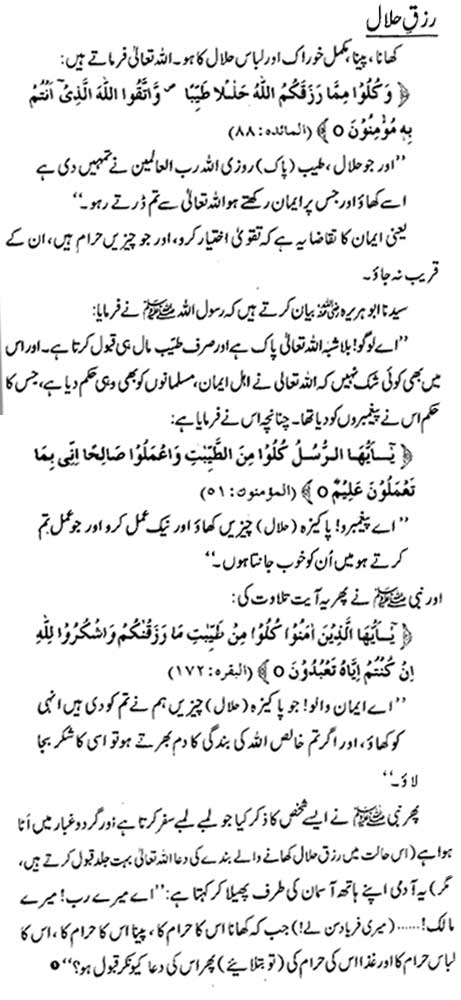
Halal Rizq
Allah’s Promises of Rizq
I was talking to a brother about Allah’s promise for the Rizq for the maklook( creations), but on the other hand, Allah’s promise for the Jannah for one if we are obedient to Allah. Yet people are running after the Duniya for their Rizq which has already been promised by Allah. We should be trying for the Jannah, which has been promised only with our effort. Arriving home I thought to share a few thoughts on this with you.
First, off all let’s agree on the meaning of Rizq mentioned below:
Rizq is earnings, profit, or wealth
The definition of rizq includes everything whether its wealth, spouse, CHILDREN, provisions, sustenance, which of course includes food, clothing, shelter, etc
“All aspects of a person’s subsistence and livelihood fall under the definition of rizq, including but not restricted to wealth, status, business, and children.”
We see in this capitalist society, everyone will do anything that is possible to gain their Rizq. People think they are expanding their rizq by doing haram, opening liquor shops, but they aren’t. Islam tells us the rizq is assigned at our birth and on top of that Allah Subhanahu Wa Ta’ala made five promises of Rizq.
1. Taqwa
“And whoever fears Allah, for him Allah brings forth a way out, and gives him provision (rizq) from where he does not even imagine…” (Surah At-Talaq: 2/3)
In reference to this Ayaat-i- Karima:
“The word taqwa primarily and literally means ‘to guard’ or ‘to refrain’. In Islamic terminology, it signifies ‘to guard against sins’. When the word is related to Allah, it is translated as ‘to fear Allah’ and implies ‘to avoid disobedience of Allah and guard against sins’.”
Once, Saiyyidina Umar ibn al-Khattab (radhiall ahu anho) asked Saiyyidina Ka’ab Ahbaar (radhiallahu anho): “What is the reality of Taqwa?”
Ka’ab (radhiallahu anho) said: “Have you ever passed a thorny tree?”
Umar (radhiallahu anho) answered: “Yes.”
Ka’ab (radhiallahu anho) asked: “How did you pass?”
Umar (radhiallahu anho) answered: “I passed with such care that I ensured that no thorn got caught into my hem.”
Ka’ab (radhiallahu anho) then elaborated: “In the very same way, the reality of Taqwa is for one to save himself from the thorns of sins and negligence.”
So, this is the first thing with which Allah Ta’ala promised the righteous believers, that He will ease every difficulty of theirs and provide for them all their needs from resources they never expected or thought about.
2. Daily Five Prayers
Everyone who ever spends time in Jama’at should know that through the daily five prayers Allah Ta’ala makes the rizq easy – if you don’t then you should definitely spend time in the way of Allah. Anyone for 4 months? Anyway…
A hadith states: “Salaah is the cause of Allah’s pleasure: It is a beloved act of the Malaikah (angels), a sunnah of the Ambiyaa (alayhimus salam), the nur (light) of ma’rifah is achieved by it, du’aas are accepted, and barakah in rizq is attained.”
Once a Sahabi (radhiallahu anho) said: “When the household of Sayyidina Rasulullah (Sallallahu Alayhi Wasallam) experienced difficulty in their expenses he commanded the performing of salaah, and recited this aayah:
“And enjoin upon thy people worship, and be constant therein. We ask not of thee a provision: We provide for thee. And the sequel is for righteousness.” (Surah Ta Ha: 132)”
3. Istighfar
Sayyidina Rasulullah (Sallallahu Alayhi Wasallam) has said in another Hadith: “The one who seeks forgiveness for Muslim males and females from Allah Ta’aala twenty-six or twenty-five times every day, Allah Ta’ala will count that person among those whose Du’a is accepted, and through the barakah of whom those on earth gain rizq (sustenance) .”
Rasulullah (Sallallahu Alayhi Wasallam) not only made himself 70 till 100 times a day Istighfar and Taubah, but as well enjoined the Muslims to ask Allah Ta’ala frequently for forgiveness. One of the many virtues of Istighfar, that can be found in Ahadith, is that Allah Subhanahu wa Ta’ala deals with the person engaging much in Istighfar in a similar way like with the servant attaining Taqwa.
Sayyidina Abdullah bin Abbas (radhiallahu anho) narrates that Sayyidina Rasulullah (Sallallahu Alayhi Wasallam) said: “The one who (regularly) says Istighfaar, that is, frequently repent to Allah Ta’aala for sins committed, Allah ‘Azza Wa-Jalla will open a path from poverty and difficulties. All sorrow and hardship will be removed, and in its place prosperity and contentment granted. One will receive sustenance from unimagined and unexpected sources.”
4. Tawakul On Allah
Tawakkul on Allah could be translated as sincere reliance on Allah Subhanahu wa Ta’ala. In our context right now it means to be 100% convinced that Allah will definitely give me the rizq, that He has fixed for me. If all creations of Allah Subhanahu wa Ta’ala (malaikah, jinns, humans, animals etc.) come together to change something about that, they simply can not.
Sayyidina Rasulullah (Sallallahu Alayhi Wasallam) has said: “If you have proper and sincere tawakkul (reliance) on Allah Ta’ala. He will grant you rizq like the birds are given rizq, who come out of their nests in the morning with empty stomachs and return to their nests in the evening with a full stomach. Allah Ta’aala says:
“And whoever places his trust in Allah, He is sufficient for him.” (Surah At-Talaq: 3)”
That’s how the Ayaat quoted above continues. Subhan’Allah, what an amazingly illustrious example our beloved Prophet Muhammad Mustafa (Sallallahu Alayhi Wasallam) has given, may Allah shower His blessings upon him and his family.
Sayyidina Imraan bin Husayn (radhiallahu anho) narrates from Sayyidina Rasulullah (Sallallahu Alayhi Wasallam) that: “The person who (sincerely) relies on Allah Ta’aala, Allah Ta’aala will suffice for all the responsibilities of that person. Rizq will be received from such sources, whence it cannot be imagined. The one who relies on the (material) world, Allah Ta’aala hands that person over to the world.”
“One who wishes to become the strongest should make tawakkul on Allah Ta’aala. One who wishes to become the most respectful should adopt taqwa (piety). The one who wishes to become the wealthiest should rely more on the qudrah (power) of Allah than that which is in ones possession.”
5. Infaaq Fisabilillah
It’s no secret that when spending or giving charity in the path of Allah, Allah Ta’ala according to His boundless mercy gives back much times more. There are many Ahadith regarding this, but to spare you time I’ll just type the incident of Hadhrat Sayyidina Ali (karamallahu wajuhu) and a beggar which will make you understand this concept very easily.
Oh yeah, and I almost forgot Asbab. There are no promises of Allah attached to Asbab, but our Yaqeen nowadays is made on them. May Allah forgive us and bring all these attributes into our life. Ameen!
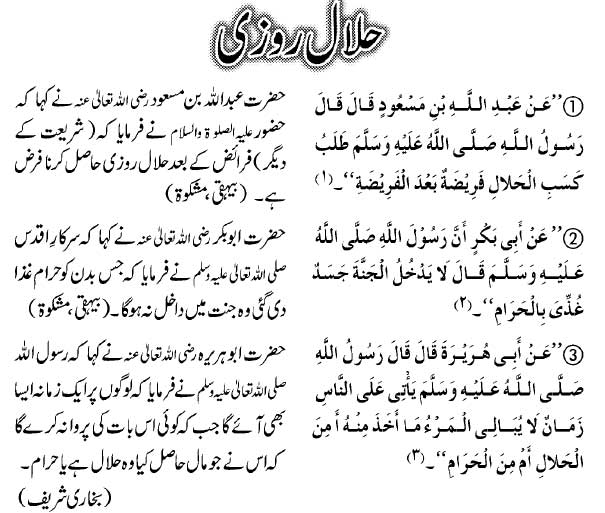
Rizq-e-Halal
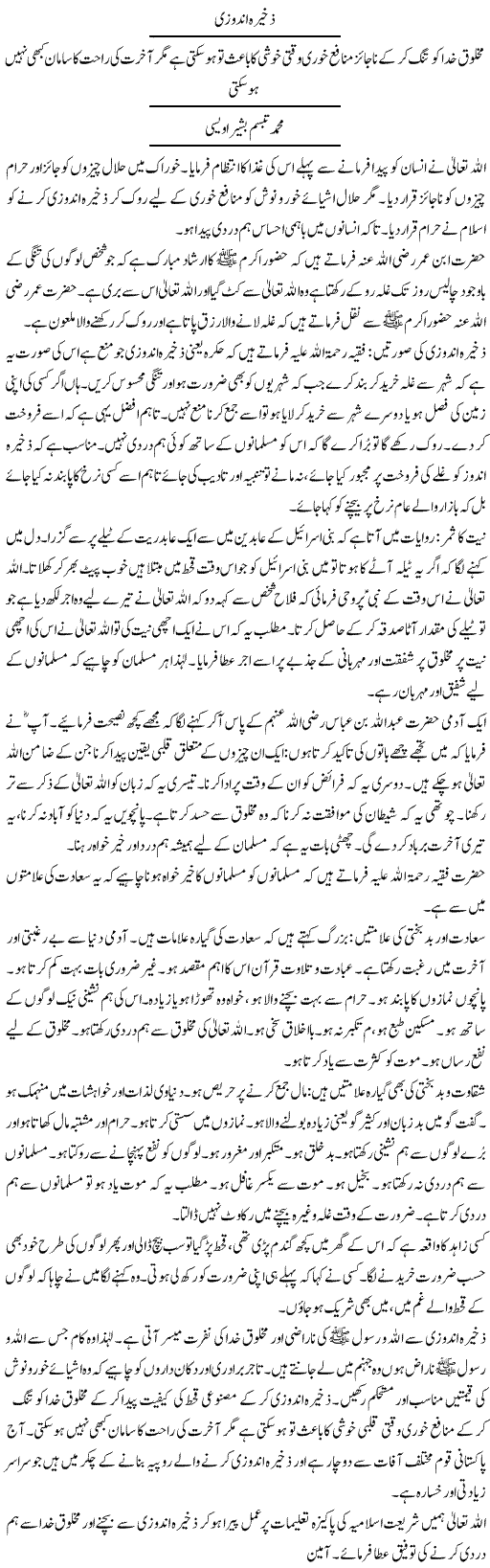
Zakheera Andozi