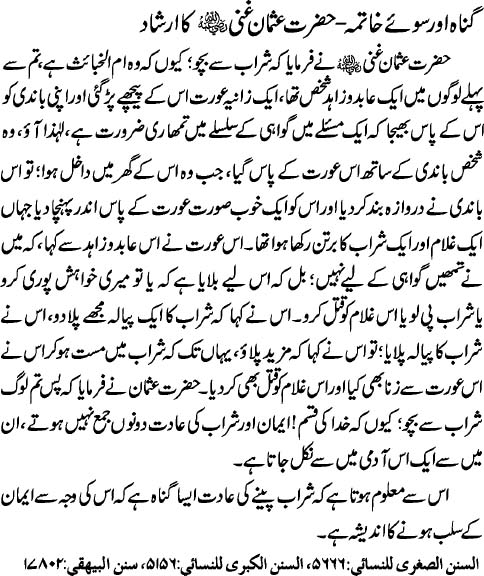
Gunnah Aur Bura Khatma: Hazrat Usman Ghani (radi Allahu anhu) Ka Irshad
TAG: Syedna Usman e Ghani
Marvels And Excellence Of Sayyiduna Uthman al-Ghani [Radi Allahu Ta’ala Anhu]
On the 18th of Zul Hijjah, the 35th year of the Hijrah, the companion of our beloved Prophet (Sallallahu Alayhi wa Sallam), Sayyiduna Usman Al-Ghani (Radi Allahu Anhu) was ruthlessly martyred. He was the third Khalifah (caliph) amongst those known as the Khulafah al-Rashideen. His patronymic (Kunyah) is Abu Amr. He is also known as Zun-Nurayn (i.e. Possessor of two Lights) because the Noble Prophet gave two of his honorable daughters’ hands in marriage one after the other to the Honorable Usman Al-Ghani (Radi Allahu Anhu).
He embraced Islam at the very advent [of Islam]. He is also known as “Sahib al-Hijratayn” (the one who migrated twice) because firstly he migrated to Habshah (Ethiopia) and then to Madinatul Munawwarah.
Ameer al-Mu’mineen, Sayyiduna Uthman Al-Ghani (Radi Allahu Anhu) was an ardent follower of the Beloved Prophet (SallAllahu Alayhi wa Sallam). He was, in fact, the embodiment of love of the Holy Prophet (Sallallahu Alayhi wa Sallam). Absolute submission to the Sunnah manifests in his words and deeds.
★ One day Sayyiduna Uthman Al-Ghani (Radi Allahu Anhu) sat by the entrance of the Masjid and asked for the meat of the limb of a goat and consumed it. He, then, offered Salah without redoing the Wudu and explained that the Noble Prophet (Sallallahu Alayhi wa Sallam) also consumed the same [whilst] sitting in the same place, and did it in the same way. [Musnad Imam Ahmed bin Hanbal, Vol. 1, Page 137, Hadith 441]
★ Once Sayyiduna Uthman Al-Ghani (Radi Allahu Anhu) smiled whilst performing Wudu. The people asked the reason, to which he replied, “Once I saw that the Holy Prophet (Sallallahu Alayhi wa Sallam) smiled having performed Wudu at this very place.” [Musnad Imam Ahmed bin Hanbal, Vol. 1, Page 130, Hadith 415]
★ Sayyiduna Abu Hurairah (Radi Allahu Anhu) narrates, “Uthman bought Jannah twice from the Prophet. Firstly, on the day of ‘The Well of Ruma’ and secondly, when the Muslims were in a very poor state.” [Al-Mustadrak li al-Hakim, Vol. 3, Page 107; Tarikh Dimashq al-Kabir, Vol. 41, Page 49; Al-Kamil li Ibn Adi, Vol. 2, Page 464]
★ When the migrants came to the blessed city of Madina Munawwarah, they did not like the taste of the water. A man from the tribe of Bani Ghaffar possessed a well, named Ruma, full of sweet water. He used to sell this water to the people. The Prophet (SallAllahu Alayhi wa Sallam) asked him if he would sell his well for a spring in paradise. The man replied, “O Prophet of Allah! This is my only income.” Hearing this, Syyiduna Uthman (Radi Allahu Anhu) came and bought the well for thirty-one thousand. He then came to the Prophet (Sallallahu Alayhi wa Sallam) and asked, “Will I be able to get the spring of Paradise as you said, if I would buy the well from him?” The Prophet (Sallallahu Alayhi wa Sallam) said, “Yes.” Thus, Sayyiduna Uthman (Radi Allahu Anhu) stated, “I have bought the well of Ruma and given it to the Muslims.” [Al-Mu’jam al-Kabir, Vol. 2, Page 41-42, Hadith 1226; Tarikh Dimashq al-Kabir, Vol. 41, Page 49; Kanz al-Ummal, , Vol. 13, Page 35-36, Hadith 36183]
★ When the Prophet (Sallallahu Alayhi wa Sallam) was preparing for the battle of Tabuk, the Muslims were in need of some financial support. At this moment the Prophet (Sallallahu Alayhi wa Sallam) sought the help of Sayyiduna Uthman Radi Allahu Anhu. Hadrat Uthman (Radi Allahu Anhu) gave 10,000 Dinars, thereafter the Prophet said, “O Uthman! May Allah forgive your outer and inner mistakes and forgive all that which you commit till the Day of Judgement. Uthman can do whatever he wills.” [Kanz al-Ummal, Vol. 13, Page 38, Hadith 36189]
★ Sayyiduna Abdullah bin Umar (Radi Allahu anhuma) has stated that Uthman bin Affan’s (Radi Allahu Anhu) absence from the battle of Badr was because the daughter of the Prophet of Allah (Ruqayyah), who was his wife, fell ill. Allah’s Prophet (Sallallahu Alayhi wa Sallam) said to him, “You will receive the same reward and share (of the booty) as anyone of those who participated in the battle of Badr (if you stay with her).” [Sahih al-Bukhari, Vol. 1, Page 523; Musnad Ahmad ibn Hanbal, Vol. 2, Page 101; Jaami’ Tirmidhi, Vol. 5, Page 395, Hadith 3726]
★ This was the specialty of Sayyiduna Uthman (Radi Allahu Anhu) as whoever does not attend the battle does not get his share of the booty. Hadrat Abdullah bin Umar (Radi Allahu Anhuma) has said, “The Prophet (Sallallahu Alayhi wa Sallam) allocated for him his share and did not do so for anyone else who was absent.” [Sunan Abi Dawud, Vol. 2, Page 18]
★ Sayyiduna Shurhabil bin Muslim (Radi Allahu Anhu) has reported, “Ameer al-Mu’mineen, Sayyiduna Uthman Al-Ghani (Radi Allahu Anhu) would feed the people with lavish food, and he himself would go home and remain contented with vinegar and olive only.” [Az-Zuhd lil Imam Ahmad, Page 155, Hadith 684]
★ He was known for his modesty, generosity and braveness. The beloved Messenger of Allah (Sallallahu Alayhi wa Sallam) said, “Should I not show modesty to one whom even the Angels show modesty.” [Sahih Muslim, Hadith 2402]
★ Ameer al-Mu’mineen, Sayyiduna Usman al-Ghani (Radi Allahu Anhu) has said, ‘The hand by which I committed Bay’ah (spiritual bond) in the blessed hands of the Most Noble Prophet (Sallallahu Alayhi wa Sallam), I have never touched my genital organ with that (i.e. right hand) thereafter.’ [Az-Zuhd lil Imam Ahmad, Page 155, Hadith 685]
★ Sayyiduna Usman al-Ghani (Radi Allahu Anhu) has said, “I swear by Allah! I never committed fornication during the pre-Islamic era of ignorance nor have I committed it after embracing Islam.” [Sunan Ibn Majah, Vol. 1, Page 99]
★ Sayyiduna Hasan al-Basri (Radi Allahu Anhu) has mentioned explaining the extreme modesty of Ameer al-Mu’mineen, Sayyiduna Usman al-Ghani (Radi Allahu Anhu), “If he had been in some room with the door properly shut, even then he would not put off his clothes for taking the bath nor would he straighten his back out of modesty.” [Hilyat al-Awliya, Vol. 1, Page 94, Hadith 159]
★ Ameer al-Mu’mineen, Sayyiduna Usman al-Ghani (Radi Allahu Anhu) would always observe Nafl (supererogatory) Fasts. Having taken rest during the initial part of the night, he would stand vigil (for worship) for the rest of the night. [Musannaf Ibn Abi Shaybah, Vol. 2, Page 173]
★ Whenever Ameer al-Mu’mineen, Sayyiduna Usman al-Ghani (Radi Allahu Anhu) would get up to offer the Salah of Tahajjud at night, he would himself arrange water for performing the Wudu. When it was asked, ‘Why do you bother yourself; let your servant do it for you’, He replied, “No, the night is theirs; it is for their rest.” [Ibn Asakir, Vol. 39, Page 236]
★ Sayyiduna ‘Abdullah bin ‘Umar (Radi Allahu anhuma) has reported that the beloved Prophet (Sallallahu Alayhi wa Sallam) prophesized a heretical event and informed Sayyiduna Uthman Al-Ghani (Radi Allahu Anhu) that he will be wickedly martyred in that. [Tirmidhi, Vol. 5, Page 395, Hadith 3728]
★ Sayyiduna Abdullah bin Salam (Radi Allahu Anhu) has stated: When the rebels had laid siege to the sanctified house of Uthman Al-Ghani (Radi Allahu Anhu) even a single drop of water was not allowed to supply his blessed home. Sayyiduna Uthman Al-Ghani would feel restless due to severe thirst. He was observing fast during the day and I went to see him. He looked at me and said, ‘O! Abdullah bin Salam, I beheld the Noble Prophet (Sallallahu Alayhi wa Sallam) through this skylight. The Most Merciful Prophet (Sallallahu Alayhi wa Sallam) said in a very sympathetic manner, ‘O Uthman! These people have made you restless by thirst blocking the water?’ I respectfully replied, ‘Yes.’ So, the Noble Prophet (SallAllahu Alayhi wa Sallam) immediately lowered a bucket towards me that was filled with water. I quenched my thirst. I can still feel the soothing effect of that water between both of my breasts and both of my shoulders.
The Prophet (SallAllahu Alayhi wa Sallam) then said, ‘O Uthman! If you wish, I’ll help you against these people; or if you like you may come to me and break your fast in my company.’ I respectfully replied, ‘Ya Rasool Allah (Sallallahu Alayka wa Sallam); breaking my fast in your graceful court is dearer to me.’ Sayyiduna Abdullah bin Salam stated that he returned that day and Sayyiduna Uthman was martyred on that same day by the rebels. [Kitab al-Manamat, Vol. 3, Page 74, Hadith 109]
★ Imam Jalal al-Din Suyuti (Alayhir Rahmah) has narrated that Shaykh Ibn Batish (Alayhir Rahmah) deduced that this event (of the sighting of the Noble Prophet Sallallahu Alayhi wa Sallam) was not a dream, rather it took place whilst awake. [Al-Hawi lil Fatawi, Vol. 1, Page 151]
★ Sayyiduna ‘Adi bin Hatim has stated that on the day when Sayyiduna Uthman Al-Ghani (Radi Allahu Anhu) was martyred, I heard with my ears that someone was saying aloud, “Give Uthman Al-Ghani the glad tidings of comfort and fragrance; tell him the delightful news about meeting with Rab (Azza wa Jal). Who is not displeased; also give him the glad tidings of forgiveness and the pleasure of his Rab (Azza wa Jal).”
Shaykh ‘Adi bin Hatim further stated that he looked around, but he did not see anyone. [Ibn Asakir, Vol. 37, Page 355; Shawahid al-Nubuwwah, Page 209]
★ It has been reported that some of the close companions of Uthman Al-Ghani (Radi Allahu Anhu) took his body to Jannat-ul-Baqi’ at night taking advantage of the darkness. They were digging the grave when suddenly a large number of riders entered Jannat-ul-Baqi’. The devotees got frightened. The riders said loudly, ‘Do not fear; we are here to take part in his burial.’ Hearing this, people’s fear abated and Sayyiduna Uthman Al-Ghani (Radi Allahu Anhu) was buried in peace. After returning from the graveyard the Sahaba al-Kiram (Alayhim ar-Ridwan) swore to the people that the riders were in fact, angels. [Shawahid al-Nabuwwah, Page 209]
Sayyiduna ‘Uthman Ghani (RA) The Third Caliph Of Islam
Election
Before he passed away, Sayyiduna Umar (radi Allahu anhu) appointed a six-man Committee to elect his successor from among themselves. After long discussions and consultation, they elected Sayyiduna ‘Uthman bin Affan (radi Allahu anhu) as the third Caliph of Islam.
Early Life
Sayyiduna ‘Uthman (radi Allahu anhu) belonged to the Ummayah tribe of the Quraish. He was a very rich cloth merchant. He was known as “Al Ghani” or “The Generous.” His father’s name was Affan and his mother was Urwa.
He accepted Islam at the invitation of Sayyiduna Abu Bakr (radi Allahu anhu) and migrated to Abyssinia with his wife, Sayyadah Ruqayyah (radi Allahu anha), who was also the daughter of Sayyiduna Rasulullah (sallal laahu alaihi wasallam).
After she passed away, he married Sayyadah Umme Kulthum (radi Allahu anha), another daughter of Sayyiduna Rasulullah (sallal laahu alaihi wasallam). Because of this, he earned the title “Zun Noorain” or “Possessor of Two Lights.” He took part in all the battles with Sayyiduna Rasulullah (sallal laahu alaihi wasallam) except the Battle of Badr.
Conquests
During the Khilaafat of Sayyiduna ‘Uthman (radi Allahu anhu), the rebellion in Azerbhaijaan and Armenia was silenced.
Sayyiduna Mu’awiyah (radi Allahu anhu), with the help of Sayyiduna Abi Sarah (radi Allahu anhu), captured Cyprus by naval attack and brought it under Islamic rule. Vast areas of North Africa including Tripoli, Tunisia, and Morocco were also brought under Islamic rule.
The Romans, although defeated several times by the Muslims in the past, made another attempt, during the Khilaafat of Sayyiduna ‘Uthman (radi Allahu anhu), to recapture the lands they had already lost. Constantine, the Emperor of Rome, made great preparations and attacked Alexandria with a naval fleet of five to six thousand strong. But, the Romans were defeated by the Muslim naval forces under the command of Sayyiduna Abi Sarah and Sayyiduna Mu’awiyah (radi Allahu anhuma).
Rebellion
The Governors of the provinces, appointed by Sayyiduna Umar (radi Allahu anhu), were removed and replaced by members of the new Caliph’s clan. The majority of the new governors were inspired by worldly means rather than by the piety and interests of their subjects. People started to demand the removal of these Governors, but the Caliph did not respond to their appeals. Delegates mainly from Iraq and Egypt, submitted their demands to the Caliph. The situation, however, got out of control.
Assassination
In the turmoil, Sayyiduna ‘Uthman (radi Allahu anhu) himself was made Shaheed by rebels while he was reading the Holy Quran inside his house. This happened on Friday, the 17th of Zil Hajj in 35 A.H. He was 84 years old.
Character
Sayyiduna ‘Uthman (radi Allah anhu) was a very simple and very kind person. His simplicity and kindness did not allow him to take strong action against the troublemakers and rioters. Above all, because of his simple-mindedness, his administration was not as disciplined as it had been during the Khilaafat of Sayyiduna Umar (radi Allahu anhu).
Sayyiduna ‘Uthman (radi Allahu anhu) was a generous man. He used to spend a lot of money for Islam and to free the slaves. He was a great and pious man who feared and loved Almighty Allah and Sayyiduna Rasulullah (sallal laahu alaihi wasallam) above everything else. Although he was very rich, his life was very simple. He did not indulge in luxury. He was ever mindful of death. Major parts of the night were spent in Salaah. He also fasted every second or third day.
The Holy Quran
A major achievement of Sayyiduna ‘Uthman (radi Allahu anhu) was the duplication of the Holy Quran from the records kept by Sayyiduna Abu Bakr (radi Allahu anhu), who handed it to Sayyiduna Umar (radi Allahu anhu), who then handed it to his daughter, Sayyadah Hafsa (radi Allahu anha), the wife of Sayyiduna Rasulullah (sallal laahu alaihi wasallam).
Sayyiduna ‘Uthman (radi Allahu anhu) made copies of the Holy Quran from the original and sent it to capitals such as Kufa, Damascus, Makkatul Mukarramah, and Basrah, each accompanied by a Sahabi for the guidance of the readers.
Ruhama’ Baynahum: Aapas Mein Rehm Karnay Waley

Ruhama’ Baynahum: Aapas Mein Rehm Karnay Waley by Mufti Muneeb
Katib-e-Wahi, Nashir-o-Hafiz Quran Syedna Usman-e-Ghani Zulnoorain
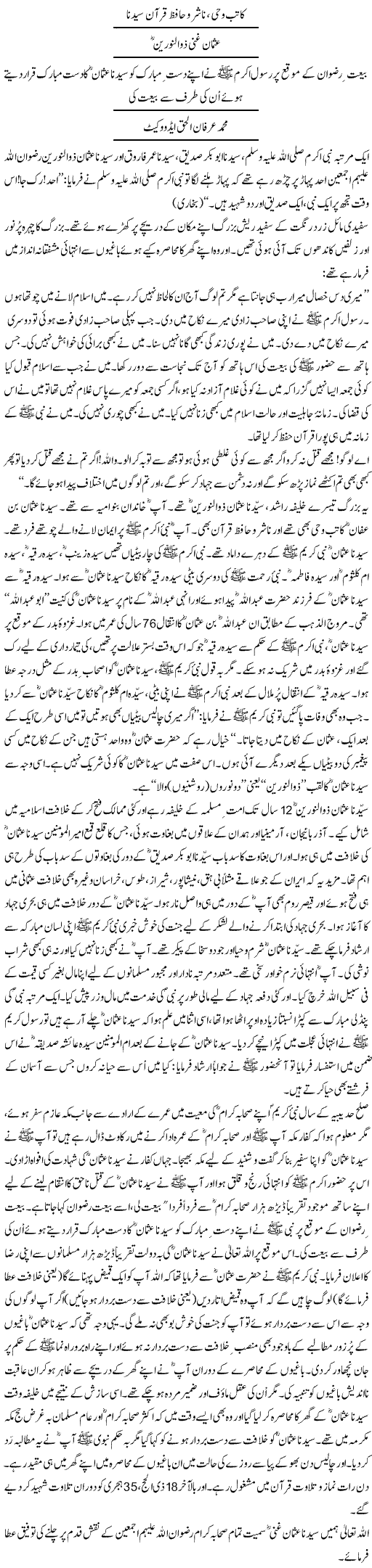
Katib-e-Wahi, Nashir-o-Hafiz Quran Syedna Usman-e-Ghani Zulnoorain
Ehd Khulafa-e-Rashideen Mein Aman Aur Rawadari

Authenticity Of Quran
One of the most common myths about the Qur’an is that Usman (r.a.), the third Caliph of Islam authenticated and compiled one Qur’an, from a large set of mutually contradicting copies. The Qur’an, revered as the Word of Allah (swt) by Muslims the world over, is the same Qur’an as the one revealed to Prophet Muhammad (PBUH). It was authenticated and written under his personal supervision. We will examine the roots of the myth which says that Usman (r.a.) had the Qur’an authenticated.
1. Prophet Muhammad (PBUH) himself supervised and authenticated the written texts of the Qur’an
Whenever the Prophet received a revelation, he would first memorize it himself and later declare the revelation and instruct his Companions (R.A. ‘Radhi Allahu Taala Anhu’) May Allah be pleased with him who would also memorize it. The Prophet would immediately ask the scribes to write down the revelation he had received, and he would reconfirm and recheck it himself. Prophet Muhammad (PBUH) was an Ummi who could not read and write. Therefore, after receiving each revelation, he would repeat it to his Companions. They would write down the revelation, and he would recheck by asking them to read what they had written. If there was any mistake, the Prophet would immediately point it out and have it corrected and rechecked. Similarly, he would even recheck and authenticate the portions of the Qur’an memorized by the Companions. In this way, the complete Qur’an was written down under the personal supervision of the prophet (PBUH).
2. Order and sequence of Qur’an divinely-inspired
The complete Qur’an was revealed over a period of 22½ years portion by portion, as and when it was required. The Qur’an was not compiled by the Prophet in the chronological order of revelation. The order and sequence of the Qur’an too was Divinely inspired and was instructed to the Prophet by Allah (SWT) through archangel Jibraeel. Whenever a revelation was conveyed to his companions, the Prophet would also mention in which surah (chapter) and after which ayat (verse) this new revelation should fit.
Every Ramadhaan all the portions of the Qur’an that had been revealed, including the order of the verses, were revised and reconfirmed by the Prophet with archangel Jibraeel. During the last Ramadhaan, before the demise of the Prophet, the Qur’an was rechecked and reconfirmed twice.
It is therefore clearly evident that the Qur’an was compiled and authenticated by the Prophet himself during his lifetime, both in the written form as well as in the memory of several of his Companions.
3. Qur’an copied on one common material
The complete Qur’an, along with the correct sequence of the verses, was present during the time of the Prophet (PBUH). The verses, however, were written on separate pieces, scrapes of leather, thin flat stones, leaflets, palm branches, shoulder blades, etc. After the demise of the prophet, Abu Bakr (r.a.), the first caliph of Islam ordered that the Qur’an be copied from the various different materials onto a common material and place, which was in the shape of sheets. These were tied with strings so that nothing of the compilation was lost.
4. Usman (r.a.) made copies of the Qur’an from the original manuscript
Many Companions of the Prophet used to write down the revelation of the Qur’an on their own whenever they heard it from the lips of the Prophet. However, what they wrote was not personally verified by the Prophet and thus could contain mistakes. All the verses revealed to the Prophet may not have been heard personally by all the Companions. There were high possibilities of different portions of the Qur’an being missed by different Companions. This gave rise to disputes among Muslims regarding the different contents of the Qur’an during the period of the third Caliph Usman (r.a.).
Usman (r.a.) borrowed the original manuscript of the Qur’an, which was authorized by the beloved Prophet (PBUH), from Hafsah (may Allah be pleased with her), the Prophet’s wife. Usman (r.a.) ordered four Companions who were among the scribes who wrote the Qur’an when the Prophet dictated it, led by Zaid bin Thabit (r.a.) to rewrite the script in several perfect copies. These were sent by Usman (r.a.) to the main centers of Muslims.
There were other personal collections of the portions of the Qur’an that people had with them. These might have been incomplete and with mistakes. Usman (r.a.) only appealed to the people to destroy all these copies which did not match the original manuscript of the Qur’an in order to preserve the original text of the Qur’an. Two such copies of the copied text of the original Qur’an authenticated by the Prophet are present to this day, one at the museum in Tashkent in and the other at the Topkapi Museum in Istanbul, Turkey.
5. Diacritical marks were added for non-Arabs
The original manuscript of the Qur’an does not have the signs indicating the vowels in the Arabic script. These vowels are known as tashkil, zabar, zair, paish in Urdu and as Fatah, damma and qasra in Arabic. The Arabs did not require the vowel signs and diacritical marks for correct pronunciation of the Qur’an since it was their mother tongue. For Muslims of non-Arab origin, however, it was difficult to recite the Qur’an correctly without the vowels. These marks were introduced into the Quranic script during the time of the fifth ‘Umayyad’ Caliph, Malik-ar-Marwan (66-86 Hijri/685-705 C.E.) and during the governorship of Al-Hajaj in Iraq.
Some people argue that the present copy of the Qur’an that we have along with the vowels and the diacritical marks is not the same original Qur’an that was present at the Prophet’s time. But they fail to realize that the word “Qur’an” means a recitation. Therefore, the preservation of the recitation of the Qur’an is important, irrespective of whether the script is different or whether it contains vowels. If the pronunciation and Arabic is the same, naturally, the meaning remains the same too.
6. Allah Himself has promised to guard the Qur’an
Allah has promised in the Qur’an :
“We have, without doubt, sent down the Message; and We will assuredly Guard it (from corruption).”
[Al-Qur’an 15:9]
May Allah guide us true path…Aameen
Hazrat Usman, Safeer Nabvi
Madina Kay Kuwein
Hazrat Usman Ghani (R.A)