

Archives
Who Are Believers According To Quran
[9. Surah At-Tawba: Ayah 112] “They who turn (to Allah), who serve (Him), who praise (Him), who fast, who bow down, who prostrate themselves, who enjoin what is good and forbid what is evil, and who keep the limits of Allah; and give good news to the believers.”
[23. Surah Al-Muminun: Ayah 1-11] “Successful indeed are the believers, Who are humble in their prayers, And who keep aloof from what is vain, And who are givers of poor-rate, And who guard their private parts, Except before their mates or those whom their right hands possess, for they surely are not blamable, But whoever seeks to go beyond that, these are they that exceed the limits; And those who are keepers of their trusts and their covenant, And those who keep a guard on their prayers; These are they who are the heirs, Who shall inherit the Paradise; they shall abide therein.”
[42. Surah Ash-Shura: Ayah 36-38] “So whatever thing you are given, that is only a provision of this world’s life, and what is with Allah is better and more lasting for those who believe and rely on their Lord. And those who. shun the great sins and indecencies, and whenever they are angry they forgive. And those who respond to their Lord and keep up prayer, and their rule is to take counsel among themselves, and who spend out of what We have given them. ”
[24. Surah An-Nur: Ayah 30-31] “Say to the believing men that they cast down their looks and guard their private parts; that is purer for them; surely Allah is Aware of what they do. And say to the believing women that they cast down their looks and guard their private parts and do not display their ornaments except what appears thereof, and let them wear their head-coverings over their bosoms, and not display their ornaments except to their husbands or their fathers, or the fathers of their husbands, or their sons, or the sons of their husbands, or their brothers, or their brothers’ sons, or their sisters’ sons, or their women, or those whom their right hands possess, or the male servants not having need (of women), or the children who have not attained knowledge of what is hidden of women; and let them not strike their feet so that what they hide of their ornaments may be known; and turn to Allah all of you, O believers! so that you may be successful.”
Our Lord! grant us good in this world and good in the hereafter, and save us from the chastisement of the fire.
Surah An-Najm Kay Fazail
Praying Duha
Fiqh-us-Sunnah Fiqh 2.31a
The time for ‘duha’ begins when the sun is about a spear’s length above the horizon and it continues until the sun reaches its meridian. It is preferred to delay it until the sun has risen high and the day has become hot.
Zaid ibn Arqam (r.a.)relates: “The Messenger of Allah (s.a.w.s) went to the people of Quba’, and they were performing the ‘Duha’ prayer, and he (s.a.w.s) said: ‘The prayer of ‘Duha’ should be observed when the young weaned camels feel the heat of the sun.'”
Related by Ahmad, Muslim, and at-Tirmidhi .
Fiqh-us-Sunnah Fiqh 2.31b
The minimum number of rak’ah to be prayed in the supererogatory ‘Duha’ (forenoon) prayer is two. The most the Prophet (s.a.w.s) performed was eight rak’at, whereas, the most he (s.a.w.s) mentioned was twelve rak’at. Some eminent scholars, such as Abu Ja’far At-Tabari, Al-Mulaimi, and Ar-Ruwyani, who subscribes to the Shafi’ school of thought, say there is no maximum limit to the number of rak’at that one may perform for the voluntary ‘Duha’ prayers.
Al-‘lraqi says, in the commentary on Sunan At-Tirmidhi: “None of the companions of the Prophet (s.a.w.s) or followers are known to have restricted it to twelve rak’at.” As-Syuti agrees with it.
Sa’id ibn Mansur (r.a.) records that al-Hassan (r.a.) was asked: “Did the companions of the Prophet (s.a.w.s) perform the ‘Duha’ prayer?” He answered: “Yes . . . some of them would pray two rak’at, and some of them would pray four rak’at, and some of them would continue until half the [early] day [had passed].”
Umm Hani (r.a.) narrates that the Prophet sallallahu ‘alehi wa sallam prayed eight rak’at of ‘Duha’ and made the taslim after every two rak’at.
Related by Abu Dawud.
Aishah (r.a.) reports: “The Prophet (s.a.w.s) would pray four rak’at for ‘Duha’ and would add to it whatever Allah willed.”
Related by Ahmad, Muslim, and ibn Majah.
Sahih Al-Bukhari Hadith 2.274 Narrated by Abu Huraira (r.a.)
My friend [the Prophet (s.a.w.s)] advised me to do three things and I shall not leave them till I die, these are: To fast three days every month, to offer the voluntary Duha prayer, and to offer Witr before sleeping.
In light of the above guidance of the Messenger of Allah (s.a.w.s), it would be considered a Sunnah to offer the voluntary ‘Duha’ (forenoon) prayers between the time the sun has completely risen until it reaches its zenith or meridian at mid-day. One may offer a minimum of two rakahs, and a maximum of as much as one wishes.
Parhaiz Ilaj Say Behtar Hai

by Mufti Muneeb ur Rehman
Allah, Be He Glorified From All That They Ascribe As Partner To Him
[ALLAH’S Quran – 9:31] “They have taken as lords beside Allah their rabbis and their monks and the Messiah son of Mary when they were bidden to worship only One Allah. There is no Allah save Him. Be He Glorified from all that they ascribe as partner (unto Him)!
The Prophet (Peace Be Upon Him) has said : [Bukhari, Book 78, Hadith 8] Narrated Anas bin Malik: Allah’s Messenger (PBUH) mentioned the greatest sins or he was asked about the greatest sins. He said, “To join partners in worship with Allah; to kill a soul which Allah has forbidden to kill, and to be undutiful or unkind to one’s parents.” The Prophet (PBUH) added, “Shall I inform you of the biggest of the great sins? That is the forged statement or the false witness.” Shu`ba (the sub-narrator) states that most probably the Prophet said, “the false witness.”
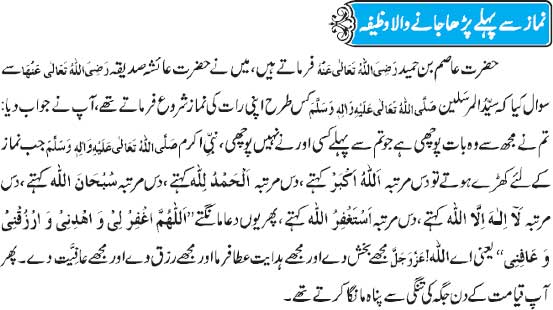
Namaz Se Pehle Parha Jane Wala Wazifa
How To Pray Salatul Tasbih
Many of us know that it is a prayer that we should pray at least once in our lifetimes, although we should make a regular habit of praying it as it is a prayer full of many virtues and benefits. May Allah ta’ala reward every person that benefits from reading and learning from this article….Ameen.
Pray Salatul Tasbih as follows:
This salaat (namaz) is offered by reading four rakaats. At a time and can be read in any part of the day and night beside the three makrooh times, keeping in mind the forbidden times for performing Salat. The Tasbih to be read in Salaat-Ul-Tasbeeh is the third kahalimah:
” Subhaan Allahi Wal Hamdulillahi Wa Laa ilaha illal Laahu Wallahu Akbar ”
Method: The above Tasbih is to be read 300 times in the four Rakaats. In the first rakaat, after reading Sana “Subhaana Kallahumma…”, read the above tasbih 15 times. Now recite Aaoz and “Bismillah…”, Then read sura Fatiha and a Surah then read the tasbih again 10 times. (this will total 25 times) Go into ruku saying Takbeer (Allah Hoo Akbar), after reciting “Subhaana Rabbiyal Azeem” a minimum of three times read the tasbih 10 times in Ruku. (Total 35) Saying “Samee Allahu Liman Hamidah Rabbana Lakal Hamdh” get up from ruku. Now read the tasbih 10 times again. (Total 45) Go into Sajdah saying Takbeer (Allah Hoo Akbar) and after reciting “Subhaana Rabbiyal A’la” minimum of three times read the tasbih 10 times in the first Sajdah. (Total 55) Now sit up from the first Sajdah and sit in the “At-tahiyah” position (sitting position) saying Takbeer (Allah Hoo Akbar). Sitting in this position read tasbih 10 times (total 65) Go into the second sajdah and again read Takbeer (Allah Hoo Akbar) and after reciting “Subhaana Rabbiyal A’la” a minimum of three times read the tasbih 10 times in the second Sajdah again. (total 75)
Get up to begin 2nd Rakat saying Takbeer (Allah Hoo Akbar). Do rakah #2 in the same fashion, but before reading Bismillah “Bismillah…”, and Surah Fatiha, read the tasbih 15 times. Follow the rest as you did in the first Rakat. After the second Sajdah of the Second Rakat sit in Qaidah Oola (first sitting) read Attahiyat, Durood, and Dua then get up for 3rd rakaat without saying, Salam. Begin the third Rakat, just like the first Rakat, with Sana “Subhaana Kallahumma…”, and read the above tasbih 15 times.
Follow the rest as you did in the first Rakat until you sit for Qaidah Akihra (last sitting) after the second sajdah of the fourth Rakah. In Qaidah Akihra Attahiyat (the last sitting position of namaz), Durood, Dua finish Salah with Salam.
Special notes for Salat-Ul-Tasbih:
1) Do not count loudly. It will break your namaz
2) Do not count on fingers or by holding a Bead Tasbih in hand.
3) You may count by pressing the fingers as a reminder. For example, if you are in Ruku. You press the pinky of your right hand first for the first count, then the finger next to it for the second count, then the middle finger for the third count, following this method until you reach the pinky of your left hand will give you an exact count of ten. Use the same method in Qayam, Sajdah, and Jalsa.
4) If missed a count then make it up in the next posture. For example, if forgot to recite Tasbih after Surah in Qayam. Then you may recite Tasbish 20 times instead of 10 in Rukuh after “Subhaana Rabbiyal Azeem”. Missed Tasbih cannot be recited in Qayam after ruku and Jalsa between Sajdah. If you missed the Tasbih in Ruku then recite 20 in the first Sajdah instead of the Qayam after rukuh. Similarly if missed the Tasbih in the first Sajdah then do not make it up in Jalsa. Instead, recite missed tasbih in the second Sajdah. If Tasbih has been missed in the last sajdah of the second or fourth Rakah then you can recite the missed ones before Attahiyat in Qaidah.
5) If you miss a wajib in Salah and have to do Sajdah Sahaw. You don’t have to recite Tasbih in Sajdah sahoo, since the 300 count has been established. But if you missed Tasbih in any of the postures and remember it later, then you may recite the missed Tasbih in Sajdah Sahaw now.
6) It is preferable to recite after Surah Fatiha Sura Takathuur in the first raka’, Surah Wal A’sr in the second raka’, Surah Kaferoon (qul ya aiyuhal Kafiroon) in the third and Surah Akhlas (Qul hu Allah-hu ahd) in the fourth raka’. If one does not remember these surahs they can recite the ones they prefer.
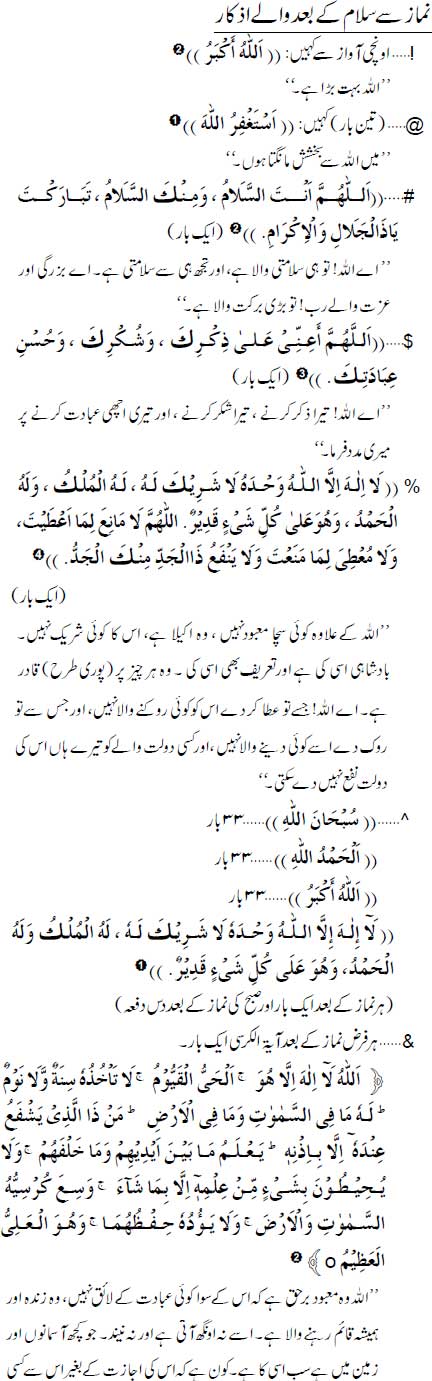
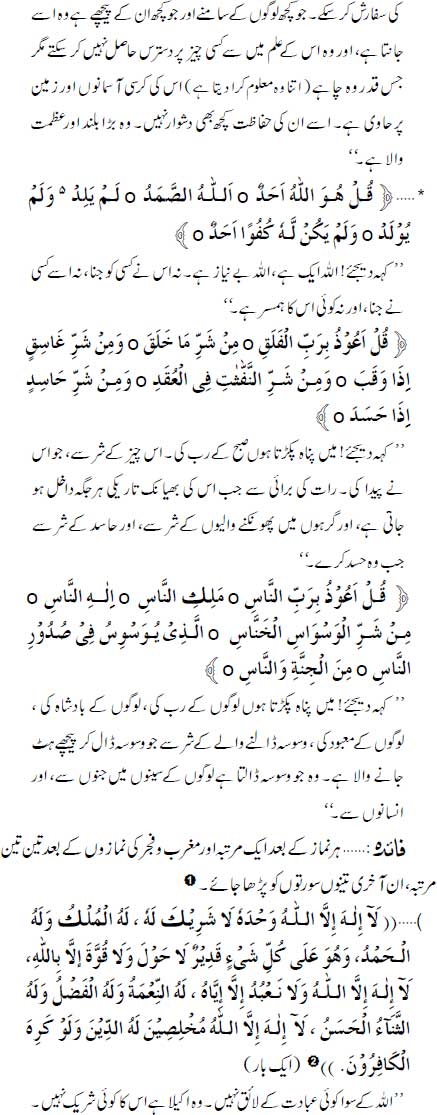
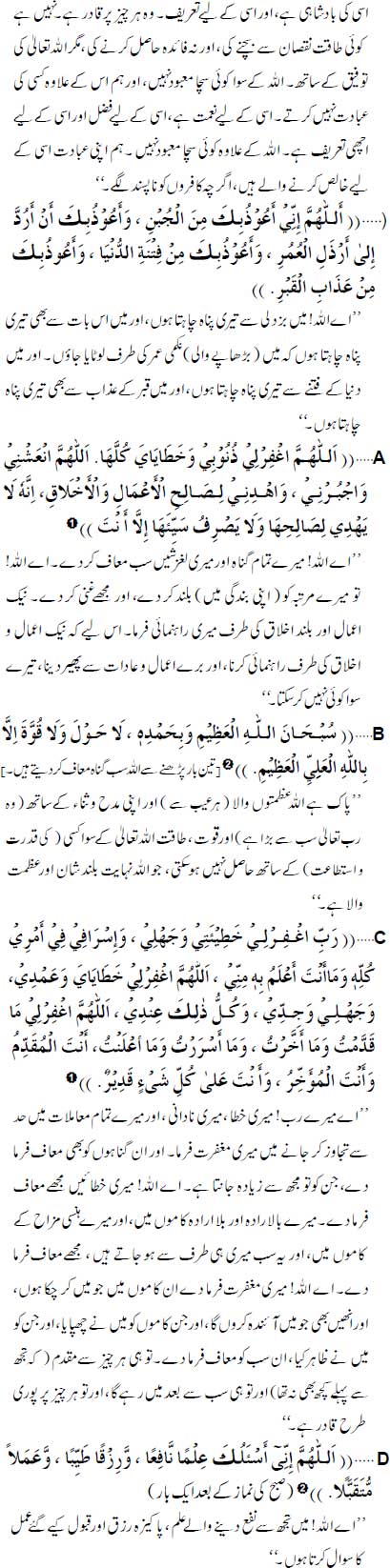
Namaz Say Salam Kay Baad Ki Duaain Aur Azkar
Sincerity In Obedience
Ikhlas (Sincerity)
Sincerity in obeying Allah is among the obligations of the heart. It is also one of the good characteristics. Sincerity in obeying Allah is doing good deeds for the sake of Allah only. It is not doing them to seek the praise and respect of people. Allah made sincerity a condition for the acceptance of good deeds.
Allah, Ta’ala, said in the Qur’an:
Ayah 110 of Surah Al-Kahf means: “Let the one who believes in the Day of Judgment do good deeds without seeking the praise of the people by doing so.”
The sincere person is the one who performs good deeds be it praying, fasting, Hajj, Zakah, or reciting the Qur’an seeking the reward from Allah, and not for the sake of people praising and mentioning him.
The one who is praying should be performing obedience for the sake of Allah only, not so that the people will say: “So and so prays, he does not miss any obligation.”
Also, the one who is fasting should be fasting for the sake of Allah only. The same applies to, the case of the one who is giving Zakah, sadaqah, reciting the Qur’an, or anyone who is performing a good deed.
The Prophet, sallallahu Alayhi wa Sallam, said: “Certainly, Allah loves for one of you when performing a deed to perform it properly.”
Someone said: “How is that, O Messenger of Allah?”
He (sallallahu alaihi wasallam) replied: “One does it only for the sake of Allah and according to the rules of the Religion.”
(Narrated by As-Suyutiyy.)
Riya (Insincerity)
Is the opposite of sincerity. It is doing good deeds, such as fasting, for the praise of the people and their admiration.
Insincerity nullifies the reward of the deed. The performer of any deed that is done with insincerity receives no reward, whether it was done for the praise of people only or coupled with seeking the reward. Moreover, such a person commits an enormous sin.
Priding oneself in obeying Allah
After performing certain types of obedience, some people feel conceitedly proud of these actions. They feel they have high status because of performing these actions, forgetting that Allah is the One Who inspired and enabled them to do these good deeds.
Insincerity and priding oneself on obeying Allah are two sins of the heart. They are also two bad characteristics that the pubescent person must avoid. One should be sincere while obeying Allah to earn the reward from Allah.