

Archives
The Prophet’s Inexhaustible Patience
The source of the Prophet’s courageous determination in the face of all the traumatic experiences he suffered was his strong faith in God. One of the marvelous qualities of the beloved Prophet Muhammad (peace be upon him) was his infinite patience.
God was with Muhammad, as He is always with those who patiently persevere: {God is indeed with those who patiently persevere.} (2:153)
The Quranic word used for patience is sabr, and there is no English equivalent for it.
We can convey the idea of sabr only by phrases such as endurance against afflictions, patience with delay, perseverance against hardships, steadfastness in the face of setbacks, courage against hostilities, self-restraint against provocations, will power against temptations, and equanimity or calmness of mind as regards fortunes and misfortunes.
Persecution against the Prophet
In all the meanings indicated by the above expressions, the Prophet was a perfect model to his followers.
Indeed his life presents the shining example of a man of extraordinary endurance: His father died before his birth; his mother died when he was only six years old, and his grandfather who took up his guardianship also died soon. Then it was his uncle Abu Talib who protected him.
And when God appointed him His last Prophet, he faced the most brutal persecution and hostility from his own people. But these harsh experiences of life did not make him a cynic; on the contrary, they perfected his faith in God, making him all the more strongly committed to his God-given mission.
The records of the Prophet’s life by his contemporaries bear testimony that during the 13 years of his life in Makkah as the messenger of God, he faced all forms of abuse, boycott, expulsion, and threats of physical violence. And yet the Prophet did not budge an inch away from his mission. And all the while, he was gentle, considerate, and sympathetic even to his enemies.
During the early days of his preaching, the people of Makkah had approached him through his uncle Abu Talib and made very tempting offers to him, such as the leadership of the City of Makkah, the most beautiful girl in marriage, and wealth of immense proportions.
The Prophet spurned all these offers and said: “I swear by the name of God, O Uncle, that if they place the sun in my right hand and the moon in my left hand in return for giving up this matter (calling people to Islam), I will never desist until either God makes it triumph or I perish defending it.”
This steadfastness and constancy against temptations were unusual in an Arab of those days.
Grieve Not, God is with Us
And imagine the day when the Prophet had to leave his home, his city, and his people and emigrate to another place! The Hijrah, as the emigration of the Prophet from Makkah to Madinah, is known, was a great sacrifice and a painful decision for the Prophet at the time when he undertook it. But his personal comforts, likes, and dislikes had no value in the face of the immense task before him.
One remembers the time when he and his Companion Abu Bakr were almost overcome by their pursuers in the Cave of Thawr. When Abu Bakr in dismay told the Prophet that they were only two persons against the enemy, he told him with unflinching faith in the Almighty not to grieve, as God was with them. God in the Quran admonishes the Muslims:
{If you will not aid him [Prophet Muhammad], God certainly aided him when those who disbelieved expelled him, he being the second of the two, when they were both in the cave when he said to his companion: Grieve not, surely God is with us. So God sent down His tranquility upon him, strengthened him with hosts that you did not see, and made lowest the word of those who disbelieved; and the word of God, that is the highest; and God is Mighty, Wise..} (9:40)
In the matter of complete reliance on God and faithful submission to Him, the Prophet was an unparalleled model to all Muslims. For he taught his followers:
“When you ask for anything, ask it from God, and if you seek help, seek the help of God. Know that if the people were to unite to do you some benefit, they could benefit you only with what God had recorded for you and that if they were to unite to do you some injury, they could injure you only with what God had recorded for you. The pens are withdrawn and the pages are dry.” (At-Tirmidhi, 1515)
The source of the Prophet’s courageous determination in the face of all the traumatic experiences he suffered was his strong faith in God and his dependence on Him. The Prophet’s conviction that God was with him when he was struggling with adverse circumstances, is evident from this teaching:
“Strange are the ways of a believer for there is good in every affair of his, and this is not the case with anyone else except in the case of a believer; for if he has an occasion to feel delight, he thanks (God); thus there is a good for him in it, and if he gets into trouble and shows resignation (and endures it patiently), there is a good for him in it.” (Muslim, 2999)
Do Patience and Gentleness Go Hand in Hand?
The Prophet was always considerate and understanding, even towards those who were ignorant and arrogant towards him. Indeed his gentleness and patience with them earned their love and respect, as God says in the Quran:
{Thus it is due to mercy from God that you deal with them gently, and had you been rough and hard-hearted, they would certainly have dispersed from around you.} (3:159)
An incident at the Prophet’s mosque in Madinah demonstrates how lenient and kind the Prophet was to ignorant people. Abu Hurairah reports: “A bedouin urinated in the mosque and some people rushed to beat him. The Prophet said, ‘Leave him alone and pour a bucket of water over it. You have been sent to make things easy and not to make them difficult’ (Al-Bukhari,6025)
Once a man approached the Prophet seeking advice, and the Prophet said: “Do not get angry.” The man asked for advice several times and the Prophet replied every time, “Do not get angry” (Al-Bukhari, 48)
The questioner was probably one disposed to a quick temper, and so the Prophet was stressing the need to control his anger. The Prophet also said: “He who is deprived of forbearance and gentleness is, in fact, deprived of all good” (Muslim, 638)
The Prophet of Islam announced forgiveness and amnesty to all his former enemies
We may remember the day of Makkah Victory: The Prophet reentered the city after 10 long years of living in Madinah, and practically there was no opposition as he was accompanied by an overwhelming number of Muslims. The whole of Makkah lay at his feet as he marched in. His enemies stood in surrender awaiting his verdict, and he could very well have cried “havoc” or “let slip the dogs of war” as the triumphant commanders of those days used to do.
Instead, in a historic break from the old tradition, the Prophet of Islam announced forgiveness and amnesty to all his former enemies. He told them simply: “You may go. You are a free people.” (Authenticated by al-Albani)
Such kindness and generosity could not have been in vain, as the whole of the community of Makkah thereafter embraced Islam, a feat that could never have been achieved by the use of force. And certainly, this superb act of forgiveness was in keeping with the Quranic injunction: {Let there be no compulsion in religion.} (2:256)
Unfaltering loyalty to the cause of God is the virtue of prophets. Prophet Muhammad was a brilliant example of a man committed to his divinely appointed mission. So it is no wonder that he stood firm against all opposition and finally succeeded in winning over the hearts and minds of millions.
Living in a fast-moving, high-tech environment of “instant nirvana” and “preemptive redemption,” most people of this postmodern world are programmed to brush aside a religion that insists on a slow-paced, meditative, prayerful form of worship five times a day (salah), as well as on a rigorous form of fasting during the daytime for a whole month (sawm).
Also, zakah and Hajj are indicative of the importance of practicing sabr in our daily life. And it is no exaggeration to say that our beloved Prophet has amply demonstrated through his own life that Islam (submission) is sabr itself; sabr with the fortunes and misfortunes our Creator has apportioned to us in this world.
For those who practice sabr in Islam, there is always the unfailing promise and prospect of a never-ending world of felicity.
By Shahul Hameed
Ehsan Kya Hai?
Emphasis On Blood Relations
The Prophet (peace be upon him) has more claim on the believers than they have on their own selves, and his wives are their mothers. Blood relatives have, according to God’s decree, a stronger claim upon one another than other believers (of Madinah) and those who have migrated (for God’s sake). Nonetheless, you are to act with kindness toward your close friends. This is written down in God’s decree. (The Confederates, Al-Ahzab: 33: 6)
This surah revealed toward the end of the fifth year after the Prophet’s emigration to Madinah begins with important legislation in family matters. It seeks to put these on the right footing. It starts with the abolition of the practice that some Arabs used to resort to when they wanted to punish their wives causing them lasting damage. A man would say to his wife that she was to him like his mother’s back, which meant that all marital relations between them were ended. Yet she was not divorced so as to be able to marry someone else. Islam put an end to this practice, imposing a heavy penalty on anyone who resorts to it. The surah then moved on to abolish adoption. This does not mean a prohibition of looking after an orphan child, or a child in need of care. What is abolished is to attach that child to one’s family as if it was born to the adopting couple, giving it the same surname.
The surah then moves on to put an end to the brotherhood institution, established by Islam following the migration of the Muslims from Makkah to Madinah. This was a practical measure to address the situation of those immigrants who had abandoned their relations and property in Makkah, and the situation of Muslims in Madinah whose relations with their families were severed as a result of their embracing Islam. At the same time, the Prophet’s personal authority over all believers is emphasized and given a higher position than all blood relations, while his wives are to be seen as the spiritual mothers of all believers: “The Prophet has more claim on the believers than they have on their own selves, and his wives are their mothers. Blood relatives have, according to God’s decree, a stronger claim upon one another than other believers (of Madinah) and those who have migrated (for God’s sake). Nonetheless, you are to act with kindness toward your close friends. This is written down in God’s decree.”
When the Muhajirin, i.e. the Muslims from Makkah, left for Madinah, they had to leave everything behind, preferring their faith to their relatives, clans, property, livelihood, friends, and life memories. They abandoned all this for their faith. Their migration in this way, abandoning all that was dear, including their own families, provided an example of how faith grips one’s whole being. They provided a practical example of the integrity of the Islamic personality, confirming the Qur’anic statement: “Never has God put two hearts in one man’s body.”
A different situation, however, arose in Madinah as Islam began to infiltrate homes. The result was that some members of a family became Muslims while others did not. Relations between people were often severed; family bonds became shaky, and there was an even greater disruption of social bonds. The Muslim society was still in its infancy and the Muslim state was still more of an idea than a solid regime with lasting roots
This gave a new faith a strong moral impetus that superseded all emotions, traditions, social institutions, and bonds, making faith the only bond that unites hearts. At the same time, it united the small units that separated from their natural roots in the family and the clan, thus replacing the ties of blood, family, interest, friendship, race, and language. It united these Muslim units into a well-knit and coherent block that showed a high degree of solidarity, cooperation, and mutual care. This was not initiated by legislative texts or government orders; instead, it was based on an inner impetus that was stronger than anything that was familiar in ordinary human life. This provided the basis for the rise of the Muslim community, which could not be otherwise established.
The Muhajirin (i.e. the migrants from Makkah) were welcomed in Madinah by its Muslim residents, the Ansar. The Ansar opened their hearts and homes to them and gave them shares in their property. In fact, they were so keen to make the Makkan Muslims feel welcome in their new abode that the Ansar drew lots to decide who would take each of the Muhajirin: this because there were only a few of the latter as compared with the great many Ansar who were keen to host them. They, in fact, shared with the Muhajirin everything they had, willingly and with warm hearts that betrayed no trace of avarice or showing off.
The Prophet established a bond of brotherhood between individuals of the Muhajirin and individuals of the Ansar, naming every two brothers, thereby giving rise to a unique bond in the history of mutual solidarity between believers in the same ideology. Indeed this brotherhood superseded the blood relationship, as it included rights of inheritance and other commitments between relatives. The resulting moral impetus was strong because the Prophet’s companions took to the new bond seriously, in the same way as their attitude toward everything Islam laid down. This impetus was essential to the rise of Islamic society and its protection, providing all, if not more than what could have been provided by a state that enjoyed stability and well-established laws. Thus, the bond of Islamic brotherhood was necessary to safeguard and consolidate the new Muslim community in its exceptional and highly complicated circumstances. A similarly strong impetus is essential for the rise of any community facing equally unusual circumstances until it begins to have a stable state with well-defined laws that give it normality.
Although Islam welcomes such a strong impetus, it nonetheless wants Islamic society to have a foundation that relies on the normal resources its people can give in ordinary situations, not on what people are ready to sacrifice in exceptional circumstances. This is essential because once an emergency is over, people should return to their normal and ordinary standards. Therefore, once circumstances in Madinah began to settle after the Battle of Badr when the new Muslim state became more stable, social conditions and means of livelihood improved, and all were able to earn their living, the Qur’an amended the system of brotherhood. It abrogated the commitments attached to it, which normally arise from family and blood relations, but retained it as a moral bond of brotherhood that can be reactivated in reality whenever needed. Thus, the Muslim community returned to a normal situation in which inheritance and other binding commitments are limited to blood relatives as they have always been in God’s original decree and natural law: “Blood relatives have, according to God’s decree, a stronger claim upon one another than other believers (of Madinah) and those who have migrated (for God’s sake). Nonetheless, you are to act with kindness toward your close friends. This is written down in God’s decree.”
Jinn Aur Insan ki Paidaish Ka Asal Maqsad

Jinn Aur Insan ki Paidaish Ka Asal Maqsad
The Ship That Will Never Sink
Let us board “the ship of Tawheed” at the beginning of the new year and sail safely from this world of trials and temptations to the eternal world of ultimate bliss and enjoyment. May Allah guide and assist us to achieve this goal with sincerity and we undertake this task solely for the pleasure of Allah, the Almighty.
Let us build this ship and move away from the destructive waves of polytheism and innovations by putting up the sails of ‘Kalimatus Ikhlas’. We are well aware of the story of Prophet Nuh and his ship. It was indeed the ‘ship of Tawheed’ and by the will of Allah, it reached its destination with success. To build and board this ship we all have to ask ourselves; why are we here? What is the purpose of our life? What will be our destination? The answer should be as follows: And I have not created the jinn and the men except that they should worship Me. (Qur’an, 51:56)
Here the word ‘worship’ means to single out Allah in each and every aspect of life. As for the specific meaning of worship, Sheik Al Islam Ibn Taymiyyah (may Allah have mercy on him) said, “Worship is a comprehensive term covering whatever Allah loves and is pleased with, both words and actions, the apparent or the hidden; such as love, hope, fear, dependence, seeking refuge, having awe, prayer, fasting, zakah and other duties prescribed by Islam.”
May Allah have mercy on us to enrich our knowledge. Let us conduct a brief study of our esteemed and beloved Prophet’s (peace be upon him) life in Makkah. In the first 13 years of his prophethood, we know that he was busy expounding the essentials of monotheism and eradicating the scourge of polytheism. Prophet Muhammed (peace be upon him) prepared the Sahabiyat (companions) for migration. Their hearts migrated from worldly riches and they desired for the sought world of the hereafter and strove for the pleasure of Allah, The All-Glorious. This led to building strong ties with Allah and His Messenger (peace be upon him). They coveted Jannah and continuously sought escape from the torments of the hellfire.
What is the first obligation and prohibition that Allah has prescribed for mankind?
The first obligation is to single out Allah in all worship, and the first prohibition is not to associate anything with Him as it is clear from many of the verses from the Noble Qur’an. “And your Lord has commanded that you shall not worship (any) but Him, and goodness to your parents. (Qur’an, 17:23) Allah has stated the prohibitions and the obligations with “none has the right to be worshipped but Allah” as is obvious from the verses below. “And worship Allah and do not associate anything with Him and be good to the parents and to the near of kin and the orphans and the needy and the neighbor of (your) kin and the alien neighbor, and the companion in a journey and the wayfarer and those whom your right hands possess; surely Allah does not love him who is proud, boastful. (Qur’an, 4:36)
Say, “Come I will recite what your Lord has forbidden to you (remember) that you do not associate anything with Him and show kindness to your parents and do not kill your children for (fear of) poverty. We provide for you and for them and do not draw nigh to indecencies, those of them which are apparent and those which are concealed, and do not kill the soul which Allah has forbidden except for the requirements of justice; this He has enjoined you with that you may understand.” (Qur’an, 6:151)
What is the right of Allah upon His slaves and what is the right of the slaves upon Allah?
The Prophet Muhammad (peace be upon him) said, “O Muadh! Do you know what Allah’s right is upon His slave ?” I said, “Allah and His Messenger know better.” The Prophet (peace be upon him) said, “They worship Him (Allah) Alone and do not associate any partner in worship with Him (Allah). Do you know what their right upon Him is?” I replied, “Allah and His Messenger know better.” The Prophet (peace be upon him) said, “He will not punish them (if they did so).” [Bukhari]
This shows the tremendous importance of the Tawheed (monotheism), and the wisdom behind the creation of the jinn and mankind. It is to worship Allah alone and reject all objects of worship besides Him. May Allah enable us to sail on this ship with guidance and success.
Let us set sail in “the ship of Tawheed” with our family and friends and attain security and guidance from Allah as He the Exalted says: It is those who believe in the Oneness of Allah and worship none but Him Alone and confuse not their belief with Zulm wrong i.e. by worshipping others besides Allah, for them (only) there is security and they are the guided. (Qur’an, 6:82)
It is Allah’s promise that the one who actualizes Tawheed and keeps his belief clear from the many shades of polytheism for him there will be complete security in five things; his religion, mind, health, wealth and offspring.
Not believing in Tawheed will result in a loss of security and guidance, the greatest loss a person can ever suffer. Even the Prophets were constantly reminded of Tawheed as Allah’s Messenger (peace be upon him) said, “ When Musa [Moses] said: “O my Rabb, teach me something by which I can remember You and supplicate to You.” Allah answered: “say, O Musa La ilaha illallah (none has the right to be worshipped).” Musa said: “O, my Rabb, all Your slaves say this.” Allah said: “O, Musa, if the seven heavens and all of their inhabitants besides Me, and the seven earths were in a pan (of a scale) and La ilaha illallah was in (another) pan La ilaha illallah would outweigh them.” (Al-Hakim)
This means that if the sins of the slaves of Allah reached the weight of the seven heavens along with all its inhabitants besides Him, and the weight of the earth, the statement La ilaha illallah would outweigh the weight of the sins. This is the greatest virtue of Tawheed and it is only for those in whose heart it is planted firmly with a strong belief and complete faith. He should be a sincere believer and should have no doubts relating to it. He should understand its value, seek pleasure in it and love its meaning. He must also not associate anything with Him in worship and that is when his heart will be strong and pure with the statement of Tawheed. The mere uttering of it enlightens him, and gives him peace apart from washing away his sins.
The Messenger of Allah said,” Allah says: O, son of Adam! If you came to Me with sins filling the earth, then you meet Me without associating anything in worship with Me, I would come to you with its (the earth’s) full of forgiveness.” (Al-Tirmidhi)
Now, why is it that the statement of Tawheed outweighs everything except Allah, the Highest? It is because the statement with its conditions has great value and virtue that no man or Jinn can imagine. The statement singles out Allah, the Highest, in a unique way. It contains negation of worship to anyone besides Him and affirmation of worship solely for Him. The pure essence of singling out can only be obtained through negation and affirmation. To ponder upon is the fact that if Prophets were in need of reminders then how is it that we are ignorant of such a great matter and to top it all most of us don’t even strive toward learning it.
Nowadays many of ignorant Muslims claim that one who utters the Kalimatul Ikhlas will enter paradise. Merely uttering the Kalima will not lead to the peace and blessings of paradise. One has to say the Kalima wholeheartedly, observe the five pillars of Islam, adhere to the teachings of the Prophet (peace be upon him), and read the Qur’an. Only then that he will be granted bounties and favors from Allah, the Highest. However, if he says the statement of Tawheed, but does not abstain from Shirk he will not be entitled to the promise mentioned in the Hadith above.
Thus, one’s heart must be filled with Allah’s greatness, praise, glory, magnificence, honor, and love. When it is totally suffused with these attributes of Allah, The Supreme, will forgive him and make the fire forbidden for him that is without any punishment.
For indeed Allah has forbidden hell for those people who say: “There is nothing worthy of being worshipped but Allah, thereby seeking the pleasure of Allah.” (Bukhari and Muslim)
May Allah, The All-Forgiving forgive us and admit us to paradise without reckoning, so that we may also be a part of His abundant favors, blessings and mercy.
-By Farzana Qamar
Zamane Ko Bura Bhala Kahna
Turning To The Qur’an In Times Of Tribulation
The murder of a family member causes great unrest in one’s heart. And indeed the death of a small animal is sufficient for an individual to remember the return to their Lord. Upon the idea of the creation of mankind, the Angels were disturbed because of the potential level of injustice and the spilling of blood that we would cause. Yet Allah, with His infinite wisdom created mankind and informed them of their role as custodians of truth and justice in this world. With this in mind, we reflect on the current situation of the world, and the escalating legitimized removal of wealth, freedom, and life.
The greatest crimes on a global scale are arguably those committed against Muslims and many find entertaining the regular action-packed news of the ‘progress’ being made to maintain safety and security. But the same ‘progress’ is at the expense of the freedom and lives of many Muslims who are often unable to fulfill their basic human necessities. Chilling is the image of another Muslim being killed and even more so, the mass murder that we witness regularly. Allah informs us that “the believers are nothing else than brothers,” (Qur’an, 49:10) and His Messenger (peace be upon him) said that “the Muslim nation is like one body…if a single part hurts then the rest feels the suffering with fever, and cannot sleep.” (Al-Bukhari and Muslim)
Throughout history trials and tribulations have faced those nations that affirmed the truth of Allah’s sovereignty and unity of worship. However, this nation, as in those who follow Muhammad (peace be upon him), has been given a special status coupled with a complete and comprehensive source of guidance to last till the Day of Resurrection.
“Thus We have made you the best nation so that you be witnesses over mankind, and the Messenger (Muhammad) be a witness over you.” (Qur’an, 2:143)
The Muslims must therefore appreciate and understand the position that they hold and turn to the guidance that they have been blessed with. Some individuals feel secure from such trials, and find themselves busy with their own affairs. Yet Allah warns us: “Do people think they will be left alone because they say we believe, and will not be tested. And indeed We tested those who were before them. And Allah will certainly make known (the truth of) those who are true, and will certainly make known (the falsehood of) those who are liars.” (Qur’an, 29:2-3)
All of mankind will therefore be tested and in addition, the same tests will affect both the sinners and pious among mankind due to their vastness. In another verse we are warned:
“And fear the Fitnah (affliction and trial, etc.) which does not affect only those of you who do wrong (but it may afflict all the good and the bad people), and know that Allah is Severe in punishment.” (Qur’an, 8:25)
Tribulations and whatever else the Prophet (peace be upon him) informed us about must surely take place. Therefore, it is incumbent upon Muslims to observe patience, prepare, and be cautious of them. In fact, we must take extra caution in our current times because we have drawn closer to the final hour. The nature of tribulations is that they spiral out of control and often confuse people so that one would assume something prohibited to be permissible or vice versa. The 9/11 and 7/7 events are pertinent examples and the perpetrators are unable to control the plethora of consequences that result.
Due to the complexity of tribulations and their potential implications, many respond incorrectly and often go to extremes, despite knowing the Qur’an has been revealed to guide us in all of our affairs.
If a Muslim responds to a situation in accordance with the Qur’an then they will be elevated in status and rewarded, while if they do otherwise they will be lowered and face the consequences. Thus, we find guidance through correctly contemplating the verses and in particular stories of the Qur’an, and contrasting them with our own situations. Allah says:
“(This is) a Book which We have sent down to you full of blessings, so that they may ponder over its verses, and so that men of understanding may remember.” (Qur’an, 38:29)
Many of the stories in the Qur’an provide exemplary responses which can be correlated to situations that we witness today. Stories of true leaders, who acquired great strength in their belief, were steadfast upon the truth, and endured physical, mental, and emotional tests. Every Muslim who is granted wisdom must contemplate the path that Allah chose for the best of the believers.
Patience and firmness in the religion of Allah, while seeking the reward in the next life, is perhaps the most common lesson that can be taken from the stories in the Qur’an. The knowledge and wisdom in these stories are abundant and a fundamental source of insight into these stories is authentic exegesis.
The Qur’an is the source of guidance, honor, and strength for Muslims. We must all build a relationship with the Qur’an, study its meaning and understanding, contemplate its verses, and remember Allah through them. Allah says:
“Verily, in the remembrance of Allah do hearts find rest.” (Qur’an, 13:28)
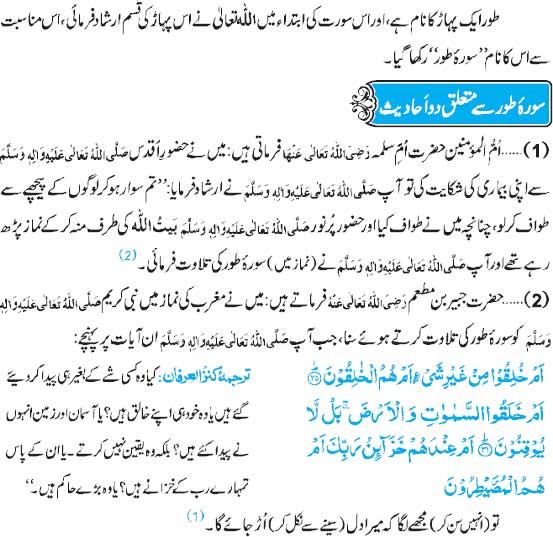
Surah At-Tur Say Mutaliq Hadith
Unnecessary Obstacles To marriage
Young women have many hopes and dreams. Among the most important of these dreams focus upon their future husbands, the men who are going to be their partners through the long and arduous journey of life. Some girls want their husbands to be young and handsome. Others prefer men who are gentle and romantic. Still, others want their husbands to be rich or famous.
These dreams are sometimes beset by obstacles that prevent the young woman from ever realizing them, obstacles to marriage that are uncalled for and unnecessary. Among the most important of these are the following:
1. Studies: This can take many years, depending on the program of study undertaken and the desired degree goals. In truth, a woman’s marriage is not incompatible with her furthering her studies. What it needs is for there to be an understanding from the onset between the husband and wife about the matter of her studies.
I see this as part of facing up to our changing circumstances. There are many destructive influences that beset our young men and women today. The mass media has an overwhelming effect. The world is more open. Early marriage has become more of a necessity for our young men and women than it has ever been before. It needs to be given priority. A young woman should give the matter her attention, as should her parents.
2. The father: A father may turn away prospective suitors for his daughters for many reasons. These reasons might be financial or cultural. Sometimes the father insists that his daughter marry one of her cousins or no one else.
Consider the following examples:
• A woman over 30 years of age complains that her father has a distorted sense of his own greatness and sees himself as a man of considerable importance and status. He refuses to marry his daughter to anyone except a man who satisfies his standards. Such a man will never come.
• A university graduate who works and is obliged to give her monthly salary over to her father in full is prevented by her father from ever marrying for reasons that are obvious.
A father prohibiting his daughter from marriage is a terrible crime that makes the skin crawl. Even if the father’s faith is weak and he is not God-fearing, we would think that he would have some humanity or mercy in his heart. We find more mercy exhibited by wild animals for their children. While this father sleeps comfortably in his room with his wife at his side, his grown-up daughters are tossing and turning restlessly in their beds, because they are being denied the greatest of physical blessings that Allah has placed within us the drive to seek out.
Allah is speaking to every believer when He says: “…do not prevent them from marrying their husbands, if they mutually agree on reasonable basis. This (instruction) is an admonition for him among you who believes in Allah and the Last Day. That is more virtuous and purer for you. Allah knows and you know not.” (Qur’an, 2:232)
So where are those who believe in Allah and the Last Day?
Preventing one’s daughters from marrying suitable men with whom they are pleased is a serious form of oppression. Friends and relatives need to intervene in order to help those women and free them from their confinement. If this does not happen, then the courts need to intervene. Social and governmental agencies should be mobilized to protect women who are being prevented from marriage and confront the transgression of those fathers.
It is true that most fathers are merciful and feel compassion for their daughters and it is allowed for them to prevent their daughters from marrying certain suitors when they have a valid reason to do so. However, there are situations – though they may be few in number, they are seriously painful for the women involved – where outside intervention is needed. In many cases, the daughter will be unable to speak up in her own defense or voice a complaint.
This is because she fears destroying her relationship with her father or fears that her reputation will be tarnished. She might not have any opportunity to leave home in the first place or to speak to anyone who can air her grievances on her behalf. In this way, she can spend her whole life and waste her youth in bitter waiting.
3. The man: The young man who wishes to get married wants a beautiful wife, and beauty to him is what his eyes have grown accustomed to seeing in the movies and on television. He wants her to be fair in complexion, tall, and young. He wants her to have the beauty of a fashion model, the piety of the Prophet’s Companions, and the wealth of a tycoon, without him having to exert any effort on his part. He needs to come down to earth.
This may be one of the negative effects of constantly watching movies and programs that cause our young people to live in a fantasy world that has no connection whatsoever with reality. Even if a young man lowers his unrealistic standards, he remains in distress and this puts a strain on his future relationship with his wife.
Allah tells us: “O you who believe! Follow not Satan’s footsteps: if any will follow the footsteps of Satan, he will (but) command what is shameful and wrong.” (Qur’an, 24:21)
4. Exuberant costs: Heavy expenditures for marriage as well as numerous and excessive material demands place a great burden upon the shoulders of young men, forcing them to turn away from the prospect of marriage.
The postponement of marriage is a hindrance that everyone must work together to solve. It has to be addressed publicly by scholars, orators, intellectuals, public figures, and reformers. The means to marriage need to be simplified. Institutions need to be established to facilitate marriages materially, socially, and on a personal level.
By Sheikh Salman Al-Oadah – Islam Today