Archives
Why Should A Muslim Offer Salat In Arabic?
Being a universal religion, Islam is meant for all people with different languages. Although Arabic is the language of the Qur’an and Islamic heritage, Islam did not aim at eradicating other languages that are the mother tongues of Muslims in some parts of the globe.
Islam views the differences in human tongues as one of the Signs of Allah in His creation. This is proven by the fact that Arabic is not the native tongue of the majority of Muslims. However, Muslims are required to perform prayer in Arabic with few exceptions, as in the case of new converts until they become able to say their prayers in Arabic, according to the Hanafi School of thought.
It is well known that during their service of worship (Salat), Muslims employ only the Arabic language: They recite certain passages of the Qur’an and pronounce certain formulae to attest to the sublimity of Allah and humility of man. This is done both by the Arabs and the non-Arabs, even by those who do not know a word of Arabic. Such was the case in the time of the Prophet Muhammad (peace be upon him) and such has been the case to this day, whatever the country and the tongue of Muslims.
At first sight, it may seem normal and even desirable that the faithful should address his prayer to the Lord in a way that he is fully conscious of what he says. Of course, the mother tongue is the medium best suited for the purpose, the worship being performed in as many languages as are spoken by the Muslim community. But a little deeper consideration shows that there are reasons that militate strongly against such a solution.
It is noteworthy that according to Islamic belief the Qur’an is the Word of Allah, the recitation of which is considered something meritorious. This is evident from the spiritual point of view. It stands as the faithful journey’s unto the Lord through the sacred word of the Lord Himself. His Word is the path toward Him, something like a wire to conduct the electrical current that illuminates the bulb. The journey unto the Lord is of course the ultimate goal that every soul aspires to reach. The original Word has been revealed in Arabic: any translation would be a human work and human word, and this can scarcely serve the purpose of this mystical journey.
For those who would seek more mundane reasons, let us recall first that a clear distinction is to be made between prayer, in the sense of supplication (Du`aa), and prayer in the sense of the service of worship (Salat), in so far as Du`aa is concerned — i.e., the prayer in general and outside the formal way of worshiping Allah, the tete-tete with the Lord (munajaat)— nobody has ever raised the slightest objection to the liberty of the individual to address one’s need, one’s petitions to the Lord in any language and in any physical posture one prefers. It is purely a personal and private affair and concerns the relations of the individual creature directly with the Creator.
The Salat (prayer), on the contrary, is a collective and public affair, where the needs and requirements of other companions of the congregation are evidently to be taken into consideration. It is important to note that the Salat is in principle and preferably to be performed in common along with others (congregation): the Salat individually and in isolation is only tolerated and is never recommended, going to the congregational service is preferred. Let us see now more closely the diverse aspects of this collective and public act that is performed in the company of others.
Had Islam been a regional, racial or national religion, one would certainly have employed the current language of the region, of the race, of the nation. But quite different are the requirements of a universal religion, whose members speak hundreds of regional languages — of which each is incomprehensible to all the rest of the human groups — belonging to different races and regions of the earth. Our life today is getting more and more cosmopolitan, and practically every town has Muslims belonging to several linguistic groups, both from among the permanent residents and the travelers in transit, and has to take into consideration the aspect of courtesy and hospitality to strangers.
Supposing an Englishman goes to China and knows not a word of its language, and supposing he hears in the street something like “chen chu chih shan”, evidently he would not understand what is meant by that; and if it is the regional translation of the well-known call to prayer, the Allah-o-Akbar, he would fail to perceive it and would miss the weekly prayer on Friday, or the congregational prayer of the moment.
Similarly, a Chinese Muslim, traveling through other countries, would find nothing in common with his co-religionists if these others said their congregational worship in their local tongues. So a universal religion requires certain basic things to be common to all the faithful. A passing remark may be made about the fact that sometimes words of two different languages sound alike but have different meanings, at times the harmless word of one signifying something ridiculous or obscene in another. Such a risk is greater in languages with which one is utterly unfamiliar and hears only during a journey for example. This would be contrary to the dignity of the service of worship to Allah. Things familiar from childhood avoid such complications, even if the individual is a non-Arab and recites in Arabic the required formulae.
One cannot neglect the psychological aspect of human beings who have at times shown prejudices of xenophobia. Occasions would arise daily when political (national) or even personal and individual frictions would induce, for instance, an Englishman not to participate in the Salat led in French or Russian or some other language. Arabic, as the language of the Qur’an and the Hadith, has respect and a halo in the minds of every Muslim, and one employs it not as the language of the Arabs but as the language of the Prophet Muhammad (peace be upon him), the language of the Mothers of the Faithful, the language Allah Himself has chosen for revealing His latest Word to us.
The need for unity among co-religionists can never be too stressed. One should create new links to strengthen their ties of fraternity, rather than destroy those that already exist.
There is another aspect of the question which is no less important. In fact, no translation ever replaces the original. There are, for instance, nowadays numerous translations of the Holy Qur’an in English (as also in practically every language of the world), yet every now and then there are new and unceasing attempts to produce another translation, thinking that the older ones are partly defective. This is true not only of English but of every language of the world, and true also of the translation of any and every work. Should one utilize a defective thing or the perfect one, the translation or the original?
Let us recall in this connection that practically no religion, except Islam, possesses today integrally the original of the Revelation on which it is based, the original teaching of its founder: It is the translation, or at best fragments, of which dispose the Christian, Jewish, and other communities. How fortunate the Muslims is that they form an exception, and possess integrally the original text of the Revelation, the Holy Qur’an!
One should not lose sight of the fact that in the entire Salat there are very few passages to recite. There are first the Adhan and Iqamah (call to prayer). Then inside the service of worship, there are the formulae Allah-o-Akbar, Subhana rabbiyal-‘azim, Subhana rabbial-a`la, the short chapter Al-Fatiha, two other short chapters, the Tashahhud, and that is all. The totality does not exceed a page or two, and most of the words of these texts are commonly understood by the Muslim masses and have penetrated into all the languages of the Muslim countries, so much so that even a child or a beginner learns their meaning without pain or strain. And once the significance of these formulae is learned, the Salat of a Muslim remains no more a mechanical recitation without understanding.
There is an aspect of the Arabic language which merits to be brought into relief here. Apart from its incomparable musical qualities, the Arabic language itself, in its literary form, changed at least 1500 years neither in grammar, vocabulary, spelling, and even pronunciation. Those who understand the language of Arabic newspapers and radio broadcasts today understand as perfectly the language of the Holy Qur’an. For a religion brought by the last of the Messengers of Allah and the Seal of the Prophets, and also destined for all times till the end of the world, is it not providential that the language selected for this Message should also be otherwise stable and unchanging?
Of course, there are provisions for exceptional cases, such as the needs of a new convert: immediately on his embracing Islam, he has to commence to perform the five daily services in which it is necessary to recite by heart the prescribed formulae. Until such time as he learns these formulae by heart, he may use their sense in any other language he can. For this, we have the very high precedent of Salman Al-Farsi, who sent the translation of Al-Fatiha to some Persian converts, with the authorization of the Prophet Muhammad (peace be upon him) himself and they used it until their tongue got familiarized with the Arabic text.
Syed-Ul-Mursaleen Ki Khush Tabai
World’s Life Is Only Sport And Play
“And it may be that you dislike a thing while it is good for you, and it may be that you love a thing while it is evil for you, and Allah knows, while you do not know.” [2. Surah Al-Baqarah: Ayah 216]
Know that the life of this world is but amusement and diversion and adornment and boasting to one another and competition in increase of wealth and children – like the example of a rain whose [resulting] plant growth pleases the tillers; then it dries and you see it turned yellow; then it becomes [scattered] debris. And in the Hereafter is severe punishment and forgiveness from Allah and approval. And what is the worldly life except the enjoyment of delusion.[57. Surah Al-Hadid : Ayah 20]
And this world’s life is naught but a play and an idle sport and certainly the abode of the hereafter is better for those who guard (against evil); do you not then understand? [6. Surah Al-An’am : Ayah 32]
And this life of the world is nothing but a sport and a play; and as for the next abode, that most surely is the life– did they but know. [29. Surah Al-‘Ankabut : Ayah 64]
The life of this world is only idle sport and play, and if you believe and guard (against evil) He will give you your rewards, and will not ask of you your possessions. [47. Surah Muhammad : Ayah 36]
O men! surely the promise of Allah is true, therefore let not the life of this world deceive you, and let not the arch-deceiver deceive you respecting Allah. [35. Surah Fatir : Ayah 5]
Nay! you prefer the life of this world, While the hereafter is better and more lasting. [87. Surah Al-A’la : Ayah 16-17]
Women In Islamic Society – When Looking For A Spouse
In most societies, the normal practice is that the prospective husband will propose marriage. A woman normally holds back from suggesting marriage, feeling that she should be sought after. This applies to families as well. The woman’s family would not initiate a proposal unless the woman’s father or guardian is certain that, if he were to suggest marriage, his proposal will be received well by the man concerned. The Prophet received proposals from several women who thought that they could not do better than being married to him. This normally took the form of the woman saying to the Prophet that she would gift herself to him. It is understood that the gift is one of marriage. In Islam, a woman cannot gift herself to a man in this way, but this was allowed for the Prophet only. The Prophet could take her as a wife, but he normally decided her case as her guardian. This special privilege given to the Prophet is stated in the Qur’an, in a verse that outlines women who are lawful to marry. The verse says in this particular case:
“And any believing woman who offers herself freely to the Prophet and whom the Prophet might be willing to wed: (this latter) applies to you alone and not to other believers.” (33: 50)
Needless to say, at the time when a proposal of marriage is made, the man and the woman will need to meet and discuss matters in order to carry the proposal forward or withdraw it. Sahl Ibn Saad reports: “A woman came to the Prophet and said: ‘Messenger of God! I have come to offer myself to you as a gift…’ The Prophet repeatedly looked up and down at her, then he lowered his head. When the woman realized that he has made no decision concerning her, she sat down.” (Related by Al-Bukhari and Muslim.) Another version of this Hadith adds that the Prophet said to her: “I have no need for women nowadays.”
Commenting on this Hadith, Imam Ibn Hajar, who wrote an extensive commentary on Al-Bukhari’s authentic anthology in 14 large volumes, says: “This Hadith gives us several important points… One of these is the permissibility of looking carefully at a woman’s attractions when one is thinking of marrying her, even though such thoughts of marriage were not entertained earlier, nor was a proposal made. We see that the Prophet looked repeatedly at the woman, moving his looks up and down. The Hadith is stated in a way that implies a serious, long look. Needless to say, the Prophet did not consider marrying this woman prior to her proposal. He indeed told her that he had no desire at the time to go into a new marriage. Yet he looked seriously at her, which suggests that had he seen in her something that was attractive to him, he would have married her. Otherwise, he would not have looked so intently at her.”
Ibn Hajar suggests that the Hadith may be understood in other ways. We, however, prefer the view we have quoted because this is supported by other Hadiths that encourage looking at a woman if one intends to marry her. The present case is not dissimilar to that of a man making a proposal. This is supported by the following Hadith: “When the Muslims from Makkah arrived in Madinah, the Prophet established a bond of brotherhood between them and the Muslims from Madinah. He made Abd Al-Rahman Ibn Awf and Saad Ibn Al-Rabie brothers. Saad said to Abd Al-Rahman: ‘I am one of the richest people among the Ansar. I will share my wealth equally with you. I also have two wives. Look at them and tell me which one you prefer. I will divorce her and when she finishes her waiting period, you can marry her.’ Abd Al-Rahman said: ‘May God give you much blessing in both your family and your wealth…” (Related by Al-Bukhari.) Ibn Hajar comments that this Hadith confirms that it is proper that a woman looks carefully at a woman when he wants to propose marriage to her.
Perhaps we should add here that Abd Al-Rahman was as noble as his brother. He declined to take any money but started a business of his own to earn his living. Nor did he take the offer of marrying one of his brother’s wives after she is divorced. When his business took off, he married someone else.
It is also permissible for a woman to propose marriage to a man whom she thinks to be a good husband. Thabit Al-Bannani reports: “I was at Anas’ place, with one of his daughters present. Anas mentioned that a woman came to the Prophet offering to marry him. She said: Messenger of God! Would you like to marry me?’ Anas’ daughter said: ‘How shameless of her!’ He said to her: ‘She is better than you. She wished to marry the Prophet and she went to him suggesting that.” (Related by Al-Bukhari.)
Al-Bukhari enters this Hadith under the heading: “A woman’s proposal to marry a good man.” In his commentary on this Hadith, Ibn Hajar quotes Ibn Al-Muneer: “A subtle note by Al-Bukhari is that realizing the special privilege involved in this Hadith, he highlighted what is generally applicable, representing no privilege, which is the permissibility of a woman making a proposal to a good and pious man, thinking that she will be happy with him because of his piety.” Ibn Hajar adds: “There is nothing to be taken against a woman who wishes to marry someone who is in a better position than hers, particularly if her motive is a good one, either because the man is virtuous, or because she admires him to the point that it is feared that something wrong may happen unless such a proposal is made.”
We may add here a verse from the Qur’an mentioning a proposal made to a man by the father of a pious woman. The man concerned is Moses, but this took place long before he became a prophet. He had fled from Egypt where he was in danger of being killed. In Madyan, he helped two girls give water to their sheep. Then one of them invited him to meet her father, who was a pious man. When the father learned Moses’ story, he offered one of his daughters to him in marriage. “(The father) said: ‘I will give you one of these two daughters of mine in marriage on the understanding that you will remain eight years in my service. If you should complete ten years, it will be your own choice. I do not wish to impose any hardship on you. You will find me, if God so wills, an upright man.” (28: 27)
Moses accepted the proposal, married the girl, and spent ten years helping her father. Needless to say, had there been anything unacceptable in this story, the Qur’an would have made that clear.
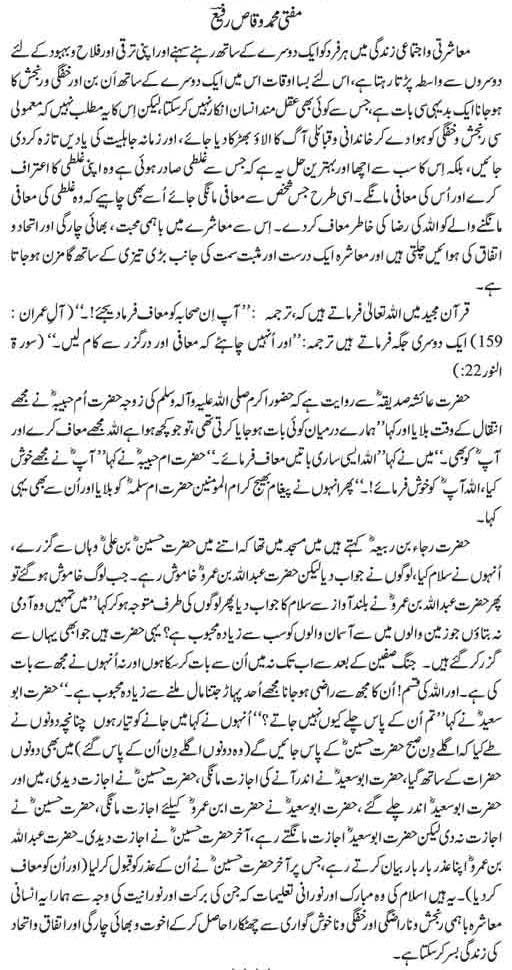
Maafi Mangnay Ki Fazeelat
Quran Revealed In Truth, Quran Descended In Truth
[Quran – 17:105] “We have sent down the Qur’an with the Truth, and it is with the Truth that it has descended.”
QUR’AN Described by Ali (May ALLAH Be Pleased with him), the 4th Caliph of Islam
“Kitabullah (The Book of ALLAH) is the way, for it contains information of what happened before you, news of what will come after you a decision regarding matters that will occur among you. It is the Distinguisher and is not jesting. If any overweening person abandons it, Allah will break him, and if anyone seeks guidance elsewhere ALLAH will lead him astray. It is ALLAH’S stalwart rope, the wise reminder, the straight path; it is by which desires do not swerve nor the tongue becomes confused, and the learned cannot grasp it completely. It is not worn out by repetition nor its wonders ever cease. It is that of which the jinn did not hesitate to remark when they heard it: ‘We have heard a wonderful recitation which guides to what is right, and we believe in it; he who utters it speaks the truth, he who acts according it is rewarded, he who pronounces judgment according to it is just, and he who invites people to it guides them to the straight path” [At-Tirmidhi, Sunan, Fada’il al-Qur’an:14, Hadith #2906]
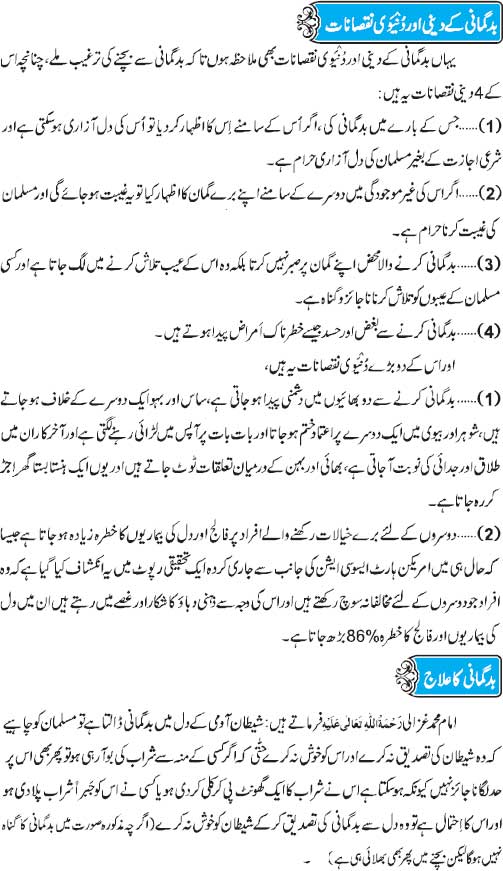
Badgumani Kay Deeni Aur Dunyavi Nuqsanat
Fear Allah Wherever You Are
Abu Dharr al-Ghifari and Mu`adh b, Jabal relate that the Prophet (peace be upon him) said: “Fear Allah wherever you are. Follow up a bad deed with a good deed and it will blot it out. And deal with people in a good manner.” [ Sunan al-Tirmidhi ]
The importance of this hadith:
Ibn Rajab says: “This is powerful advice, bringing together the rights of Allah and the rights of His servants..”
The fear of Allah
The Arabic word for the “fear of Allah” is taqwa. It comes from the root word meaning “to protect from something, to prevent”. Indeed, a person exhibits the fear of Allah by seeking to prevent Allah’s punishment by carrying out what Allah has commanded of him and abstaining from what Allah has prohibited him.
Allah had called upon all people in every era to fear Him. Allah says: “And We had enjoined upon those who were given the Scripture before – as well as yourselves – to fear Allah.” [ Surah al-Nisa’ : 131]
It is Allah’s right over His servants that they fear Him as He ought to be feared. Allah says: “O you who believe! Fear Allah as He ought to be feared and do not die except as believers.” [ Surah Al `Imran : 102]
Ibn Mas`ud explained what it means to fear Allah as He ought to be feared by saying: “It means that He is to be obeyed not disobeyed, remembered not forgotten, and shown gratitude, not ingratitude.”
The fear of Allah is the path to forgiveness, salvation, and the attainment of Allah’s mercy. Allah says:
“Indeed, Allah is with those who fear Him and those who do good.” [ Surah al-Nahl : 128]
“And My mercy encompasses all things, and I shall decree it for those who fear Me.” [ Surah al-A`raf : 156]
“He is worthy of being feared and worthy of granting forgiveness.” [ Surah al-Muddaththir : 56]
“And whoever fears Allah – He will pardon him his sins and grant him a great reward.” [ Surah al-Talaq : 5]
“Indeed, those who fear Allah will be among gardens and rivers, in a seat of truth near an All-Powerful Sovereign.” [ Surah al-Qamar : 54-55]
Allah promises those who fear Him that He will provide for their needs and grant them a way out of their worldly difficulties. Allah says: “And whoever fears Allah, He will make for him a way out, and provide for him from whence he could never imagine.” [ Sûrah al-Talaq: 2-3]
This is Allah’s promise. We should draw strength from it when we are tired in life with difficulties that tempt us to resort to what Allah has forbidden.
The relationship between knowledge and the fear of Allah
Allah says: “It is only those who have knowledge among Allah’s servants who fear Him.” [ Surah Fatir: 28]
There are two ways in which knowledge and the fear of Allah are related. The first is that true fear of Allah comes about as the result of having proper knowledge of Allah and His perfect attributes.
Ibn Abbas said about this verse: “They are those who know that Allah is capable of all things.”
He also said: “The verse means: The only people who fear me are those who know my power, my might, and my dominion..”
Ibn Kathir says in his commentary of this verse: “The only people who fear Allah in the true sense are those who are knowledgeable about Allah. This is because the more knowledge a person has about the Almighty, the All-Powerful and All-Knowing, who possesses the attributes of perfection and the best of names – the more perfect and complete this knowledge is – the greater and more total his fear of Allah will be.” [ Tafsir Ibn Kathir ]
The second way that the fear of Allah and knowledge are related stems from the fact that the fear of Allah is to seek to prevent Allah’s punishment by carrying out Allah’s commands and abstaining from His prohibitions. Consequently, a Muslim needs to have knowledge of these matters in order to fear Allah properly. An ignorant Muslim may have a sense of fear, but he will not be able to fully carry out what that fear requires of him.
Ibn `Abbas said: “To have knowledge of the Most Merciful is to be someone who associates nothing as a partner with Him, who deems lawful what He has made lawful, who prohibits what He has prohibited, who preserves what He has enjoined upon him, and who has certainty that he shall meet Him and that his actions will be accounted for.”
Follow up a bad deed with a good deed
The Prophet (peace be upon him) tells us that performing a good deed wipes away the sin incurred from perpetrating an evil one. Scholars have disagreed whether the “good deed” being referred to here refers specifically to the context of repentance or whether it is general for all good works.
The strongest view is that all good deeds can wipe away evil deeds. Allah says: “And establish prayer at the two ends of the day and at the approach of the night. Indeed, good works do away with evil deeds. That is a reminder for those who take heed.” [ Surah Hud: 114]
A man once came to the Prophet (peace be upon him) and informed him that he had contact with a woman like a husband has with his wife, except that he did not go so far as to fornicate with her. This man had just prayed the Fajr prayer. The Prophet (peace be upon him) said: “Have you prayed with us the Fajr prayer?” When he replied that he had, the Prophet (peace be upon him) recited: “Indeed, good works do away with evil deeds.” [ Sahîh al-Bukhârî (526) and Sahîh Muslim (2763)]
However, a believer should always repent for his sins. Allah says: “And those, who when they commit an indecency or wrong themselves, remember Allah and seek forgiveness for their sins – and who forgives sins except Allah – and then do not knowingly persist in what they have done, for them is forgiveness from their Lord and gardens beneath which rivers flow, wherein they shall abide forever. How great is the reward for those who work righteousness.” [ Surah Al `Imran : 135]
A believer should follow up his sincere repentance with the performance of good works. This is what Allah wants from us. He says: “Indeed, I am Most Forgiving to whoever repents, believes, and works righteous deeds and then continues upon guidance.” [ Surah Taha: 82]
Allah also tells us: “Except for those who repent, believe, and work righteous deeds. For those, Allah will change their evil deeds into good deeds, and Allah is Most Forgiving, Most Merciful.” [ Sûrah al-Furqan: 70] This is especially true for major sins. A Muslim must never leave a major sin to go without repentance, for Allah’s promise of forgiveness is for those who turn to Him in sincere repentance. The Prophet (peace be upon him) said: “A servant, if he acknowledges his sin and then repents, Allah will forgive him.” [ Sahih al-Bukhari (4141) and Sahîh Muslim (2770)]
And deal with people in a good manner
Allah tells us repeatedly in the Qur’ân to observe good manners in our dealings with others. He says: “Keep to forgiveness (O Muhammad), and enjoin kindness, and turn away from those who are ignorant.” [ Surah al-A`raf : 199]
Allah says: “Nor can goodness and evil be equal. Repel (evil) with what is better. Then he between whom and you there had been hatred will become as though he were your dear friend.” [ Sûrah Fussilat : 34]
The Prophet (peace be upon him) is the perfect example of what it means to possess good manners. Allah says, describing him: “Indeed you are of a great moral character.” [ Surah al-Qalam : 4]
The Prophet (peace be upon him) emphasized how good manners are of paramount importance in Islam when he said: “I was sent only to perfect good manners.” [ Musnad Ahmad (8952)]
Indeed, he tells us those good manners are part of faith. He said: “The believers with the most complete faith are those who have the best manners.” [ Sunan al-Tirmidhi (1162) and Sunan Abî Dawud (4682)]
Among the good manners that we should cultivate is to be sensible in our dealings with others and not to react hastily when they do that which displeases us. The Prophet (peace be upon him) said to Ashajj `Abd Qays: “You possess within yourself two qualities that Allah loves: discernment and forbearance.” [ Sahîh Muslim (17)]
Qira’at (Quran Parhany) Kay Ahkam