
Archives
Neither Love Nor Hatred Can Be Allowed To Ccompromise Justice
There is one word that captures the essence of all Islamic laws and all Islamic teachings; one word that describes the overriding value that permeates all Islamic values. Justice. The Qur’an says:
“We sent afore time our messengers with clear Signs and sent down with them the Book and the Balance, that men may stand forth in Justice.” [Al-Hadeed57:25]
The sole purpose of sending the prophets was to establish Justice in the world and end injustice. Broadly speaking, doing justice means giving everyone his due. But this simple statement camouflages all the complexities of life in their myriad and ever-changing relations; all the temptations; all the apprehensions and concerns; all the conflicts and dilemmas. To guide the people, Allah sent down the prophets with clear signs, the Book, and the Balance. The Book contains the revelations that spell out what’s fair and unfair or right and wrong. Balance refers to our ability to measure and calculate so we can follow the path shown by the Book and explained by the prophets.
Together these sources taught us what are the rights of Allah, of other people, and of our own persons on us and how to balance them. A life lived in obedience to Allah, then, is a continuous balancing act, both individually and collectively.
Under normal circumstances, many people can be just. But Islam commands its followers to be just even in the face of strong conflicting emotions. In dealing with other human beings, two major impediments to justice are love and hatred. See how the Qur’an teaches us to overcome the first impediment when we are dealing with our closest relatives or even ourselves.
“O ye who believe! Stand out firmly for justice, as witnesses to Allah, even as against yourselves, or your parents, or your kin, and whether it be (against) rich or poor: for Allah can best protect both. Follow not the lusts (of your hearts), lest ye swerve, and if ye distort(justice) or decline to do justice, verily Allah is well-acquainted with all that ye do.” [An-Nisa 4:135]
Here is the resolution from the Qur’an of the perennial conflict between self-interest and justice. Be just, even if it is against your narrowly defined self-interest or of those very close to you. Ignorant people think they are protecting their self-interest by being unjust to others. Their decision to be just or unjust may be based on a cold calculation of self-interest. But real faith in Allah elevates one beyond that narrow-mindedness. These verses remind us that the real protector of interests of all people is also Allah and He will protect us when we follow His command to be just.
The justice demanded by Islam permits no favoritism.
The other equally potent impediment is hatred. Here again, Qur’an commands:
“O ye who believe! Stand out firmly for Allah, as witnesses to fair dealing, and let not the hatred of others to you make you swerve to wrong and depart from justice. Be just: that is next to piety: and fear Allah. For Allah is well-acquainted with all that ye do.”[Al-Maidah 5:8]
In other words you cannot do injustice even when you are dealing with the enemy. The natural, uneducated, and uncivilized tendency is to treat the enemy as less than a human being; one who has no rights and deserves no justice or fairness. It was as true in the pre-Islamic tribaljahilya (based on ignorance) society as it is today. See how Islam directly curbs it. It is a command to the believers, with a reminder that Allah is watching you, that enmity of others cannot be used as an excuse for committing injustices against them.
Justice does require retribution and Islam does call for, “an eye for an eye.” But it does not mean an innocent eye for an innocent eye; it means the eye of the perpetrator for the eye of the victim. It is amazing how those who call the latter as barbaric, actually rally for the former when a real crisis develops.
Fourteen hundred years ago these commands created a society where rich and poor, friend and foe, Muslim and non-Muslim, the ruler and the ruled, were all treated equally and all of them could count on receiving justice. The qazis (judges) were independent and no one, including the Khalifah, was above the law. If a dispute arose between the Khalifah and an ordinary person, both had to appear in court and provide their evidence. Islamic history is full of stories of this justice that filled the earth wherever Muslims ruled in their golden era.
Even during their period of decline, we find sporadic incidents that are just unparalleled. One example from recent history may suffice here. During the British Rule in India, once a dispute arose between Hindus and Muslims over a piece of land. Hindus claimed it belonged to a temple while Muslims claimed it to be a mosque. Emotions were high on both sides and the possibility of a riot was real. The English judge could not find any means of ascertaining the truth. It was one group’s words against the other’s. Finally, the Judge asked both groups if they could trust the testimony of any person.They could. It was a particular Muslim imam (religious leader) who was known for his piety. The person was requested to come to the court as a witness in a very charged atmosphere, with the entire community urging him to help them win the case through his testimony. His testimony was brief. “The Hindus are right,” he said. “The Muslim case is baseless.” He had not betrayed the community. He had once more affirmed its unflinching commitment to truth and justice above all else. That is the justice the world needs today.
“Allah doth command you to render back your trusts to those to whom they are due; and when ye judge between man and man, that ye judge with justice: verily how excellent is the teaching which He gives you! For Allah is He Who hears and sees all things.” [An-Nisa 4:58]
If Allah is with you, whom do you have to fear? If Allah is against you, what hope do you have? If He is not with you, you will feel distressed even in a rose garden, If He is with you, it will feel like being in a rose garden even in a desert
By Khalid Baig
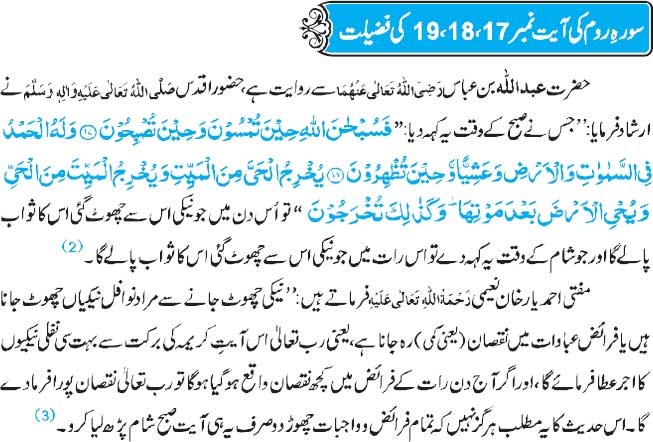
Surah Ar-Rum Ki Aayaath Ki Fazeelat
What Should Be Done With The Sacrifice?
It is mustahab or preferable for one who has made a sacrifice not to eat anything on that day before he eats from it, if this is possible, because of the Hadith, “Let every man eat from his sacrifice.” (Sahih Al-Jami, 5349). He should eat after the Eid prayer and khutbah (sermon). This is the opinion of the scholars, including Ali, Ibn Abbas, Malik, Ash-Shafi’i, and others. The evidence for this is the Hadith of Buraydah (may Allah be pleased with him): “The Prophet (peace be upon him) would not go out on the Day of Fitr until he had eaten, and he would not eat on the day of Adha until he had slaughtered (his sacrifice).” It is better for a person to slaughter the sacrifice himself, but if he does not, it is mustahab for him to be present when it is slaughtered.
It is mustahab to divide the meat into three: one third for consumption, one third to be given as a gift and one third to be given in charity. This is the opinion of Ibn Mas’ud and Ibn Umar (may Allah be pleased with them). The scholars agreed that it is not permissible to sell anything from its meat, fat, or skin. The Prophet (peace be upon him) is reported to have said: “Whoever sells the skin of his Udhiyah, there is no Udhiyah for him (i.e., it is not counted as Udhiyah).” (Sahih Al-Jami, 6118). The butcher should not be given anything of it by way of reward or payment, because Ali (may Allah be pleased with him) said: “The Messenger of Allah (peace be upon him) commanded me to take care of the sacrifice and to give its meat, skin in charity, and not to give anything of it to the butcher as a compensation. He said, ” We will give him something from what we have.” (Al-Bukhari and Muslim).
It was said that it is permissible to give the butcher something as a gift, and that it is permissible to give some of it to a non-Muslim if he is poor or a relative or a neighbor, or in order to open up his heart to Islam.
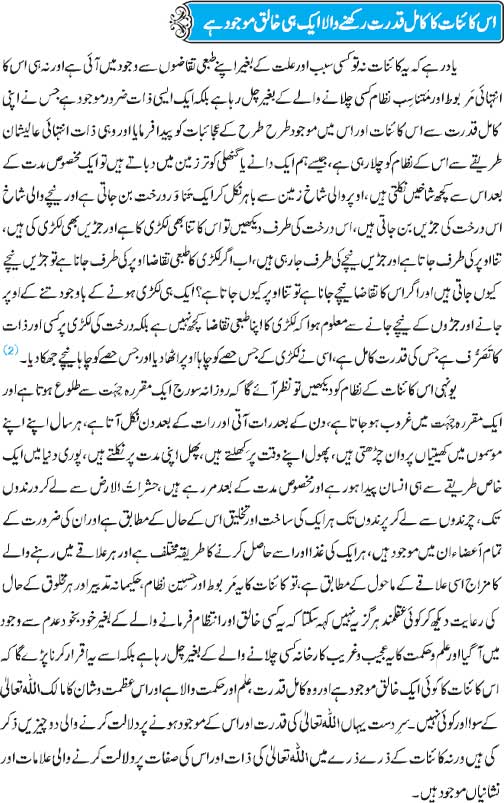
kamil Qudrat Rakhnay Wala Khaliq
Hajj Rites – In Short
8 Dhul Hijjah
- Days of Tarwiyyah
- Assume Ihram
- Go to Mina
- Pray 5 Salaat, start with Dhuhr (shortened, but not joined) stay until sunrise of 9th
9 Dhul Hijjah
- Day of Arafat. Go to Arafat
- Join and shorten Dhuhr and ‘Asr at the time of Dhuhr
- Make such Du’aa until sunset
- Leave after sunset for Muzdalifah
- Pray Maghrib and ‘Isha in Muzdalifah and spend night there
10 Dhul Hijjah
- Pray Fajr as early as possible then go to Mina before sunrise
- Pick up seven pebbles
- Stone Jamarat Al ‘Aqabah
- Do sacrifice
- Cut hair (partially out of Islam)
- Do Tawaf Al-Ifadah (and Sa’ee) before sunset (fully out of Ihram)
- Stay in Mina
11 Dhul Hijjah
- Pick up 21 pebbles
- Throw pebbles in afternoon at small, medium and big Jamarat
- Stay in Mina for night
12 Dhul Hijjah
- Pick up 21 pebbles
- Throw pebbles in afternoon at small, medium and big Jamarat
- Stay in Mina for night or leave before Sunset
13 Dhul Hijjah
- Optional – Pick up 21 pebbles
- Throw pebbles in afternoon at small, medium and big Jamarat
- Stay in Mina for night or leave before Sunset
Qurbani Kay Fazail Aur Masail

Quranic And Hadith References : Livlihood Of Women
Who is responsible for livelihood of women?
Legal period and payment (Iddah and Mahr).
Surah An-Nisa Chapter 4 Verse 34
Men are in charge of women by [right of] what Allah has given one over the other and what they spend [for maintenance] from their wealth. So righteous women are devoutly obedient, guarding in [the husband’s] absence what Allah would have them, guard. But those [wives] from whom you fear arrogance – [first] advise them; [then if they persist], forsake them in bed; and [finally], strike them. But if they obey you [once more], seek no means against them. Indeed, Allah is ever Exalted and Grand.
Surah At-Talaq, Chapter 65 Verse 1
O Prophet, when you [Muslims] divorce women, divorce them for [the commencement of] their waiting period and keep count of the waiting period, and fear Allah, your Lord. Do not turn them out of their [husbands’] houses, nor should they [themselves] leave [during that period] unless they are committing a clear immorality. And those are the limits [set by] Allah. And whoever transgresses the limits of Allah has certainly wronged himself. You know not; perhaps Allah will bring about after that a [different] matter.
Surah At-Talaq, Chapter 65 Verse 4
And those who no longer expect menstruation among your women – if you doubt, then their period is three months, and [also for] those who have not menstruated. And for those who are pregnant, their term is until they give birth. And whoever fears Allah – He will make for him of his matter ease.
Surah At-Talaq, Chapter 65 Verse 6
Lodge them [in a section] of where you dwell out of your means and do not harm them in order to oppress them. And if they should be pregnant, then spend on them until they give birth. And if they breastfeed for you, then give them their payment and confer among yourselves in an acceptable way; but if you are in discord, then there may breastfeed for the father another woman.
How women should come out to earn livelihood?
Surah An-Noor, Chapter 24, Verse 30
Tell the believing men to reduce [some] of their vision and guard their private parts. That is purer for them. Indeed, Allah is Acquainted with what they do.
Surah An-Noor, Chapter 24, Verse 31
And tell the believing women to reduce [some] of their vision and guard their private parts and not expose their adornment except that which [necessarily] appears thereof and to wrap [a portion of] their headcovers over their chests and not expose their adornment except to their husbands, their fathers, their husbands’ fathers, their sons, their husbands’ sons, their brothers, their brothers’ sons, their sisters’ sons, their women, that which their right hands possess, or those male attendants having no physical desire, or children who are not yet aware of the private aspects of women. And let them not stamp their feet to make known what they conceal of their adornment. And turn to Allah in repentance, all of you, O believers, that you might succeed.
Surah Al-Ahzab, Chapter 33 Verse 32
O wives of the Prophet, you are not like anyone among women. If you fear Allah, then do not be soft in speech [to men], lest he in whose heart is disease should covet, but speak with appropriate speech.
Surah Al-Ahzab, Chapter 33 Verse 59
O Prophet, tell your wives and your daughters and the women of the believers to bring down over themselves [part] of their outer garments. That is more suitable that they will be known and not be abused. And ever is Allah Forgiving and Merciful.
Surah An-Nisa, Chapter 4, Verse 27 & 28Allah wants to accept your repentance, but those who follow [their] passions want you to digress [into] a great deviation.
And Allah wants to lighten for you [your difficulties], and mankind was created weak.
Surah Al-Maeda, Chapter 5, Verse 5
This day [all] good foods have been made lawful, and the food of those who were given the Scripture is lawful for you and your food is lawful for them. And [lawful in marriage are] chaste women from among the believers and chaste women from among those who were given the Scripture before you, when you have given them their due compensation, desiring chastity, not unlawful sexual intercourse or taking [secret] lovers. And whoever denies the faith – his work has become worthless, and he, in the Hereafter, will be among the losers.
What ruling for adultery and lewdness?
Surah An-Nisa Chapter 4 Verse 15
Those who commit unlawful sexual intercourse of your women – bring against them four [witnesses] from among you. And if they testify, confine the guilty women to houses until death takes them or Allah ordains for them [another] way.
Surah An-Noor, Chapter 24 Verse 2
The [unmarried] woman or [unmarried] man found guilty of sexual intercourse – lash each one of them with a hundred lashes, and do not be taken by pity for them in the religion of Allah, if you should believe in Allah and the Last Day. And let a group of the believers witness their punishment.
Punishment for adulterer in the light of Hadiths
Narrated Abu Huraira: A man from Bani Aslam came to Allah’s Apostle while he was in the mosque and called (the Prophet ) saying, “O Allah’s Apostle! I have committed illegal sexual intercourse.” On that the Prophet turned his face from him to the other side, whereupon the man moved to the side towards which the Prophet had turned his face, and said, “O Allah’s Apostle! I have committed illegal sexual intercourse.” The Prophet turned his face (from him) to the other side whereupon the man moved to the side towards which the Prophet had turned his face, and repeated his statement. The Prophet turned his face (from him) to the other side again. The man moved again (and repeated his statement) for the fourth time. So when the man had given witness four times against himself, the Prophet called him and said, “Are you insane?” He replied, “No.” The Prophet then said (to his companions), “Go and stone him to death.” The man was a married one. Jabir bin ‘Abdullah Al-Ansari said: I was one of those who stoned him. We stoned him at the Musalla (‘Id praying place) in Medina. When the stones hit him with their sharp edges, he fled, but we caught him at Al-Harra and stoned him till he died. (Book #63, Hadith #196)
Narrated ‘Abdullah bin ‘Umar: The Jews came to Allah’s Apostle and told him that a man and a woman from amongst them had committed illegal sexual intercourse. Allah’s Apostle said to them, “What do you find in the torah (old Testament) about the legal punishment of Ar-Rajm (stoning)?” They replied, (But) we announce their crime and lash them.” Abdullah bin Salam said, “You are telling a lie; torah contains the order of Rajm.” They brought and opened the torah and one of them solaced his hand on the Verse of Rajm and read the verses preceding and following it. Abdullah bin Salam said to him, “Lift your hand.” When he lifted his hand, the Verse of Rajm was written there. They said, “Muhammad has told the truth; the torah has the Verse of Rajm. The Prophet then gave the order that both of them should be stoned to death. (‘Abdullah bin ‘Umar said, “I saw the man leaning over the woman to shelter her from the stones.” (Book #56, Hadith #829)
Waseem Anwar
A human being, who is not receptive to Natural Law, can not be made or forced to accept any fabricated or human-made law. Natural Law is the law of Allah (God) i.e. The Holy Quran supplemented by explanation and interpretation
(Sunnah and Hadiths) of His beloved Prophet Muhammad (PBUH). How is it possible that a human who does not follow the sending of Allah (God) will follow fabricated or human-made law? We need more fabricated and human-made laws when we deviate from Natural Law.
Gumrah Groh
What Is The Meaning Of Kafir, Munafiq And Zindiq
The religious teachings revealed by Islam are the teachings that are written in the books of the scholars of Ahl as-Sunna [1]. A person becomes a kafir (disbeliever) if he does not believe, among the teachings of iman [2] and the Sharia [3] that have been reported by the scholars of Ahl as-Sunna, even one of the nasses (ayats [4] or hadiths [5]) with explicit meaning. If he keeps his disbelief secret, he is called a munafiq. If not only he keeps it secret but also he tries to deceive Muslims by passing himself off as a Muslim, he is called a zindiq. If he makes tawil (to interpret) of the nasses with explicit meaning without knowing, that is, gives wrong meaning to them and believes wrongly, he again becomes a disbeliever and is called a mulhid.
If he believes wrongly by making tawil of the nasses with inexplicit meaning, he does not become a disbeliever but, because he has departed from the right path of the Ahl as-Sunna, will go to Hell. Since he believes in the nasses with explicit meaning, he will not remain in Hell eternally but will be taken into Paradise. Such people are called ahl al-bida or heretical groups. There are seventy-two heretical groups. None of their ibadat (worship) is acceptable. Muslims whose faith is correct are called Ahl as-Sunnat wa l-Jamaa or Sunnis. In relation to ibadat, the Sunnis belong to four different Madhhabs [6]. Those who follow one of these madhhabs acknowledge that the followers of the other three also belong to Ahl as-Sunna, and they love one another. He who does not belong to Ahl as-Sunna is either a disbeliever or a man of bida.
[1] Ahl as-Sunna (wal-Jamaa): the true pious Muslims who follow as-Sahabat al-kiram. These are called Sunni Muslims. A Sunni Muslim adapts himself to one of the four Madhhabs. These madhhabs are Hanafi, Maliki, Shafii and Hanbali.
[2] iman: faith, belief, beliefs of Islam; kalam, itiqad.
[3] Shariat: (pl. of Sharia) i) rules and commandments as a whole of the religion. ii) religion.
[4] ayat: a verse of al-Quran al-kerim; al-ayat al-kerima.
[5] hadith (sherif): i) a saying of the Prophet (alaihi s-salam); al-Hadith ash-sherif: all the hadiths as a whole; ii) ilm al-hadith; iii) Books of the hadith ash-sherif. iv) Al-hadith al-qudsi, as-sahih, al-hasan: kinds of hadiths (for which, see Endless Bliss, II).
[6] Madhhab: all of what a profound alim of (especially) Fiqh (usually one of the four Hanafi, Shafii, Maliki, Hanbali) or iman (one of the two, namely Ash-ari, Maturidi) communicated.