

Archives
The Boy Who Broke His Father’s Idols
Thousands of years ago a boy questioned his father about the idols he would make. The town he grew up in adhered to the religion of their ancestors. However, this young boy thought differently. He reasoned and wondered why they worshipped idols? How could the idols benefit them? Could the idols even defend themselves if they were attacked? More importantly, is it not true that it was God who created the heavens and the earth and everything that exits? Then why do humans worship what they make with their own hands?
Furthermore, who will these people call upon if they happen to be in the midst of a storm while at sea? Will they not turn to the heavens and call upon the One God, who is unseen and who hears every call?
His father and his people, could not answer him so they shrugged him off. Since no one paid heed to the boy’s words, he decided to put his words into a dramatic scene, as a picture is worth a thousand words. He found an opportunity on the day when everyone was away celebrating a festival. When the people returned they found all the idols broken except for the biggest one. An axe was leaning against it. What could this mean? They did not get the picture.
The young lad was their prime suspect. On confrontation, he said that the big idol must have done it and it must be questioned.
At that moment they understood the message and realized their plight.
“The idol does not speak. And how could a lifeless idol break other idols,” they protested.
“Then,” asked the boy, “Why do you worship these lifeless idols?” The point was driven home in a dramatic fashion.
The boy grew up to be Ibrahim (Abraham), the Prophet and Messenger of Allah calling people to worship Allah alone, the Creator of everything that exists. Ibrahim (peace be upon him) is also revered by Judaism and Christianity.
Seerat e Mustafa
Events Must Not Push Us To Edge Of Religion
“And from the people is he who worships Allah as if he were on an edge (i.e. in doubt): if good befalls him, he is content with it. And if a trial befalls him, he turns back on his face. He loses both this world and the Hereafter. That is the clear loss.” (Qur’an, 22:11)
Commenting on this verse, Ibn Kathir said in his Tafsir (3/279): Such a person enters the religion on an edge. So, if he finds what he likes, he sticks with it. Otherwise, he retreats. Al-Bukhari reported that Ibn Abbas said, “A man would come to Madina. If his wife gave birth to a son and his mare gave birth to foals, he would say, ‘This is a good religion.’
If his wife didn’t give birth and his mare didn’t either, he would say, ‘This is a terrible religion.’” Ibn Abbas also said, “Some bedouins would come to the Prophet and become Muslims and then they would return to their homelands.
If they returned to a year of rain, produce, and good children being born, they would say, ‘This religion of ours is good. So, stick to it.’ If they came back to a year of hunger, bad children being born, and drought, they would say, ‘There is no good in this religion of ours.’ So, Allah revealed this (the above) verse.”
Abdul Rahman Bin Zayd Bin Aslam said (about this verse): “This is with regard to the hypocrite. If everything is going well for him in his life, he is consistent in his worship.
If things change and go bad for him, he goes back and wavers in his worship, except when things are going well.
So, if a trial, hardship, test, or inconvenience befalls him, he abandons his religion and returns to kufr (disbelief).”
Zuban Ki HIfazat
Greeting And Salutations To The Holy Prophet Muhammed Sallaahu Alaihi wassallam
The Holy Prophet’s (sallalaahu alaihi wasallams) Command to the Muslims to send him Darood and salaam on Friday
Invoke blessings on me abundantly on the day of Jum‘ah (Friday). Verily it is attended and the angels attend it, and none invokes blessings on me but his supplication is presented to me till he finishes it.
The narrator, Abu Darda Radiallahu taala anhu , asked:
(Is it also compulsory for us) even after your demise?
The Holy Prophet sallalaahu alaihi wasallam replied:
And even after my demise because Allah has forbidden the earth to eat up the bodies of the Prophets. Therefore, a Prophet of Allah is alive (and) is granted provisions (from Heaven).
Ibn Majah, Sunan, b. of jana’iz (funerals) ch. 65 (1: 524 # 1637).
The Blessings(Salaams) are received by the Holy Prophet Muhammed sallalaahu alaihi wasallam wherever you may be
Invoke blessings on me, since blessings invoked by you are conveyed to me wherever you may be
Abu Dawood, Sunan, b. of manasik (rituals of hajj) (2: 218 # 2042); ‘Ali bin Abu Bakr Haythami, Majma‘-uz-zawa’id, 2: 247.
The Holy Prophet Muhammed (sallalaahu alaihi wasallam) also listens to the voice directly of the people sending him the salaams
Different traditions reveal that the Prophet( sallalaahu alaihi wasallam) himself directly listens to those who invoke blessings on him irrespective of their nearness and remoteness.
As Abu Darda’ narrated Allah’s Messenger (sallalaahu alaihi wasallam) said:
Invoke blessings on me abundantly on Friday. Verily it is an attended day and the angels attend. Whoever invokes blessings on me, his voice reaches me regardless of the distance. We asked, “Even after your demise?” The Prophet (sallalaahu alaihi wasallam) replied, “(Yes), even after my demise because Allah made unlawful for the earth to eat up the bodies of the Prophets.”
Yousuf bin Isma‘il Nabhani, Hujjatullahi ‘alal-‘alameen, p.713.
This hadith reveals the vastness of the Prophet’s sense of hearing. in the phrase “his voice reaches me regardless of the distance”
On another occasion, the Prophet (sallalaahu alaihi wasallam) was asked about those who invoke blessings on him from far and wide. The Prophet (sallalaahu alaihi wasallam) replied:
I listen to the blessings of my lovers and know them.
Muhammad Mahdi, Matali‘-ul-masarrat, p.81.
It is revealed that the Prophet (sallalaahu alaihi wasallam) knows his lovers and listens to them.
Once he said to his companions about Hadrat ‘Isa (Alaihis salaam) that he will return to this world. Then Hadrat Eisa (Alaihis salaam) will visit Madinah and the Prophet (sallalaahu alaihi wasallam) said:And when he (‘Isa) will stand beside my grave calling: “O Muhammad!” I will respond to him.(sallalaahu alaihi wasallam)
Ibn Hajar ‘Asqalani, al-Matalib-ul-‘aliyah, (4: 23 # 3853).
The Holy Prophet Muhammed (sallalaahu alaihi wasallam) answers the greetings
Abu Hurayrah (Radiallahu taala anhu) reported the Prophet (sallalaahu alaihi wasallam) said:
There is no Muslim in the east and the west who salutes me, but I and the angels of my Lord answer him.
Abu Nu‘aym Asbahani, Hilyat-ul-awliya’ wa tabaqat-ul-asfiya’, 6: 349.
Taqiyy-ud-Din Subki says about the mentioned traditions in the following words:
The aforesaid sayings of the Prophet Muhammed (sallalaahu alaihi wasallam) substantiate that the Prophet’s soul has been returned to him. Certainly, he listens to the salutations and responds in return.
Taqiyy-ud-Din Subki ‘Ali, Shifa’-us-siqam fi ziyart khayr-il-anam, p.133.
[Extracted from Tahir Ul Qadri’s Book, Greeting and Salutations on the Holy Prophet(sallalaahu alaihi wasallam) ]
Allah Hafiz
Zaroriyat e Zindagi Mein Sahaba Karam Ka Zuhd
Others Who It Was Reported Will Be In Paradise
* Ja’far ibn Abi Taalib and Hamzah ibn ‘Abdul-Muttalib
Abu Hurayrah reported that the Messenger of Allah (saw) said “I saw Ja’far ibn Abi Taalib flying like an angel with his two wings in Paradise” [at-Tirmidhi, Abu Ya’laa, al-Haakim and others, saheeh]
Ibn ‘Abbaas narrated that the Prophet (saw) said: “I entered Paradise yesterday and l ooked at it and saw Ja’far flying with the angels, and I saw Hamzah reclining on a couch” [at-Tabaraani, Ibn ‘Adiyy, al-Haakim, Saheeh al-Jaami’, 3/140, no. 3358]
In a Saheeh hadith the Prophet (saw) said, “The leader of the martyrs is Hamzah ibn ‘Abdul-Muttaalib” [Saheeh al-Jaami’, 3/219, no. 3569]
* ‘Abdullaah ibn Salaam
From Mu’aadh that the Messenger of Allah (saw) said, “‘ Abdullaah ibn Salaam is the tenth of the first ten to enter Paradise” [Saheeh al-Jaami’ as-Sagheer, 4/25, no. 3870, Ahmad, at-Tabaraani, al-Haakim]
* Zayd ibn Harithah
ar-Rawayanee and ad-Diyaa reported from Buraydah that the Prophet (saw) said, “I entered Paradise and I was welcomed by a young girl. I asked, “Who do you belong to?” She said, “To Zayd ibn Harithah” [Saheeh al-Jaami as-Sagheer, 3/141, no. 3361]
* Zayd ibn ‘Amr ibn Nufayl
From ‘Aa’ishah (ra) that the Messenger of Allah (saw) said, “I entered Paradise and I saw that Zayd ibn ‘Amr ibn Nufayl had two levels.” [Saheeh al-Jaami as-Sagheer, 3/141, no. 3362. Ibn ‘Asaakir]
This Zayd used to preach Tawheed at the time of Jaahileeyyah; he was a Haneef, a follower of the way of Ibraaheem.
* Harithah ibn al-Nu’maan
at-Tirmidhi and al-Haakim narrated from ‘Aa’ishah that the Messenger of Allah (saw) said, “I entered Paradise and I heard someone reciting. I asked, “Who is that?” They said, “Harithah ibn al-Nu’maan; this is the righteous man” [Saheeh al-Jaami as-Sagheer, 3/142, no. 3366]
* Bilaal ibn Abi Rabah
at-Tabaraani and Ibn ‘Adiyya report with a Saheeh isnaad from Abu Umamah that the Prophet (saw) said, “I entered Paradise, and heard footsteps ahead of me. I asked, “What is this sound?” I was told, “This is Bilaal, walking in front of you”” [Saheeh al-Jaami’ as-Sagheer, 3/142, no. 3364]
Ahmad reported with a Saheeh isnaad from Ibn ‘Abbaas that the Prophet (saw) said, “I entered Paradise on the night of Israa’ and I heard an indistinct sound from the side. I asked, “What is this, O Jibreel?” He said, “Bilaal, the muadhin” [Saheeh al-jaami’ as-Sagheer, 3/142, no. 3367]
* Abud-Dahdah
Muslim, Abu Dawood, at-Tirmidhi and Ahmad reported from Jaabir ibn Samurah that the Messenger (saw) said, “How many bunches of dates are hanging for Abud-Dahdah is Paradise!”
This is the one who gave his garden called Bayrahaa, the best garden in Madinah, in charity when he heard that Allah (swt) had revealed,
“Who is he that will lend to Allah a goodly loan so that He may multiply it to him many times?” [2:245]
* Waraqah ibn Nawfal
al-Haakim reported with a Saheeh isnaad from ‘Aa’ishah that the Messenger (saw) said, “Do not slander Waraqah ibn Nawfal for I have seen that he will have one or two gardens in Paradise” [Saheeh al-Jaami as-Sagheer, 6/1534, no. 7197]
Waraqah believed in the Prophet (saw) when Khadeejah brought him to him at the beginning of his Call; he had asked Allah to let him live until he saw His Messenger so that he could support him.
Surah At-Takathur Tafseer
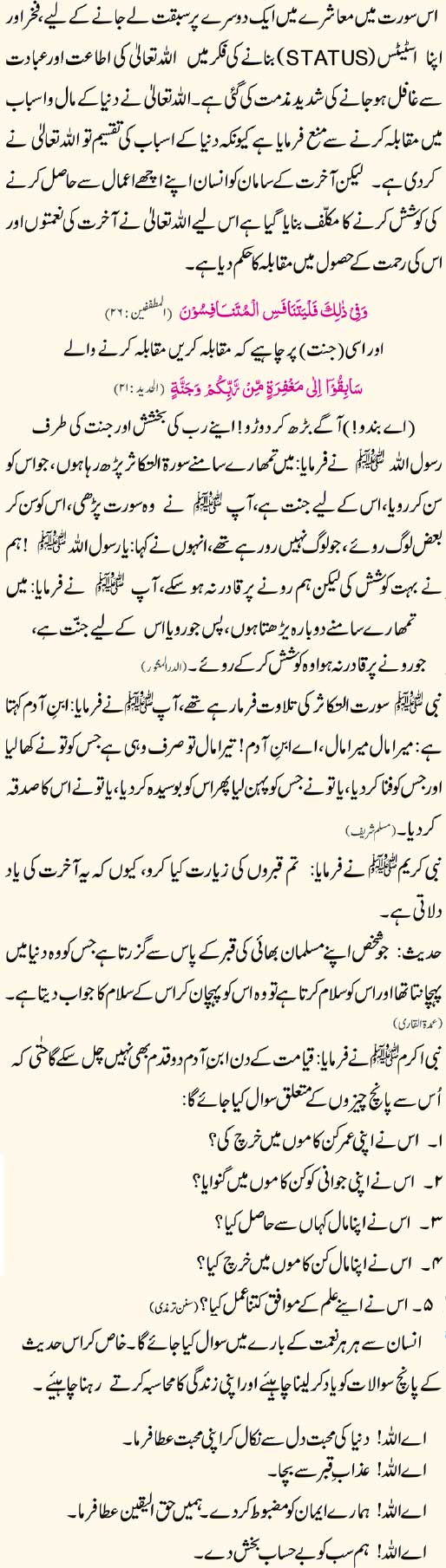
No Soul Shall Bear The Burden Of Another
[Quran – 53:38] “That no soul shall bear the burden of another”
The Prophet (Peace Be Upon Him) has said:
[Muslim, Book #001, Hadith #0229] “It is narrated on the authority of Ibn ‘Abbas: When this verse:” Whether you disclose that which is in your mind or conceal it, Allah will call you to account according to it” (ii 284), there entered in their minds something (of that fear) such as had never entered their hearts (before). The Apostle (may peace be upon him) observed: Say: We have heard and obeyed and submitted ourselves. He (the reporter) said: Allah instilled faith in their hearts and He revealed this verse:” Allah burdens not a soul beyond its capacity. It gets every good that it earns and it suffers every ill that it earns. Our Lord, call us not to account if we forget or make a mistake. He the (Lord) said: I indeed did it. Our Lord! do not lay on us a burden as Thou didst lay on those before us. He (our Lord) said: I indeed did it. And pardon us, have mercy on us. Thou art our Protector” (ii. 286). He said: I indeed did it.”