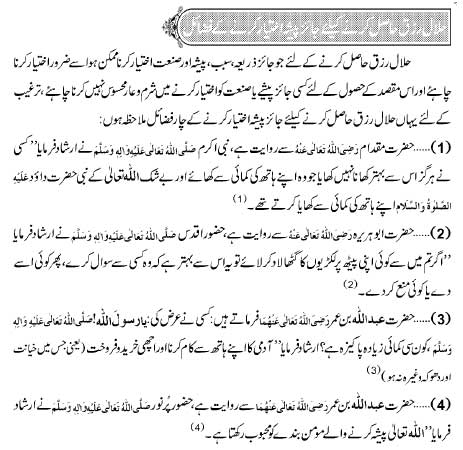
حلال رزق حاصل کرنے کے لۓ جائز پیشہ اختیار کرنے کے فضائلِ


Islam is a complete way of life. It considers the family the cornerstone of Islamic society. It bases the atmosphere in the family on sacrifice, love, loyalty, and obedience. When we say “family” we mean the traditional definition of it, namely husband, wife and children. Grandparents are also part of the extended Muslim family.
It may be asked here: how does Islam organize family relationships? To answer this, we have to concentrate on husband-wife relationship and parent-children relationship.
As for husband wife relationship the following verse portrays the right Islamic atmosphere:
“And among His Signs is this: He created for you spouses from yourselves, that you may find rest in them, and He ordained between you affection and mercy.” (Qur-an, 30-21)
If we contemplate the Noble Qur-an, we find that it refers to parents-child relationships in four main places. Before it asks children to be good and loyal to their parents, it requires parents to be extremely careful in upbringing their children. In other words it asks parents to do their duty before asking for their rights.
These are the two main chapters of the Noble Qur-an that decide and clearly depict the Islamic relationship between parents and children. It is a relationship based, as we see, on belief in Allah, and feeling that He observes all that we do and that we are accountable to Him even in the bad breath that we may release against our parents when we are angry. Even this has to be controlled.
Let us remember, however, that it is only parents who do their duty, who deserve this honorable treatment of their children. That is why when a parent came to the Prophet (Peace Be Upon Him) and complained to him about the ingratitude of his son, the son said: He was ungrateful to me oh Messenger of Allah, before I showed ingratitude to him. So the Prophet (Peace Be Upon Him) did not blame the son but disliked the attitude of his parent. This is a message to all parents.
The third place in the Noble Qur-an that refers to parents child relationship is in chapter 46 called Al Ahqaf where Allah says:
“And We have enjoined on man to be dutiful and kind toward his parents. His mother bears him with hardship and delivers him with hardship. His bearing and weaning are thirty months, till when he attains full strength and reaches forty years, he says: ‘My Lord! Arouse me that I may give thanks for the favor where with you have favored my parents, and I may do right acceptable unto you. I have turned unto you repentant and Lo! I am one of the Muslims.”
Concerning this type of child the Noble Qur-an has the following comment: “Those are they from whom We accept the best of what they do, and We overlook their evil deeds among the dwellers of Paradise – a promise of truth, which they have been promised (in the world).”
The Noble Qur-an then turns to the other category of or children who are disbelievers and are, as a result, ungrateful to their parents. It declares:
“As for him who said to his parents: Fie upon you both! Do you threaten me that I shall be brought forth (again) when generations before me have passed away! While they too cry unto Allah for help and say: Woe unto you! Believe! Verily, the promise of Allah is true. But he says: This is nothing but fables of the ancient.”
Commenting on this attitude Allah says:
“Such are those whom the Word concerning nations of the jinn and mankind which have passed away before them has effect. Verily, they are the losers. And for each there will be degrees due to what they did; that He may recompense them in full for their deeds! And they will not be wronged.” (Qur-an, 46:15-19).
The forth and last place in the Noble Qur-an that refers to parents-child relationship is what is mentioned briefly in chapter 29 that says:
“We have enjoined on man to be good and dutiful to his parents. But should they strive to make you join with Me that of which you have no knowledge, then obey them not. Unto Me is your return and I shall tell you what you used to do.” (Qur-an, 29:8)
As we travel through life, we find ourselves in one of two situations. Either something good is happening in our lives, in which case as Muslims our role is to thank Allah for the blessing, or something bad or something we dislike is happening to us, and our role then is to be patient. This is the formula for a happy life, a life cruising towards earning the pleasure of Allah. Sabr (patience) or Shukr (gratitude), the worry stops here.
The Messenger of Allah (peace be upon him) said:
“Strange is the affair of the believer. Verily, all his affairs are good for him. If something pleasing befalls him, he thanks (Allah) and it becomes better for him. And if something harmful befalls him he is patient (Saabir) and it becomes better for him. And this is only for the believer.” (Saheeh Muslim)
Ibn Al-Jawzi said, “If this world was not a station of tests it would not be filled with sicknesses and filth. If life were not about hardship, then the prophets and the pious would have lived the most comfortable of lives. Nay, Adam suffered test after test until he left the world. Nuh cried for 300 years. Ibrahim was thrown into a pit of fire and later told to slaughter his son. Ya’qub cried until he became blind. Musa challenged Pharaoh and was tested by his people. ‘Isa had no provision except the morsels his disciples provided him with. And Muhammad (peace be upon him) met poverty with patience as his uncle, one of the most beloved relatives to him, was slain and mutilated, and his people disbelieved in him … and the list of prophets and the pious goes on and on.”

Hazrat Ibn Umar (Radiallahu Anhuma) reported Allah’s Messenger (Sallallahu Alaihi Wa Sallam) as saying, “The believer is not given to cursing.” A version has “It is noy fitting for a believer to be given to cursing.”
(Tirmizi Sharif)
Hazrat Samura Bin Jundub (Radiyallahu Anhu) reported Allah’s Messenger (Sallallahu Alaihi Wa Sallam) as saying, “Do not invoke Allah’s curse, Allah’s curse, Allah’s anger, or Jahannam on one another.” A version has, “or Hell.”
(Tirmizi Sharif)
Hazrat Abu Dardaa (Radiyallahu Anhu) told that he heard Allah’s Messenger (Sallallahu Alaihi Wa Sallam) say, “When a man curses anything the curse goes upto heaven and the gates of heaven are locked against it. Then it comes down to the earth and its gates are locked against it. It then goes right and left ,and if it finds no place of entrance it returns to the thing which was cursed, and if it deserves what was said (it enters it) ; otherwise it returns to the one who uttered it.”
(Abu Dawood)
Hazrat Ibn Abbas (Radiyallahu Anhu) told that the wind snatched away a man’s cloak and he cursed it, so Allah’s Messenger (Sallallahu Alaihi Wa Sallam) said, “Do not curse it, for it is under command, and if anyone curses a thing undeservedly the curse returns upon him.”
(Tirmizi Sharif,Abu Dawood)

ALI BIN ABU TALIB said: “Narrate to people what they can understand; do you want Allah and His Messenger to be disbelieved?” (Al-Bukhari)
Ibn Hajr said in Fath Al-Bari, “(In this narration) there is evidence that ambiguous knowledge should not be mentioned amongst the general public.”
Sheikh Muhammad Bin Saleh Al-Uthaymeen explained this very important and often misunderstood point beautifully. After mentioning the instruction of Ali, he states:
It is therefore an aspect of wisdom in da’wah (calling others to Allah) that you should not surprise people with things they are not able to comprehend. Rather, you should call them in stages, bit by bit until their minds settle…”
He goes on to say:
“(The statement of Ali) ‘Do you want Allah and His Messenger to be disbelieved?’ is a rhetorical question, posed as a criticism of such behavior. It means: by narrating to people things they cannot understand do you want Allah and His Messenger to be disbelieved? This is because in such cases when you say, “Allah said, and His Messenger said” they will say you have lied if their minds cannot comprehend what you are saying. Here, they are not disbelieving Allah and His Messenger, but they are disbelieving you because of this speech that you have attributed to Allah and His Messenger. Thus they will end up disbelieving Allah and His Messenger – not directly – but by way of the one who transmits this knowledge (i.e. you).
“Now if it is said: Should we stop telling people things they cannot understand even if they need to know? The answer is: no, we do not leave this knowledge altogether, but we should tell them in a way that they will be able to understand. This is done by telling them in stages – bit by bit – until they can accept the speech we want them to know and they can feel comfortable with it. We do not abandon knowledge that people cannot understand and just say ‘this is something they will reject or dislike so we will not speak about it.’
“The same is the case with acting upon a Sunnah that people are not used to and which they might find objectionable. We should act by this Sunnah, but only after informing people about it, such that they will be able to accept it and feel comfortable about it.
“We learn from this narration that it is important to employ wisdom in calling to Allah, and that it is incumbent upon anyone who calls to Allah to consider the level of understanding of those he is inviting, and that he should put everyone in their proper place.”
– Majmoo’ Fatawa Ibn Uthaymeen, vol.10 pg. 140.
When life on earth ends and the Day of Resurrection arrives, all mankind will be resurrected. They come hurriedly out of their graves to stand in an open expanse. No one looks at another, because they are all preoccupied with their own destiny. The sun is brought near and the heat is enormous. They suffer the heat according to their own deeds. Some of them will be so profusely sweating that their sweat reaches as high as their knees, or even higher. Yet seven types of people are immune from that heat. Who are these?
Abu Hurayrah quotes the Prophet (peace be upon him) as saying: “Seven types shall enjoy God’s shelter on the Day when there is no shelter other than what He provides: a just ruler, a young man who is brought up as a committed worshipper, a man whose heart always inclines toward mosques, two friends whose friendship is for God’s service: it is uppermost in their minds when they meet and when they part, a man who resists seduction by a woman of power and beauty saying to her, “I fear God,” a man who gives something to charity in secret so as his left hand would not know what his right hand has given away, and a man who remembers God when alone and his eyes are tearful.” (Related by Al-Bukhari).
We must first of all make clear that whatever applies to men in this Hadith also applies to women. When we read this Hadith carefully, we realize that it speaks of people who are true believers and whose faith is so strong that they are able to put it ahead of all other considerations. Let us briefly look at each one of the seven.
There is no doubt that any ruler will be hard pressed to maintain justice in all situations and all types of dispute. Therefore, a ruler who makes ensuring justice his priority needs to put up very hard effort not to err against justice. This ensures for him God’s protection on the Day of Judgment.
Scholars explain that although the Prophet mentions rulers in this Hadith, this type includes anyone who is in a position of authority over others and maintains justice between them. Thus it includes every head of a department who supervises a number of employees, an army officer who commands a number of soldiers, a company owner or director who ensures justice among his staff, etc. In fact it also includes a teacher who does not favor certain students over others and a parent who has several children and treats them equally. The Prophet says: “The just will be with God, sitting on desks of light, to the right of the Lord of Grace. These are the ones who maintain justice in their rulings, and within their families, and with whoever is under their authority.” (Related by Muslim).
The just ruler is specifically stated here because his rules affect a large number of people. When he maintains justice and makes it uppermost among his concerns all his people will benefit.
Young people are often tempted by their strong desires and flowing energy. They find it hard to resist tempting situations. Therefore, when a young person goes through youth, adolescence and early adulthood attending to his worship, preferring always to remain obedient to God, he deserves reward of the richest type. His resistance of temptation indicates that he is truly God-fearing. The Prophet says in another Hadith: “God is particularly pleased with a young person who does not give in to desire.” Hence, such young people are included in the seven categories enjoying God’s favor.
– By Adil Salahi
Sahih Bukhari Volume 1, Book 7, Number 331:
Narrated Jabir bin ‘Abdullah: The Prophet said, “I have been given five things which were not given to anyone else before me.
1. Allah made me victorious by awe, (by His frightening my enemies) for a distance of one month’s journey.
2. The earth has been made for me (and for my followers) a place for praying and a thing to perform Tayammum, therefore anyone of my followers can pray wherever the time of a prayer is due.
3. The booty has been made Halal (lawful) for me yet it was not lawful for anyone else before me.
4. I have been given the right of intercession (on the Day of Resurrection).
5. Every Prophet used to be sent to his nation only but I have been sent to all mankind.
Sahih Bukhari Volume 1, Book 7, Number 331:
Had the Holy Prophet Muhammed Salalaahu Alaihi wasallam not been there niether Adam , not the sky nor the earth would have been created , everything was created for him , even all humanity , all animals , all birds , every microorganism living on the planet,
The Universe has been created for him , He was the first of all creations