

Archives
Whoever Fills His Muslim Brother Needs
[Sahih Bukhari: Volume 3, Book 43, Number 622]
Narrated ‘Abdullah bin Umar (Radi Allah Anhu) : Allah’s Apostle (sal-allahu-alleihi-wasallam) said, “A Muslim is a brother of another Muslim, so he should not oppress him, nor should he hand him over to an oppressor. Whoever fulfilled the needs of his brother, Allah will fulfill his needs; whoever brought his (Muslim) brother out of a discomfort, Allah will bring him out of the discomforts of the Day of Resurrection, and whoever screened a Muslim, Allah will screen him on the Day of Resurrection.”
[Sahih Bukhari: Volume 3, Book 43, Number 624]
Narrated Anas (Radi Allah Anhu) : Allah’s Apostle (sal-allahu-alleihi-wasallam) said, “Help your brother, whether he is an oppressor or he is an oppressed one. People asked, “O Allah’s Apostle! It is all right to help him if he is oppressed, but how should we help him if he is an oppressor?” The Prophet said, “By preventing him from oppressing others.”
[Sahih Bukhari: Volume 3, Book 43, Number 629]
Narrated Abu Huraira (Radi Allah Anhu) : Allah’s Apostle (sal-allahu-alleihi-wasallam) said, “Whoever has oppressed another person concerning his reputation or anything else, he should beg him to forgive him before the Day of Resurrection when there will be no money (to compensate for wrong deeds), but if he has good deeds, those good deeds will be taken from him according to his oppression which he has done, and if he has no good deeds, the sins of the oppressed person will be loaded on him.”
These Are The Real Stars
PROPHET MUHAMMAD (peace be upon him) described his Companions as the stars when he said, “My Companions are like the stars, whoever of them is taken as a role model will serve as a real guide.” In this article, we shall shed some light on the morals and manners of these real stars.
Since the beginning of the 20th century, movie stars, singers and footballers have been regarded as the stars in any society, but they are stars in terms of fame and popularity. But if we would like to talk about the real stars who should be taken as examples to be followed, we have to follow the Prophet’s description of the real stars, his Companions.
For example, Abu Bakr Al Siddiq (may Allah be pleased with him) spent almost all his wealth in supporting Islam and freeing Muslims who were still slaves of Makkah chieftains. Omar Ibn Al-Khattab (may Allah be pleased with him) was the epitome of justice. During his reign, nobody dared to usurp the rights of another person because they knew that Omar would never tolerance that.
Othman Ibn Affan (may Allah be pleased with him) was the ideal example of generosity; he was one of the richest Muslims and spent all his money to support Islam and help Muslims to the extent that he bought a well owned by a Jews when he knew that that Jew exploited Muslims’ needs for water.
Ali Ibn Abi Talib (may Allah be pleased with him) was an embodiment of deep knowledge of religion and erudition. After the death of the Prophet (peace be upon him) and especially in the reign of Omar Iban Al-Khattab, whenever Muslims faced a religious problem or had a question, Ali (may Allah be pleased with him) was there to solve their problems and answer their questions. Many Western historians and Orientalists describe that the Companions were devoted followers of the Prophet (peace be upon him) and honest representatives of all his teachings and message. They encouraged other people including Persians, Romans, Egyptians, South East Asians etc. to embrace Islam by their good manners, morals and humane behavior.
In my opinion, the second important thing, after exploring why they were described as stars by the Prophet (peace be upon him) is to take these people as role models: ‘Muhammad is the apostle of Allah; and those who are with him are strong against Unbelievers, (but) compassionate amongst each other. You will see them bow and prostrate themselves (in prayer), seeking Grace from Allah and (His) Good Pleasure. On their faces are their marks, (being) the traces of their prostration. This is their similitude in the Taurat; and their similitude in the Gospel is: like a seed which sends forth its blade, then makes it strong; it then becomes thick, and it stands on its own stem, (filling) the sowers with wonder and delight. As a result, it fills the Unbelievers with rage at them. Allah has promised those among them who believe and do righteous deeds forgiveness, and a great Reward.” (Qur’an, 48:29)
Success Is In Islam
UMAR Bin Al-Khattab (may Allah be pleased with him) was on his way to take over Jerusalem from the Romans. They insisted that they would hand over the keys of the city only to the leader of Muslims, whose power and might was well-known.
His journey was special. He would take turns with his slave to ride the camel. If for some distance he rode and the slave walked pulling the camel, then for the next equal distance the slave would ride and Umar would walk, pulling the camel. Jerusalem was near, the city’s gates were almost in sight, and it was the slave’s turn to ride the camel. While Umar walked, he passed through a pool of mud, so his clothes got soiled.
Abu Ubaidah Bin Al-Jarrah, commander of the Muslim army, was worried. He came to Umar, the leader of Muslims, and suggested that he rode the camel as they were about to enter Jerusalem. He thought the Romans, who are used to pomp and glory, will not respect his leader if he entered with such simplicity.
At first, Umar (may Allah be pleased with him) was taken aback. He didn’t expect Abu Ubaidah, one of the 10 whom the Prophet (peace be upon him) gave good news of Paradise in this world itself, to say something like this!
Then Umar spoke one of the most powerful statements ever to go down in history. He said, “We were a people who lived in humiliation before. Allah gave us honor through Islam. If we sought honor through anything else (at the cost of Islam) then Allah will humiliate us again.”
That statement looks as if Umar was directly addressing us, Muslims of the 21st century. Surely enough, what was the Arabian peninsula before Islam? It was steeped deep into ignorance that rulers would pass by and would not bother conquering it.
People would bury their female babies alive; fights would start at the drop of a hat and continue for hundreds of years; immoral practices were rampant; and most importantly idols made by their own hands were worshiped.
Who could have thought during the time that in less than 100 years the same people would be ruling from Spain to nearly the Indian subcontinent and beyond? But that is what Islam did to them, that is what standing firm upon the truth brought them. They were exemplary as believers – practicing Islam with full conviction, and obeying Allah with full submission. This is what we lack today. We lack knowledge that precedes action, and faith that turns knowledge into deeds. If we set that right, Allah promises us the success we so desperately seek.
“So do not become weak (against your enemy), nor be sad, and you will be superior (in victory) if you are indeed (true) believers.” (Qur’an, 3:139)
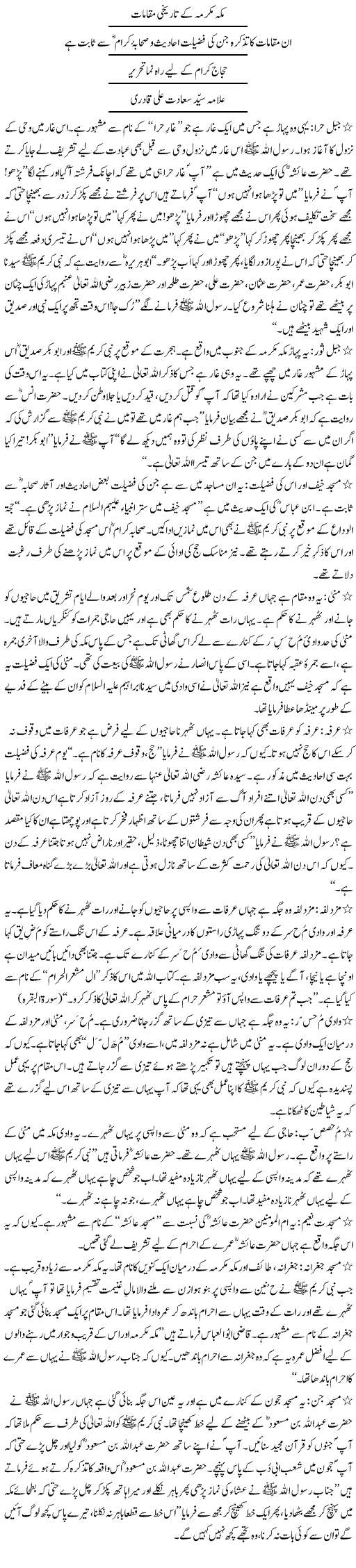
Makkah Mukarma Kay Tarikhi Muqamat
The Soil Of Paradise
al-Bukhaari and Muslim reported the hadith of al-Mi’raaj from Anas ibn Maalik from Abu Dharr in which Abu Dharr (ra) said, “The Messenger of Allah (saw) said, “I entered Paradise where I saw lights of pearl and its soil was musk”. Muslim and Ahmad report from Abu Sa’eed that Ibn Sayyaad asked the Messenger (saw) about the soil of Paradise. He said, “It is a fine white powder of pure musk”.
Ahmad reports from Jaabir ibn ‘Abdullaah that the Messenger of Allah (saw) said, concerning the Jews: “I am going to ask them about the soil of Paradise, which is a fine white powder.” So he asked them, and they said, “It is like a loaf of bread, O Abul-Qaasim,” The Messenger of Allah (saw) said, “Bread is like pearls”. [an-Nihaayah, 2/242]
Ahmad at-Tirmidhi and ad-Daarimi reported that the Prophet (saw) said, “I asked “O Messenger of Allah (saw), From what are people made?” He said, “From water.” We asked, “From what is Paradise built?” He said, “Bricks of gold and silver and mortar of fragrant musk; its pebbles are pearls and rubies, and its soil is saffron. Whoever enters it is blessed with joy and will never be miserable; he will remain there forever and never die; his clothes will never wear out, and his youth will never fade away .” [Mishkaat al-Masaabeeh, 3/89, no. 5630]
Footnotes
[1] Ibn Hajar said, in Taqreed al-Tahdhib, “Na’eem ibn Hammar or Hibaar or Khammaar. He was a Sahaabee and the majority of sources give his father’s name as Himaar.”
The Keepers of Hell
Standing over Hell are MIGHTY and STERN angels who never disobey Allah subhaanahu wa ta’ala Who has created them. They do whatever He commands them, as Allah subhaanahu wa ta’ala says:
“O you who believe! Save yourselves and your families from a Fire whose fuel is men and stones, over which are [appointed] angels stern [and] severe, who flinch not [from executing] the Commands they receive from Allah, but do [precisely what] they are commanded.” (66:6)
Their number is nineteen as Allah (swt) says:
“Soon I will cast him into Hellfire. And what will explain to you what Hellfire is? Naught does it permit to endure, and naught does it leave alone! Darkening and changing the color of man! Over it are nineteen [angels as guardians and keepers of Hell]” (74:26-30)
This number was a challenge to the kuffaar who thought that they would easily overcome such a small number, but they did not realize that one of these angels has the strength to confront the whole of mankind on his own. For this reason, Allah (swt) said in the next aayah:
“And We have set none but angels as guardians of the Fire, and We have fixed their numbers [19] only as a trial for the disbelievers..” (74:31)
Ibn Rajab said, “What is known and well-established among the earlier and later generations (as-Salaf wal-Khalaf) is that the trial came about when the number of angels was mentioned and the kuffaar thought that it was possible to kill them. They thought that they would be able to fight and resist them. They did not know that humankind in its entirety would not be able to resist even ONE of them.” (at-Takhweef min an-Naar, p.174)
The Good Shepherds
IT is narrated that a man came to a knowledgeable person from among our pious predecessors and asked him, “I just had a child, what should I do?” The answer came, “If you are just now asking this question, then you have already lost.”
This narration shows how serious Muslims used to be about raising children. So much so that they told this man, who had just had a child that he had lost. This is because they believed correctly that the proper upbringing of a child begins even before the child is conceived. It begins by us being good Muslims ourselves, choosing good mates and educating ourselves about Islam, and how to be good parents and how to raise good Muslim children. Unfortunately, many Muslim parents today do not understand the importance of raising good Muslim children the way they should.
As we go about our daily lives, pursuing our occupations as homemakers, doctors, businessmen, teachers or whatever we may be, how often do we forget that the most important job we have is being a shepherd, and that it is this job that Allah will call us to account for on the Day of Judgment. For Allah ‘s Prophet(peace be upon him) said:” All of you are shepherds and each one is responsible for his flock. A leader of a people is a shepherd and responsible for them. A man is a shepherd over his family and is responsible for them. A woman is a shepherdess over her husband ‘s house and his children and she is responsible for them. And a servant is a guardian over his master’s property and is responsible for it. So all of you are guardians and are responsible for your charges.” (Bukhari)
As parents, Allah, has made us responsible for our families. It is the primary responsibility of parents to raise their children as Muslims. And therefore, as shepherds we must never give our children the impression that Islam is merely a series of rituals to be done in a certain way, day in, and day out.
Rather, we should be keen to tell them and to convey to them Islam as a complete way of life, and it is the way of life that brings about true peace and happiness, in this world as well as in the Hereafter.
As shepherds, we must realize that it is our responsibility to guide our flock and to keep them away from the prohibited pastures. Prophet Muhammad (pbuh) said “Whoever indulges in these suspicious things is like a shepherd who grazes (his animals) near the hima (private pasture) of someone else and at any moment he is liable to get in it. (O people) Beware! Every king has a hima and the hima of Allah on the earth is His illegal (forbidden) things.” (Bukhari)
As parents, are we outraged when our children bring home bad grades from school, yet we are indifferent when that same child misses salah(prayer). Are we more concerned with our child’s place in Harvard than we are with his place in the Hereafter? Are our homes places where the Qur ‘an is only dusted off for the ritualistic reading during the month of Ramadan?
So, how do we become good shepherds? The first step is to make a self-evaluation. We need to ask ourselves, are my feelings about Islam in accordance to what Allah requires of me? Does my action match my speech? How much of my time do I spend learning about Islam and/or performing acts of obedience to Allah? Only after affirming the strengths and weaknesses of our own Islam and constantly striving in our practice of Islam, can we begin to guide our flock on the path that is pleasing to Allah.
As parents and as shepherds our primary responsibility is fulfilling the commands of Allah “O you who believe, save yourselves and your families from the fire.” (Qur’an; 66:6)
Our flocks are the future of this religion. Are we raising them to be good shepherds?
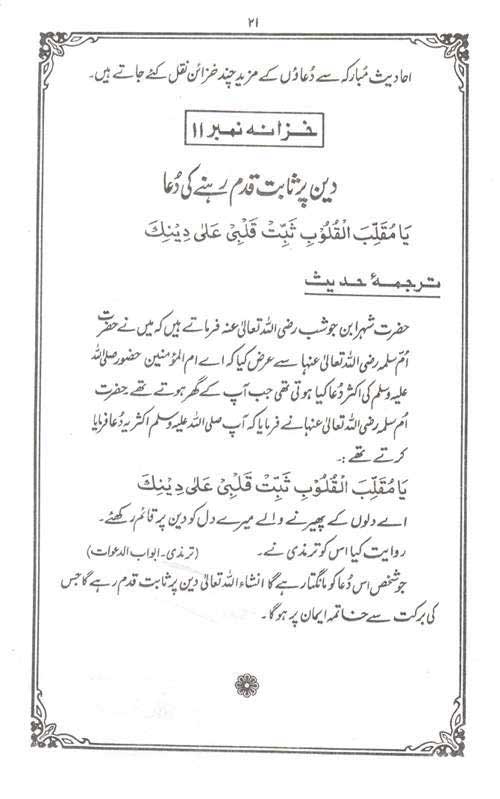
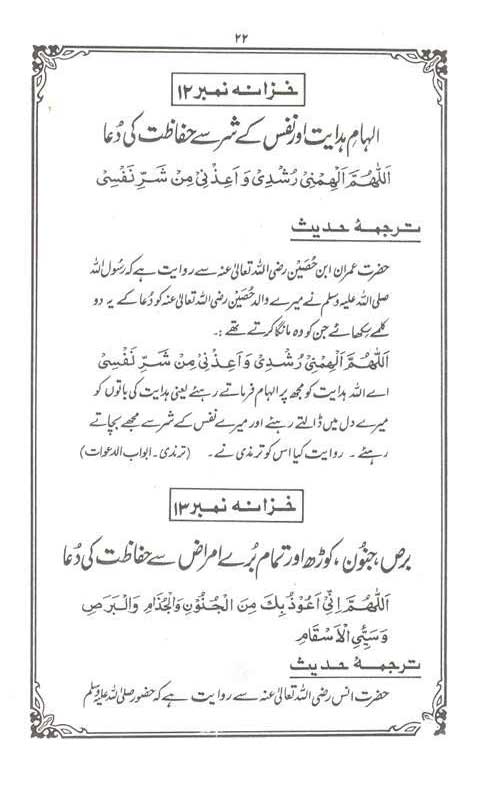
Khazana Hadees Shareef
Merits Of Reciting The Greatest Verse Of The Qur’an
AYAT-ul-Kursi (Qur’an, 2:255) is the most magnificent verse of the Qur’an.
Ubayy Bin Ka’b says once the Prophet (peace be upon him) asked me, “O Abu Mundhir, do you know which verse of the Qur’an with you is the most magnificent?” I submitted: “Allah-o-la-illaaha illa huwal-hayyul Qaiyum…” (2:255).
The Prophet (peace be upon him) thumped my chest as a gesture of appreciation and said: “Congratulations on your knowledge (of the Qur’an), O Abu Mundhir!” (Sahih Muslim)
Abu Hurairah narrates:
Prophet Mohammed (peace be upon him) appointed me to guard the Sadqa Fitr (alms given during Ramadan before Eid). One night an intruder came and started collecting the food. I caught hold of him and said: “I will produce you before the Prophet (peace be upon him)” but the intruder pleaded: “I am a poor man and have number of children to support. I am badly in need of help and succor.” On hearing this woeful tale I let him go.
In the morning the Prophet (peace be upon him) asked me: “Abu Hurairah what happened to your thief last night?” I answered, “O Messenger of Allah! He pleaded his dire necessity and complained about his large family. As such I felt pity for him and let him go.” The Prophet (peace be upon him) remarked: “He has lied, he will come back again.”
I was sure he would come again as the Prophet (peace be upon him) had said, and therefore I kept watch and waited for him. The thief did come again and started gathering food. I caught him again and said that I would definitely take him to the Prophet (peace be upon him).
On this he requested that he was a needy person and had a large family to support and that he may be let off and promised that he would not come back. I felt pity for him once more and let him go.
Next morning the Prophet (peace be upon him) asked: “Abu Hurairah what about your prisoner of last night? I answered: “O Messenger of Allah, he pleaded his dire necessity and the fact that he had a large family, and therefore I felt pity for him and let him go.” He (peace be upon him) said: “He told you a lie and will come back again!”
So I maintained a watch for him a third time. He did come to steal food (from the alms store) Abu Hurairah says: “I caught hold of him and said; I shall certainly take you to the Prophet (peace be upon him) and this is the last of the three times you promised that you will not come back, (but you have broken your promise and came back).”
He pleaded: “Please let me go and I will in return teach you some phrases which will bring benefit and mercy from Allah.” I asked him: “What are those?” He said: “When you go to bed (during night) recite the verse (Ayat-ul-Kursi, 2:255). (As a result of its blessings) Allah will appoint a guard to protect you, and Satan will not be able to come near to you till morning.”
So I allowed him to go. Next morning when I visited the Prophet (peace be upon him) he asked me: “What did you do with your prisoner last night?” I said, “O Messenger of Allah, he said that he would teach me some phrases through which I would receive benefit and mercy of Allah. On this I let him go.” He (peace be upon him) asked, “What are those phrases?” I said: “He told me, when you go to your bed for sleep, recite the verse ‘Ayat-ul-Kursi’ from beginning to end, and told me that Allah would post a guard on me and Satan would not be able to come near me till the morning.”
The Prophet (peace be upon him) said: “This time he told you the truth although he is a liar. Abu Hurairah, do you know with whom you were speaking during these three nights?” I answered; “No.” The Prophet (peace be upon him) said: “It was Satan (the devil).”
Prophet Mohammed (peace be upon him) also said that whoever recites Ayat-ul-Kursi after every Fardh (obligatory) Salah, nothing can keep him away from entering Paradise except death. (Al-Bukhari)