

Archives
Abu Bakr’s Admonition To Umar
ABU Bakr Al-Siddiq, on his deathbed, called Umar and said:
Fear Allah, O Umar. Know that there are deeds to be done in the day which Allah will not accept if done at night, and there are deeds to be done at night which He will not accept if done during the day. He will not accept extra (Nafl) deeds unless you fulfill the obligatory ones.
The scales of some will be weighty on the Day of Resurrection only because they followed the truth in this life and it was weighty to them. And the scales on which the truth will be placed tomorrow truly deserve to be heavy. The scales of some will be light on the Day of Resurrection only because they followed falsehood in this life and it was a light matter to them. And scales in which falsehood will be placed tomorrow truly deserve to be light.
Allah the Exalted has mentioned the people of Paradise and mentioned them in the context of their best deeds, and overlooked their evil deeds, so when I remember them I say to myself: I fear that I will not be included among them.
And Allah the Exalted has mentioned the people of Hell and mentioned them in the context of their worst deeds and rejected their best deeds, so when I remember them I say: I hope I won’t be amongst them. Allah’s worshipers should always be in a state of hope and fear, they shouldn’t entertain flimsy wishes about Allah and neither should they despair of Allah’s mercy.
If you keep to this advice of mine, no one who is not with you now should be more beloved to you than death – and it is sure to come to you. But if you disregard this advice, no one who is not with you now should be more hated to you than death – and you cannot escape it.
– Abu Nu’aym, Hilyah Al-Awliya Vol.1 p18; and Ibn Al-Jawzi, Sifah Al-Safwah.
What Was So Special About Him
Anas (may Allah be pleased with him) said: We were sitting in the presence of Allah’s Messenger (peace be upon him) one day, and he said, “A person is about to arrive from this mountain path who is from the people of Paradise.”
So a person from the Ansar arrived, his beard dripping with water from wudhu and his left hand carrying his sandals. He greeted us with salaams.
The second and the third day too the Prophet (peace be upon him) said similar words and the
same man appeared in the same condition.
Abdullah Bin Amr Bin Al-Aas followed the man sought his permission to stay with him for three days .
So Abdullah spent three nights with this person. But he did not see him stand up for the night prayer at all! All he did was, mention Allah and make takbeer when he turned sides on his bed. He would do this till he stood up for the Fajr prayer.
However, Abdullah said, “I never heard him speak anything except good.”
So when the three days were over, Abdullah told the man, “O, servant of Allah! I heard Allah’s Messenger (peace be upon him) saying on three occasions, ‘A person is about to arrive who is from the people of Paradise,’ and you arrived on those three occasions.
But I have not seen you perform a great deal of deeds, so what is it that made the Prophet (peace be upon him) say that about you?” He replied, “I do not harbor disloyalty to any of the Muslims within me, and neither do I feel jealous for the wealth that Allah has bestowed upon them.”
Abdullah said, “This is what has (made you special) and it’s something we cannot endure.” (Musnad Ahmad – Hasan)
Ten Useless Things
- Knowledge that is not acted on.
- The deed that has no sincerity.
- Money that is hoarded, as the owner neither enjoys it during this life nor obtains any reward for it in the Hereafter.
- The heart that is empty of love and longing for Allah, and of seeking closeness to Him.
- A body that does not obey and serve Allah.
- Loving Allah without following His orders or seeking His pleasure.
- Time that is not spent in expiating sins or seizing opportunities to do good.
- A mind that thinks about useless matters.
- Serving those who do not bring you close to Allah, nor benefit you in your life.
- Hoping and fearing those who themselves are under the authority of Allah; while they cannot bring any benefit or harm. – Al-Fawa’id
A great scholar, Ibnul Qayyim Al-Jawziyyah (d. 751H) was also known as the ‘doctor of hearts’. He was a prominent student of Sheikh-Al-Islam Ibn Taymiyyah.
– By Ibnul Qayyim Al-Jawziyyah
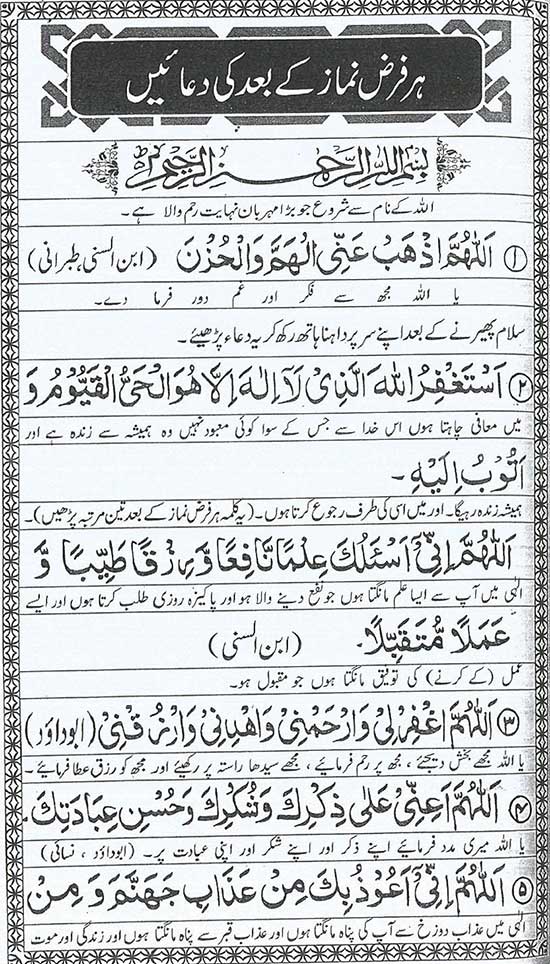
Har Farz Namaz Kay Baad Ki Duaaien
Prophet Muhammad (pbuh) – A Perfect Human Being In All Respects
We always stress that Muhammad (peace be upon him) was a human being who experienced all that a person may experience in life. However, he was chosen by God to be His messenger to mankind, bringing them God’s final message and providing them with practical guidance on how to conduct their lives in accordance with the teachings of God’s message.
We have detailed descriptions of what he looked like, but what is more important to us is to understand his character and how he behaved with other people. From these descriptions we gather that he was a rare example of Arab manly charm who combined all aspects of an attractive physical and personal appearance.
He was handsome, loveable, awe-inspiring, modest, loyal, loving and caring. He was very happy when he brought a smile to anyone, but his happiness would be greater if that person was a child, a helpless woman or an unfortunate elderly person.
The Prophet combined all this with exceptional physical strength and vigor. He consistently overcame strong people in combat. When he was still in Makkah, a man who was renowned for his strength and wrestling ability told Prophet Muhammad that he would believe in him as God’s messenger if he could beat him in wrestling.
The Prophet accepted the challenge and beat the man. The latter tried to find excuses and wanted the match to be restarted. The Prophet beat him again. Moreover, Prophet Muhammad (peace be upon him) could ride an unsaddled horse and easily tame and control him.
However, he did not use his physical strength to press any advantage over others, or to gain their love or respect. He wanted people to take everything easily and live with him as they live with a dear friend. With members of his family, he wanted life to run smoothly and showed them that he was one of them. He would even compete with those he loved in a pleasant way.
Ayesha reports that she was accompanying the Prophet on a journey when she was still young and thin.
“The Prophet told his fellow travelers to go ahead of them. He then said to me: Shall we race? We raced, and I won. He said nothing. Later, when I had put on some weight, we were on another trip, when he told other people to march ahead. He then said to me: Shall we race? We raced and he won. He laughed and said: We thus draw, one race each.” Thus, he took such things so lightly, even though he was approaching sixty years of age, and he was the head of a powerful state where he enjoyed unparalleled popular love.
Yet he would visit his servant’s family and extend his kindness to them. Anas ibn Malik was a servant at the Prophet’s home for 10 years.
The Prophet visited Anas’ home on numerous occasions. Anas reports: “The Prophet visited my mother and saw that my young brother, Abu Umayr, was sad. He asked her: ‘What grieves Abu Umayr?’ She told him that he had a little bird, which died that day. The Prophet asked my brother: ‘Abu Umayr, where is the little bird gone?’ He asked him the same question every time he saw him.
This incident tells us much about the Prophet’s kindness to all people. He visits his servant’s people in their home, and inquires about the reason for a child’s sadness, comforting him about the loss of his bird, and remembers his feelings every time he sees the child.
– by Adil Salahi
10 Things To Hand Down To Your Daughter
* Knowledge of and love for Allah and the Deen. This is one of the most precious and enduring gifts you can pass down to your daughter, one that will benefit her in this life and the next.
* Memorization of the Qur’an. No matter how little you have memorized yourself, push your daughter to memorize as much she can. Encourage her and help her to revise. It will stand her in good stead in her life and will be a source of reward for you after your death as well.
* A good example of Muslim womanhood. Most girls look to their mothers for guidance. Embody the characteristics of a strong, faithful Muslimah and she will be inspired to follow your example.
* A sense of self-worth and self-esteem. Instill a sense of confidence in your child by encouraging her skills, talents and personality to develop. Make her feel secure in her identity and show her that she is loved and appreciated. This will have a positive impact on her future relationships and how she interacts with the world.
* A sense of modesty. Instill a love for Hijab in your daughter and encourage her to be modest, never boastful or conceited, in all areas of her life.
* Your language. If you speak Arabic, be sure to teach it to her so that she has the key to the understanding of the Qur’an. Also, if you have a mother tongue or speak a second language yourself, pass it on: a second or third language is always an asset, whether in study, work or social environment.
* A skill that you have. If you are an avid gardener, knitter or love painting, pass your skill onto your daughter. With so many ‘traditional’ skills being lost in today’s fast-paced world, you owe it to her to share your knowledge and pass it on to the next generation.
The Intensity Of The Suffering Of The People Of Hell
The Fire is an intense punishment, in which there are different types of torment, to escape which people would give the dearest possessions that they own:
“As for those who reject Faith, and die rejecting – never would be accepted from any such as much gold as the earth contains, though they should offer it for ransom. For such is [in store] a penalty grievous and they will find no helpers”. (3:91)
“As to those who reject faith – if they had everything on earth and twice repeated, to give as ransom for the Penalty of the Day of Judgement, it would never be accepted of them. Theirs would be a grievous Penalty.” (5:36)
Muslim reports from Anas ibn Maalik that the Messenger of Allah (saw) said: “One of the people of Hell who found the most pleasure in the life of this world will be brought forth on the Day of Resurrection, and will be dipped into the Fire of Hell. Then he will be asked: O son of Aadam, have you ever seen anything good? Have you ever enjoyed any pleasure?” He will say, “No, by Allah (swt), O Rabb”” (Muslim, Mishkaat al-Masaabeeh, 3/102).
Just a few short moments will make the kuffaar forget all the good times and pleasure that they had enjoyed. al-Bukhaari and Muslim report from Anas ibn Maalik that the Messenger of Allah (saw) said, “On the Day of Resurrection, Allah will say to one whose punishment in the Fire is the lightest, “If you had whatever you wanted on earth, would you give it up to save yourself?” He will say, “Yes”. Allah (swt) will say, “I wanted less than that from you: when you were still in the loins of Aadam, I asked you not to associate anything in worship with Me, but you insisted on associating others in worship with Me””. (al-Bukhaari, in Kitaab ar-Raqaaq, Baab Sifaat al-Jannah wan-Naar, Fath al-Baari, 11/416, See also Mishkaat al-Masaabeeh, 3/102)
The horror and intensity of the Fire will make a man lose his mind, and he would give up everything he holds dear to escape it, but he will never be able to:
“..the sinner’s desire will be: would that he could redeem himself from the Penalty of that Day by [sacrificing] his children, his wife and his brother, his kindred who sheltered him, and all, all that is on earth, so that it could deliver him. By no means! For it would be the Fire of Hell! Plucking out [his being] right to the skull”. (70:11-16)
This horrendous ongoing punishment will make the life of these evildoers one of continual sorrow and pain.
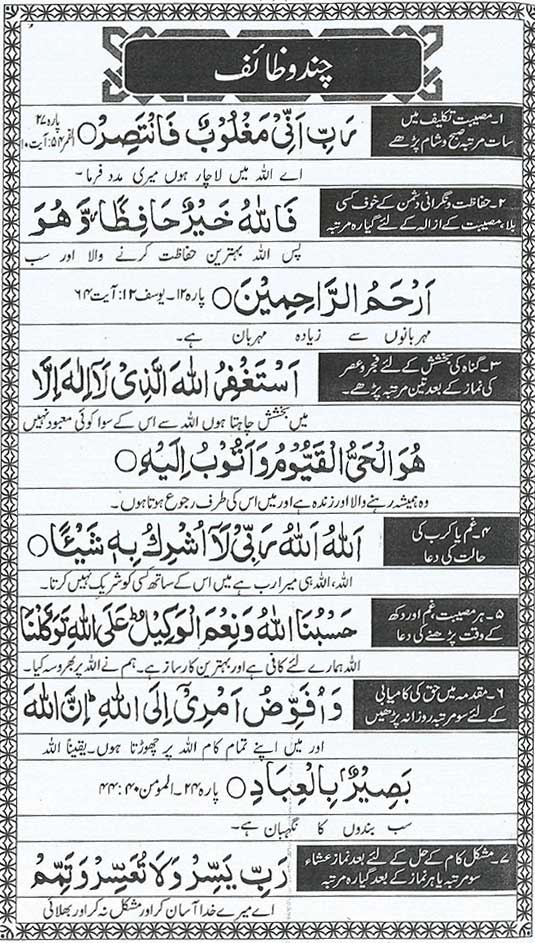
Chund Behtreen Wazaif
There Is Good In Every Event
EVERY event that happens to the Muslim has one sort or another aspect of goodness in it. Allah states that even events that seem to be unfavorable may have a lot of good in them: ” … It may be that you dislike a thing and Allah brings through it a great deal of good.” (Surah 4:19).
Aware of this secret, believers seek goodness and beauty in every event. No seemingly adverse incident, hardship, or mischief ails or worries them. They maintain their composure, whether the experience is insignificant or a serious ordeal. Sincere Muslims even see goodness and Divine purpose in the loss of all their hard earned possessions. They express gratitude to Allah for the gift of life. They have faith that Allah may have protected them from committing an evil act or against too much attachment for possessions.
Accordingly, believers give their most inner thanks to Him because no loss in this world equals the loss in the Hereafter. Loss in the Hereafter means eternal and intolerable punishment (unless Allah wills otherwise). Those who keep themselves occupied with the remembrance of the Hereafter view every event as goodness and beauty leading to the Hereafter.
Those who overcome such ordeals will recognize their weaknesses before Allah and will reconsider how much they are in need of Him. They will turn to Allah with much humility through prayers and remembrance that will bring them closer to Him. This is surely an enormous benefit to one in the Hereafter. These aside, by putting absolute trust in Allah and showing steadfastness, they will earn His pleasure and will be rewarded with eternal bliss.
People should seek goodness and beauty not only in ordeals, but also in daily routines. For example, burning the food one has painstakingly prepared may lead one to take numerous measures that would, by the will of Allah, prevent a more serious accident in the future. A young person might fail the college admission test on which all hopes for the future had been pinned.
People should, however, know that there is goodness in their failure, too; they should be able to think that Allah might have willed them to avoid some adverse circumstances or people and thereby feel pleased with the result. Alternatively, by thinking that Allah has placed in every event many other blessings that are either obvious or beyond the imagination, believers see the beauty of full submission to the guidance of Allah.
People may not always see the goodness and divine purpose behind every incident. Even if this be the case, they know for certain that there is goodness in all events. They offer prayers to Allah to discover the goodness and divine purpose hidden behind everything that happens.
Those who are aware that everything has a purpose in Allah’s creation never use phrases such as “I wish I had not done this” or “I wish I had not said that” and so on. Mistakes, defects, or seemingly unfortunate events essentially include blessings, and each one of them is the trial of destiny. Allah gives important lessons and reminders to humans in the destiny He decrees individually for each person.
For those who can evaluate with insight, there are no mistakes or adversities, but rather lessons, warnings, and wisdom from Allah. For example, a Muslim whose shop burns down will search his or her soul, and will become even more sincere and true in his or her faith, deeming it as a warning by Allah against over-indulgence in worldly goods and attachments.
Consequently, no matter what one encounters in this life, the ordeals will all eventually end. A person who recalls a hardship will be amazed that it is nothing more than reminiscence in the mind. This is also how people recall the scenes from a film. Accordingly, one day will come and the most painful experience will become only a memory, more like the image of a scene from a movie. Only one thing will remain — the attitude a person assumed during the time of hardship and whether Allah is pleased with him or her.
People will not be called to account for their experiences, but rather for their attitudes, thoughts, and sincerity they displayed at the time of these experiences.
Therefore, endeavoring to see the goodness and the divine purpose Allah creates in the situations encountered and taking a positive attitude will bring bliss to believers both in this world and in the Hereafter. No sorrow or fear awaits these believers who are aware of this secret. Similarly, no one, no event can create fear, harm, or distress in this world or in the Hereafter. Allah reveals this secret in the Qur’an: “And whoever follows My Guidance, there shall be no fear on them, nor shall they grieve.” (Surah 2:38)