
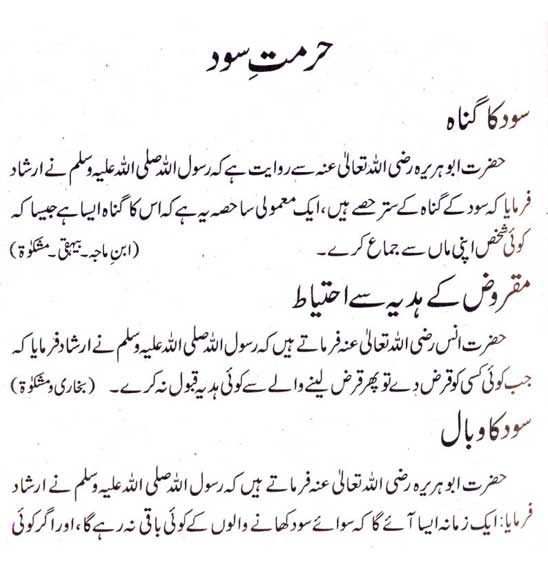
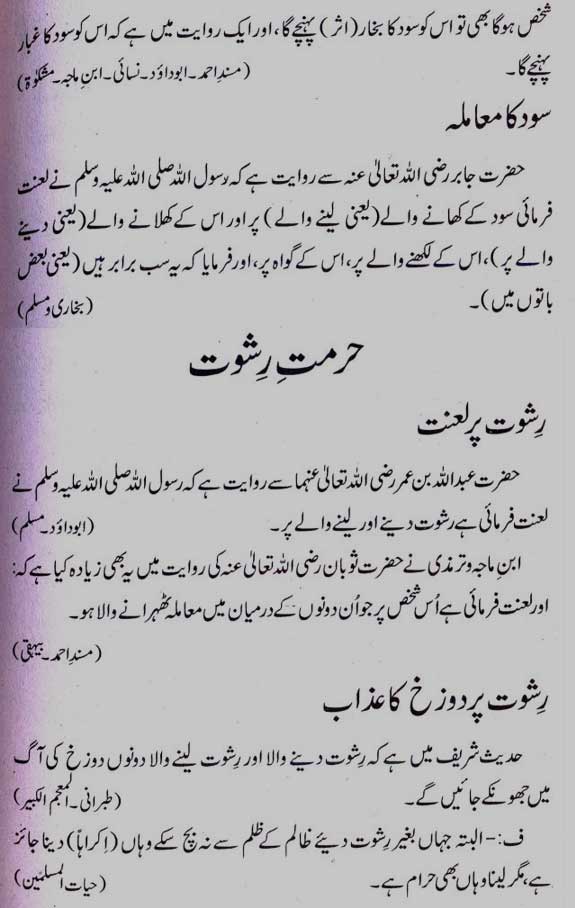
Hurmat e Sood
Archives
Taking A Shower On Friday
During the lifetime of the Prophet (peace be upon him), Muslims mostly endured hard times, with many Arabian tribes and other forces lined up against them.
Moreover, they suffered economic siege for long periods. Therefore, they were mostly poor. Their clothes were simple, rough, and hardly suitable for the climate. Many did not have more than one robe which they would wear every day, at work and other places. With the hot climate in Arabia, they were bound to sweat. This often gave them a bad smell. When they came to the mosque, particularly on Friday, the smell was often too sharp for comfort. Some of them complained to the Prophet. He advised all his companions to take a shower on Friday before coming to the prayer.
Abu Said Al-Khudri reports: “I bear witness that God’s messenger (peace be upon him) said: ‘Taking a bath on Friday is a duty on everyone who has attained puberty, as is cleaning his teeth and wearing some perfume if he finds it’.” (Related by Al-Bukhari).
This Hadith is the strongest with regard to the standards of cleanliness that we should observe on Friday. There are other Hadiths that may give more details, but they make clear that such actions are strongly recommended, not duties. The difference is that a duty involves clear instructions that must be obeyed. If it is not, then the person who neglects it leaves himself open to punishment by God. A recommended action is less important. It earns reward for us when we do it because by doing it we show our obedience to God and His messenger. If we fail to do it, we incur no sin and are liable to no punishment, but we deprive ourselves of the reward that goes with it.
The great majority of scholars are of the view that taking a bath or shower on Friday is strongly recommended, before going out to attend the Friday prayer, which must be offered in congregation. The Prophet also recommended we to use a toothbrush to clean our teeth and mouths. This would ensure that no one will have a bad mouth smell when they come to the mosque. In addition, he has recommended us to wear some perfume. He made it clear that this is recommended, adding the phrase “if he finds it” to indicate that it is not obligatory.
Scholars agree that all these actions should be done before we go out to attend the Friday prayer, which falls due just after midday. However, if one takes a bath early, or at any time after dawn prayers, he does well. Needless to say, the closer one does this to the time of Friday prayer, the better. However, the matter is left to people’s convenience. It may be that an earlier bath is more convenient for some people, particularly when several adults live in the same house. If they all want to take a bath shortly before the prayer, they may be in each other’s way.
It must be made clear that taking a bath or shower on Friday applies to everyone who attends the prayer, man or woman. It does not apply to children, below the age of puberty, because prayer is not obligatory to them. However, if they are going to the mosque, it is better if they are instructed to take a bath so that they develop this habit at an early age. Friday prayer in the mosque is not obligatory for women, but they are welcome to attend it if they so wish. They are also recommended to follow the same practices of cleanliness.
– By Adil Salahi
How Friendly And Likeable Is Your Behavior?
The Muslim who truly understands the teachings of his religion is gentle, friendly, and likable. He mixes with people and gets along with them. This is something that should be a characteristic of the Muslim who understands that keeping in touch with people and earning their trust is one of the most important duties of a Muslim.
It is an effective means of conveying the message of truth to them, and exposing them to its moral values, because people only listen to those whom they like, trust, and accept. Hence there are many Ahadith who commend the type of person who is friendly and liked by others. Such a person is one of those chosen ones who are beloved by the Prophet (peace be upon him) and will be closest to him on the Day of Resurrection.
“Shall I not tell you who among you is most beloved to me and will be closest to me on the Day of Resurrection?” He repeated it two or three times, and they said, “Yes, O Messenger of Allah (peace be upon him).” He said, “Those of you who are the best in manners and character.” (Ahmad; authentic) Some reports add, “Those who are down-to-earth and humble, who get along with others and with whom others feel comfortable.”
One of the attributes of the believer is that he gets along with others and others feel comfortable with him.
The Prophet (peace be upon him) said, “The believer gets along with people and they feel comfortable with him. There is no goodness in the one who does not get along with people and with whom they do not feel comfortable.” (Ahmad)
The Prophet (peace be upon him) set the highest example of good behavior towards people. He was skillful in softening their hearts and called them to follow him in word and deed.
He was always cheerful and easy-going, never harsh. When he came to any gathering, he would sit wherever there was an empty space, and he told others to do likewise. He treated everyone equally. If anyone came to him and asked for something, he would give it to him, or at least respond with kind words.
– The Ideal Muslim/IIPH
Five Ways To Disobey Allah!
Ibn Qudamah Al-Maqdisi mentions a conversation between a young lad and the great scholar Ibrahim Bin Adham in his book Kitab At-Tawwabeen, page 285.
The young boy: O Abu Ishaq, I am wronging my soul, advise me with something that’ll hold me back from disobeying Allah and breathe new life into my heart.
Ibrahim Bin Adham: Alright. If you take five things from me and fulfill them, you can disobey Allah the Almighty all you want, and no harm will come to you.
Young boy: (Interested) Ok, tell me.
Ibrahim Bin Adham: One, if you want to do other than what Allah wants you to do, then do not eat the food that He provides you.
Young boy: Then where am I supposed to eat from when all the food on earth is from Allah?
Ibrahim Bin Adham: Dear lad, is it right that you eat the food Allah the Almighty has given you and then go off and disobey Him?
Young boy: No it is not right. What is the second?
Ibrahim Bin Adham: Two, if you want to live life to the fullest in disobedience of Allah, then don’t live on His land.
Young boy: That’s harder than the first. Where shall I live when all that is in the east and west belongs to Him?
Ibrahim Bin Adham: Dear boy, is it right that you eat His food and live in His land, yet still insist on turning your back when He calls you?
Young boy: No it’s not right. What’s the third?
Ibrahim Bin Adham: If you want to disobey Allah, yet still eat the food He gave you and still live in His land, then find a place where He can’t see you.
Young boy: O Abu Ishaq, how can that be so when Allah is the All-Seeing and All-Knowing of all that happens, even what the heart whispers?
Ibrahim Bin Adham: Dear boy, is it right that you eat His food and live in His land and disobey Him while He watches you and what you are exposing?
Young boy: No it’s not right. What’s the fourth?
Ibrahim Bin Adham: When the angel of death comes to snatch your soul, tell him to grant you a day so that you can sincerely ask Allah for forgiveness and change your life.
Young boy: He won’t grant me that.
Ibrahim Bin Adham: Dear boy, if you find yourself helpless to put off death for just one day and you know that it cannot be delayed by your wishes, how do you expect to win?
Young boy: (With a sigh) What is the fifth?
Ibrahim Bin Adham: When the gatekeepers of Hell will come to drag you away on your face to Hellfire refuse to go with them.
Young boy: Nothing will stop them.
Ibrahim Bin Adham: How do you expect to be saved then?
Young boy: Enough, Abu Ishaq. (And he lowers his head crying). O Allah, forgive me for my transgression.
Epilogue: Young boy went on to become a student of Ibrahim Bin Adham. He repented to Allah sincerely and lived an upright life with his teacher until death parted the two.
Imam Ibrahim Bin Adham died over a thousand years ago in the year 778 CE.
Jhoot Sey Perhaiz
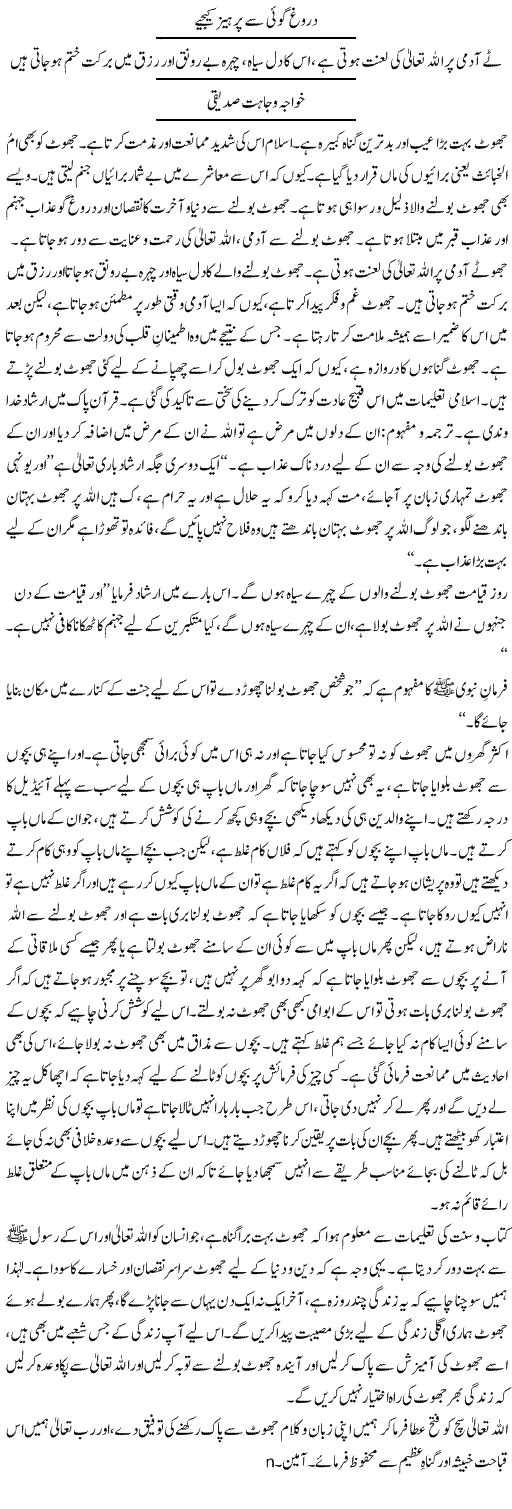
Jhoot Sey Perhaiz
Give Gifts Without Expecting A Return
So often we hear people saying, “He never gives me an expensive gift. That is why I have chosen this cheap gift for him” or someone might say, “I am going to buy an expensive gift for her because she is rich. She will return it with a better one.”
Is this what exchanging gifts is all about? While saying such things we forget the real meaning of a gift. Giving a gift or present should be done without expecting any compensation.
It is a voluntary act that does not require anything in return. Therefore it is totally different from trade. In Islam, giving gifts is a virtuous deed and an expression of love, friendship, and gratitude. It is strongly recommended in the religion because it strengthens the bonds of brotherhood. Prophet Muhammad (peace be upon him) said, “Exchange gifts, as that will lead to increasing your love for one another.” (Al-Bukhari)
Looking down upon one’s gift is disliked in Islam as Prophet Muhammed (peace be upon him) said, “O Muslim women! None of you should look down upon the gift sent by her she-neighbor even if it were the trotters of the sheep (fleshless part of legs).” (Al-Bukhari)
Abu Huraira also narrated that the Prophet (peace be upon him) said, “I shall accept the invitation even if I were invited to a meal of a sheep’s trotter, and I shall accept the gift even if it were an arm or a trotter of a sheep.” (Al-Bukhari)
If we receive a gift from anyone, we are encouraged to respond by giving him or her something better than what we received. Al-Bukhari narrated that Ayesha (may Allah be pleased with her) said: “The Messenger of Allah (peace be upon him) used to accept gifts and reward people for giving them.” The Prophet (peace be upon him) said: “Whoever do you a favor, respond in kind, and if you cannot find the means of doing so, then keep praying for him until you think that you have responded in kind.” (Abu Dawood)
The Prophet of Allah (peace be upon him) disliked taking back gifts that one had already given, and strongly discouraged this habit, as is evident by the narration of Ibn Abbas (may Allah be pleased with them) who narrated that the Prophet (peace be upon him) said, “One who takes back his gift (which he has already given) is like a dog that swallows its vomit.”
The consequences of not following the Islamic etiquettes are long-lasting. If a Muslim gives a gift to a rich person expecting a better gift in return, and if this wish is not fulfilled, he might spoil his relations with his fellow Muslim because of his greater expectation.
Similarly, a person who follows Sunnah will always return the giver with something better and this creates love, friendship, and brotherhood amongst each other.
Thus when we do deeds for the sake of Allah and hoping for His reward alone, then we won’t have expectations from people, then this leads to peace of mind and success in this world and the hereafter.
On Proceeding To Journey
(1) A ‘Hajj’ pilgrim should get his faults excused by his friends and relatives at the time of taking their leave and request them to pray for his well-being. When he intends to get out of his house, he should offer two ‘Rak’at of Nafl prayers. On getting near the exit of his house he should recite Surah Inna Anzalna. (ch.97).
When he comes out he should give whatever he can afford as charity and should recite ‘Ayat-ul-Kursi’.
Thereafter he should pray to Allah in these words:-
“O Allah: I seek Thy protection against that I go or be led astray, or that I oppress or be oppressed; and against that I do an act of ignorance or fall a victim thereto” :
This invocation should also be pronounced:-
“O Allah! We ask Thee for righteousness and piety in this journey of ours. We request Thee to bless us with the acts that may please Thee.”
“O Allah! make this journey of ours convenient for us and help us in crossing over its distance easily.”
“O Allah! Thou art our companion in this journey and the caretaker of our family behind us.”
“O Allah! I seek Thy protection against the troubles in this journey; against beholding my property and family in bad condition on my return and against being impaired after being settled and against the malediction of the oppressed one.”
(2) If the Arabic text of the invocations is not safe in memory, the subject matter written in the translation underneath may be repeated in one’s own language.
(3) On taking leave of the relatives this invocation should be repeated :
“I commend you to Allah’s protection under whose charge the things are not lost.”
(4) At the time of getting into the traveling carriage ‘Bismillah…….’ along with the following invocation should be pronounced :
“Praise be to Allah who made it submissive to our control and we were not to control it (without the help of His omnipotence). No doubt we are certainly to return to our Lord.”
Count Yourselves Before You Are Counted
Here is something very nice, and good to read at Fajr insha Allah. Let this be a reminder to us.
Islamic daily life
- Have you prayed Fajr, every day with the group, in the Masjid? (for men) women should have a special place at home.
- Did you perform all of the prayers daily inside the Masjid, with the group? (for men)
- Did you read the Book of Allah (Quran) today?
- Did you mention Allah and Glorify Him after each prayer?
- Did you keep the extra prayers (Sunnah) before or after each prayer?
- Were you concentrating daily on your prayers by meditating on what you said in your prayers?
- Have you remembered Death and the Tomb today?
- Have you thought about the Day of Judgment and its overwhelming hardship?
- Have you asked Allah three times to permit you into Paradise? Because if you say: Oh Allah, permit me into Paradise- three times, the Paradise will reply: Oh Allah, allow him/her to enter me. (Tirmidhi)
- Have you asked Allah to protect you from the Hellfire today, three times? If you did the Hellfire will say: Oh Allah, protect him/her from me. (Tirmidhi)
- Did you read a Hadith about the Prophet (p.b.u.h.) today?
- Haven’t you thought about being away from those who are evil doers?
- Have you tried to avoid laughing and joking too much or too often?
- Did you thank Allah for bestowing on you hearing, sight, good heart, and all the other gifts?
- Did you pay charity today to the poor and needy?
- Did you get angry for your own sake or for the sake of Allah?
- Did you avoid arrogance and self-admiration?
- Have you cried today out of the fearness of Allah?
- Did you mention Allah after Fajr or Isha prayer?
- Have you asked Allah to forgive you for the sins and transgressions that you have committed, by making (astaghfirullah) seeking forgiveness from sins?
- Did you ask Allah sincerely and honestly today to grant you Shahadat (martyrdom)? The Prophet (p.b.u.h) said: “The one who asks Allah sincerely to grant him/her Shahadat, Allah will grant it to him/her
even though he/she dies in his/her bed. (Muslim) - Did you ask Allah to stabilize your heart and your religion?
- Did you take the opportunity to make dua (supplication) in the hours that Allah accepts them?
- Did you buy a new Islamic book for the sake of learning from it the knowledge of the religion?
- Did you seek forgiveness for the Believers, men, and women, alive or dead, because if you did, Allah will reward you for each of them?
- Did you thank Allah for His Blessings on you, by making you Muslim and for the Blessings of Islam?
- Did you visit a brother or sister for the sake of Allah?
- Did you invite people to Allah, your family, your brothers, sisters, neighbors, or those whom you have been in contact with?
- Were you kind to your parents today?
- Have you faced a problem and did you say: Inna lellaahi wa innaa ilaihir raaje’oon (By Allah we are created and to Him, we shall return)?
- Have you made dua by saying,”Oh Allah, I seek refuge in You, from the things I have committed wrongfully and knowingly. And I seek forgiveness for the things that I have committed without my knowledge.” If you say this, Allah will wipe off the big sins and the small sins.
Aashiq E Saadiq Siddiq-E-AKBAR R A
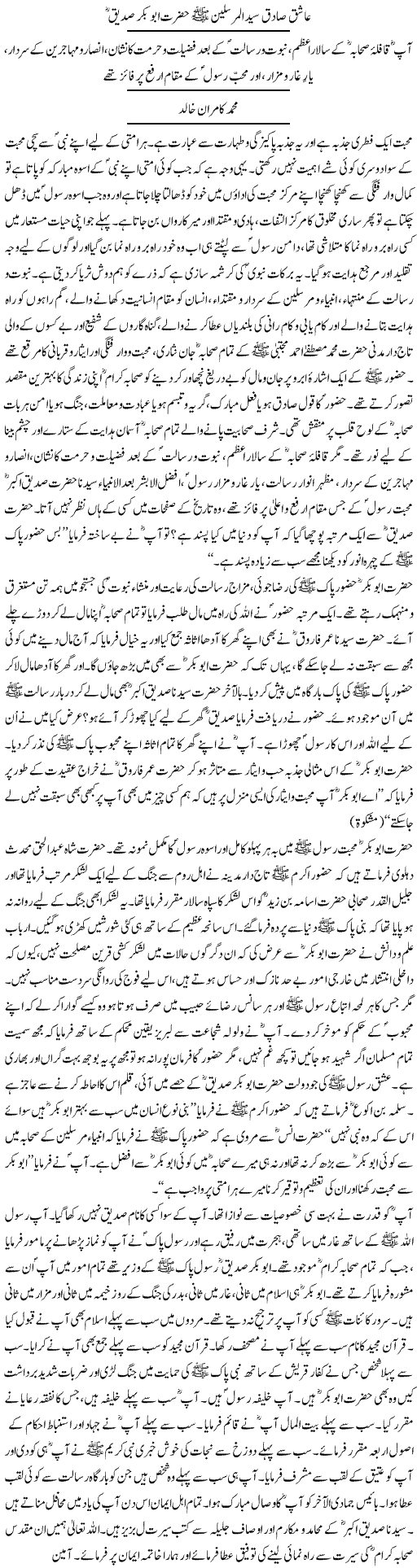
Aashiq E Saadiq Siddiq-E-AKBAR R A
Jannat
When MOMIN will enter Jannat, it will be announced
1) You will remain healthy forever, disease will never come.
2) You will remain alive forever, death will never come.
3) You will remain in bounties which will never be finished.
Jannat is made with:
Bricks of Gold and Silver
Its cement is of perfumed Musk
Its chips are pearls and Yaqoot
Its sand is Zafraan
There are eight doors to Jannat. These are eight grades of Jannat:
1. Jannatul Mava
2. Darul Maqaam
3. Darul Salaam
4. Darul Khuld
5. Jannat-ul-Adan
6.. Jannat-ul-Naeem
7. Jannat-ul-Kasif
8. Jannat-ul-Firdous
Jannatul Mava is in the lowest,
Jannat-ul-Adan is the middle &
Jannat-ul- Firdous is on the highest.
Food of Jannat:
They will eat foods and fruits continuously for up to 40 years
Every bowl will have a new taste
They will take eructation which will digest the food and there will be perfumed sweating for the digestion of water
There will be no urine and stool
Place Name:
There will be gardens in Jannat.
Every garden will have a length of about 100 years’ journey.
The shadow of these gardens will be very dense.
Their plants will be free of thorns.
The size of their leaves will be equal to the ears of elephants.
Their fruits will be hanging in rows.
Those who love each other for the sake of Allah will get a pillar of Yaqoot, on which there will be seventy thousand (70,000) rooms. These will shine for the residents of Jannat as the sun shines for the residents of Duniya
There will be rooms in Jannat in such a way that every room will have seventy thousand (70,000) dinning sheets. On every dining sheet, 70,000 types of foods will be served. For their service, 80,000 young boys will be moving around looking like beautiful scattered pearls.
One bunch of dates will be equal to the length of 12 arms. The size of a date will be equal to the big pitcher. These will be whiter than milk, sweeter than honey and softer than butter, and free of seeds. The stem of these plants will be made up of gold and silver.
There will also be gardens of grapes. The bunches of grapes will be very big. The size of a single grape will be equal to a big pitcher.
Someone asked, ya Rasulullah (Sallalahu alaihi wasallam): will it be sufficient for me and my family? It was answered, it will be sufficient for you and your whole tribe.
The Dresses of Jannat:
The dress of Jannat will be very beautiful.
One will wear 70 dresses at a time.
These will be very fine, delicate, and weightless, having different colors.
These dresses will be so fine that the body even the heart will be visible.
And the waves of love in the hearts will also be visible.
These dresses will never become old, never be dirty, and will never tear.
There will be four canals in every Jannat:
1. Water.
2. Milk.
3. Honey.
4. Sharabun Tahoora.
There will also be three fountains in Jannat:
1. Kafoor.
2. Zanjabeel.
3. Tasneem.
Qualities of People of Jannat:
In Jannat,
The height of every MOMIN will be equal to the height of Hazrat Adam (Alaihissalaam) 60 arms (90 feet).
Beauty will be like that of Hazrat Yousuf (Alaihissalaam).
The age of youth will be like that of Hazrat Esa (Alaihissalaam) 30-33 years).
The sweetness of the voice will be like that of Hazrat Dawud (Alaihissalaam).
Tolerance will be like that of Hazrat Yaqoob (Alaihissalaam).
Patience will be like that of Hazrat Ayyub (Alaihissalaam).
Habits will be like that of Sayyaduna Muhammad (Sallalahu alaihi wasallam).
NOTE:
If a person makes Du’a for Jannat three times, Jannat requests Allah that O, Allah; make his entry into Jannat.
And if a person makes Du’a for safety from Jahannum three times, The Jahannnum requests Allah that, O, Allah; save him from Jahannum.
JAZAK ALLAHU KHAIR- May Allah Forgive our sins… Ameen!