

Joote Pehnaney Ki Sunnatien
Archives
Small Acts Of Kindness Earning A Great Reward
The Prophet (peace be upon him) often used graphic descriptions and vivid images to emphasize the point he is imparting to his audience. Needless to say, when the point is linked to an image the recipient is impressed with, the point is never forgotten.
One good example is given in a Hadith related by Al-Bukhari on the authority of Abu Hurayrah who quotes the Prophet as saying: “A man was walking and he was very thirsty. He went down a well to drink. When he came up, he found a panting dog who was licking the earth because of his thirst. The man thought: This dog is as thirsty as I was a short while ago. He went down the well again, filled his shoe with water, and came up holding the shoe by his mouth. He gave it to the dog to drink. God thanked him by forgiving him for his sins. People asked the Prophet: Are we given a reward for kindness to animals? He said: You shall be rewarded for kindness to any living thing.”
As human beings, we are always liable to slip, make mistakes, incur sins, and yield to temptation. Therefore, we are always in need of God’s forgiveness. Hence, any action that brings us forgiveness is viewed with great interest. What the Prophet describes in this Hadith as bringing such reward from God is very simple and costs only small labor. The Prophet describes a man traveling on foot, probably in hot weather or in the desert. His water is exhausted and he is very thirsty. Then he finds a well, but he has to go down the well to drink. He does so and comes up having refreshed himself, only to find a dog who looks very thirsty. The man compares the dog’s condition to his own before he had his drink. He could easily turn away and continue on his way. However, he feels unable to do so unless he helps the dog. He has no container to bring water in. Therefore, he uses his own shoe. Consider the image the Prophet draws of the man as he is coming up, holding his shoe, which is filled with water, in his mouth only to give to a stray dog. What kindness motivates that man!
Up till this point, the image is fine and the man’s kindness is shown in full color. We admire him for what he has done. The Prophet, however, adds here a couple of greatly important touches, telling us how God views man’s actions. The first touch is that God is grateful to man. The second translates this gratitude into forgiveness of sins. To a Muslim, God’s forgiveness is a great reward, because it enhances one’s chances of admission into heaven. Great indeed is the prize.
The Prophet’s companions were amazed at the thought that such forgiveness is ensured through an act of kindness to a dog. Hence their question: “Are we given a reward for kindness to animals?” They wanted to be sure that this is true so that they would bring their treatment of animals in line with this principle. The Prophet’s answer was very clear: “You shall be rewarded for kindness to any living thing.” Even a small kindness is rewarded. If you put out some water in the garden for birds or other animals to drink, or some food that you may not need, you earn a reward for that.
Islam impresses on its followers that no kindness, however small, is overlooked. God rewards people even for the smallest action they do, as long as it is done for no selfish reason. A good action that is done purely for show-off earns no reward from God. What pleases Him and earns His generous reward is an action that is pure of selfish interest.
– by Adil Salahi
Kind Treatment of Wives
ALLAH instructs men to be nice to their wives and to treat them well to the best of their ability: “And live with them in honorably.” (4:19)
The Messenger of Allah (peace be upon him) said, “The most perfect of believers in belief is the best of them in character. The best of you are those who are the best to their women.” (Al-Tirmidhi).
The Prophet of Mercy (PBUH) tells us that a husband’s treatment of his wife reflects a Muslim’s good character, which in turn is a reflection of the man’s faith. How can a Muslim husband be good to his wife? He should smile, not hurt her emotionally, remove anything that will harm her, treat her gently, and be patient with her.
Being nice includes good communication. A husband should be willing to open up and be willing to listen to his wife. Many times a husband wants to air his frustrations (like work). He should not forget to ask her about what annoys her (like when children would not do their homework). A husband should not talk about important things with her when he or his wife is angry, tired, or hungry. Communication, compromise, and consideration are the cornerstone of marriage.
Being nice includes encouraging one’s wife. The most meaningful admiration comes from a sincere heart that notices what really matters — what the wife really values. So a husband should ask himself what she feels most insecure about and discover what she values. That is the wife’s sweet spot of praise. The more the husband compliments it, the more the wife will admire it, and the more on-target this healthy habit will be. Kind words are like, “I like the way you think,” “You look beautiful in those clothes,” and “I love hearing your voice on the phone.”
Human beings are imperfect. The Messenger of Allah (PBUH) said , “A believing man should not hate a believing woman. If he dislikes something in her character, he should be pleased with some other trait of hers.” (Sahih Muslim)
Fulfill The Rights Of Fellow Muslims
ABU Huraira relates that the Noble Prophet (peace be upon him) said, “A Muslim has six claims over another Muslim.” When asked what those claims were, the Noble Prophet (peace be upon him) said, “When you meet a Muslim brother wish him, when he invites you, accept his invitation, when he needs your sympathy, offer it, when he sneezes and thanks Allah, you should respond to him when he is ill, you should visit him and when he dies, you should join his funeral.” (Muslim)
In the Hadith under study, the Noble Prophet (peace be upon him) enjoins the believers to fulfill the rights of fellow Muslims. Here only six rights have been mentioned.
Wishing a Muslim brother. Wishing is not mere verbal salutation but a declaration and pledge that your Muslim brother’s life, property, and honor are safe from you and that you will never cause him any trouble and will pray for the safety of his faith and belief and for the Divine Mercy to descend on him.
Acceptance of invitation is another measure to strengthen the bonds of cordiality between the two. For, acceptance of the invitation means the presence of a cordial relationship, and its rejection is just the contrary.
Sympathy towards a Muslim in need. Only a person with the milk of human kindness in the heart can sympathize with or extend a helping hand to others. When he finds someone in need, he stands ready to do everything possible to redress the woes of his fellow Muslims.
Response to one’s thanking Allah on sneezing (that is, if he says Alhamdulillah). The response to thanking God on sneezing is to say Yarhamuk-Allah (may Allah have mercy upon you) and you remain firm in obedience to Allah and may not through your own deeds become a laughing stock.
Visiting an ailing Muslim brother. Visiting an ailing person is the practical manifestation of one’s sympathy towards others. It helps the patient feel that he is not alone in his hour of distress, and elicits the visitor reward from Allah.
Joining the funeral of a Muslim. This is the last concrete expression of one’s attachment to one’s fellow being, and there is great reward for fulfilling this obligation.
Ayatul-Kursi Ki Fazeelat
Ayatul-Kursi Ki Fazeelat
Growth Of A Child
Abdullah Bin Mas’ud (Allah be pleased with him) reported that Allah s Messenger (peace be upon him) who is the most truthful said: Verily your creation is in this wise. The constituents of one of you are collected for forty days in his mother s womb in the form of blood, after which it becomes a clot of blood in another period of forty days. Then it becomes a lump of flesh and forty days later Allah sends His angel with instructions concerning four things, so the angel writes down his livelihood, his death, his deeds, his fortune, and his misfortune. By Him, besides Whom there is no god, that one amongst you acts like the people deserving Paradise until between him and Paradise there remains but the distance of a cubit, when suddenly the writing of destiny overcomes him and he begins to act like the denizens of Hell and thus enters Hell, and another one acts in the way of the denizens of Hell until there remains between him and Hell a distance of a cubit that the writing of destiny overcomes him and then he begins to act like the people of Paradise and enters Paradise
The Virtues of Reciting Some Surahs of the Qur’an
Here are some benefits of reciting certain Surahs (chapters) in the Qur’an:
Surah Al-Fatihah (1)
Once the Prophet (peace be upon him) was traveling when he disembarked and began walking alongside a companion.
He asked him, “Shouldn’t I tell you the best part of the Qur’an?” Then he recited “Alhamdu lillahi rabbil alameen” (Praise be to Allah, The Cherisher and Sustainer of the Alamin (mankind, jinn, and all that exist). (The first verse in Surah Al-Fatihah; (1:1)
Prophet Muhammad (PBUH) said: “Whoever masters the first seven (chapters or verses) from the Qur’an is a great scholar.”
Also, Prophet Muhammad said: “In the Fatiha of the Qur’an, there is a cure for all maladies (illnesses).”
Surah Al-Baqarah (2)
Prophet Muhammad said: “The Qur’an and those who committed themselves to it will be presented on the Day of Judgment, preceded by Surah Al-Baqarah and Surah Al-Imran.”
Prophet Muhammad also said: “Learn how to recite Surah Al-Baqarah for there is a blessing in it, and there is sorrow for abandoning it, and it is unbearable for the idle and that Al-Baqarah and Al-Imran are like two flowers which will shade those who learned them by heart on the Day of Judgment as if there were two large clouds or two flocks of birds.”
Also, Prophet Muhammad said: “Recite Surah Al-Baqarah in your dwellings and do not turn them into graves.
He also said that whoever recited Surah Al-Baqarah at night would be crowned with a crown of Paradise.”
Prophet Muhammad said: “Do not make your house as graves, for Satan shuns a dwelling wherein Surah Al-Baqarah is recited”
Prophet Muhammad was asked, “Which part of the Qur’an is the best?” He replied, “The Surah in which the cow is mentioned.”
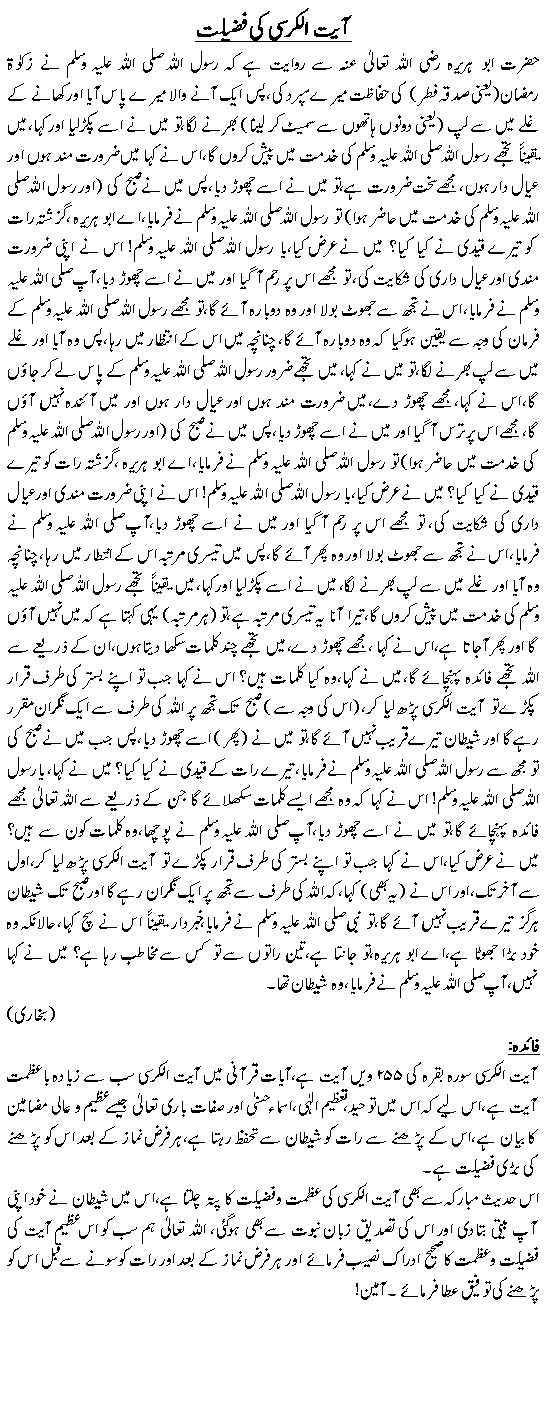
He was then asked, “Which part of that Surah?” He replied, “The verse of the Throne (Ayat Al-Kursi) and the last part of Surah Al-Baqarah came down from under the Throne.”
Prophet Muhammad (PBUH) said: “Whoever recites four verses from the first part of Surah Al-Baqarah, the verse of the Throne, two verses after the verse of the Throne and three verses from the last part of Surah Al-Baqarah, Satan would never come near him or the members of his family on that day, and nothing he despises would come near him or the members of his family, and never are these verses recited over a madman without him regaining his sanity.”
Ways To Obtain The Love Of Allah
The great scholar Ibn Al-Qayyim Al-Jawziyyah is often referred to as the ‘Imam of the Hearts.’ Reading and reflecting on his treatise on the ways that bring about the love of Allah, it isn’t hard to see why…
* Recitation of the Qur’an with reflection and understanding of its meanings and what is intended by it, as one reflects over a book which he has memorized and which he expounds so that he may understand what its author intends from him.
* Getting closer to Allah with supererogatory acts of worship, after the obligatory ones, for they will take him to another level of love that comes after love.
* Constant remembrance in every circumstance by the tongue, the heart, the actions, and (one’s) condition, so a person’s share of love is in accordance with his share of this remembrance.
* Preferring His love over your own when desires overcome you and climbing to reach His love, even if the ascent is difficult.
* The heart’s comprehension of His Names and Attributes, witnessing them and having knowledge of them, to immerse himself in the garden of this knowledge and its fundamental pillars. Whoever knows Allah by His Name, Attributes, and Actions, will, no doubt, love Him.
* Witnessing His generosity, His benevolence, His favors, and blessings, both hidden and open, for these things all call to His love.
* And this is the most amazing of all: the heart’s total surrender to and humility in front of Allah, the Highest, and there are no other words and considerations which give expression to this meaning.
* Being alone in the time of the Descent of Allah (last third of the night) for having private conversations with Him, reciting His Words, investigating the heart, displaying the manners of servitude whilst in front of Him, and then sealing all of that by seeking forgiveness and repentance.
* Sitting with the truthful lovers (of Allah) and gathering the good fruits (emanating) from their speech, just as one picks out the best of fruits, and that you do not speak except when the benefit of the speech prevails and when you know that there is the betterment for you and benefit for others in it.
* Keeping distant from everything that comes between the heart and Allah, the Mighty, and the Majestic. May Allah make us of those who strive to love Him and are loved by Him, Ameen.
– Abridged and excerpted from Madaarijus-Saalikeen from the book The Path to Guidance (pgs.56-60), published by Salafi Publications.
Miswak Ki Ahmeat Aur Fazeelat
Miswak Ki Ahmeat Aur Fazeelat
Doing Good Deeds For Show-Off
“So woe to the worshippers, who are neglectful of their prayers. Those who want to be seen (by men).” (Qur’an, 107:4-6)
The word Riya is taken from the word Ruyah (to be seen). So the one to be seen is viewed by the people as one seeking esteem among them. So at times, one would seek self-esteem through one’s actions in this world.
Riya is of many types and forms, its nature and tendency are that it invalidates the actions as stated in the Book and the Sunnah.
“Like those who spend from their wealth to be seen by men, and they do not believe in Allah and the Last Day. Their example is like the example of a hard rock on which is a little soil, then on it falls heavy rain which flows off it and they will not be able to do anything with whatever they have earned and Allah does not guide the disbelieving people.” (Qur’an, 2:264)
The Prophet (peace be upon him) said: “What I fear for you the most is the minor shirk, that is Ar-Riya. Allah will say on the Day of Judgement when He is rewarding the people for their actions: Go to those for whom you did Riya for in the world then see if you find the reward with them.” (Ahmad, 5/428, 429)
The Prophet (peace be upon him) said: “Shall I not inform you of what I fear for you more than the Maseeh Ad-Dajjaal? It is the hidden shirk. It is when a man stands up for prayer, then beautifies his prayer for another to look at.” (Ibn Majah, no. 2604, Hasan)
So be warned, from Riya as it is an evil tribulation that annihilates our actions. The Fire will be kindled first for the people who showed off because they took enjoyment from the results of their actions in the life of this world.
So flee from Riya as you would flee from a lion, as Riya and one’s hidden desires even weakened the stands of the senior scholars, let alone the general masses.
The scholars and the active worshippers, who made great efforts to tread the path to the Hereafter, were put to trial by it. When they took control of themselves and abstained from desires, they were not being allured to the apparent and open sins committed by the limbs.
However, when they became relaxed, they began to pretend to show knowledge, and actions and to present gatherings, to be observed by the people with reverence and esteem. They feel great delight and they looked down upon the idea of leaving sins.
So one of them thinks that he is from amongst the sincere worshippers of Allah but he has been confirmed as one of the hypocrites. This is a great deception and no one is safe from it except the angels.
O Allah, Lord of the Heavens and the earth, purify our hearts from hypocrisy and our actions from Riya. Make us firm upon Your straight path so that we achieve certainty.
Excerpt from the book Invalidation of Actions.