
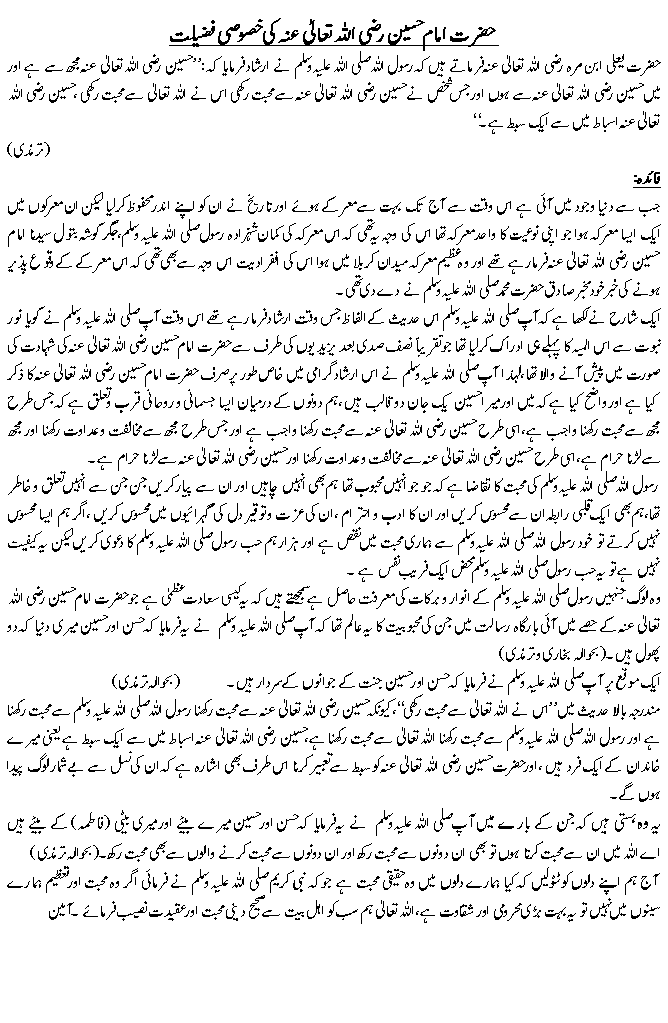
Hadrat Imam Hussain (Radi Allahu Anhu) Ki Fazeelat
Archives
How To Strengthen Our Faith
Recite and ponder on the meanings of the Qur’an. Tranquility then descends and our hearts become soft. To get optimum benefit, remind yourself that Allah is addressing you. People are described in different categories in the Qur’an; think of which one you find yourself in.
Realize the greatness of Allah. There are signs in everything we see that points us to His greatness. Everything happens according to His permission. Allah keeps track and looks after everything, even a black ant on a black rock on a black moonless night.
Make an effort to gain Islamic knowledge. Learn at least the basic things we need to know in daily life, e.g. how to make Wudhu properly. Know the meanings of Allah’s names and attributes. Only those who have knowledge truly fear Allah (Refer Qur’an, 35:28).
Attend gatherings where Allah is remembered and His religion is taught.
Do more good deeds. One good deed leads to another good deed. Good deeds must be done continuously, not in spurts.
Remember death, the destroyer of pleasures, frequently.
Ponder over the different stages of the Hereafter. From graves to being raised on the Day of Judgment to one’s final destination in paradise or hell-fire.
Make Du’a. Realize that we need Allah. Be humble. Don’t covet material things in this life.
Every night, before going to sleep, think about the good deeds and the sins we did during that day.
Realize the effects of sins and disobedience. Eemaan (faith) increases with good deeds and decreases with sins.
Hope In Allah
RAJAA’ (hope) is an aspect of worship. This is the type of hope a person has for Allah’s pleasure and reward along with having Iman (correct belief) and doing righteous deeds. It is waiting for Allah’s reward and seeking His pleasure. Hope is the opposite of despair. Being despaired of Allah’s Mercy is one of the major sins. Hope, however, is an act of worship beloved to Allah. Allah said in the Qur’an:
“Verily, those who have believed, and those who have emigrated (for Allah’s religion) and have striven hard in the way of Allah, all these hope for Allah’s Mercy…” (Qur’an, 2:218)
The opposite of hope is despair and hopelessness in the Mercy of Allah. Allah said:
“…Certainly no one despairs of Allah’s Mercy, except the people who disbelieve.” (Qur’an, 12:87)
And in another verse:
“…And who despairs of the Mercy of his Lord except those who are astray?” (Qur’an, 15:56)
So hope is a quality or an aspect of Tawheed, whereas despair, its opposite, is not. It is (rather) an act of disobedience. Allah mentioned in the above verses that despair is a characteristic of those who are astray and who do not believe in Him.
Extract from the Sheikh’s lecture “Enter into Islam wholeheartedly”
Evil Deeds That Lead One To Hell
Sheikh al-Islaam Ibn Taymiyyah, may Allah (SWT) have mercy on him, was asked: “What are the deeds of the people of Hell and what are the deeds of the people of Paradise?” He replied, “The deeds of the people of Hell are:
- associating partners in worship with Allah (SWT)
- disbelieving in His Messenger
- kufr (ingratitude, disbelief)
- hasad (malicious envy)
- lying
- treachery
- oppression and wrongdoing (dhulm)
- promiscuity
- backstabbing
- cutting off the ties of kinship
- cowardice at the time of jihad
- miserliness
- inconsistency between what is in one’s heart and the face one shows to people
- despairing of the mercy of Allah (SWT)
- feeling secure from the plan of Allah (SWT)
- panicking blindly at the time of crisis
- pride and extravagance at the time of plenty
- abandoning one’s duties towards Allah (SWT)
- transgressing His limits
- violating His sanctity
- fearing a created being instead of the Creator
- showing off
- going against the Qur’an and Sunnah in word or deed
- obeying a created being in some act of disobedience to the Creator
- blindly supporting falsehood
- mocking the signs of Allah (SWT)
- rejecting the truth
- withholding knowledge and testimony that should be revealed
- witchcraft and magic
- disobeying one’s parents
- killing any soul forbidden by Allah (SWT) except for reasons of justice
- consuming the wealth of the orphan
- riba (usury)
- desertion from the battlefield
- slandering the reputation of innocent, chaste, believing women” (Yaqadhat uli al-I’tibar, p.222)
The Messenger of Allah (saw) mentioned all the sins that will lead one to Hell. Muslim reports from ‘Iyadh bin Himaar that the Messenger of Allah (saw) said, during a lengthy khutbah:
“..the people of Hell are five: the weak who lack the power to (avoid evil); the (carefree) who pursue (everything irrespective of whether it is good or evil) and who have no concern for their families or their wealth; the dishonest people whose greed cannot be concealed even in the case of minor things; and those who betray you, morning and evening, with regard to your family and your property. He also mentioned misers, liars, and those who are in the habit of abusing people and using obscene, foul language”. (Muslim in Kitaab al-Jannah wa Sifaat Na’imihaa Baab as-Sifaat allaatee yu’raf bihaa fid-dunyaa ahl al-Jannah wa ahl an-Naar, 4/2197 no. 2865)
Muanqa Aur Musafiha Ki Sunnatain

Muanqa Aur Musafiha Ki Sunnatain
Ramadan Duties
Ramadan is the month “in which the Holy Qur’an was sent down as a guide to mankind and as clear (signs) for guidance and judgment between right and wrong.” This month calls upon us, yet again, to reflect on our lives and judge for ourselves to what extent we have lived, and live, by Divine Guidance.
True, we observe fast and attend night prayers. But do we, in the 11 interposing months, remember that while fasting is “for a fixed number of days,” the spirit of self-discipline and the sense of mission that it is meant to instill in us are for the lifetime? And are we looking forward to this Ramadan as a new opportunity to recommit ourselves to a meaningful life, or as another yearly opportunity to relapse into a month of zombie days and gastronomic nights while deluding ourselves that we are pious?
The Qur’an is quite specific about what fasting is for. It is neither to punish the body with thirst and hunger nor to indulge it with fat and sloth. “O ye who believe! Fasting is prescribed to you as it was prescribed to those before you, that ye may have taqwa.” Authentic commentators have translated the comprehensive word “taqwa” as “self-restraint” in its widest sense of guarding one’s tongue, hand, and heart against evil and, hence denotes righteousness, piety, and good conduct.
Fasting and special prayers are an important part of Ramadan, defined as they are as our obligations to our Creator and Sustainer. Equally important are the duties He has placed on us as obligations to our fellow men and other living beings that share this planet with us and to the planet itself — the environment, water, air, vegetation, and other bounties of nature. Ramadan is the time when we must rededicate ourselves to one of the basic principles of Islam — “Render unto each his due”: To the One God His due — worship to Him alone, and to His creations their due — their rights.
The test is: Have we been becoming, with every passing Ramadan, more conscious of our obligations to render these dues? Living in a society we acquire obligations — as parents or children, wives or husbands, neighbors or colleagues, employers or employees, rulers or ruled, compatriots or aliens, superiors or subordinates.
Beginning a verse with “It is not righteousness that ye turn your faces toward East or West,” the Qur’an defines righteousness as, among others, “… to spend your sustenance, out of love for Him, for your kin, for orphans, for the needy, for the wayfarer, for those who ask and for the freedom of slaves” and closes it with “(and) fulfill the contracts which ye have made… Such are the people of truth, the God-fearing.”
An honest review will tell most of us that, the worst of our failures in every Ramadan has been our failure to “fulfill the contracts we have made” — specifically or by assumption — as citizens, public officials, employers, employed, or ordinary men and women.
We should remember that for the Prophet (peace be upon him) and his companions, Ramadan was a month of action, of fulfilling obligations — to their Lord and to their fellow creations. It cannot be anything less for us if we hope to be “the People of Truth, the God-fearing.”
May Allah help us make it so.
Teach Kids To Do Good
It is one of Allah’s blessings to the Muslim that He enables him to fast in the daytime of Ramadan and spend his nights in prayer. It is a month in which good deeds are multiplied and people are raised in status when Allah frees some of His servants from the Hellfire. So the Muslim should strive to make the most of this month to attain the goodness it brings; he should hasten to worship Allah night and day.
Such great blessing of Allah is obvious in considering people who have been deprived of tasting the sweetness of this month because of sickness, death, or misguidance! A Muslim must make use of this blessed month to get his children accustomed to the ethics and morals of fasting.
A Muslim must make the most of his time during this month. He has an unavoidable duty toward his children, to raise them well and bring them up properly, to urge them to do all kinds of good deeds and make them get used to that. A child usually grows up in the manner to which the parents make him or her accustomed.
During the blessed days of Ramadan, fathers and mothers have a great role to play in seizing this good occasion for their own benefit and for that of their children, and we can offer parents the following advice:
1. Check on the children’s fasting and encourage those who fall short in this regard.
2. Remind them about the real nature of fasting, and that it is not just giving up food and drink, but it is a means of attaining taqwa (piety), and that it is an opportunity for sins to be forgiven and expiated.
It was reported by Abu Hurairah (Allah be pleased with him) that the Messenger of Allah (peace be upon him) ascended the pulpit and said Ameen: It was said to him, “O Messenger of Allah, why did you do that?” He said, “Jibreel (Aleh Salam) said to me, ‘May Allah curse a person who lets Ramadan elapse without having his sins forgiven,’ and I (Prophet Muhammad) said, ‘Ameen.’ Then he said, ‘May Allah curse the one who lives to see his parents grow old, one or both of them, but he does not enter Paradise,’ and I said, ‘Ameen.’ Then he said, ‘May Allah curse the one in whose presence you (the Prophet) are mentioned and he does not send blessings upon you,’ and I said, ‘Ameen. ‘ (Reported by Ibn Khuzaymah, At-Tirmidhi, Ahmad, and Ibn Hibban)
3. Teach them the manners and rules of eating, such as eating with the right hand from what is directly in front of them, reminding them that extravagance is haram (unlawful) and harmful to the body.
4. Don’t let them spend too long eating iftar so that they don’t miss performing Maghrib prayer in the congregation.
5. Remind them about the situation of the poor and destitute who cannot find even a morsel of food to satisfy their hunger. Remind them of the situation of those who have migrated or are fighting in jihad for the sake of Allah in all places.
Ramadhan Is Approaching! Are You Ready?
Success in whatever we do depends on how clear we are on the objectives we want to achieve and how well we plan for them. Even a recreational activity such as going on vacation takes much planning. It is not feasible for a person to simply just get up and depart to a vacation destination without planning, especially if one wants to have a good vacation or recreational activity. For example, if one is going to Disney World, usually planning is done months in advance of the trip. In addition to making traveling and accommodation arrangements, people consult friends, read literature, and research how to get the most benefit while there. Time and effort are spent deciding beforehand as to which rides should be given preference, which shows should be watched and which sites or theme parks should be visited, in what order, and at what times of the day so that one can get the maximum benefit at minimum cost in a reasonable time. People make significant efforts to plan the trip because it means so much to them to make such a trip.
What does Ramadhaan mean to you? Does it mean more to you than going on a vacation? Are you mentally and psychologically ready to attain all the goodness and blessings Ramadhaan has to offer? Are you then spending enough time and taking pains to plan how can you get the most benefit from the opportunity Ramadhaan affords you?
Some people do plan for Ramadhaan, but that planning is only to the extent of who to invite for Iftaar, where to go for one, what special foods to prepare, or how to get the best deal on dates and iftaar delicacies. But is this the type of outcome that is the objective of Ramadhaan?
The objectives of Ramadhaan are to:
- Increase our Taqwa
- Make us more charitable? both financially and in our social dealings
- Develop patience and willpower to resist temptations
- Prepare us for our life-long Jihaad to remain steadfast on the path of Allah’s obedience
- Strengthen our relationship with the Holy Qur-aan, celebrate its revelation; and
- Thank Allaah Subhaanahu wa Ta`aala for guiding us so kindly.
Uthne Baithne Ki Sunnatain

Uthne Baithne Ki Sunnatain
Etiquette Of Going To The Bathroom
You may say that this is a strange topic to be writing about. However, we all visit the bathroom and as we know, it is a place of filth where we relieve ourselves of the filth in our bodies. Have we ever stopped to think about what the Islamic etiquette is to visit the bathroom or has it become an automated everyday action?
We must be aware that this beautiful religion has even instructed us on how to clean after relieving ourselves.
Just observe the greatness of Islam that nothing, major or minor, has been left out. At the time of the Prophet (peace be upon him), when one of the polytheists said to Salman Al-Farsi mockingly, “Your Prophet has taught you everything, even how to defecate!” Salman replied with pride, “Yes, indeed! He forbade us to face the Qiblah when urinating or defecating.” (Al-Tirmidhi, no. 16)
Therefore, we should know that this is not a matter of shame, but something we should be proud of.
Below are some points are listed that we should remember when visiting the bathroom.
1. Always enter with the left leg and recite the du’a: (O Allah! I seek refuge in you from male and female noxious beings (devils or evil Jinn).”
2. Don’t face the Qiblah or show your back towards it. The Messenger of Allah (peace be upon him) said: “When any one of you sits down to answer the call of nature, he should not face the Qiblah or turn his back towards it.” (Sahih Muslim, no. 389)
3. Allah’s name should not be mentioned in the toilet, nor should anything that has the name of Allah on it be carried inside.