

Miswak Ki Sunnatain
Archives
Prophet’s (peace be upon him) Mercy To Animals
Allah said in the Qur’an that Prophet Muhammad (peace be upon him) was a mercy, not only for human beings and jinn, but also to the entire creation. His kindness is exemplary even when it comes to animals, who are very often neglected.
While he permitted to use animals for specific purposes, he forbade misusing or abusing them. Muhammad Al-’Arifi mentions this aspect of the Prophet (peace be upon him) in his book “Enjoy your life” published by Darussalam.
ONCE, when the Prophet (peace be upon him) was on a journey with his companions, he stopped over to answer the call of nature. Meanwhile, some of his companions noticed a redstart bird with two chicks. They took the chicks away. The bird came and began to circle around them flapping its wings. When the Prophet (peace be upon him) came and saw the scene, he turned to his companions and said, “Who distressed the bird by taking its chicks from it? Return the chicks to the bird!”
On a different occasion, the Prophet (peace be upon him) noticed a burnt ants’ nest. “Who burnt the nest?” he demanded.
One of his companions replied, “I did.”
The Prophet (peace be upon him) became angry and said, “No one but Allah punishes with fire!”
The Prophet (peace be upon him) was so merciful that if he saw a cat whilst he was performing ablution, he would lower the utensil down for the cat to drink from and then perform ablution from the leftover water.
Once he passed by a man who had laid a sheep on the ground and placed his foot on its neck to slaughter it while sharpening the knife as the sheep looked on. The Prophet (peace be upon him) became angry upon seeing this and said, “Do you want it to die twice? Why didn’t you sharpen your knife before you laid it on the ground?”
On another occasion, he (peace be upon him) passed by two men in the middle of a conversation and each of them was sitting on his camel. When he saw this, he felt pity for the camels and therefore forbade people from using animals as chairs, meaning that one is not to mount it except when required and that when the need is fulfilled, one should dismount and allow it to rest. The Prophet (peace be upon him) also forbade branding an animal on its face.
Secret For Du’a To Be Answered
I often find that people supplicate with certain prayers and have their prayers answered, and they couple their supplication with their neediness and turn towards Allah, or a good deed they carried out that caused Allah to respond to this supplication out of appreciation for this good deed, or they happened to supplicate at a time in which it is more likely to be accepted, etc. So, his supplication was answered because of this.
One might think that the secret was in the specific wording of his supplication, and might therefore approach it simply from this angle while ignoring all of these other things that were coupled with it by the person supplicating. This is like someone who uses beneficial medicine at its proper time and in the proper manner and it benefits him as a result, and someone else thinks that simply using this medicine regardless of these other factors will bring about the same benefit. This person is wrong, and this is where many people fall into error.
And supplications and prayers of refuge are like weapons, and a weapon is only as effective as the person using it, not just based on how sharp it is. So, as perfect and flawless a weapon is, as strong as the arm that is using it, as much as there is nothing to nullify its effectiveness – the more damaging it will be against the enemy. And whenever one of these three elements is absent, the effect will be held back.
So, if the supplication itself is not good, or the one supplicating does not have both his heart and tongue present when making it, or there is some element present to prevent it from being answered, it will have no effect.
– By Ibn Qayyim Al-Jawziyyah
– Ad-Da’ wad-Dawa’; p. 40-41
Do Not Take Sins Lightly
If we say that sins are dangerous, then belittling sins and taking them lightly is more dangerous than sinning itself. The Prophet (peace and blessings be upon him) warned us against taking sins lightly because, doing so, sins will become an inherent habit in us and we will have no problem insisting on them. This will lead the person to be categorized as a pervert (fasiq) and will lead him in the end to be subject to Allah’s severe punishment, which will overtake him at any time.
Allah has made repentance obligatory saying: “O you who believe! Turn to Allah with sincere repentance . . . ” (At-Tahrim, 66:8), and He has granted us time to repent until the Scribes register the sin in our names.
But the problem with most people is that they do not estimate the majesty of the Lord as they should. They disobey Him in many ways, day and night. Adding insult to injury, they take many sins lightly and claim that such sins are minor and thus of no great harm. In consequence, they stare freely at pictures of women in magazines or on television. Some of them, when told about the sin of it, go a step further and inquire amusedly, “OK, what’s the magnitude of the sin involved? Is it a major or minor one?”
Compare this attitude with that of the Companions of the Prophet (peace and blessings be upon him). Anas radi allahu anhu said to one of his followers, “You imagine certain sins to be more insignificant than a straw. But at the time of the Prophet, we used to count them among those that can destroy a man.” Ibn Mas`ud radi allahu anhu said, “A believer treats a sin as if it is a mountain over his head that may fall on him any moment; whereas a dissolute (fajir) looks at them as a fly that perked on his nose and he waived it away with his hand.”
Will these people then learn something from the above, and from the Hadith of the Prophet (peace be upon him) that says: “Beware of the minor sins. For the example of the minor sins is like that of a group of travelers who broke their journey in a valley. Then one of them brought in a straw. Another came up with another (and a third with one more) until with their collection they were able to gather enough to cook their food. Remember! If a man is held for questioning (on the Day of Judgment) for his minor sins, surely they will destroy him.” In another version, he is reported to have said: “Beware of minor sins. For they add on until they destroy the man.”
Scholars say that when minor sins are committed without any remorse, without the fear of Allah, and accompanied by contempt, there is the fear they will be counted as major sins. To those who belittle their sins, we say, “Do not look at the sins if they are small or big. Look at Him in Whose defiance you are committing them.”
Still, for all sinners, the doors are open, for Allah says: “Declare ( O Muhammad, peace be upon him) unto My slaves that truly I am Oft-Forgiving, the Most Merciful.” (Al-Hijr 15:49).
Fazail Ahle-Bait
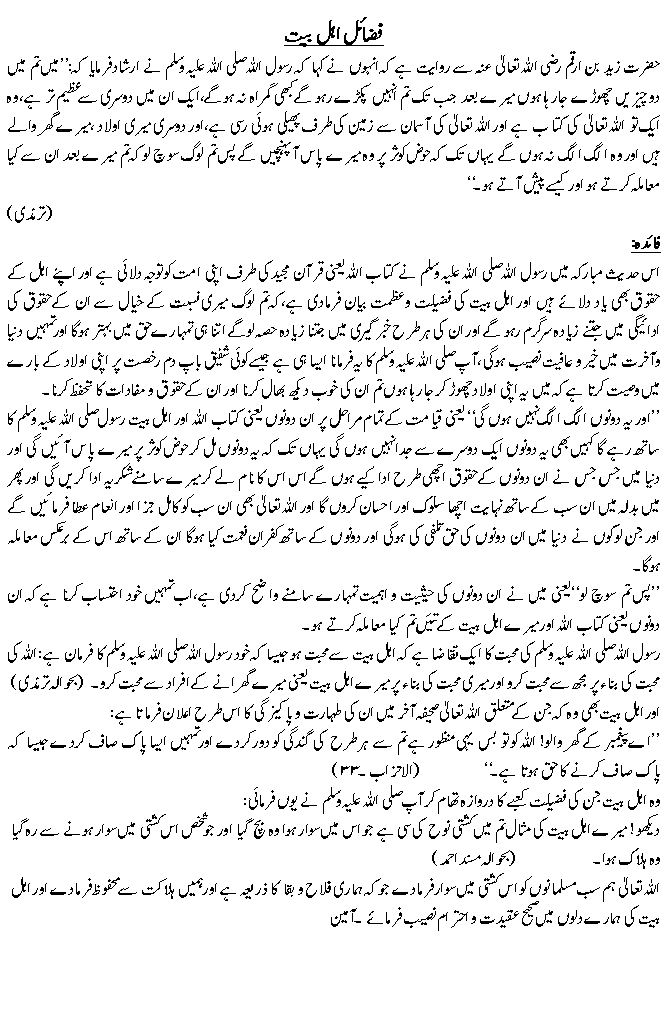
Fazail Ahle-Bait
The Islamic Calendar
“They ask you, (O Muhammad, peace be upon him), about the new moons. Say: There are signs to mark fixed periods of time for mankind and for the pilgrimage.” (2:189)
The Islamic or Hijri calendar is based on a lunar month of 29 to 30 days, with the day starting at sunset.
The new moon announces the arrival of a new month, but due to differences in the weather (rain and fog, etc.) that may prevent a clear view of the moon, or due to great distances between countries, the start of a new month is neither definite nor conclusive. Therefore scientists have developed a number of norms to help predict when the first sighting of the crescent moon will be, but there will be small discrepancies between countries when determining the birth of the crescent heralding the month of Ramadan and the first day of the following month, indicating the end of the fast.
The Islamic year consists of 12 months: (1) Muharram, (2) Safar, (3) Rabi Al-Awwal, (4) Rabi Al-Thani, (5) Jumad Al-Awwal, (6) Jumad Al-Thani, (7) Rajab, (8) Sha’ban, (9) Ramadan, (10) Shawwal, (11) Dhu’l-Qadah and (12) Dhu’l-Hijja.
The most important dates in the Islamic calendar are 1 Muharram (Islamic New Year); 10 Muharram (Day of Ashura); 27 Rajab (Israa and Mi’raj); 1 Ramadan (first day of the month of fasting); the last ten days of Ramadan, which include (Laylat Al-Qadr); 1 Shawwal (Eid Al-Fitr); 8-10 Dhu’l-Hijja (Haj, the annual pilgrimage to Makkah); 9 Dhu’l-Hijja (Day of Arafah); 10 Dhu’l-Hijja (Eid Al-Adha). However, the dates of some of these events, such as that of Laylat Al-Qadr and the Prophet Muhammad’s journey of Israa’ and Mi’raj, have not been conclusively specified, and there has been some uncertainty about the exact date of the events.
Four of the 12 months are sacred: Rajab, Muharram, Dhu’l-Qadah, and Dhu’l-Hijja). In the pre-Islamic period, raids among the Arab tribes were forbidden and hunting was halted during these months. Islam inherited and approved this practice. Fighting (killing) is prohibited during these sacred months except in self-defense.
Since the Islamic calendar is lunar, its year is 10 or 11 days shorter than the Gregorian year. This means that Muslim months fall in different seasons. For example, Ramadan and Haj can fall in the summer as well as in the winter. It takes about 33 years for the Islamic dates to rotate through the solar seasons.
The dating of the Islamic years was introduced by Second Caliph Umar Bin Al-Khattab in 638 CE (16 AH) in an attempt to circumvent all the various conflicting dating systems used during his time. After consulting his companions, he set the Hijra – the journey of the Prophet (peace be upon him) from Makkah to Madina – as the most appropriate reference to the new Islamic era. The Hijra, historically speaking, is the central event of early Islam, the turning point in Islamic history that led to the foundation of the first Muslim state.
The Basic Duties Of A Muslim
Muslims, as individuals and groups, have to fulfill certain basic duties which summarize the universal values of Islam. When these duties are observed they bring justice, peace, and happiness in this world and they will indeed bring success and salvation in the Hereafter.
“In the Glorious Qur’an, Allah, Most High, says: “And your Lord has decreed that you worship none but Him. and that you be dutiful to your parents. If one or both of them attain old age in your life, say not to them a word of disrespect, nor shout at them, but address them in terms of honor.
And lower unto them the wing of submission and humility through mercy, and say: ‘My Lord! Bestow on them Your Mercy even as they did bring me up when I was young.’ Your Lord knows best what is in your inner selves. If you are righteous, then, verily, He is Ever Most Forgiving to those who turn to Him again and again in obedience, and in repentance.
“And give to the kinsman his due and to Miskin (poor) and to the wayfarer. But spend not wastefully (your wealth) in the manner of a spendthrift.
Verily, the spendthrifts are brothers of the Shayatin (devils) and the Shaitan (Devil-Satan)is ever ungrateful to his Lord.”
” And even if you (O Muhammad, peace be upon him) turn away from them (kindred, poor, wayfarer, whom We have ordered you to give their rights, but if you have no money at the time they ask for it) and you are awaiting mercy from you, Lord for which you hope, then, speak unto them a soft, kind word ( i.e. Allah will give me and I shall give you). (17: 23-28) ”
Surat al-Isra’ was revealed to Prophet Muhammad (peace be upon him) in Makkah after his Night Journey from Makkah to Jerusalem. In this surah, Allah mentions some basic commitments of Muslims. Without fulfilling these commitments no individual or group can succeed. Muslims have to live by these values and should invite humanity to these principles. These principles are not limited to one race, tribe or group; they are universal in their scope and application. These are also called the Hikmah or the teachings of wisdom. It is wise for everyone to follow them. If followed properly they are capable of increasing the goodness and wisdom of all people.
These principles are:
1. To worship Allah alone: This means to recognize Allah as the ultimate reality and to recognize Allah as the Lord, to worship Him with all sincerity, and to submit to Him in every aspect of life. A Muslim’s life is nothing but a total commitment to Allah. We are not only monotheists (people of Tawhid) but we are also theocentric people. Allah is the center of our life and He is our total and ultimate concern.
Main Features Of An Islamic Society
1. Faith in the Oneness of Allah
There is nothing worthy of worship except Allah, the Creator and Sustainer of the universe. He gave mankind a code of life that guarantees their well-being in this world and in the hereafter.
2. Cooperation
Human beings cannot live independently of each other. They have to live together and cooperate for maximizing welfare and warding off evils.
3. Not materialistic
A member of Islamic society is not an ‘economic man’ but one with the goal of earning the pleasure of Allah through the right action and service to his fellow human beings. Good intentions and right action thrive when they receive a positive response from others. Ultimately, competition in good deeds results in benefits to all concerned.
4. Generosity
Generosity and benevolence must prevail in society. People should prefer others’ needs to their own needs. On the other hand, lust for money, and miserliness are condemned in all cases. Luxurious living should be avoided.
5. State’s role
In society, there must not be monopoly, exploitation, fraud, or usurious transactions. Good should be enjoined and evil should be forbidden. The state has an active role to play in economic life. It should intervene if freedom is abused or people are not fulfilling their obligations.
– Economic Concepts of Ibn Taimiyah (pp. 137-8)
Ghar Main Aanay Janay Ki Sunnatain
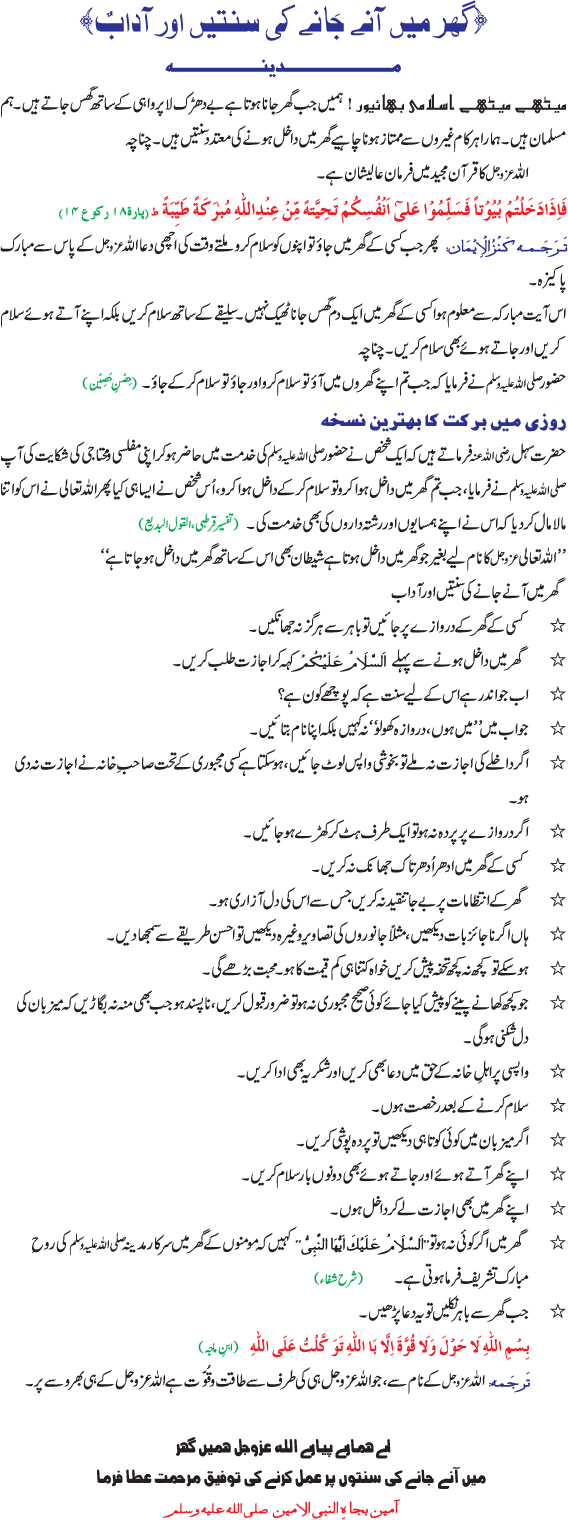
Ghar Main Aanay Janay Ki Sunnatain
Israa’ And Mi`raj
(Glorified be He Who carried His servant by night from the Inviolable Place of Worship to the Far Distant Place of Worship the neighborhood whereof We have blessed, that We might show him of Our tokens! Lo! He, only He, is the Nearer, the Seer.) (Al-Israa’ 17:1)
On 27 Rajab Muslims remember Israa’ and Mi’raj, the miraculous Night Journey and Ascension of the Prophet Muhammad (peace and blessings be upon him). The exact date of the event is uncertain, but the majority of scholars place it at 12 to 16 months before the Hijrah, the Prophet’s migration to Madinah.
One night Prophet Muhammad (peace and blessings be upon him) was sleeping near the Kaaba in Makkah when the Angel Jibreel alaihis salam (Gabriel) came to him, woke him up, and, taking him by the arm, led him to Al-Buraq, a beast resembling a horse with two huge wings springing from its back. From Makkah, Al-Buraq took off toward Jerusalem. There, the Prophet was met by all the other prophets. He (peace and blessings be upon him) dismounted, tethered Al-Buraq to a ring in the gate of Jerusalem, and led them in Prayers.
Two vessels were then brought to him, one containing milk, the other wine. Muhammad (peace and blessings be upon him) drank the milk. Jibreel alaihis salam said, “O Muhammad, you enjoy what is pure. Surely you will guide your people to the right path.” This journey demonstrates God’s might and ability to make possible the impossible. The concepts of time and space as we understand them do not apply, and what applies cannot be perceived by our limited faculties.