


Rozay Ki FazeelatJa
Recite Surah Al-Kahf On Friday
Surah Al-Kahf (The Cave)
Virtues of reciting Surah al-Kahf
We are encouraged to recite/read Surah Kahf on Fridays. This is something proven by the Sunnah of the Prophet (peace be upon him). There are saheeh ahadith from the Prophet (peace and blessings of Allaah be upon him) concerning the virtues of reciting Surah al-Kahf during the day or night of Jumu’ah (Friday).
These include:
From Abu Sa’eed al-Khudri (May Allah be pleased with him), who said: “Whoever reads Surah al-Kahf on the night of Jumu’ah, will have a light that will stretch between him and the Ancient House (the Ka’bah).”
(Narrated by al-Daarimi, 3407. This hadeeth was classed as saheeh by Shaykh al-Albaani in Saheeh al-Jaami, 6471)
“Whoever reads Surah Al-Kahf on the day of Jumu’ah, will have a light that will shine from him from one Friday to the next.”
(Narrated by al-Haakim, 2/399; al-Bayhaqi, 3/249. It was classed as saheeh by Shaykh al-Albaani in Saheeh al-Jaami’, 6470)
The surah may be read during the night or the day of Jumu’ah. The night of Jumu’ah starts at sunset on Thursday,
and the day of Jumu’ah ends at sunset. Therefore the time for reading this surah extends from sunset on Thursday to sunset on Friday.
Introduction
Name
This Surah takes its name from v. 9 in which the word (Al-kahf) occurs.
Period of Revelation
This is the first of those Surahs which were sent down in the third stage of Prophethood at Makkah. We have already divided the life of the Holy Prophet (peace be upon him) at Makkah into four stages in the Introduction to Chapter VI. According to that division, the third stage lasted from the fifth to the tenth year of Prophethood. What distinguishes this stage from the second and the fourth stages is this. During the second stage, the Quraish mainly resorted to ridiculing, scoffing, threatening, tempting, raising objections, and making false propaganda against the Holy Prophet (peace be upon him) and his followers in order to suppress the Islamic Movement. But during the third stage, they employed weapons of persecution, manhandling, and economic pressure for the same purpose. So much so that a large number of the Muslims had to emigrate from Arabia to Habash, and those who remained behind were besieged in Shi’ib Abi Talib along with the Holy Prophet (peace be upon him) and his family. To add to their misery, a complete social and economic boycott was applied against them. The only redeeming feature was that there were two personalities, Abu Talib and Hadrat Khadijah, whose personal influence had been conducive to the support of two great families of the Quraish. However, when in the tenth year of Prophethood these two persons died, the fourth stage began with such revere persecutions as forced the Holy Prophet (peace be upon him) and all his Companions to emigrate from Makkah.
It appears from the theme of the Surah that it was revealed at the beginning of the third stage when in spite of persecutions and opposition, migration to Habash had not yet taken place. That is why the story of “Ashab-i-Kahf” (the Sleepers of the Cave) has been related to comforting and encouraging the persecuted Muslims and showing them how the righteous people have been saving their Faith in the past.
Subject and Topics
This Surah was sent down in answer to the three questions that the mushriks of Makkah, in consultation with the people of the Book, had put to the Holy Prophet (peace be upon him) in order to test him. These were:
(1) Who were “the Sleepers of’ the Cave”?
(2) What is the real story of Khidr? and
(3) What do you know about Zul- Qarnain?
As these three questions and the stories involved concerned the history of the Christians and the Jews and were unknown in Hijaz, a choice of these was made to test whether the Holy Prophet (peace be upon him) possessed any source of knowledge of the hidden and unseen things.
Allah, however, not only gave a complete answer to their questions but also employed the three stories to the disadvantage of the opponents of Islam in the conflict that was going on at that time at Makkah between Islam and unbelief:
1. The questioners were told that “the Sleepers of the Cave” believed in the same doctrine of Tauhid that was being put forward in the Qur’an and that their condition was similar to the condition of the persecuted Muslims of Makkah. On the other hand, the persecutors of the Sleepers of the Cave had behaved in the same way towards them as the disbelievers of the Quraish were behaving towards the Muslims. Besides this, the Muslims have been taught that even if a Believer is persecuted by a cruel society, he should not bow down before falsehood but emigrate from the place all alone, if need be, with trust in God. Incidentally, the disbelievers of Makkah were told that the story of the Sleepers of the Cave was clear proof of the creed of the Hereafter, for this showed that Allah has the power to resurrect anyone He wills even after a long sleep of death as He did in case of the Sleepers of the Cave.
2. The story of the Sleepers of the Cave has also been used to warn the chiefs of Makkah who were persecuting the small newly formed Muslim Community. At the same time, the Holy Prophet (peace be upon him) has been instructed that he should in no case make a compromise with their persecutors nor should he consider them to be more important than his poor followers. On the other hand, those chiefs have been admonished that they should not be puffed up with the transitory life of pleasure they were then enjoying but should seek after those excellences which are permanent and eternal.
3. The story of Khidr and Moses has been related in such a way as to supply the answer to the question of the disbelievers and to give comfort to the Believers as well. The lesson contained in this story is this “You should have full faith in the wisdom of what is happening in the Divine Factory in accordance with the will of Allah. As the reality is hidden from you, you are at a loss to understand the wisdom of what is happening, and sometimes if it appears that things are going against you, you cry out, ‘How and why has this happened’. The fact is that if the curtain is removed from the “unseen”, you would yourselves come to know that what is happening here is for the best. Even if sometimes it appears that something is going against you, you will see that in the end it also produces some good results for you.
4. The same is true of the story of Zul-Qarnain for it also admonishes the questioners, as if to say, “O you vain chiefs of Makkah you should learn a lesson from Zul-Qarnain. Though he was a great ruler, a great conqueror, and the owner of great resources, he always surrendered to his Creator, whereas you are rebelling against Him even though you are insignificant chieftains in comparison with him. Besides this, though Zul-Qarnain built one of the strongest walls for protection, yet his real trust was in Allah and not in the “wall”. He believed that the wall could protect him against his enemies as long as it was the will of Allah and that there would be cracks and holes in it when it would be His will: whereas you who possess only insignificant fortified abodes and dwellings in comparison with him, consider yourselves to be permanently safe and secure against all sorts of calamities.”
While the Qur’an turned the tables on the questioners who had tried to “expose” the Holy Prophet (peace be upon him), at the end of the Surah the same things have been reiterated that were stated at its beginning: “Tauhid and the Hereafter are absolutely true and real and for your own good you should accept these doctrines, mend your ways in accordance with them and live in this world with this conviction that you are accountable to Allah: otherwise you shall ruin your life and all your doings shall be set at naught.”
Oh ALLAH! Make useful for me what You taught me and teach me knowledge that will be useful to me!
Rozay Ki Niyat
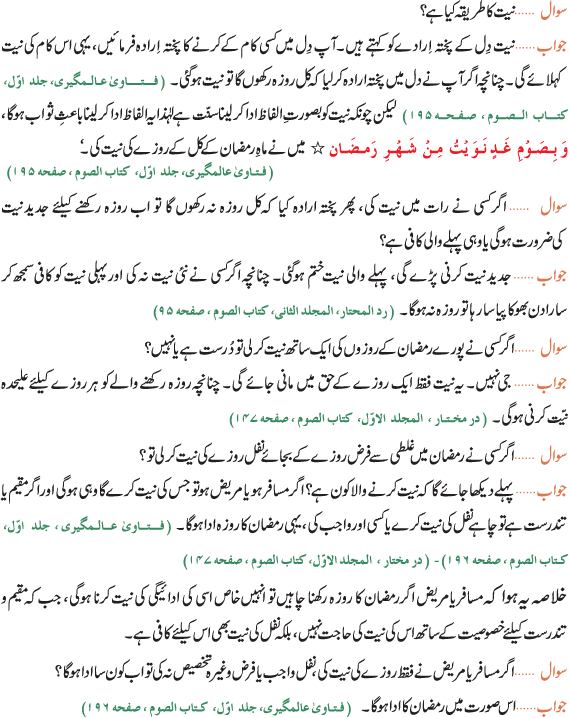
Rozay Ki Niyat
Quran, The Glorious Book Of Guidance
“(This is) the Glorious Book in which there is no chance of doubt. (It is) a guide for those who guard against evil and fear Allah: who believe in the unseen, and are steadfast in prayer, and spend out of what We have provided them with; Who believe in what has been revealed to you and what was revealed to those before you, and are certain of the Hereafter. It is they who follow the guidance from their LORD and it is they who shall prosper.”
[2:2]; [2:3]; [2:4]; [2:5]
The Prophet (peace be upon him) has said :
[Muslim, Book #004, Hadith #1694] “’Abd al-Rahman b. ‘Auf reported: I asked ‘A’isha, the mother of the believers, (to tell me) the words with which the Apostle of Allah (may peace be upon him) commenced the prayer when he got up at night. She said: When he got up at night he would commence his prayer with these words: O Allah, Lord of Gabriel, and Michael, and Israfil, the Creator of the heavens and the earth, Who knowest the unseen and the seen; Thou decidest amongst Thy servants concerning their differences. Guide me with Thy permission in the divergent views (which the people) hold about Truth, for it is Thou Who guidest whom Thou wilt to the Straight Path”
Ramadan Kay Rozon Ka Sharai Hukum
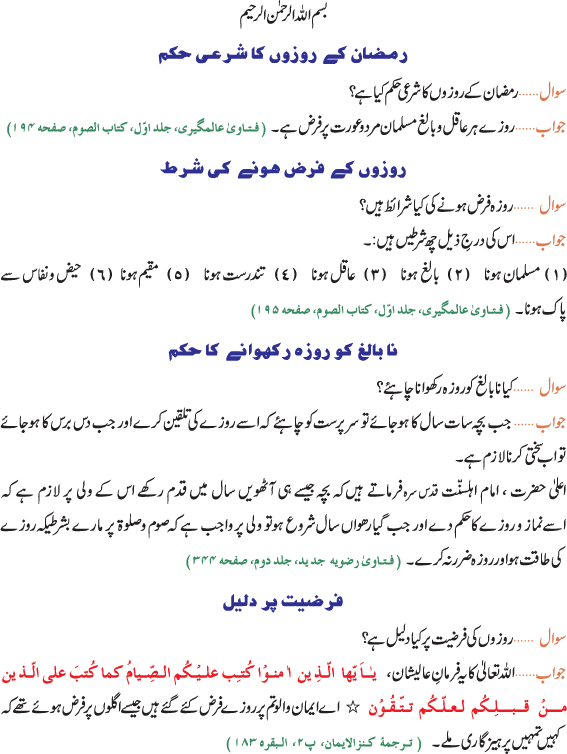
Ramadan Kay Rozon Ka Sharai Hukum
Will There Be More Men Or Women In Paradise?
Men and women engaged in this dispute when the Sahaabah were still alive. Muslim reports from Ibn Sireen: “Men and women disputed as to which of them would form the majority in Paradise. According to another report, either they were competing, or they were discussing, whether there would be more men or women in Paradise. They consulted Abu Hurayrah, who said that women would form the majority, on the basis of the words of the Prophet (saw): “The first group to enter Paradise will be as beautiful as the full moon, and the group that follows them will be like the brightest shining stars in the sky: each man of them will have two wives, the marrow of whose leg-bones will be visible through the flesh because of their extreme beauty. There will be no one who is unmarried in Paradise” [Sahih Muslim, Kitaab al-Jannah, Baab awwal zumrah tadhkul al-Jannah, 4/2179, hadith no. 2834]
This hadith clearly indicates that there will be more women than men in Paradise. Some others thought that there would be more men, because of the hadith, “I saw that they [women] formed the majority of the people of Hell”. The response to this is the fact that women will form the majority of the inhabitants of Hell does not necessarily mean that they will be a minority in Paradise, as Ibn Hajar al-‘Asqalaani said [Fath al-Baari 6/325]
The two hadiths may be reconciled by stating that women will be in the majority in both Paradise and Hell, just as there are more women than men in this world. We could say that the hadith narrated by Abu Hurayrah indicates that the total number of women in paradise, including women of this world and al-Hoor al-‘Eeyn, will outnumber men. The question then is, who will be greater in number in Paradise: the men of this world or the women? al-Qurtubee reconciled these two hadiths by suggesting that women will form the majority of the inhabitants of Hell before the Shafaa’ah [intercession] when the sinners from amongst the muwwahideen will be brought out of Hell. Thereafter women will form the majority of the people of Paradise. [at-Tadhkirah, al-Qurtubee, p. 475]
Mah-e-Ramadan k Fazail
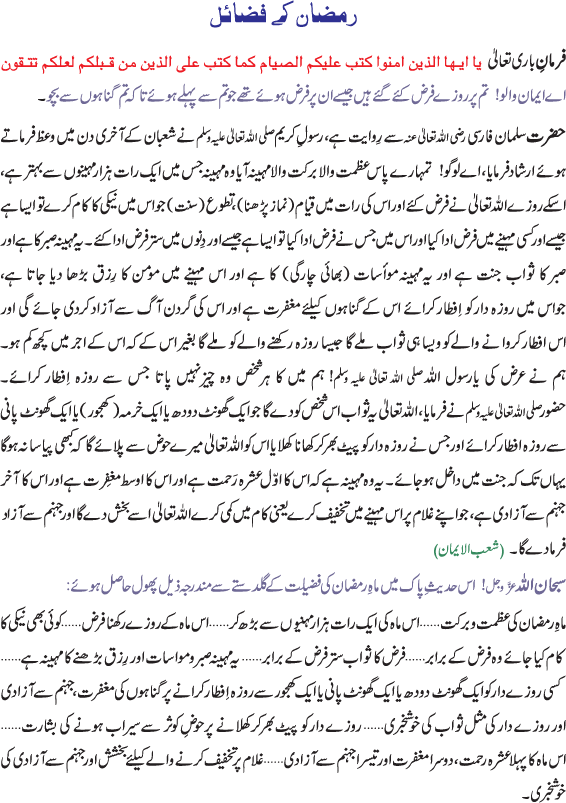
Mah-e-Ramadan k Fazail
The Origin of Zamzam Well
Explaining the origin of Zamzam Ibn ‘Abbas said: “When Hajar reached the (mountain) of Marwah in search of water for her baby son Isma’il and herself to quench their thirst. she heard a sound, and said to herself, “Quiet.” She again heard the sound, whereupon she said, “I have heard you. Help me, if you can.” All of a sudden she found an angel at the place where now Zamzam is. He either dug it with his heel or touched it (the ground) with his wing and a spring of water appeared. Hajar encircled the water with soil. She took some water in a container she had, and water kept bubbling up unchecked.”
Ibn ‘Abbas reported that the Prophet (peace be upon him) said, “‘May Allah shower His mercy on Isma’il’s mother. Had she left it untouched, or (the narrator is not sure) the Prophet said, had she not drunk of its water, the Zamzam would have turned into a clear flowing spring.’ He added, ‘So she drank the water and gave some to her son.’ The angel said to her, ‘Fear no loss because this is the site of Allah’s House, which this boy and his father shall build. Allah never permits His servant to be lost. At the site of the House was a hill that was split by flood waters running down its right and left.”‘
Fiqh-us-Sunnah
Fiqh 5.82
Hadith Qudsi: Allah Ki Takzeeb Na Karo
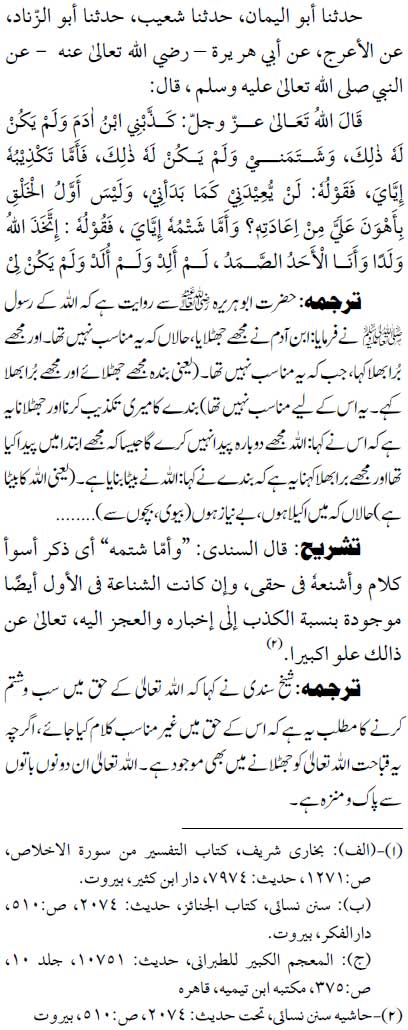
Hadith Qudsi: Allah Ki Takzeeb Na Karo
Historical Background Of Sa’i Between Safa and Marwah
Ibn ‘Abbas said: ‘Prophet Ibrahim (peace be upon him) brought Hajar, his wife, and her son Isma’il (peace be upon them), whom she was still nursing, and left them at (the site of) the House of Allah under a tree above the Zamzam. Makkah at that time was a place where there was neither water nor any dweller. He left a bag of dates and a container of water for them. Then Ibrahim (peace be upon him) turned to go away. Isma’il’s mother said to him, “O Ibrahim! Where are you going? And who are you leaving us to in this valley without a companion or a thing?” She repeated this several times but he did not respond. At last, she asked him, “Has Allah commanded you to do so?” He answered, “Yes.” Thereupon she said, “Then He will not let us perish!” (Bukhari) In another narration, we
read: “She asked him, ‘Who are you leaving us to?’ He answered, ‘To Allah’ where she responded, ‘I am satisfied,’ and turned back.”
Ibrahim left and when he reached a mountain pass where he could no longer see them, he turned his face toward the Kaaba and with his hands raised, supplicated, “O Our Lord! I have made of my offspring to dwell in a valley without cultivation by your Sacred House; Our Lord, that they may establish regular prayer: so fill the hearts of some among men with love towards them, and feed them with fruits, so that they may give thanks!” (Qur’an 14.37)
Hajar sat under the tree with her baby next to her. She drank from her water container hanging nearby, and nursed her baby, until all the water she had was gone, and her milk dried out. Her son grew hungrier and hungrier. She could hardly bear to look at him. She went and stood at Safa – the hill nearest to her. She looked down the valley to see if someone was around to help. She could see no one. So, she climbed down Safa and reached the valley. She struggled hard, crossed the valley, and reached Marwah. She stood on Marwah and looked around. Still, she could see no one around. She repeated this seven times. Ibn ‘Abbas added, “The Prophet (peace be upon him) said: ‘It is (to commemorate this walk) that pilgrims walk between Safa and Marwah.”‘
Fiqh-us-Sunnah
Fiqh 5.85