

khajoor Aur Anar Kay Fazail
Have You Made Your Will?
‘It is not right for any Muslim who has anything to bequeath that they may pass even two nights without having their will written.’ (Prophet of Allah (saw))
Under English law, if someone dies without having written a will his or her property does not automatically pass on to those who the deceased would have chosen to be the natural inheritors. Furthermore, inheritance tax may have to be paid to the government from the estate of the deceased, and many legal complications will have to be sorted out to save the distress of the deceased’s heirs.
In Britain, about 70% of people die without making a will, this means that their hard-earned property – their home, savings, and personal belongings – are not distributed amongst their relatives as they would have liked.
Making a will is simple. However, to maker sure that your will is legally valid you should get professional advice from a solicitor. A Muslim solicitor will be in a better position to help you in matters of dividing your estate according to Shari’ah (Islamic Law).
Before seeing a solicitor you should make sure of the following:
Calculate the value of your estate Your estate is money, land, property, and all other material possessions after deducting all your liabilities such as outstanding debts, loans, etc.
Appointment of executor(s) Executor(s) is the persons who carry out the instructions contained in a will. You can choose between one and four people such as your spouse, relative, a friend, or anyone whom you trust. It can even be your solicitor or a combination of these people.
Find two witnesses Witnesses cannot be the people who will benefit from your will.
Appoint a guardian If you have any children under the age of 18 years, it is advisable to appoint a guardian for them in case they are left without both parents. Make sure the appointed guardian is willing to take responsibility.
A will according to the Shari’ah should contain the following:
A declaration of your faith in Islam.
Instructions to the executors/relatives of your will to bury your body according to the rites prescribed in Islam.
Directions to your executors/relatives to pay your funeral expenses and debts including debts to Allah (such as Zakah).
Directions to your executors and other authorities to pay legacies or bequests to charities, Islamic institutions, friends, or relatives who are not considered heirs under Islamic law.
This portion must not exceed one-third of your entire estate after burial costs, debts and other expenses have been paid, except when a person has no surviving blood relatives.
Directions to your executors and other authorities to divide the remaining two-thirds of your estate amongst your heirs into shares fixed according to Shari’ah (Islamic Law).
Legacies are usually gifts of money.
Bequests are usually gifts or items of property.
Estate is your money, property, and material possessions.
Leaving Sadaqah
Leaving a contribution in your will in the form of sadaqah to some charitable institution is surely a great and noble decision. It will be deemed as sadaqah-i-jariah (an everlasting sadaqah).
In your will, you can leave parts of your estate as sadaqah, such as:
A gift of money.
An item of value such as a house, a car, etc.
A share of your residuary estate (the residuary of your estate is the sum total left after paying out debts, bills taxes).
Gada Gari Ki Sakht Mumaniat
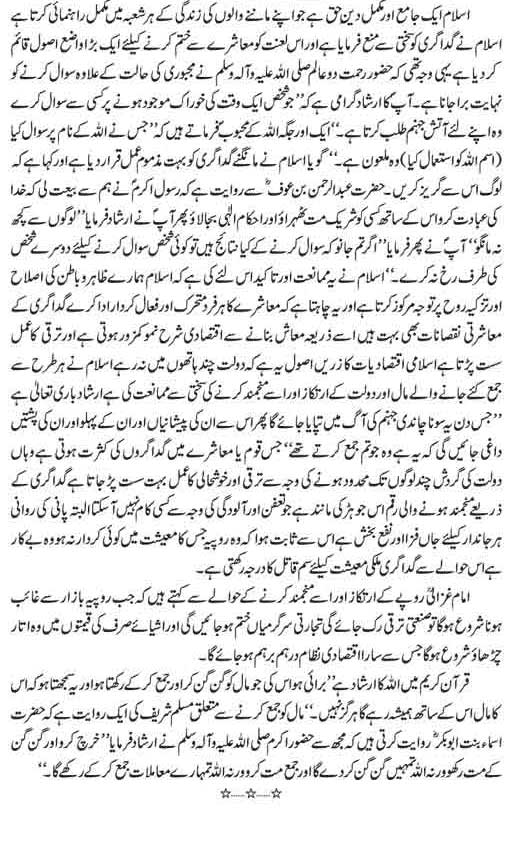
Gada Gari Ki Sakht Mumaniat
A Brief History Of Hadith Methodology
As time passed, more reporters were involved in each isnad (chain of narrators), and so the situation demanded strict discipline in the acceptance of Ahadith; the rules regulating this discipline are known as Mustalah Al-Hadith (Hadith methodology).
Among the early traditionists (muhaddithun, scholars of Ahadith), the rules and criteria governing their study of Hadith were meticulous, but some of their terminologies varied from person to person, and their principles began to be systematically written down, but scattered among various books; for example, in Ar-Risalah of Ash-Shafi`i (d. AH 204), the introduction to the Sahih of Muslim (d. AH 261) and the Jami of At-Tirmidhi (d. AH 279). Many of the criteria of early traditionists, for example, Al-Bukhari, were deduced by later scholars from a careful study of which reporters or isnads were accepted and rejected by them.
One of the earliest writings to attempt to cover methodology comprehensively, using standard (generally accepted) terminology, was the work by Ar-Ramahurmuzi (d. AH 360). The next major contribution was Ma`rifat Ulum Al-Hadith by Al-Hakim (d. AH 405), which covered 50 classifications of Hadith, but still left some points untouched; Abu Nu`aim Al-Asbahani (d. AH 430) completed some of the missing parts to this work. After that came Al-Kifayah fi `Ilm ar-Riwayah of Al-Khatib Al-Baghdadi (d. AH 463) and another work on the manner of teaching and studying Ahadith. Later scholars were considered to be greatly indebted to Al-Khatib’s work.
After further contributions by Qadi Iyad Al-Yahsubi (d. AH 544) and Abu Hafs Al-Mayanji (d. AH 580) among others, came the work which, although modest in size, was so comprehensive in its excellent treatment of the subject that it came to be the standard reference for thousands of scholars and students of Hadith to come, over many centuries until the present day: `Ulum al-Hadith of Abu Amr `Uthman Ibn As-Salah (d. AH 643), commonly known as Muqaddimat Ibn As-Salah (Muqaddimah of Ibn As-Salah), compiled while he taught in the Dar Al-Hadith (Hadith school) of several cities in Syria. Some of the numerous later works based on that of Ibn As-Salah are these:
Al-Irshad, an abridgment of Muqaddimah, by An-Nawawi (d. AH 676), which he later summarized in his Taqrib. As-Suyuti (d. AH 911) compiled a valuable commentary on the latter entitled Tadrib Al-Rawi.
Ikhtisar `Ulum al-Hadith by Ibn Kathir (d. AH 774); Al-Khulasah by Al-Taibi (d. AH 743); Al-Minhal by Badr Ad-Din ibn Jama`ah (d. AH 733); Al-Muqni` by Ibn Al-Mulaqqin (d. AH 802); and Mahasin al-Istilah by Al-Balqini (d. AH 805 ), all of which are abridgments of Muqaddimat Ibn As-Salah.
Nukat by Az-Zarkashi (d. AH 794); At-Taqyid wal-Idah by Al-`Iraqi (d. AH 806); and An-Nukat by Ibn Hajar Al-`Asqalani (d. AH 852), all of which are further notes on the points made by Ibn As-Salah.
Alfiyyat al-Hadith by Al-`Iraqi, a rewriting of Muqaddimah in the form of a lengthy poem, which became the subject of several commentaries, including two (one long, one short) by the author himself; Fath Al-Mughith by As-Sakhawi (d. AH 903); Qatar Ad-Durar by As-Suyuti; and Fath Al-Baqi by Sheikh Zakariya Al-Ansari (d. AH 928).
Other notable treatises on Hadith methodology include the following:
Al-Iqtirah by Ibn Daqiq Al-`Id (d. AH 702); Tanqih al-Anzar by Muhammad ibn Ibrahim Al-Wazir (d. AH 840), which was the subject of a commentary by Al-Amir As-San`ani (d. AH 1182).
Nukhbat Al-Fikr by Ibn Hajar Al-Asqalani, again the subject of several commentaries, including one by the author himself, one by his son Muhammad, and those of Ali Al-Qari (d. AH 1014), `Abdur-Ra’uf Al-Munawi (d. AH 1031) and Muhammad ibn Abdul-Hadi As-Sindi (d. AH 1138). Among those who rephrased the Nukhbah in the poetic form are At-Tufi (d. AH 893) and Al-Amir As-San`ani.
Alfiyyat Al-Hadith by As-Suyuti, the most comprehensive poetic work in the field; Al-Manzumah by Al-Baiquni, which was expanded upon by, among others, Az-Zurqani (d. AH 1122) and Nawab Siddiq Hasan Khan (d. AH 1307); Qawaid At-Tahdith by Jamal Ad-Din Al-Qasimi (d. AH 1332).
Tawjih an-Nazar by Tahir Al-Jaza‚iri (d. AH 1338), a summary of Al-Hakim’s Ma`rifah.
Fana Hona Bhi Naimat Hai
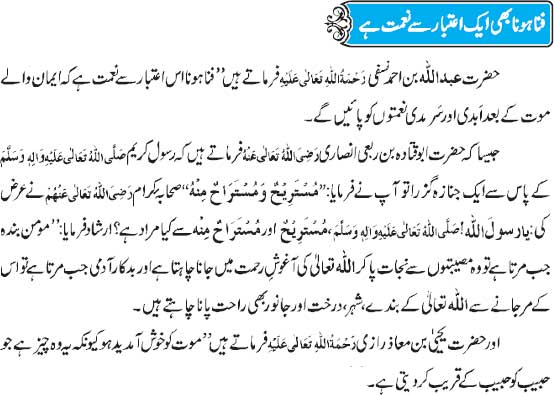
Fana Hona Bhi Naimat Hai
Errors During Umrah
Recently in Makkah, an old lady came for Umrah wearing the Ihram of men, the two white pieces of cloth. A few women at the Haram (the Grand Mosque in Makkah) helped her cover her head and change her clothes. Millions of people come for Umrah and Haj from around the world, but many, like the lady above, are unaware of its Islamic rulings and rites.
Here are some common errors adapted from the above resource:
Meeqat point
Some pilgrims bypass the designated Meeqat point of lhram on their route without either being in the state of Ihram or entering into Ihram there, proceeding until they reach Jeddah or some other place at which they enter Ihram.
This is against the command of Allah’s Messenger (peace be on him). Every pilgrim should enter into Ihram at the designated Meeqat point in his route. If one did not pass through one of the five Meeqat points, he should enter into Ihram at a point that is nearest to it.
If someone bypassed, he must either go back to the Meeqat point in his route and enter into Ihram, or he must give an expiation by sacrificing a sheep in Makkah and feeding all its meat to the poor.
Tawaf
Starting the Tawaf at some point other than the site of the Black Stone, while it is obligatory to begin Tawaf from the Black Stone.
Doing one’s Tawaf inside the Hijr of lsma’il. The Hijr of Isma’il is a part of the Ka’bah which would then be left out of Tawaf. Such a Tawaf is invalid.
Doing Ramal (taking quick short steps) during all seven circuits while Ramal is to be done only during the first three of the “Tawaf of Arrival” (Tawaf Al-Qudum).
Struggling vehemently to kiss the Black Stone in this process and hitting or pushing people. Such acts, which are injurious to Muslims, are not permissible.
Touching the four corners of the Ka’bah or its walls. The Prophet (peace be upon him) did not touch any part of Ka’bah except the Black Stone and the Yemeni Corner.
Specifying supplications reserved for each circuit. The Prophet (peace be on him) did not specify any supplications except to say “Allahu Akbar” when he reached the Black Stone and, at the end of each circuit between the Yamani Corner and the Black Stone, he said: “Rabbana, atina’ fid-dunya hasanatan wa fil-akhirati hasana wa qina adhaban-nar.”
(Our Lord, give us good in this world and good in the Hereafter and save us from the punishment of the Fire.)
Raising voices above the voices of others; while following or leading a group during Tawaf and creating confusion among other worshippers.
Scuffling and wrestling to pray at the Station of lbrahim. This is contrary to the sunnah, besides causing harm to other pilgrims. It is sufficient to pray the two Raka’ah after completing Tawaf anywhere within the Sacred Mosque.
Sa’ee
When climbing upon Safa and Marwah, some pilgrims face the Ka’bah and raise their hands towards it while saying “Allahu Akbar”. The Prophet (peace be upon him) did not do so.
Here you may glorify and magnify Allah in any words you wish while facing the direction of the Ka’bah. It is preferable, however, to say what the Prophet (peace be on him) recited at Safa and Marwah.
Azan Kay Ahkam
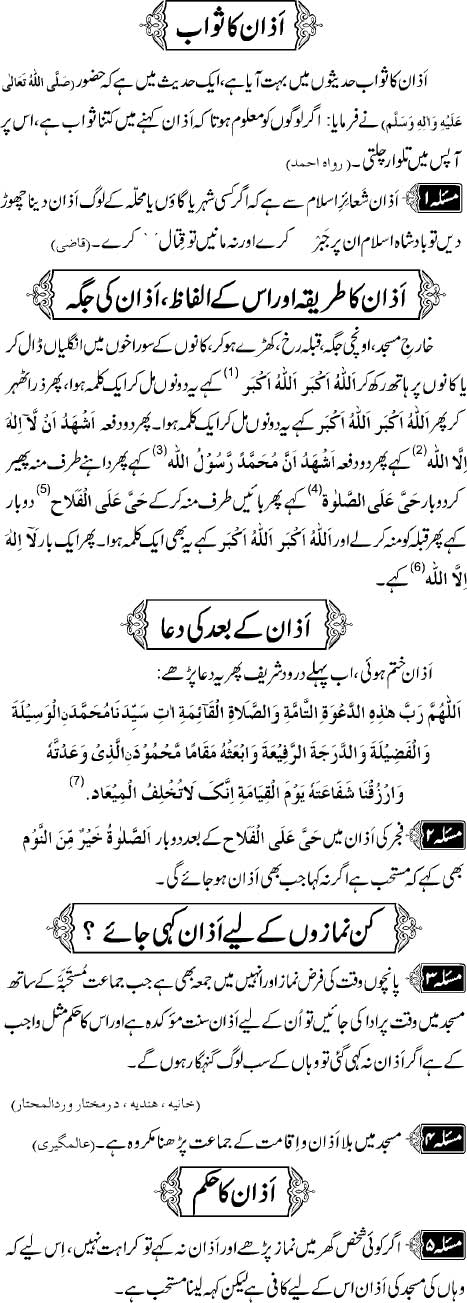
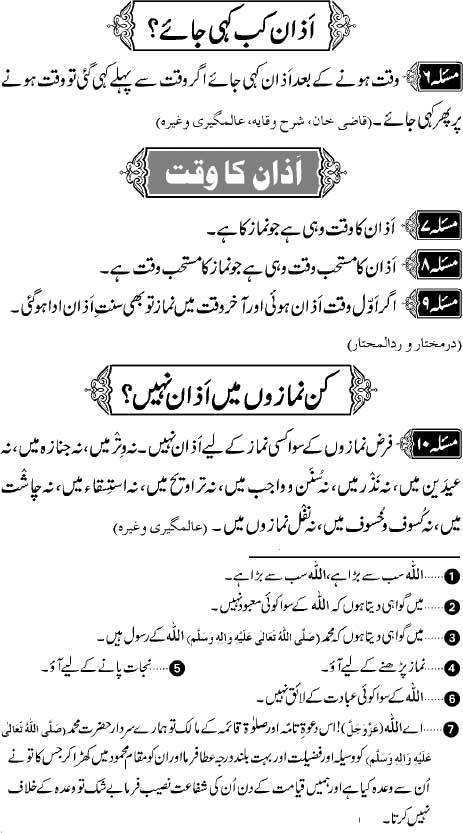
Azan Kay Ahkam
Nature, Too, Praises Allah
{As for the unbelievers, their deeds are like a mirage in the desert that the thirsty traveler supposes to be water, but when he comes near to it finds that it is nothing. But he finds that Allah (has always been present) with him, and that He will pay him his account in full; for Allah is swift in reckoning.
Or else, like the depths of darkness in a vast deep ocean, made yet more dark by wave billowing over the wave, with clouds above it all: Depths of darkness, layer upon layer, (so that) when one holds up his hand, he can hardly see it. Indeed, those from whom Allah withholds light will find no light at all.
Are you not aware that it is Allah Whose limitless glory all creatures that are in the heavens and earth extol, even the birds as they spread out their wings? Each of them knows how to pray to Him and glorify Him, and Allah has full knowledge of all that they do.
To Allah belongs the dominion over the heavens and the earth, and to Allah will all return.} (An-Nur 24:39-42)
The first two verses paint two scenes that are full of life, describing the situation the unbelievers find themselves in. The first of these two scenes highlights the surprise faced by the unbelievers when Allah gives them their account. It is a much greater surprise than that of a desert traveler being deluded by a mirage and then finding it to be nothing.
In the second scene, layers of darkness gather on top of one another, which stands in contrast to the false brightness of the mirage. The great fear is transmitted by the bottomless ocean engulfed in darkness and by the waves upon waves moving in a never-ending motion. Above all these, dark clouds gather. Thus, layers of darkness amass, to the extent that if someone holds out his or her hand, he or she fails to see it in the engulfing darkness that spreads an air of fear and panic.
This is all a description of unbelief, which is shown as darkness totally isolated from the divine light that radiates throughout the universe, a deep error that prevents people from seeing even the nearest signs of guidance, a fear that leaves no trace of security. For, {Indeed, those from whom Allah withholds light will find no light at all.}
Allah’s light is guidance planted in people’s hearts, giving them an informed insight and a bond between human nature and the laws that operate in the universe at large. It is the only true enlightenment. People who are cut off from this light remain in the darkness that cannot be removed, in fear with no security, and in error without return. In the end, they find all their actions to be a mirage leading them to ruin. No action is valid unless based on faith, no guidance without faith, and no light unless Allah’s.
No one should turn anywhere other than to God, and no refuge is to be sought except with Him. Meeting Him is inevitable.
This is the scene of unbelief, error, and darkness in human life. The scene of faith, guidance and light in the great universe follows it. It is a scene showing the entire universe with all that live in it, humans and Jinn, planets and stars, and all beings, whether animate or inanimate, sharing in Allah’s glorification. We feel how awesome the scene is as we hear the glorification echoing everywhere in the heavens and the earth.
{Are you not aware that it is Allah whose limitless glory all creatures that are in the heavens and earth extol, even the birds as they spread out their wings? Each of them knows how to pray to Him and to glorify Him; and Allah has full knowledge of all that they do. To Allah belongs the dominion over the heavens and the earth, and to Allah will all return.} (An-Nur 24:41-42)
Humans do not live alone in this universe. All around them, to their right and to their left, above them and underneath them, and in the expanse beyond, whether reached by their imagination or not, there are beings Allah has created with different natures, forms, and shapes. All of them share in their belief in Allah, turn to Him, and extol His praises. He {has full knowledge of all that they do.}
The Qur’an directs humans to look around them: All is of Allah’s making and all living things everywhere in the heavens and earth are His creatures, glorifying Him, and singing His praises. The Qur’an also directs our full attention to something we see every day without stirring any feeling in us because of its familiarity: It is the scene of birds lifting up their legs and spreading out their wings as they fly. They also glorify Allah. {Each of them knows how to pray to Him and to glorify Him..} Only humans neglect to glorify their Lord when He is the one Who should be most aware of the importance of believing in Allah and glorifying Him.
In this scene, the whole universe appears full of humility as it turns to its Creator, singing His praises and addressing its prayers to Him. It does this by nature. Its obedience to Allah is represented in its laws, which operate by Allah’s will.
When humans refine their senses, they see this scene as reality, as though they hear the rhythm of Allah’s glorification echo throughout the universe. They share with all creatures their prayers and appeals to Allah.
Such was Muhammad, Allah’s Messenger (peace and blessings be upon him): When he walked, he heard the gravel under his feet singing Allah’s praises. Such was David (Dawud): When he chanted his Psalms, the mountains and the birds chanted with him.
To Allah belongs the dominion over the heavens and the earth, and to Allah will all return.} No one should turn anywhere other than to Him, and no refuge is to be sought except with Him. Meeting Him is inevitable. His punishment, if deserved, cannot be averted except through His grace. To Him, all will return.
By Sayed Qutb
Muslim Intellectual — Egypt
Surah Al Waqiah Kay Fazail
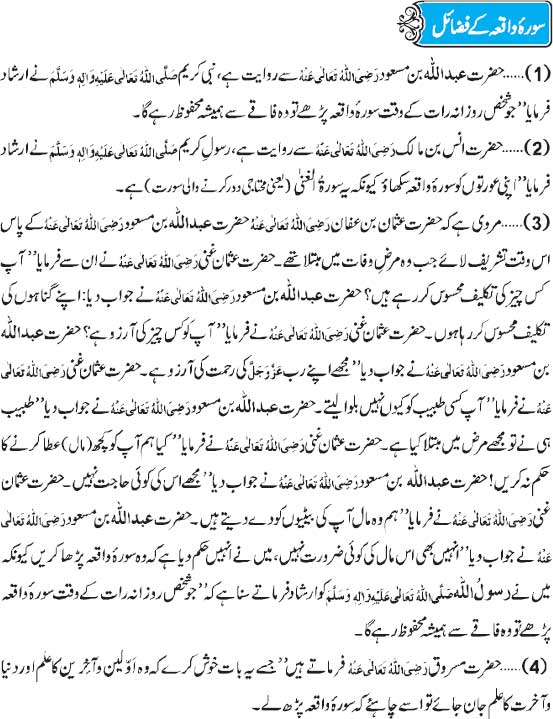
Surah Al Waqiah Kay Fazail
What Are Your Subhan Allah Moments?
I don’t know about you, but life can be a real roller coaster. Some days, I wake up and think, “This is going to be a good day, Insha Allah.” The kids are listening without talking back, the food tastes particularly good, people seem unusually positive and supportive, time for worship is plentiful and beneficial, and life is good. Then, the downward spiral of the roller coaster begins. Suddenly the storm clouds come out and crisis sets in.
Allah challenges the believers in the Qur’an, asking: Do the people think that they will be left to say, “We believe,” without being put to the test? No, we have tested those before them… (Qur’an, 29:2-3)
Indeed, Allah has decreed for mankind a life of hardships and struggles, tests of one’s true faith and resolve. Each person feels their individual trial as intensely as the next person, and life can sometimes feel overwhelming.
Perhaps the test is in your relationship with your spouse, or even finding a spouse. Maybe obeying your parents or taking care of them in their old age brings on hardship. Of course, there can be problems at work, difficulty in finding work, financial instability, trials with parenthood, academic struggles, and health problems; the list of possibilities goes on and on. Sometimes, the trial is long and your patience grows thin. You begin to believe the trial will never end, that this will become your permanent living situation.
It is during these times that one most needs a “Subhan Allah” moment, a remembrance of purpose, and a refuge in the beauty of creation.
I wanted to share with you some of my “Subhan Allah” moments. These are moments I return to when I am feeling most distressed that help brings back balance and perspective to my situation. I encourage you to try to slowly read each of the following moments out loud, one by one, allowing each to enter your ears and travel to your heart. Close your eyes after each one and experience the sights, smells, and feelings of each moment until your tongue responds with the Dhikr of Allah.
- Embracing my child as he sits in my lap and softly explores my face with his tiny, roaming fingers.
- Listening to a new Muslim nervously struggling through their Shahadah for the first time in front of the entire mosque.
- Finally pondering a Qur’anic verse I have skimmed over numerous times and understanding it to the extent it brings tears to my eyes.
- Inhaling the wonderfully intense smell of brewing coffee on a cold winter day.
- Passing a grave site and thinking of the possible torture of its inhabitants.
- Feeling the first drops of water roll down my parched throat and fill my belly with cool relief after a long summer day of fasting.
- Reading a Hadith about the Prophet (peace be upon him) that exemplifies the beauty and compassion of Islamic manners, comforting me when I am feeling tested by the outside world.
- Listening to the Imam struggle through his recitation as his voice weighs heavy with tears and fear of the Hellfire.
- Finally getting confirmation of the first day of Ramadan, and anxiously calling my phone tree to spread the good news to friends and family.
- Being humbled by a new Muslim’s sincerity and struggle for the Religion that I take for granted.
- Staring at the dark night sky as a million stars dance around the crescent moon.
- Standing at Arafat during Haj with millions of believers from all over the world, mutually grieving from the fear of the Day of Judgment.
- Realizing the weight and immensity of Allah’s favor upon me when He guided me to the Truth.
The next time we are driven to the brink of insanity from the so-called realities of life, let’s seek refuge in the true realities, and say, Subhan Allah!
Muslimmatters