

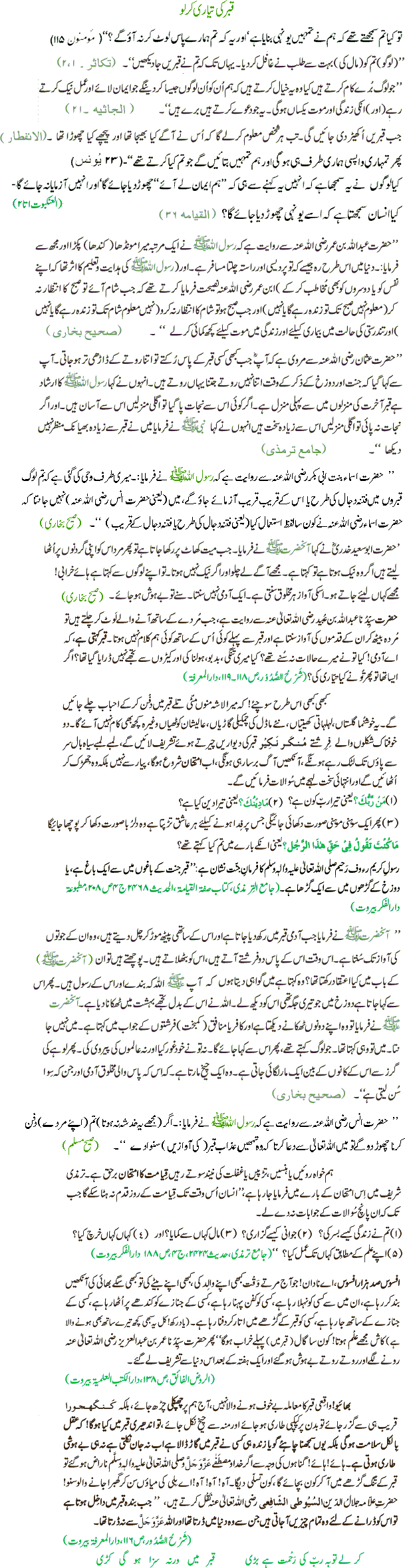
Qabar Ki Tayari Kar Lo
Prophet Jonah (PBUH)
In the name of Allah, the Most Merciful, the All-Compassionate
“May the Peace and Blessings of Allah be Upon You”
Praise be to Allah, we seek His help and His forgiveness. We seek refuge with Allah from the evil of our own souls and from our bad deeds. Whomsoever Allah guides will never be led astray, and whomsoever Allah leaves astray, no one can guide. I bear witness that there is no god but Allah, and I bear witness that Muhammad is His slave and Messenger.
Bismillah Walhamdulillah Was Salaatu Was Salaam ‘ala Rasulillah
As-Salaam Alaikum Wa-Rahmatullahi Wa-Barakatuhu
Prophet Yunus (Jonah)
Prophet Jonah (Yunus) (PBUH), also known as Dhan-Nun. About his people, Almighty Allah said: “Was there any town community that believed after seeing the punishment, and its Faith at that moment, saved it from the punishment? (the answer is none)–except the people of Jonah; when they believed, We removed from them the torment of disgrace in the life of the present world, and permitted them to enjoy for a while.” (Ch 10:98 Quran)
The inhabitants of the town of Nineveh were idolaters who lived a shameless life. Prophet Jonah (PBUH) was sent to teach them the worship of Allah. The people disliked his interference in their way of worship, so they argued. “We and our forefathers have worshiped these gods for many years, and no harm has come to us.”
Jonah Leaves His People
Try as he might to convince them of the foolishness of idolatry and of the goodness of Allah’s laws, they ignored him. He warned them that if they kept on with their foolishness, Allah’s punishment would soon follow. Instead of fearing Allah, they told Jonah that they were not afraid of his threats. “Let it happen,” they told him. Jonah was disheartened. “In that case, I will leave you to your misery!” So saying, he left Nineveh, fearing that Allah’s anger would soon follow.
“Remember Dhan Nun (Jonah), when he went off in anger, and imagined that We shall not punish him (the calamities which had befallen him)! (ch 21:87)
The People are Forgiven
Hardly had he left the city when the skies began to change color and looked as if they were on fire. The people were filled with fear at the sight of this. They recalled the destruction of the people of Ad, Thamud, and Noah. Was theirs to be a similar fate? Slowly, faith penetrated their hearts. They all gathered on the mountain and started to beseech Allah for His mercy and forgiveness. The mountains echoed with their cries. It was a momentous hour, filled with sincere repentance.
Jannat Aur Iss Ki Naimatien
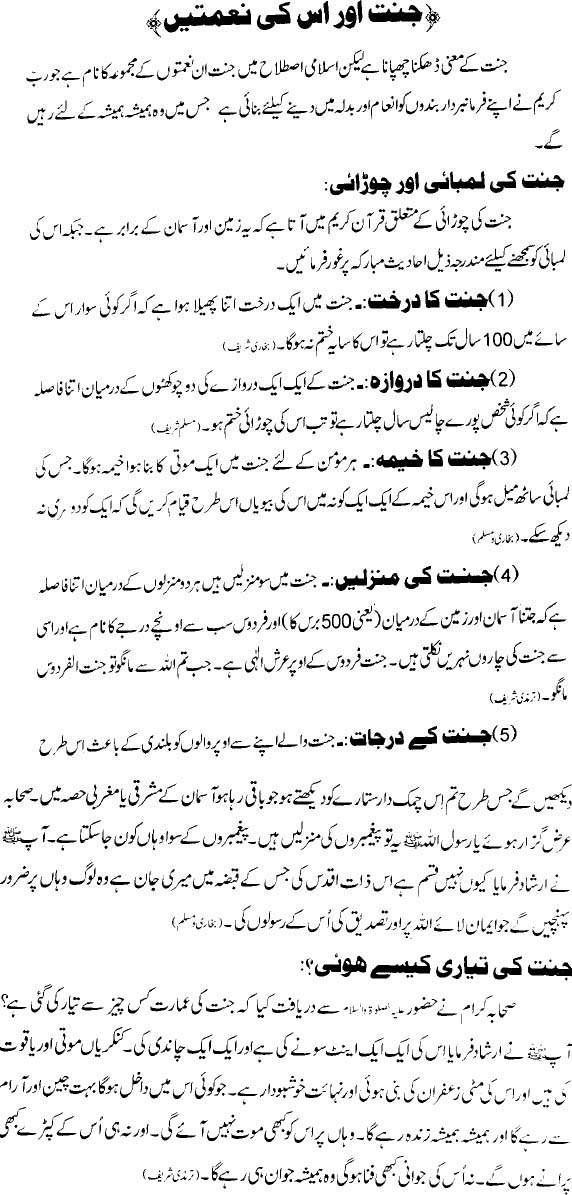
Jannat Aur Iss Ki Naimatien
Want A Palace(In Jannah)?..Give Up Malice!
Narrated Hudhaifa (Radi Allahu anhu): The Prophet (SallAllahu alaihi wasallam) said,” Before your time, the angels took the soul of a man and asked him, ‘Did you do any good deeds (in your life)?’ He replied, ‘I used to order my employees to grant time to rich person to pay his debts at his convenience and excuse the one in hard circumstances.’ So Allah said to the angels, ‘Excuse him,'” Sahih Al-Bukhari 3:291
Want a Palace(In Jannah)?..Give up, Malice!
Every person’s honor is sacred. We are duty-bound to respect and honor our fellow brothers and sisters and never…yes, NEVER to hold an iota of malice or ill will in our hearts towards them. The Noble Messenger of Allah (peace be upon him) tried to eliminate hatred, malice, jealousy, and rivalry by inducing brotherhood, sincere love and friendship. (Please note that while in most cases the ahaadeeth mention the masculine gender, the same rewards etc. refer to the females as well)
Our society is ideally built upon the foundation of brotherhood, as the Noble Messenger of Allah (peace be upon him) advised: “Believers are like a structure, parts of which support one another. The believers, in their mutual friendship, mercy, and affection, are like one body; if any part of it complains, the rest of the body will also stay awake in fever.” (Hadith-Al-Bukhaari and Muslim).
The Noble Messenger of Allah (peace be upon him) also said, “Do not break off ties with one another, do not turn away from one another, do not hate one another, and do not envy one another. Be O slaves of Allah brothers.” (Al-Bukhaari)
Women Of Paradise: The Black Woman
We often hear speakers in Friday prayer or in admonitions talking about Paradise and all of us find our hearts, minds and thoughts tuned on to that ‘frequency’. However, the majority of the speakers talk about Paradise as if it were a house for men only. Reality is not like that.
Paradise is for the believing men and women.
The only price for it is sound belief in Allah, love of Alaah and His Messenger salla Allaahu alaihi wa sallam, and obedience to Allah and His Messenger salla Allaahu alaihi wa sallam.
In what follows are the glad tidings given by the Messenger of Allah salla Allaahu alaihi wa sallam, to some of the women among his companions.
Aamal e Maghfirat: Namaz
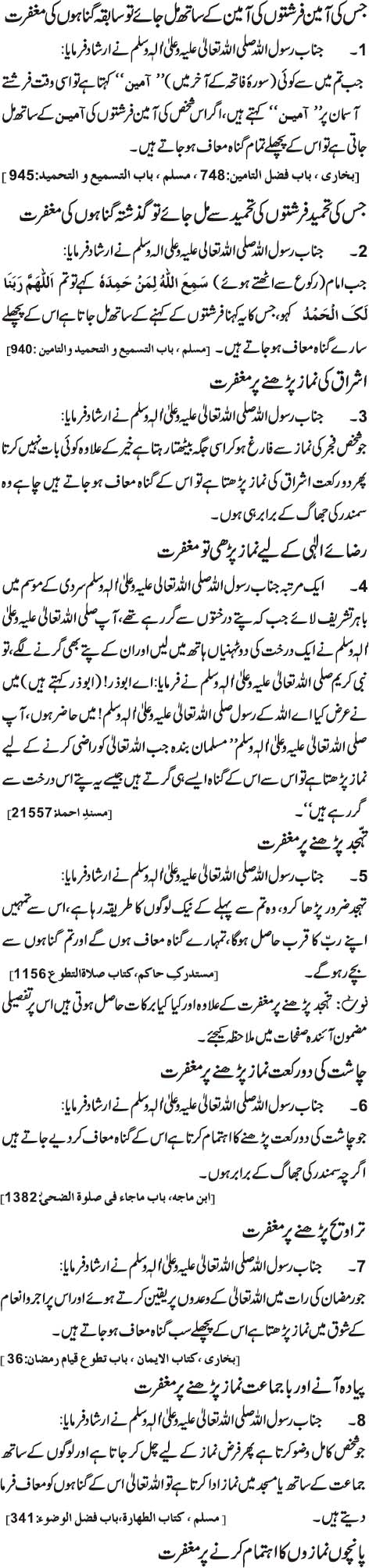
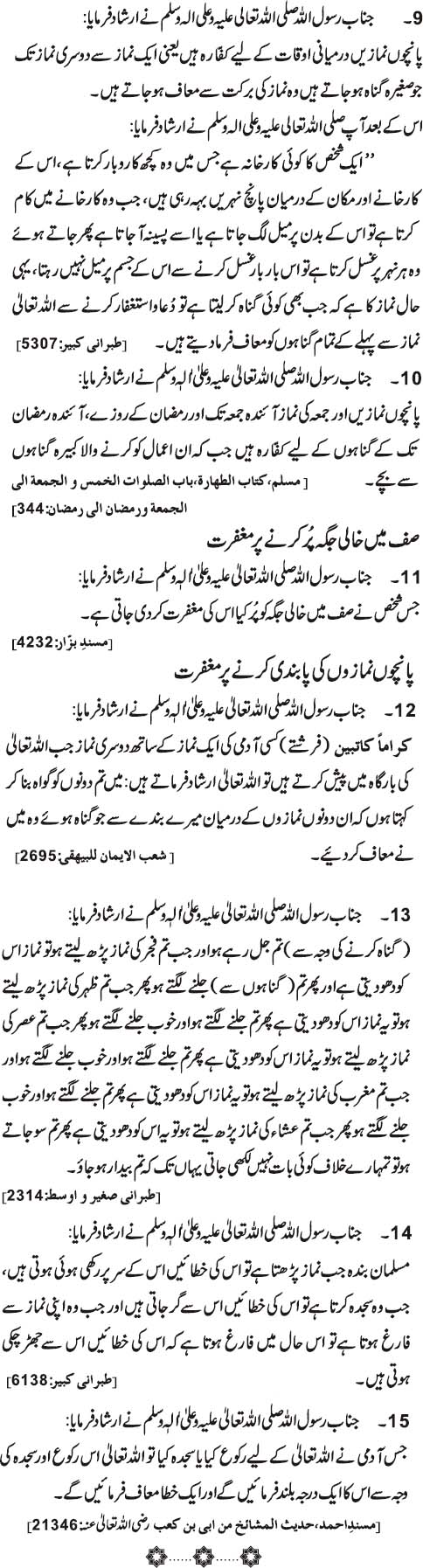
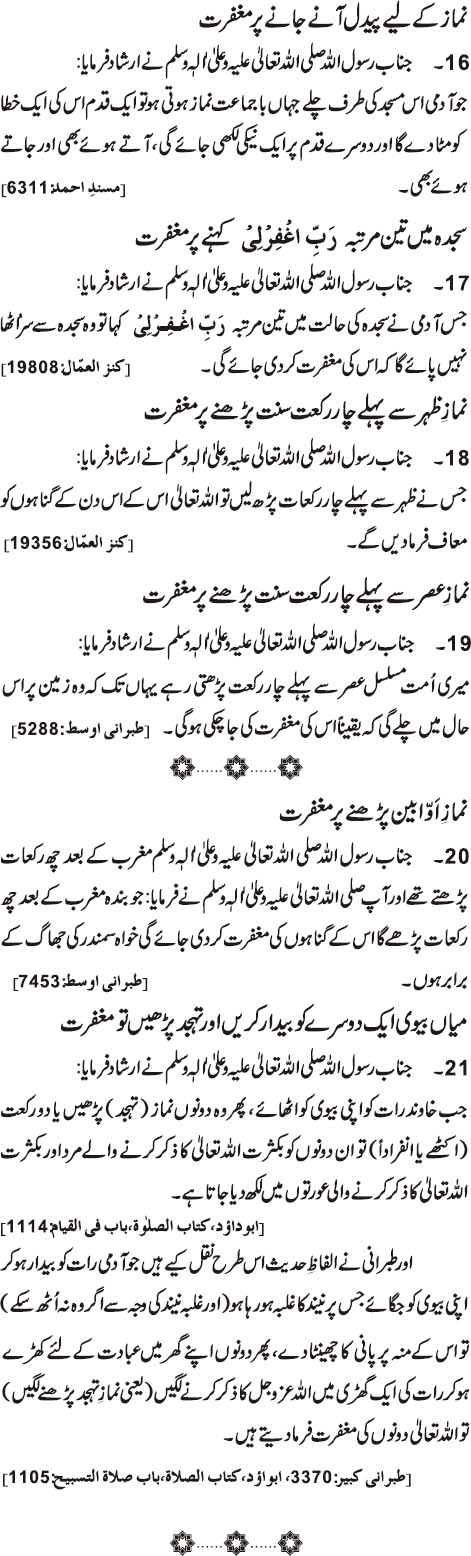
Aamal e Maghfirat: Namaz
The Major Sin – Not Praying
Allah, most High, says: Then there succeeded them a generation which neglected prayers and followed lusts. They will meet with destruction (Ghayy), excepting the one who repents and believes and acts righteously. (Quran 19:59-60)
Ibn Abbas (RAA) explained that this does not mean that they completely abandoned prayers, but that they delayed them to the end of their prescribed times.
Said bin Musayyab, a great Imam following the generation of the Companions, elaborated on this, saying: “A person neglects if he delays the noon prayer up to the afternoon prayer time, afternoon prayer up to almost sunset prayer time, sunset prayer up to evening prayer time, and evening prayer up to morning prayer time, while delaying morning prayer until just before sunrise.
If anyone dies without repentance while continuing in this manner, Allah has promised Ghayy for him, and that is a valley in Hell which is very deep and has foul food.”
Allah Most High says: Woe to the worshipers who are unmindful of their prayer.
(Quran 107:4-5)
Saad bin Abi Waqqas said: “I asked Allah’s Messenger (SAW) about the meaning of unmindful, and he replied: It is delaying it (the prayer) up to the end of its prescribed time.'” (Bazar)
While Allah calls such people, they are lazy and perform the prayer very late. He has promised them Wayl, which signifies a great punishment.
Some say, “Wayl is a valley in Hell, exceedingly hot, and that is the place for those who delay or miss the prayer, excepting the ones who repent and correct their habits.”
Allah Most High says: O you who believe, let neither your wealth nor your children distract you from the remembrance of Allah. And those who do so, they will be the losers (Quran 63:9)
The commentators say: “The remembrance of Allah in this verse means the five daily prayers. If anyone is so busy in buying and selling, or with his daily work of earning a livelihood, or with his children, that he cannot perform prayers on time, he will be among the losers.”
The Prophet (SAW) said in this regard: “The first thing which will be judged among a person’s deeds on the Day of Resurrection is the prayer. If that is in good order, he will pass the test and prosper, and if that is defective, he will fail the test and be a loser.” (Tirmidhi)
Informing us about the inhabitants of Hell, Allah Most High says: (The people in Hell will be asked): “What caused you to enter Hell-fire?” They will say: “We were not among those who prayed, nor did we feed the needy. We used to engage in vain discourse with the vain-talkers, and we used to deny the Day of Judgment, until there came to us that which is certain (ie, Allah’s judgment).” Then no intercession by any intercessors will benefit them. (Quran 74:42-48)
The Prophet (SAW) said: “The covenant between us and them (that is, believers) is prayer, so if anyone abandons it, he has become an infidel.” (Ahmad, Ibn Majah, Abu Dawood, Nisai, Tirmidhi).
He also said: “What lies between a man and infidelity is the abanonment of prayer.” (Muslim)
Allah’s Messenger (SAW) is reported to have said: “If anyone abandons the afternoon prayer, his deeds are of no avail.” (Bukhari).
And he said: “If anyone abandons prayer deliberately, he has no claim upon Allah” (Sunan).
Abdullah bin amr bin al-As (RAA) said that the Prophet (SAW) mentioned prayer one day saying, “If anyone keeps to it, it will be light, evidence, and salvation for him on the day of Resurrection; but if anyone does not keep to it, it will not be for him light, evidence, or salvation; and on the Day of Resurrection, he will be associated with Qaran, Pharoah, Haman, and Ubayy bin Khalaf (a great enemy of Islam from among the Quraish).” (Ahmad, Darimi, and Baihaqi)
Some scholars have explained that the person who abandons prayer will be raised with such a foursome because his neglect of prayer may be due to his involvement with his property, his country, his administrative work, or his trade.
Therefore, if he were involved with his property, he would be resurrected with Qarun; if with his country, then with Pharoah; if with his administrative work, then with Haman; and if with his trade, then with Ubayy bin Khalaf, the trader among the unbelievers of Mecca.
Muadh bin Jabal (RAA) reported Allah’s Messenger (SAW) as saying: “If anyone abandons prayer intentionally, he has no claim to Allah Most High.” (Ahmad)
Umar ibn al-Khattab (RAA) reported that a man asked the Prophet (SAW): “Messenger of Allah, what action is dearest to Allah Most High?”
The Prophet (SAW) replied: “Prayer at its proper time. The one who does not pray has no religion. Prayer is the main pillar of the religion (of Islam).” (Baihaqi)
Abdullah bin Shaqiq (RAA) said that the Companions of the Prophet (SAW) did not consider the abandonment of any good deeds to be unbelief, excepting the abandonment of prayer.
When Ali (RAA) was asked about a woman who did not pray, he replied: “The one who does not pray is an unbeliever.”
Ibn Masood said that the one who does not pray has no religion, and Ibn Abbas said: “The one who leaves off a single prayer deliberately will find, when he meets Allah Most High, that He is angry with him.”
Allah’s Messenger (SAW) said: “When a person meets Allah after neglecting his prayer, he will meet him as if he had not worshiped him at all, nor done any good deeds.”
And Ibn Hazm said: “There is no greater sin after polytheism than missing a prayer [That is to say, if one deliberately delays a prayer until its time has passed, although he was able to pray it on time, without any valid reason which permits delaying it before its time.] and killing a believer without just cause.”
Ibrahim Nakahi said, “The one who has left off the prayer has become a disbeliever.”
Abdullah bin al-As reported Allah’s Messenger (SAW) as saying: “A person who combines two prayers without a valid excuse, enters a gate among the major sins.”
Qayamat Ke Din Har Naimat Ke Bare Mein Pocha Jaye Ga
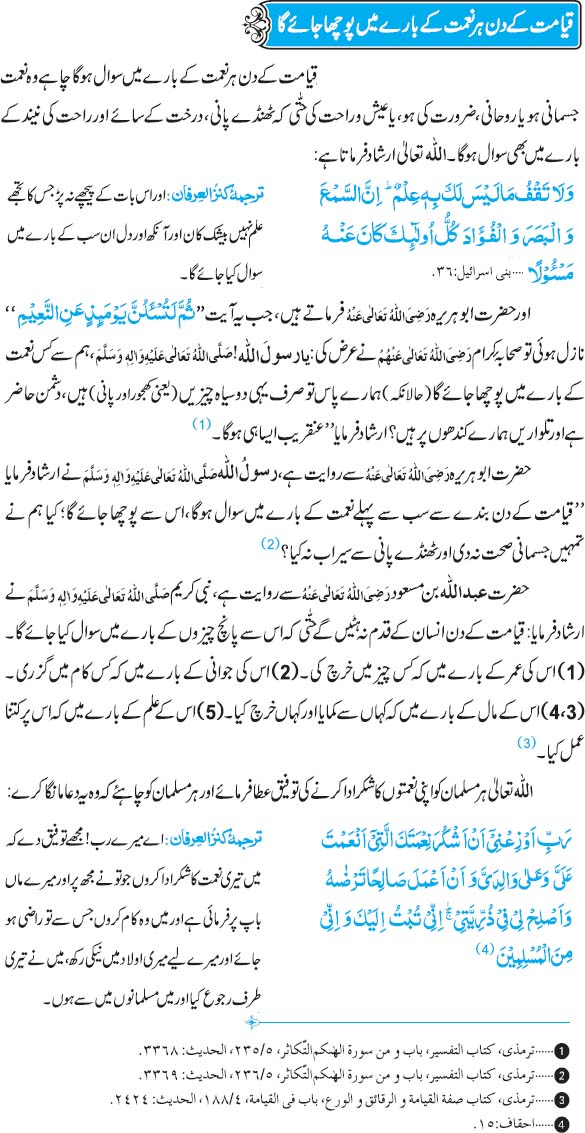
Qayamat Ke Din Har Naimat Ke Bare Mein Pocha Jaye Ga
Major Sin: Bearing False Witness
Allah says (interpretation of the meaning): “. . . So shun the abomination (worship) of idols, and shun lying speech (false statements) – hunafaa’Lillah (i.e., to worship none but Allah), not associating partners (in worship, etc.) unto Him …” [al-Hajj 22:30-31]
Abd al-Rahmaan ibn Abi Bakrah (may Allah be pleased with him and his father) reported that his father said: “We were with the Messenger of Allah (peace and blessings of Allah be upon him) when he said: I fear for you three major sins – three times:
associating partners with Allah,
disobedience to parents, and – – he was reclining, but he sat up at this point and said: –
And bearing false witness.
He kept repeating this with such fervor that we wished he would stop (for his own sake).” (Reported by al-Bukhaari, see al-Fath, 5/261).
The warning against bearing false witness was uttered repeatedly because people take it too lightly, and there are many motives for doing so, such as hatred and envy.
The resulting corruption is great indeed: how many people have lost their rights because of false witness! How many innocent people have been treated unjustly, and how many people have gained what they did not deserve, because of it!
An example of the ways in which people take this matter lightly is what sometimes happens in the courts, when a person might say to someone he has only just met, “Testify for me and I will testify for you.”
So one might testify for the other in a case where he does not have the necessary knowledge of what really happened, like testifying that this person owns a piece of land or a house, or recommending him when he has never seen him before that day in court.
This is lying and false witness, whereas testimony should be as described in the Book of Allah: “… We testify not except according to what we know …” [Yousuf 12:81]
source- Prohibitions that are taken too lightly Book by Sheikh Muhammed Salih Al-Munajjid
Shafeeq Bin Ibrahim RA
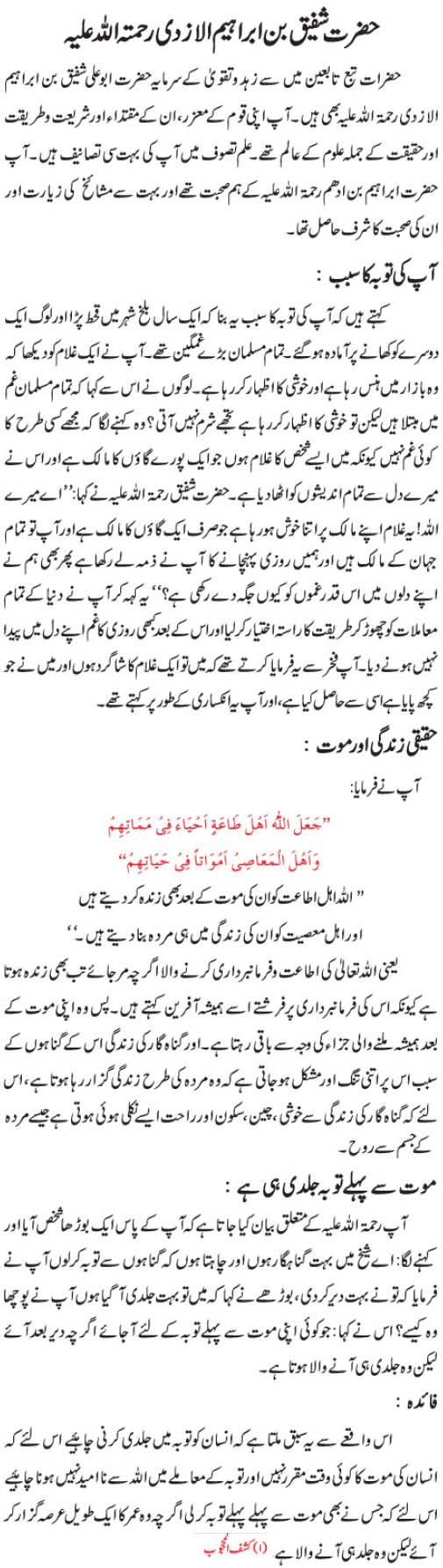
Shafeeq Bin Ibrahim RA