

Guide People To Right Path
{Invite (mankind, O Muhammad ) to the Way of your Lord (i.e. Islam) with wisdom (i.e. with the Divine Inspiration and the Qur’an) and fair preaching, and argue with them in a way that is better. Truly, your Lord knows best who has gone astray from His Path, and He is the Best Aware of those who are guided.}
(Holy Quran-16:125)
{And who is better in speech than he who [says: “My Lord is Allah (believes in His Oneness),” and then stands straight (acts upon His Order), and] invites (men) to Allah’s (Islamic Monotheism), and does righteous deeds, and says: “I am one of the Muslims.”} (Holy Quran-41:33)
The prophet (peace and blessings of Allah be upon him) said: “By Allah if Allah guides one person by you, it is better for you than the best types of camels.” [al-Bukhaaree, Muslim]
The prophet (peace and blessings of Allah be upon him) also said, “Whoever calls to guidance will have a reward similar to the reward of the one who follows him, without the reward of either of them being lessened at all.”
[Muslim, Ahmad, Aboo Daawood, an-Nasaa’ee, at-Tirmidhee, Ibn Maajah]
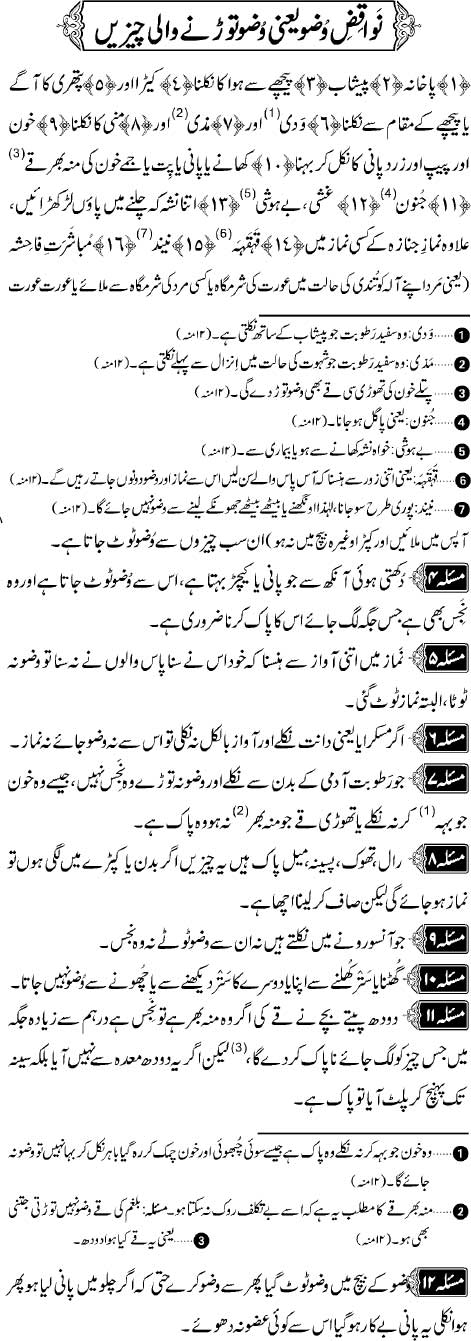
Allah Ki Raza Kay Liay Aik Doosray Say Mohabbat Rakhnay Kay Fazail
When A ChildIs Born, Make Aqiqah
The ahaadeeth about the prescription of the ‘Aqiqah’ are many. From them is that which al-Bukhari reports: that Allah’s Messenger (peace be upon him) said: “With the child, there is ‘Aqiqah’, so spill blood for him and remove the harm from him”.
And from them is the hadeeth of Samurah who said: Allah’s Messenger (peace be upon him) said: “Every child is in pledge (raheenah) for its ‘Aqiqah’ which is sacrificed for it on its seventh day, and it is named on it, and its head is shaved.”
1. When a boy or girl is born, it is preferable to name the child and make Aqiqah on the seventh day. By making Aqiqah, the child is safeguarded from all types of dangers and calamities.
2. The method of Aqiqah is that if a boy is born, two goats or two sheep should be slaughtered. If a girl is born, one goat or one sheep should be slaughtered. Alternatively, if one wishes to take a share in a bull that is being slaughtered for Qurbani, then two shares should be taken for a boy and one share for a girl. Furthermore, the child’s head should be shaved, the hair should be weighed, and gold or silver equal to the weight of the hair should be given to charity. If one wishes, saffron could be applied to the child’s head.
3. If one does not make the Aqiqah on the seventh day, one should bear in mind the seventh day (when making the Aqiqah in the future). The method of calculating the seventh day is that the day that the child is born, Aqiqah should be made the following week but one day before that. For example, if the child is born on a Friday, Aqiqah should be made on the following Thursday. If the child was born on a Thursday, Aqiqah should be made on the following Wednesday.
4. The custom of slaughtering the animal at the exact time when the barber places his shaving machine on the child’s head is nothing but a useless custom. According to Shariah, it is permissible to slaughter the animal either before shaving the head or after. It is not good to insist on following customs that have no basis in the Shariah.
5. The animal that cannot be used for Qurbani cannot be used for Aqiqah as well. If an animal is permissible for Qurbani, it will be permissible for Aqiqah as well.
6. The meat of Aqiqah could be distributed raw or cooked, or it could be prepared as a meal and people could be invited to join in the meal.
7. It is permissible for the parents, grandparents, etc. to consume the meat of Aqiqah.
8. A person does not have sufficient wealth. He, therefore, makes Aqiqah of only one animal on behalf of his son. There is no harm in doing so. If a person does not make Aqiqah at all, there is no harm in this as well.
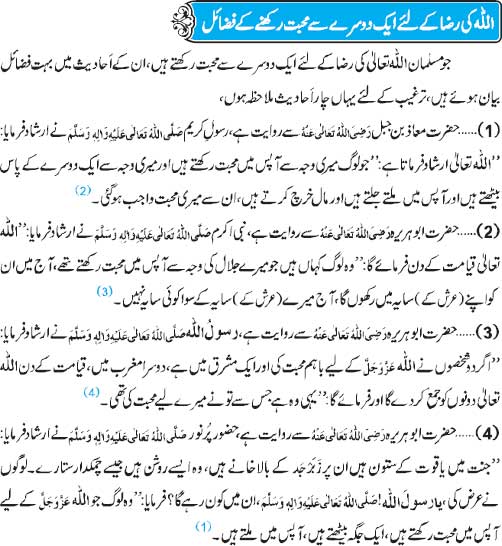
Yateemon Ki Nighadasht
Road To Makkah: The Way To Allah
THE intention of performing Hajj has fixed times, namely within the months of Shawwal and Dhu’l-Qadah and the first days of Dhu’l-Hijjah; a Muslim cannot intend to perform Hajj except within these appointed times. There are also fixed places for intending Hajj (dependent on the pilgrim’s residence), which a pilgrim cannot pass without being in the state of Ihram.
At these places (miqat) the pilgrims perform ritual purification, pray two rak’ahs, make the intention of Hajj or Umrah, and raise their voices while chanting the Talbiyah. After that, the pilgrims have to avoid all the acts that harm their Hajj, such as wearing sewn clothes [this for men only], wearing perfume, shaving the head or cutting the hair, trimming the nails, killing game, cutting down trees, etc.
Just like pilgrims who begin their journey to Makkah in Ihram, Muslims can begin their way to Allah by sincere repentance, as Almighty Allah generally commands when He says: “… And all of you beg Allah to forgive you all, O believers, that you may be successful.” (24:31)
True repentance is represented in quitting sins, regretting them, resolving never to commit them again, and following the righteous way steadfastly. Repentance is not true if there is the intention to return to the concerned sin, for mere quitting does not mean sincere repentance.
For example, a person may quit a sin for some other reasons, such as giving up a sin for being unable to commit it or quitting drinking due to its physical harm while still being attached to it. This is not regarded as repentance, for repentance is a spiritual act followed by physical submission, seeking the pleasure and forgiveness of Almighty Allah.
To blot out any trace of sin through repentance, Muslims should observe piety and deeds of righteousness, for good deeds annul evil ones, as Almighty Allah says: And perform As-Salat (Iqamat-as-Salat) at the two ends of the day and in some hours of the night [i.e. the five compulsory prayers]. Verily! the good deeds remove the evil deeds. This is a reminder (advice) for the mindful (those who accept advice). (11:114)
Another condition for repentance is that if the concerned person owes people any rights unjustly taken away, he or she should return them or seek their forgiveness. The Messenger of Allah (peace be upon him) once asked his Companions, “Do you know who the insolvent is?” They replied, “An insolvent man among us is one who has neither dirham with him nor wealth.” The Prophet said, “The insolvent of my Ummah would be the one who would come on the Day of Judgment with prayers and fasts and Zakah but (he would find himself bankrupt on that day as he would have exhausted his funds of virtues since) he hurled abuses upon others, brought calumny against others, unlawfully consumed the wealth of others, shed the blood of others and beat others. Thus, every one of them would be given of his good deeds (that is, his virtues would be credited to the account of those who suffered at his hands). And if his good deeds fall short of clearing the account, then he would be given of their sins and he would be thrown into the Hellfire.”
When Muslims start their journey to Makkah through sincere repentance, they begin spiritually rising from the stage of the evil-commanding soul to that of the self-reproaching soul until finally, they reach the stage of the tranquil (righteous) soul. The evil-commanding soul is accompanied by Satan, who leads it astray, gives it false promises and dreams, blinds it to ugliness, and carries it off to an abyss. However, the self-reproaching soul reproaches one for the negligence of one’s duties toward Allah, pushing one forward to righteousness and obedience and leading one to safety from the Hellfire. As for the tranquil, righteous soul, it is the one that is reassured by wisdom and decrees of Almighty Allah and follows in the footsteps of the prophets and the righteous. Therefore it deserves Almighty Allah’s reassurance when He says : (It will be said to the pious — believers of Islamic Monotheism): O (you) the one in complete rest and satisfaction! Come back to your Lord, – well-pleased (yourself) and well-pleasing (unto Him)! Enter you, then, among My honored slaves, And enter you My Paradise! (89:27-30)
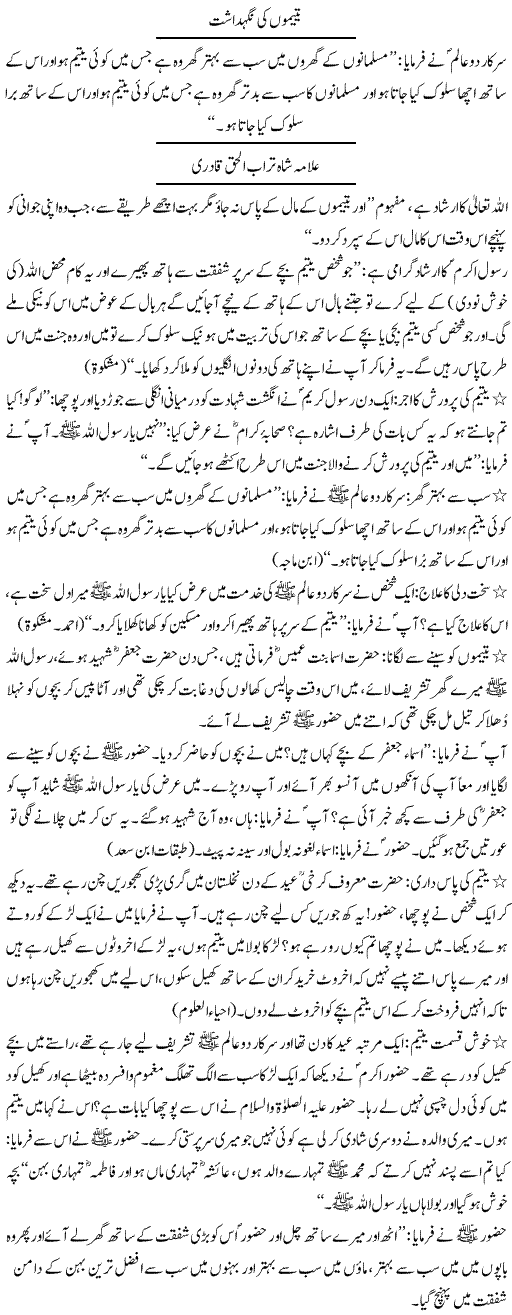
Namaz Kay Faraiz
Allah And Evil
Good and evil are not alien to humankind. Humans are equipped with a sharp vision to separate the former from the latter. More often than not, he strikes the right choice between right and wrong. Even where he fails, he is found to have another good sense. This sense helps him appreciate the correct choice when someone else distinguishes
between good and evil. While he appears to be instinctively inclined to good in order to personify it, he seems to experience strong repulsion to evil – so much so that he wants to eliminate it altogether. His adherence to good makes him feel relieved, contented, and humble. And his submission to evil causes him to feel low, embarrassed, and arrogant. However, perpetual adherence to either virtue or vice determines the course of his life before too
long. Little does he deviate from this course once it is set by his conscious compliance with either of them – he is then destined to reach the destination defined by his own actions.
The Holy Quran says that the Lord has shown him both these ways. In addition to blessing him with eyes, tongue, and lips, he also blessed him with the knowledge of right and wrong (Quran 90:9-10). In more than one place, the Quran reinforces that man knows both ways and it is up to him to choose whatever he may wish; he can either become thankful by taking the correct course of life or be unthankful by treading the path of evil (Quran 76:3). The Lord indeed has inspired him the boundaries to respect and the vices to avoid that lie beyond them (Quran 91:7-8). The assertions of the Quran can hardly be disputed since they depict a phenomenon commonly observed. The
tradition of the majority of humankind seems to be pregnant with narratives of how they have cherished the good virtues and loathed the despicable ways of evil. The annals of history record the awe-inspiring anecdotes of the sacrifices made for upholding the virtue of justice, and eradicating the evil of oppression. From a simple shoemaker to a grand emperor each has made unforgettable contributions to the preservation of virtues and elimination of
evil. It is therefore highly improbable that we can put down the assertions of the Holy Book regarding the human knowledge of right and wrong.
Despite our instinctive impulses to comply with our knowledge of good and bad, the Holy Quran enjoins us to remind each other of the mutual teaching of Truth. It is true that we have the knowledge; we nonetheless have other frailties that obstruct perpetual adherence to good. The Holy Book recognizes that to have this knowledge does not mean that we have acquired a knack and that we are now preconditioned to do good (Quran 103:3). For if we were
conditioned, there would have been no reward for us in the Hereafter. To confuse knowledge with conditioning is to overlook the central problem in most issues facing humankind on the face of this earth. Unless hypnotized by falsehood, man will carry out good works by his own free desire. To galvanize human desire in the favor of good, one needs to be reminded constantly. It is a duty prescribed for us – to help others and be helped in order to lead a life that is virtuous.
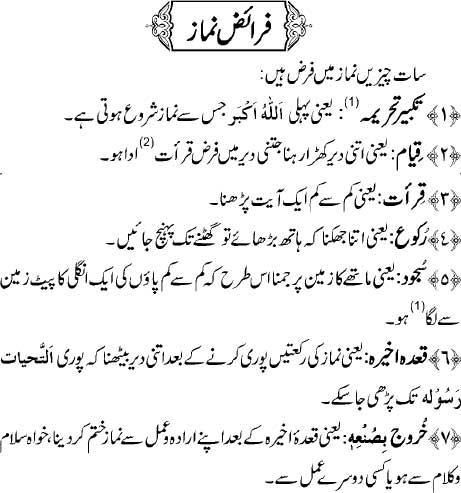
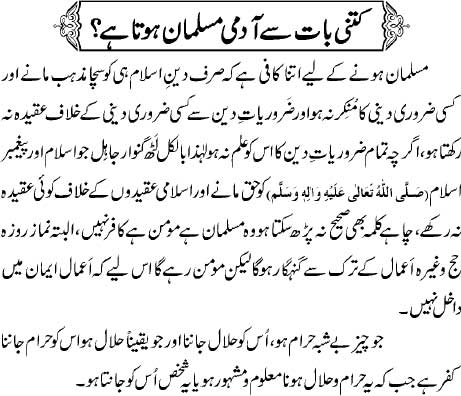
Kitni Baat Say Aadmi Musalman Hota Ha?
Marriage Between The Two Eids
THE Islamic approach is to regulate the satisfaction of the sexual urge in a way that allows it to operate within certain limits, neither suppressing nor giving it free rein. This is the stand of the revealed religions, which have instituted marriage and have prohibited fornication and adultery.
In particular, Islam duly recognizes the role of the sexual drive, facilitates its satisfaction through lawful marriage, and just as it strictly prohibits sex outside of marriage and even what is conducive to it, it also prohibits celibacy and the hatred of women. The claim that marriage between the two Eids, a period of time that extends for about 70 days, is prohibited has no religious backing. What is known in Islam is that there is no religious reservation against marriage in all months and on all days as marriage is best welcomed at all times because it is a religious observance and a Prophetic Sunnah. He who gets married has really completed half of his religion and guarded himself against temptation.
There is nothing in Islam that prohibits performing marriages at any time of the year. The only restrictions pertaining to consummating marriages are during certain times. For instance, it is not allowed to consummate a marriage while fasting, or while one is in a state of consecration or Ihram for performing Haj or Umrah. But as far as solemnizing marriages is concerned, there is no restriction to solemnizing them at any time of the year.
Despite the clear teachings of Islam on this issue, we find a lot of misconceptions prevailing among Muslims today. The source of such misconceptions can be traced to the pagan superstitions about bad omens that were prevalent before Islam. Unfortunately, such superstitions are still widely prevalent today.
However, in Islamic terms, the Prophet (peace be upon him) strongly opposed such superstitions and categorically declared: “There is no bad omen.” He taught us that only Allah has the power to bring benefit or inflict harm. He further encouraged us to have positive thoughts and use all our resources and then put our trust in Allah.