
Functions Of Iblis/ Shaytan
Satan makes them promises and creates in them false desires, but satan’s promises are nothing but deception. [4:120]
The Evil one threatens you with poverty and bids you to conduct unseemly. Allah promises you His forgiveness and bounties. And Allah careth for all and He knoweth all things. [2:268]
The Evil One has got the better of them: so he has made them lose the remembrance of Allah. They are the Party of the Evil One. Truly, it is the Party of the Evil One that will perish! [58:19]
O ye who believe! Intoxicants and gambling, (dedication of) stones, and (divination by) arrows, are an abomination,- of Satan’s handwork: eschew such (abomination), that ye may prosper. [5:90]
Satan’s plan is (but) to excite enmity and hatred between you, with intoxicants and gambling, and hinder you from the remembrance of Allah, and from prayer: will ye not then abstain? [5:91]
Never did We send an apostle or a prophet before thee, but, when he framed a desire, Satan threw some (vanity) into his desire: but Allah will cancel anything (vain) that Satan throws in, and Allah will confirm (and establish) His Signs: for Allah is full of Knowledge and Wisdom: [22:52]
Remember Satan made their (sinful) acts seem alluring to them and said: “No one among men can overcome you this day, while I am near to you”: But when the two forces came in sight of each other, he turned on his heels, and said: “Lo! I am clear of you; lo! I see what ye see not; Lo! I fear Allah. for Allah is strict in punishment.” [8:48]
“Did I not enjoin on you, O ye Children of Adam, that ye should not worship Satan; for that he was to you an enemy avowed?- [36:60]
“He did lead me astray from the Message (of Allah. after it had come to me! Ah! the Evil One is but a traitor to man!” [25:29]
By Allah, We (also) sent (Our apostles) to Peoples before thee; but Satan made, (to the wicked), their own acts seem alluring: He is also their patron today, but they shall have a most grievous penalty. [16:63]
Verily Satan is an enemy to you: so treat him as an enemy. He only invites his adherents, that they may become Companions of the Blazing Fire. [35:6]
O ye Children of Adam! Let not Satan seduce you, in the same manner as He got your parents out of the Garden, stripping them of their raiment, to expose their shame: for he and his tribe watch you from a position where ye cannot see them: We made the evil ones friends (only) to those without faith. [7:27]
O ye who believe! Enter into Islam whole-heartedly, and follow not the footsteps of the evil one; for he is to you an avowed enemy. [2:208]
O ye who believe! follow not Satan’s footsteps: if any will follow the footsteps of Satan, he will (but) command what is shameful and wrong: and were it not for the grace and mercy of Allah on you, not one of you would ever have been pure: but Allah doth purify whom He pleases: and Allah is One Who hears and knows (all things). [24:21]
Say to My servants that they should (only) say those things that are est: for Satan doth sow dissensions among them: For Satan is to man an avowed enemy. [17:53]
Dr.Masood Tariq
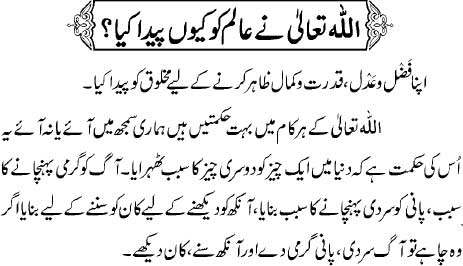
Allah Nay Alam Ko Kyon Peda Kiya
Common Misconceptions About Islam
Perhaps the most common misunderstanding about Islam is its attitude toward women. In light of modern sensibilities, Islam, as practiced by most Muslims, does retain some pre-modern attitudes. Much of this is cultural; however, some are not. For example, although the home is generally considered the best place for a woman, Islam does not prohibit a woman from a career in the outside world. In fact, many early Muslim women including the Prophet’s wife, Khadijah, were scholars and merchants. While Islamic law does legislate some differences between men and women, they are few in number. The majority of practicing Muslim women do not view them as demeaning because a woman is considered equal to a man before God. The Qur’an clearly states, “Whoever works righteousness, man or woman, and has faith, verily to him will We give a new life, and life that is good and pure, and We will bestow on such their reward according to the best of their actions” (Qur’an, p. 663).
Another aspect of Islam that tends to spark interest is the idea of Jihad or holy war. Some people think Islam condones violence and even terrorism. In reality, Islam rarely permits Muslims to use coercive force and does so only for reasons such as self-defense. Moreover, with the exception of self-defense, only legitimate state authority can exercise coercive force. Although there is a religious duty to fight to defend the lands of Islam, strict rules of engagement apply. The Prophet specifically prohibited the killing of religious people, old people, as well as women and children. Later, Muslim legal theorists included any noncombatants in this prohibition. Sadly, like other religions, Islam has violent fanatics and extremists who justify their crimes by distorting Quranic verses and the sayings of the Prophet Muhammad (peace be upon him) for heinous ends.
Muslims are a racially diverse community, the majority of which are non-Arab. Although Islam began in Arabia, Arabs comprise less than 15 percent of Muslims. The largest Muslim population is in Indonesia, and the second-largest is in Pakistan. There are estimated to be over 60 million Muslims in modern China. Islam is considered to be the fastest-growing religion in the twenty-first century. Islam is the third largest religion in the United States and is expected to be the second after Christianity.
Tasbeeh e Fatima

After Death
Once a Muslim dies, the people left behind must prepare the body by washing, perfuming, and shrouding it. The funeral prayer is then performed, and the deceased is buried in a graveyard without a coffin, simply laid in the earth and covered. A person, usually a relative, informs the deceased of what is happening, as Muslims believe that the deceased can hear and understand what is being said. Muslims believe the dead person is not always aware of the transition, and so the one giving instructions informs the deceased that he or she has died, is being laid in the grave, and that two angels known as Munkar and Nakir will soon come into the grave to ask three questions. To the first question, “Who is your Lord?,” the deceased is instructed to reply, “God.” In answer to the second question, “Who is your Prophet?,” the deceased should say, “Muhammad,” and the correct response to the third question, “What is your religion?” is “Islam.” If the individual passes this first phase of the afterlife, the experience of the grave is pleasant, and he or she is given glimpses of the pleasures of paradise. If however, the deceased does not pass this phase, then the grave is the first stage of chastisement.
After this, the soul sleeps and does not awake until a blast from an angel at God’s command. According to Islamic tradition, this blast signals the end of the world and kills any remaining souls on the earth. It is followed by a second blast that causes all of the souls to be resurrected. At this point, humanity is raised up and assembled on a plain. The Qur’an states, “On that day We shall leave them to surge like waves on one another; the trumpet will be blown, and We shall collect them all together” (Qur’an, p. 735). From there, humanity will beg each of the prophets to intercede for them and hasten the Day of Judgment because the waiting is so terrible, but the prophets will refuse.
Finally, all of humanity goes to the Prophet Muhammad. He will agree to intercede for them and ask that the Judgment commence. This intercession is granted to him alone. Then, each soul is judged based upon its beliefs and actions, which are weighed in the scales of divine justice. At this point, the two guardian angels assigned to all people throughout their adult lives will testify for or against them. According to the Qur’an, the limbs of each person will testify, and the earth herself is resurrected and bears witness against those who caused her harm. Next, a person will be given a book either in the right or left hand. For those given a book in the right hand, they pass the Judgment and are given the grace of God. For those given a book in their left hand, they fail the Judgment and are condemned to hell. However, at this point, prophets and other righteous people are allowed to intercede for their relatives, followers, or friends among the condemned, and their intercession is accepted.
Once the Day of Judgment is over, humanity proceeds to a bridge known as the sirat, which crosses over hell. The saved cross it safely to the other side and are greeted by their respective prophets. The Muslims who make it safely across are greeted by Prophet Muhammad (peace be upon him).The condemned fall into hell. The Qur’an states that some will only spend a brief time there, while others, the unrepenting and idolatrous ingrates, are condemned forever. Muslims see death as a transition to the other side. Islam is seen as the vehicle that will take one safely there. It is only in paradise that the believer finds ultimate peace and happiness.
Surah An-Nasr

Death And Its Relevance To Muslims
Death is a question of ultimate concern for every human being, and Islam has a very vivid portrayal of the stages of death and the afterlife. Death is likened to sleep in Islam; interestingly, sleep in Arabic is called “the little brother of death.” The Prophet spoke often of death, and the Qur’an is filled with warnings of the dangers of ignoring one’s mortality and of not preparing for death before it is too late. In one poignant passage, the Qur’an reads,
And spend something (in charity) out of the substance which We have bestowed on you before death should come to any of you and he should say, “O my Lord! Why didst Thou not give me respite for a little while? I should then have given (largely) in charity, and I should have been one of the doers of good.” But to no soul will God grant respite when the time appointed (for it) has come, and God is well-acquainted with (all) that ye do. (Qur’an, pp. 1473–1474)
Hence, the world is seen as an opportunity to cultivate for the hereafter, and time is seen as capital that human beings either invest wisely or squander, only to find themselves bankrupt in the next life. Prophet Muhammad (peace be upon him) said, “One of you says, ‘My wealth! My wealth!’ Indeed, have any of you anything other than your food that you eat and consume, your clothes that you wear out, and your wealth that you give in charity which thus increases in return in the next world?”
The idea of mentioning death and reflecting on death is very important in a Muslim’s daily life, and attending any Muslim’s funeral, whether known or not, is highly encouraged; for such attendance, one is rewarded greatly by God. Prophet Muhammad (peace be upon him) advised, “Make much mention of the destroyer of delights,” which is death. He also said, “Introduce into your gatherings some mention of death to keep things in perspective.” This is not seen as a morbid exercise, and Muslims surprisingly accept death, resigned to what is called “one’s appointed time” (ajal). Like the telemere in biology that dictates how many times a cell may regenerate before dying, an individual’s appointed term, according to Islam, is inescapable and fated. When a Muslim survives a near-death experience, such as a serious car accident, an operation, or an illness, he or she will often remark, “My appointed time did not come yet.”
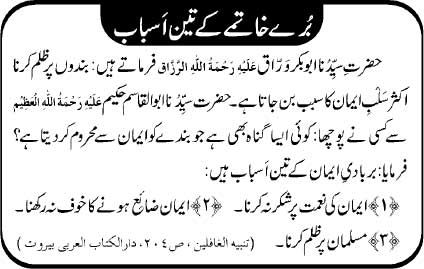
Buray Khatmay kay Asbab
Living And Dying In Islam
The German philosopher Goethe wrote, “If Islam means submission to the will of God, then in Islam we all live and die.” This succinctly summarizes the goal of Muslims: To live and die in accordance with God’s will as revealed in the Qur’an and practiced by the Prophet. Muslims attempt to adjust their view of the world with the lens of the Qur’an. The will of God is expressed in the Qur’an through both expectations and examples. The expectations are usually descriptions of how a believer should live his or her life, and various stories in the Qur’an provide positive and negative examples. The epitome of a positive exemplar is Moses, whose story is dealt with in great detail in the Qur’an. The struggle is at the root of life on earth, a spiritual survival of the fittest. The fittest are those closest to God; they are those who are “steadfast in prayer and spend out of what We have provided for them” (Qur’an 2:3; Ali 1999, p. 17). The negative prototype is embodied in Pharaoh, who elevates himself above God’s law and makes his own law the only source of guidance. Moses is given the Promised Land for his perseverance and steadfastness, and Pharaoh is destroyed by his own hubris and rebellion against the divine will. The story of Moses is an example of submission (Islam), and Pharaoh’s is of rebellion and infidelity (kufr). Between these two lies the struggle of humanity.
Life is meant to be an arena whereby one struggles with good and evil. The Qur’an teaches that good and evil exist in the heart of every individual as well as in society. The individual struggle is to act righteously in accordance with the Qur’an and prophetic example and to shun one’s own evil and its impulses. The collective struggle is to work with others to make the world a more righteous place. In Arabic, this inward and outward struggle is called jihad. While it can mean a militant struggle against those who attack the Muslim lands, it also signifies a person’s struggle with the lower tendencies of the soul, the gravitational pull of self-destructive forces that lead to alienation from God and a state of spiritual disequilibrium. Because humans inevitably fall short morally and succumb to these destructive tendencies from time to time, a means of reestablishing spiritual balance is given, called Tauba or atonement. This is done by experiencing a genuine sense of remorse for one’s transgressions and removal of the unhealthy effects of that state by turning to God and seeking divine grace through prayer, charity, and a sincere resolution not to return to the destructive patterns of the past.
While life is seen as a spiritual test and journey, it is also seen as being filled with blessings from God to be enjoyed: “Eat and drink, but waste not by excess, for God loveth not the wasters. Say: ‘Who hath forbidden the beautiful (gifts) of God which He hath produced for His servants, and the things, clean and pure, (which He hath provided) for sustenance?” (Qur’an, p. 352). Thus, in Islam, marriage is highly recommended and celibacy is frowned upon. The Muslim savants of the past identified sexual relations between a wife and her husband as a foretaste of eternal bliss in the afterlife. The Prophet Muhammad (peace be upon him) encouraged marriage and stated, “There is no monasticism in Islam.” In Islam, children are highly esteemed and seen as one of God’s greatest blessings to humanity. The Prophet stated that humans were born innocent and later corrupted by their societies. Thus, parents are held responsible for maintaining that state of innocence and raising them with a sense of love and awe of the divine. Motherhood is highly regarded in the Qur’an and the prophetic tradition. In most Muslim societies, adult women are still predominantly mothers and housewives during their productive years.