
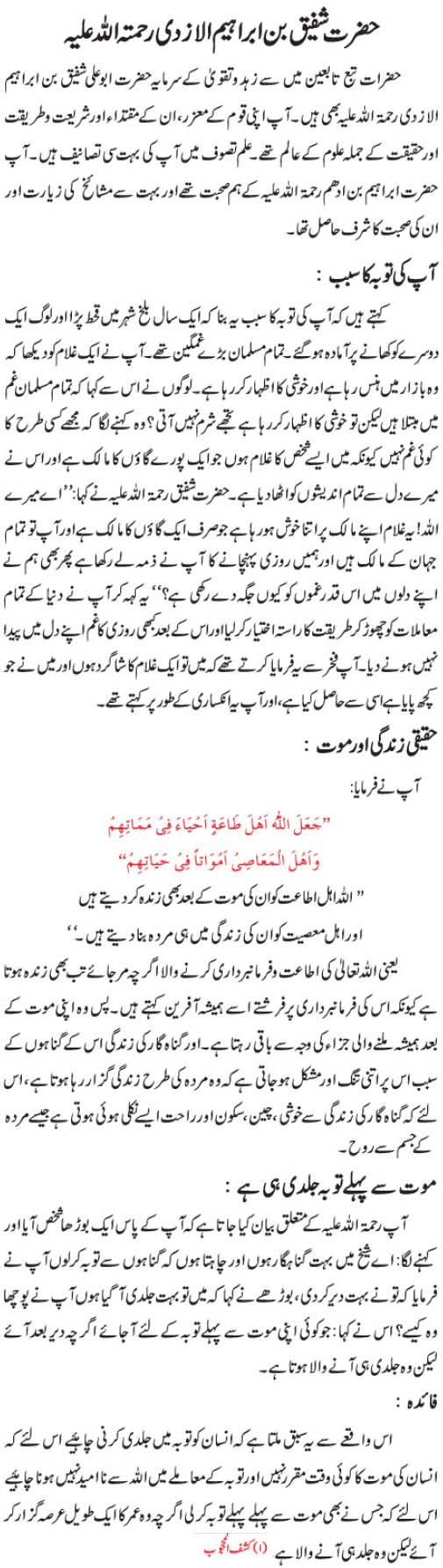
Shafeeq Bin Ibrahim RA
Patience Preserves The Health Of Hearts And Bodies
Ibn al-Qayyim said in The Prophetic medicine regarding patience: Patience is half of faith; for this is a quality composed of patience and gratitude (Shukr).
As one of the ancestors (Salaf) has said: Faith is in two halves: one half patience, one half gratitude.
And the Most High said: “Indeed in that there are signs for each one who is patiently persevering and truly grateful” [Noble Quran 14:5]
Patience in relation to faith is like the head in relation to the body. It is of three types:
1. Patience concerning the obligations (Fard) laid down by Allah, that one should not neglect them;
2. Patience in abstaining from actions forbidden by Him, that one should not commit them;
3. Patience concerning His judgments (Qadr) and decrees (Qadar), that one should not resent them.
Whoever perfectly fulfills these three degrees has perfected patience. For the pleasure of this world and the next, their blessings, and victory and conquest can only be reached over the bridge of patience, just as no one reaches Paradise except by crossing over the Path. ‘Umar b. Al-Khattab said, “We attained the best of life through patience.”
If you reflect on the degrees of perfection acquired in the world, you will see that they are all dependent on patience. And if you reflect on imperfection, which one is blamed for possessing, you will see it all stemming from a lack of patience. Thus, courage and purity, goodness and love of others, all this is the patience of an hour.
Most sicknesses of the body and heart arise simply from lack of patience. And there is naught like patience for preserving the health of hearts, bodies, and spirits. For it is the great remedy, the mighty antidote, even if it were to contain only the company of Allah… “…for Allah is with the patient” [Noble Quran 2:153]
….and His affection for them for indeed…
“Allah loves those who are patient” [Noble Quran 3:146]
….and His giving victory to His people ‘for victory comes with patience’; and that it is a good for the people of patience, “And if you show patience, that is indeed the best course for those who are patient” [Noble Quran 16:126]
….and that it is the cause of prosperity;
“O you who believe! Persevere in patience, vie in perseverance, be ever vigilant, and fear Allah, that perchance you may prosper” [Noble Quran 3:200]
By Ibn Al Qayyim
Peenay Ki Sunnatien
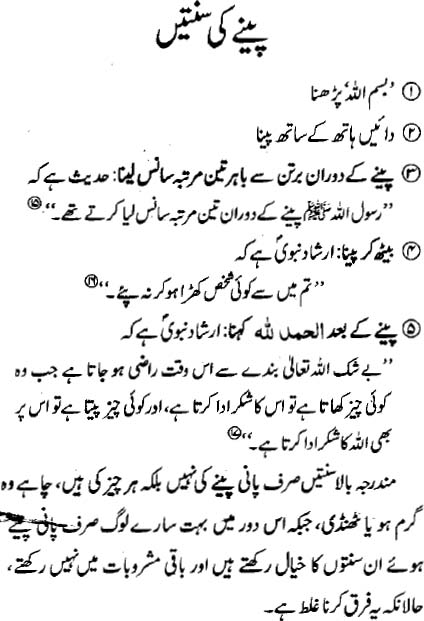
Peenay Ki Sunnatien
The Perfect Investment
We go through our entire lives looking for that perfect investment, whether it be our education, our jobs, or our wealth. We put in so much time to gather information and to make sure that our investment will yield a satisfying return. In the end, though, there is no certainty of the return on investment that we will gain; it could be 5%, 10%, or even -10%. We never know whether we will gain or lose from the investment that we make.
However, there is an alternative. The alternative is investing in the deen of Allah. In this investment, you will never lose, and that is the promise of Allah. As we all know, Allah is the one who never breaks any promise, and He is the One and Only that we can count on. So, when He promises something, you can consider it a done deal.
Who is he that will loan to Allah a beautiful loan, which Allah will double unto his credit and multiply many times? It is Allah that gives (you) want or plenty, and to Him shall be your return. – [Surah Baqarah, 2:245]
Tafsir Ibn Kathir on the above ayah:
Allah said: (Who is he that will lend to Allah a goodly loan so that He may multiply it to him many times)
In this Ayah, Allah encourages His servants to spend in His cause. Allah mentioned this same Ayah in several other parts of His Glorious Qur’an. The Hadith that mentions that Allah descends (every night down on the nearest heaven to us when the last third of the night remains) states that Allah says:
(Who would give a loan to He Who is neither poor nor unjust.)
Allah’s statement: (He may multiply it to him many times), is similar to His statement:
(The likeness of those who spend their wealth in the way of Allah is as the likeness of a grain (of corn); it grows seven ears, and each ear has a hundred grains. Allah gives manifold increase to whom He wills.) (2:261)
We will mention this Ayah later on. Allah then said: (And it is Allah that decreases or increases (your provisions), ) meaning, ‘Spend (in Allah’s cause) and do not be anxious.’ Certainly, Allah is the Sustainer Who increases or decreases the provisions to whomever He wills among His servants. Allah’s wisdom is perfect, and unto Him, you shall return on the Day of Resurrection.
Halki Phulki Shadi Babarkat Hai
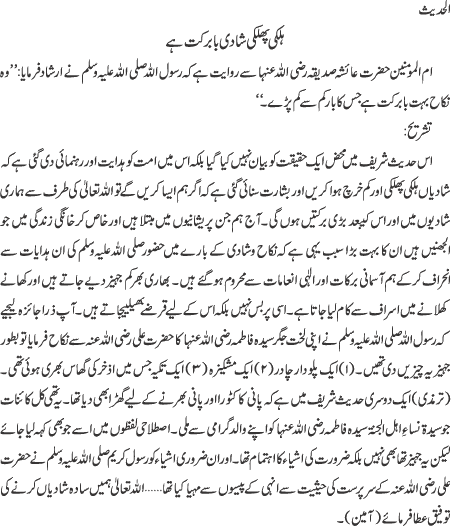
Halki Phulki Shadi Babarkat Hai
Do Not Be The Camel Of The Masjid
In the name of Allah, the Most Merciful, the All-Compassionate
“May the Peace and Blessings of Allah be Upon You”
Praise be to Allah, we seek His help and His forgiveness. We seek refuge with Allah from the evil of our own souls and from our bad deeds.
Whomsoever Allah guides will never be led astray, and whomsoever Allah leaves astray, no one can guide. I bear witness that there is no god but Allah, and I bear witness that Muhammad is His slave and Messenger.
Changing Ground Positions after praying a Fardh prayer to pray a Sunnah Prayer.
You know, sometimes when you are in the Masjid and have just finished praying a Farz Salah, you notice people around you moving to different parts of the Masjid to pray their Sunnah. Have you ever wondered why? Well, the answer is that these people are implementing a forgotten Sunnah, Masha’Allah.
Umar ibn Ata bin Abi Al-Khuwar narrated that Nafi bin Jubair sent him to As-Saib bin Yazid,the maternal nephew of Namir, asking him regarding something Muawiyah had seen him do in the prayer. He said, “I prayed Jumuah with Muawiyah in his enclosure, and when he finished, I stood up in my place and prayed. When he went inside, he sent for me and said,” Do not repeat what you have just done. If you pray Jumuah, do not join it with another prayer until you speak (made duaa) or exit the masjid”.
The Prophet (peace and blessings be upon him) ordered us to separate between prayers. One prayer must not be joined with another until you speak or exit. Collected by Muslim (883)
and Imaam an-Nawawee explains this, saying: “In this hadeeth there is evidence for what the scholars say that It is preferred to pray the optional prayers in another place than where one prayed their obligatory prayer. And the best place for that is the house, but any other place inside the masjid is also valid. “ [Taken from Saheeh Muslim, The book of Jumuah p. 409-410]
Shaikhul Islam Ibn Taymiyyah said: “‘The Sunnah is to separate between performing the obligatory and optional Salat in Jumuah Salat and other Salawaat as was narrated in the “Sahih” that he (sallallahu alayhi wa sallam) prohibited that any [obligatory] Salat be followed immediately by [optional] one; one should separate between them with speech or changing one’s place’”
Taken from: The Clarified Ruling of Mistakes Done in Salat – Mashhoor Hasan Aal Salmaan
Do Not be the Camel of the Masjid
It is detested for any muslim, to the exclusion of the Imam, to stick to one place in the mosque to do the obligatory Salat.
Abdur Rahman Ibn shibl said: Allah’s (SWT) Rasul (pbuh) forbade that a muslim does his Salat so fast like a crow when it eats, spreads his/ her arms [in prostration] as dogs do [when they sit], and sticks to one place in the mosque when doing Salat as camels stick to their resting places. Sahih” (no. 476)
Camels, if left free, will always go and sit in a particular resting place no matter what. Meaning we should avoid praying at one particular place every time we pray.
On the Day of Judgment, the ground will testify that you used it to pray on…the more amount of ground you pray on, the more that the ground will testify and witness your prayers…the higher the chance of getting into higher levels of Jannah.
Adil Khan
Tib-e-Nabvi: Zaitoon Ka Tail

Tib-e-Nabvi: Zaitoon Ka Tail
HIMA Of Allah On Earth Are His Illegal Forbidden Things
Narrated An-Nu’man bin Bashir:- I heard Allah’s Apostle, Muhammad, Peace Be Upon Him, saying:- ‘Both legal and illegal things are evident, but in between them, there are doubtful (suspicious) things, and most people have no knowledge about them. So whoever saves himself from these suspicious things saves his religion and his honor. And whoever indulges in these suspicious things is like a shepherd who grazes (his animals) near the Hima (private pasture) of someone else, and at any moment, he is liable to get in it.
O people! Beware! Every king has a Hima, and the Hima of Allah on the earth is His illegal (forbidden) things.
Beware! There is a piece of flesh in the body. If it becomes good (reformed), the whole body becomes good, but if it gets spoiled, the whole body gets spoiled, and that is the heart. [Source:-‘Bukhari’ Volume 1 Book # 2 Number # 49]
“By time, mankind is in loss, except for those who truly believe (and worship Allah alone), and do righteous deeds, (performing that which is obligatory upon them and avoiding that which they are forbidden), and enjoin one another upon obedience to Allah and enjoin one another with patient perseverance (in facing harm and trials.”) [Source:-Surah al ‘Asr (103)]
Namaz e Tahajjud

Namaz e Tahajjud
18 Sources Of Blessing/ Barakah!
If you ever feel distant from Allah, don’t despair, just put your forehead to the ground and ask the Most Merciful from His bounties.
18 sources of Barakah! If we were to look for an Islamic definition of Productivity, it can probably be summarised in the word “barakah” or Blessing. Being able to achieve more with few resources, doing much in little time, and generating a lot with little effort is surely a blessing from Allah (Subahanahu Wa Ta’ala). Yet Barakah has somehow become a lost treasure these days; everyone’s looking for it, but no one seems to find it! You always hear people complaining that there’s no barakah in their time, no barakah in their sleep, no barakah in their money, and the rest of it. In this article, we’ll solve this mystery inshaAllah: we’ll find out what Barakah is and where you can find it! What is Barakah? A Well-known daee explains it as follows:
“Barakah is the attachment of Divine goodness to a thing, so if it occurs in something little, it increases it. And if it occurs in something much, it benefits. And the greatest fruits of Barakah in all things is to use that barakah in the obedience of Allah (Subahanahu Wa Ta’ala)”
Sources of Barakah
I’m a firm believer that Barakah is not a lost treasure; rather, it’s right in front of our eyes! This treasure is only available and ready to be handed over to the one who works for it. Below, I list some of the sources of Barakah. It’s not an exhaustive list; therefore, I do hope you can contribute to it with your comments inshaAllah so we can all share and extend our understanding of this great treasure.
1. Good Intentions
If you want something to have barakah attached to it, have good intentions for it. More specifically, make sure that the deed is intended for the sake of Allah (Subahanahu Wa Ta’ala). Looking again at the definition of Barakah, you may guess that without us intending what we have or do for the Sake of Allah, the “Divine goodness” won’t be found in our deeds.
2. Piety and Belief in Allah
Allah says in the Quran: “If the people of the towns had but believed and feared Allah, We should indeed have opened out to them (All kinds of) blessings from heaven and earth…”(Surah Al-A’raf, Verse 96). And He says in the Quran: “And for those who fear Allah, He (ever) prepares a way out. And He provides for him from (sources) he never could imagine” (Surah Al-Talaq, Verses 2-3).