

Poisons Of The Heart: Too Much Food
The consumption of small amounts of food guarantees tenderness of the heart, strength of the intellect, humility of the self, weakness of desires, and gentleness of temperament. Immoderate eating brings about the opposite of these praiseworthy qualities.
Al-Miqdam ibn Ma’d Yakrib (ra) said: “I heard the Messenger of Allah (s) say: “The son of Adam fills no vessel more displeasing to Allah than his stomach. A few morsels should be enough for him to preserve his strength. If he must fill it, then he should allow a third for his food, a third for his drink and leave a third empty for easy breathing.”15
Excessive eating induces many kinds of harm. It makes the body inclined towards disobedience to Allah and makes worship and obedience seem laborious-such evils are bad enough in themselves. A full stomach and excessive eating have caused many a wrong action and inhibited much worship. Whoever safeguards against the evils of overfilling his stomach has prevented great evil. It is easier for shaytan to control a person who has filled his stomach with food and drink, which is why it has often been said: “Restrict the pathways of shaytan by fasting.”16
It has been reported that when a group of young men from the Tribe of Israel were worshipping, and it was time for them to break their fast, a man stood up and said: “Do not eat too much, otherwise you will drink too much, and then you will end up sleeping too much, and then you will lose too much.”
The Prophet (s) and his companions, may Allah be pleased with them, used to go hungry quite frequently. Although this was often due to a shortage of food, Allah decreed the best and most favorable conditions for His Messenger, may Allah bless him and grant him peace. This is why Ibn Umar and his father before him-in spite of the abundance of food available to them-modeled their eating habits on those of the Prophet (s). It has been reported that Aisha, may Allah be pleased with her, said: “From the time of their arrival in Madina up until his death (s), the family of Muhammed (s) never ate their fill of bread made from wheat three nights in a row.”17
Ibrahim ibn Adham said: “Anyone who controls his stomach is in control of his deen, and anyone who controls his hunger is in control of good behavior. Disobedience towards Allah is nearest to a person who is satiated with a full stomach, and furthest away from a person who is hungry.”
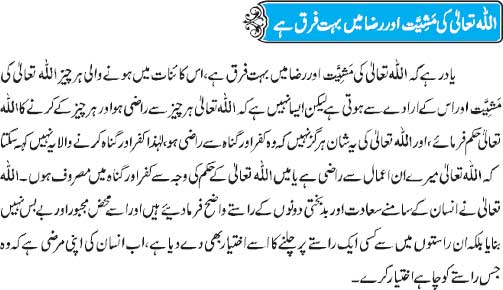
Abu Bakr (RA) Par Allah Ka Dar
Poisons Of The Heart: Unnecessary Talking
“And keep yourself (O Muhammad!) patiently with those who call on their Lord (your companions who remember their Lord with glorification, praising in prayers, etc., and other righteous deeds, etc.) morning and afternoon, seeking His Face, and let not your eyes overlook them, desiring the pomp and glitter the life of the world; and obey not him whose heart We have made heedless of Our Remembrance, one who follows his own lusts and whose affair (deeds) has been lost.” The Holy Quran: 18:28.
You should know that all acts of disobedience are poison to the heart and cause its sickness and ruin. They result in its will running off course, against that of Allah, and so its sickness festers and increases. Ibn al-Mubarak said: I have seen wrong actions killing hearts, And their degradation may lead to their becoming addicted to them. Turning away from wrong actions gives life to the hearts, And opposing yourself is best for it.
Whoever is concerned with the health and life of his heart, must rid it of the effects of such poisons, and then protect it by avoiding new ones. If he takes any by mistake, then he should hasten to wipe out their effect by turning in repentance and seeking forgiveness from Allah, as well as by doing good deeds that will wipe out his wrong actions.
Unnecessary Talking
It is reported in al-Musnad, on the authority of Anas (ra – may Allah be pleased with him), that the Prophet (may the peace & blessings of Allah be upon him) said: “The faith of a servant is not put right until his heart is put right, and his heart is not put right until his tongue is put right.”1 This shows that the Prophet (may the peace & blessings of Allah be upon him) has made the purification of faith conditional on the purification of the heart, and the purification of the heart conditional on the purification of the tongue.
At-Tirmidhi relates in a hadith (sayings or doings of the Prophet Mohammed) on the authority of Ibn Umar (ra): “Do not talk excessively without remembering Allah, because such excessive talk without the mention of Allah causes the heart to harden, and the person furthest from Allah is a person with a hard heart.” 2
Umar Ibn al-Khattab, may Allah be pleased with him, said: “A person who talks too much is a person who often makes mistakes, and someone who often makes mistakes, often has wrong actions. The Fire has a priority over such a freqent sinner.” 3
In a hadith related on the authority of Mu’adh (ra), the Prophet (s) said, “Shall I not tell you how to control all that?” I said, “Yes do, O Messenger of Allah.” So he held his tongue between his fingers, and then he said: “Restrain this.” I said, “Oh Prophet of Allah, are we accountable for what we say?” He (s) said, “May your mother be bereft by your loss! Is there anything more than the harvest of the tongues that throws people on their faces (or he said ‘on their noses) into the Fire?” 4
What is meant here by ‘the harvest of the tongues’ is the punishment for saying forbidden things. A man, through his actions and words, sows the seeds of either good or evil. On the Day of Resurrection, he harvests their fruits. Those who sow the seeds of good words and deeds harvest honour and blessings; those who sow the seeds of evil words and deeds reap only regret and remorse.
A hadith related by Abu Huraira (ra) says, “What mostly causes people to be sent to the Fire are the two openings: the mouth and the private parts.”5
Abu Huraira (ra) also related that the Messenger of Allah (s) said, “The servant speaks words, the consequences of which he does not realise, and for which he is sent down into the depths of the Fire further than the distance between the east and the west.”6
The same hadith was transmitted by at-Tirmidhi with slight variations: “The servant says something that he thinks is harmless, and for which he will be plunged into the depths of the Fire as far as seventy autumns.”7
Uqba ibn Amir (ra) said: “I said: “O Messenger of Allah, what is our best way of surviving?’ He, may Allah bless him and grant him peace, replied: “Guard your tongue, make your house suffice for sheltering your privacy, and weep for your wrong actions.”8
It has been related to the authority of Sahl ibn Sa’d (ra) that the Prophet (s) said, “Whoever can guarantee what is between his jaws and what is between his legs guarantee him the Garden (Paradise).”9
It has also been related by Abu Huraira, may Allah be pleased with him, that the Prophet, may Allah bless him and grant him peace, said, “Let whoever believes in Allah and the Last Day either speak good or remain silent.”10
Thus talking can either be good, in which case it is commendable, or bad, in which case it is haram (forbidden).
The Prophet (may the peace & blessings of Allah be upon him) said: “Everything the children of Adam say goes against them, except for their enjoining good and forbidding evil, and remembering Allah, Glorius and Might is He.” This was reported by at-Tirmidhi and Ibn Ma’jah on the authority of Umm Habiba (may Allah be pleased with her).11
Umar ibn al-Khattab visited Abu Bakr, may Allah be pleased with them, and found him pulling his tongue with his fingers. Umar said, “Stop! may Allah forgive you!” Abu Bakr replied; “This tongue has brought me to dangerous places.”12
Abdullah ibn Mas’ud (ra) said: “By Allah, besides Whom no god exists, nothing deserves a long prison sentence more than my tongue.” He also used to say: “O tongue, say good and you will profit; desist from saying evil things and you will be safe; otherwise you will find only regret.”
Abu Huraira (ra) reported that Ibn al-Abbas (ra) said: “A person will not feel greater fury or anger for any part of his body on the Day of Judgement more than what he will feel for his tongue unless he only used it for saying or enjoining good.”
Al-Hassan (ra) said: “Whoever does not hold his tongue cannot understand his deen (Religion).”
The least harmful of a tongue’s faults is talking about whatever does not concern it. The following hadith of the Prophet (may the peace & blessings of Allah be upon him) is enough to indicate the harm of this fault: “One of the merits of a person’s Islam is his abandoning what does not concern him.”13
Abu Ubaida (ra) related that al-Hassan said: “One of the signs of Allah’s abandoning a servant is His making him preoccupied with what does not concern him.”
Sahl (ra) said, “Whoever talks about what does not concern him is deprived of truthfulness.”
As we have already mentioned above, this is the least harmful of the tongue’s faults. There are far worse things, like backbiting, gossiping, obscene and misleading talk, two-faced and hypocritical talk, showing off, quarrelling, bickering, singing, lying, mockery, derision and falsehood; and there are many more faults which can affect a servant’s tongue, ruining his heart and causing him to lose both his happiness and pleasure in this life and his success and profit in the next life. Allah is the One to Whom we turn for assistance.
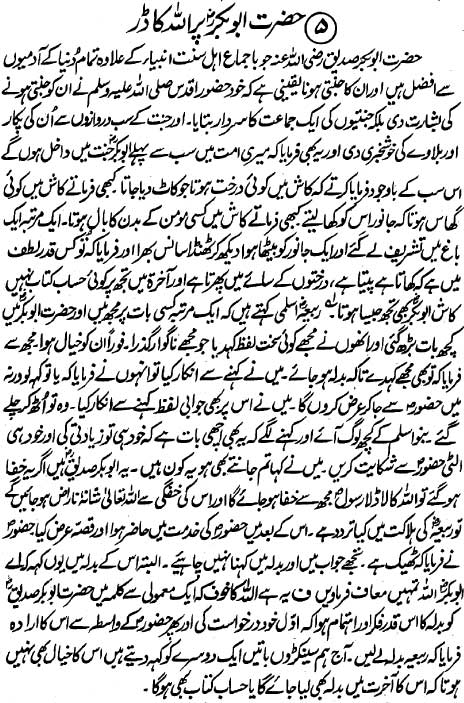
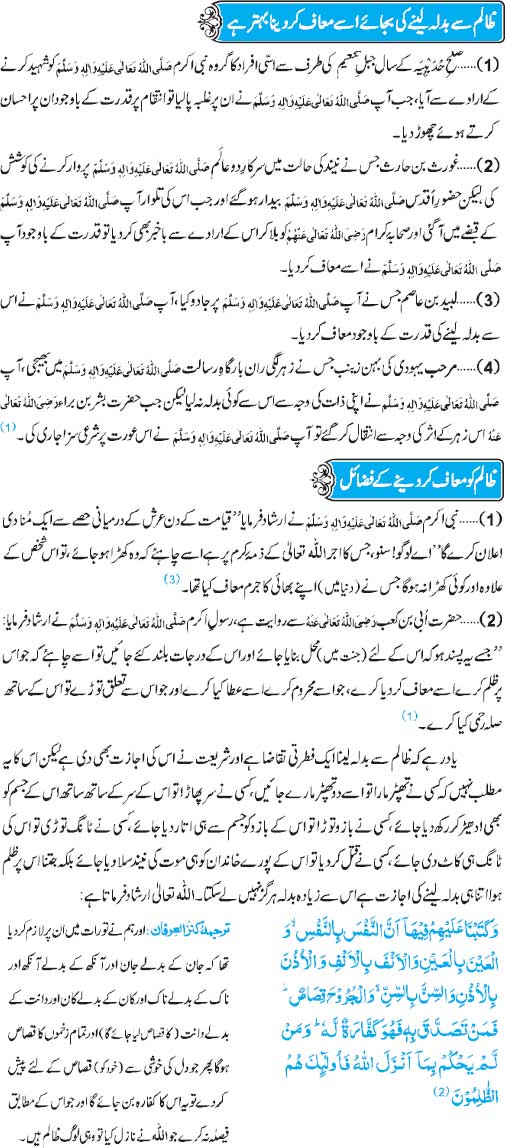
Zalim Ko Maaf Karnay Ki Fazeelat
Teachings Of Islam About The Muslim Character
- Be truthful in everything, don’t lie.
- Be sincere and straightforward, don’t be hypocritical.
- Be honest, don’t be corrupt.
- Be humble, don’t be boastful.
- Be moderate, don’t be excessive.
- Be reserved, don’t be garrulous.
- Be soft-spoken, don’t be loud.
- Be refined and gentle in speech, don’t curse, and use foul language.
- Be loving and solicitous to others, don’t be unmindful of them.
- Be considerate and compassionate, don’t be harsh.
- Be polite and respectful to people, don’t be insulting or disrespectful.
- Be generous and charitable, don’t be selfish and miserly.
- Be good-natured and forgiving, don’t be bitter and resentful.
- Share and be content with what Allah has given you, don’t be greedy.
- Be cheerful and pleasant, don’t be irritable and morose.
- Be chaste and pure, don’t be lustful.
- Be alert and aware of the world around you, don’t be absent-minded.
- Be dignified and decent, don’t be graceless.
- Be optimistic and hopeful, don’t be cynical or pessimistic.
- Be confident and have deep faith, don’t be doubtful and wavering.
- Be spiritually oriented and not materialistic.
- Be confident of the mercy of Allah, don’t be despairing and lose heart.
- Be diligent and vigilant of your duties, don’t be negligent.
- Be thankful to Allah and constantly pray to Him, don’t be forgetful of His innumerable blessings.
Finally as the righteous say, “The love of Allah is the axis around which all good revolves.” If you fall in love with Allah, and then strive to be true in your love–in accordance with the way of the Beloved of Allah (Allah bless him and give him peace), then you’ll find nothing but increasing light and contentment in your life.
And Allah alone gives success.
Mushahidat e Miraj (Hisa Doam)

by Mufti Muneeb Ur Rehman
Having Good Manners, Character And Being Humble
Many of us think that “a perfect Muslim” is simply one who is correct in the observance of the salah (ritual Prayer), the fasting, the zakah (payment of a certain portion of one’s wealth to the poor), and the Hajj (pilgrimage to Makkah). This indeed is not the case.
If the ritual observances do not help the person to be humble, virtuous, and truly God-fearing, then he or she is not a real Muslim. A Muslim should be good and just in dealing with others, no matter their religion, and take special care to keep away from all the shameful and sinful things Allah (God) has forbidden.
One can never get close to Allah by being arrogant, full of pride, and having bad character and manners. Those who have humility and are humble and have good character and manners are the closest to Allah and Allah raises their ranks in the hereafter.
The superiority of good character:
Hadrat Abu Darda, may Allah be pleased with him, relates that the Holy Prophet Muhammad, may the peace and blessings of Allah be upon him, said, “Nothing is heavier in the scales of a believer on the Day of Judgement than his good behaviour. Allah detests a person who is obscene and shameless”. (Tirmidhi)
Having humility and being humble:
The Prophet (PBUH) said: “He who was humble for the sake of God by one degree, God (SWT) would then elevate them to a degree till they reach the uppermost of high Orders, and he who was arrogant to God (SWT), God (SWT) would then lower him for a degree till he reaches the lowest of low Orders”, (Narrated by: Muslim (Hadeeth: 6535).
Al-Nawawi said:
The Prophet (peace and blessings of Allaah be upon him) said: “And no one humbles himself before Allaah but Allaah will raise him (in status).”
Humbleness is to know the value of oneself, to avoid pride, or disregarding the truth and underestimating people. As the Prophet sallallahu `alaihi wa sallam said, according to Muslim and others, “Al-Kibr is rejecting the truth and looking down upon people” [Muslim, Tirmidhi, and Abu Dawud].
Humbleness is for one who is important and significant and he fears to gain notoriety or to become too great among people. Humbleness is that one should humble himself with his companions.
Humbleness is to humble oneself to one who is below you. If you find someone who is younger than you, or of less importance than you, you should not despise him, because he might have a better heart than you, or be less sinful, or closer to Allah than you. Even if you see a sinful person and you are righteous, do not act in arrogance towards him, and thank Allah that He saved you from the tribulation that He put him through. Remember that there might be some riyaa’ or vanity in your righteous deeds that may cause them to be of no avail and that this sinful person may be regretful and fearful concerning his bad deeds, and this may be the cause of the forgiveness of his sins.
Humbleness is that your deed should not become too great in your eyes. If you do a good deed or attempt to get closer to Allah ta`ala through an act of obedience, your deed may still not be accepted, “Allah only accepts from those who have taqwa (fear of Allah).” (Surat al-Maida: 27)
Humbleness is that, when you are advised, if Shaytaan calls you to reject the advice, you must negate him. Because the purpose of advice is that your brother points out the defects that you have.
The arrogant never gives credit to anybody or mentions good about someone, and if he needed to do so, he would also mention five defects of that person. But if he hears somebody reminding him about his own defects, he will not be flexible nor comply due to his inferiority complex. This is why it is among man’s moral integrity to accept criticism or comment without any sensitivity or discomfort or feelings of shame and weakness.
Mushahidat e Miraj (Hisa Awal)

by Mufti Muneeb Ur Rehman
Sincerely Repenting To Allah
Allah says: O son of Adam, if your sins were to reach the clouds of the sky and you would then seek My forgiveness, I would forgive you.
When a person sins and then sincerely turns to Allah for forgiveness, one will find Allah ready to accept his repentance and to forgive him, as this verse indicates:
And whoever does a wrong or wrongs himself, but then seeks forgiveness from Allah, he will find Allah forgiving and merciful. (Surat An-Nisaa 4:110)
Everyone commits sin and does wrong, but Allah is always willing to forgive and He always gives them a chance to repent and seek His forgiveness. A believer should never forget the fact that Allah is so forgiving. If Allah had willed, He could have held everyone accountable for his or her sins, but He has decreed that He shall allow His servants to seek His forgiveness and that He shall in fact forgive who and what He wills. In fact, Allah commands that His servants seek His forgiveness:
And seek Allah’s forgiveness. Certainly, Allah is Forgiving, Merciful.
(Surat al-Muzzammil 73:20)
Repentance is an act, which purifies the soul and brings the servant closer to Allah. It puts the heart at rest from guilt. It protects one from falling prey to his desires and lusts and increases his faith.
We must ask ourselves this question: Would we be willing to forgive anyone who hurts us and disobeys us constantly as easily as Allah is Able to forgive? Most probably, the answer would be no. But our Creator is the Most Kind and He is the Most Perfect.
Lo! Allah is a Lord of Kindness to mankind, but most of mankind give not thanks. (Surat al-Baqarah 2:143)
In this Hadithi Qudsi, mankind is encouraged to seek Allah’s forgiveness and repent, but there are five conditions of repentance, which must be met for one’s repentance to be accepted. The first and most important is that the act of repentance be sincerely for Allah alone. Secondly, the person must feel remorse and guilt over his actions so much so that he wished he had never done it in the first place. The third condition is that the person must immediately cease performing the wrong and sinful act. Fourthly, the repentant person must have a firm intention to never commit the sin again. And lastly, the person must repent before it is too late, meaning before death approaches.
However, there is a condition. One must not associate any partners with Allah, which is shirk. And Allah does not forgive shirk and if one dies without believing in Allah alone as one’s Creator, then he will be doomed to the Hellfire for all of eternity. So, Allah emphasizes the importance of calling on Him alone. He has no and needs no partners, associates, wives, children, etc. There is no god, but Allah. None forgives sins except Him, so one who is seeking forgiveness should seek it only from Allah.
Allah’s forgiveness and mercy are far greater and vaster than the sins of the creation. One must always have trust and hope in Allah in both good times and bad times and especially when seeking Allah’s forgiveness. And the believer who calls out to his Lord for forgiveness demonstrates his true weakness and that he is totally dependent on the Creator.
When one confesses his sins to Allah and sincerely repents with hope in Allah’s mercy, the heart should come to peace and the soul should feel rest. When a person has hope, he has no reason to despair because it only leads to destruction. Allah gives hope to all, especially those who despair that there is no reason to despair because Allah is the Most Merciful of all those who show mercy. Allah praises those who repent and turn to Him:
And those who, when they commit a lewd act or wrong themselves with evil, remember Allah and ask forgiveness for their sins, and who forgives sins except Allah? And they do not persist in what (wrong) they were doing while they knew it. For such, the reward is forgiveness from their Lord and Gardens with rivers flowing through, wherein they shall abide forever. How excellent is the reward of the doers (of good)! (Surah Ali Imran 3:135-136)