
The Qur’an And The Science Of Stars
The Qur’an is that miraculous book of Allah that brought humanity from the days of ignorance to the age of rationalism. It is that unique and phenomenal book in the history of mankind that opened doors to every science. Allah said, “We shall show them Our signs in the Universe and in their own selves until it becomes manifest to them this the Qur’an is Truth.” (Qur’an, 41:53)
There have been many contentions and theories on scientific subjects by various people around the world, the Qur’an, however, has definite answers to all. It has been readily proven time and again; that many doctors and scientists have accepted that the Qur’an holds answers to all those questions which have been answered by them, recently, with the help of modern technology. As Allah said, “He has taught man which he knew not.” (Qur’an, 96:5)
Some accepted facts about the sun, the moon, and the stars are as follows:
Allah said, “And He has made the sun and the moon, both constantly pursuing their courses.” (Qur’an, 14:33)
When the sun is wound round and its light is lost. And when the stars fall. (Qur’an, 81:1-2)
Then when the stars lose their lights. (Qur’an, 77:8)
Qur’an has mentioned the two theories of science. First, about the movement of the stars, and the second about the end of solar energy. Under the Ptolemaic system, it was said that sunrises and pierces through the sky and the earth is stable. But, this notion was dropped in the 16th century and the theory of Prussian astronomer Copernicus was accepted, who said that the earth revolves around the sun.
It was only after Galileo, an Italian mathematician, that the true nature of the solar phenomenon was recognized. He invented a telescope and observed the rotation of the sun. Thus, what the Qur’an mentioned in the early 17th century was accepted by people in the seventeenth century. “And the sun runs on its fixed course for a term (appointed). That is the Decree of the All-Mighty, the All-Knowing.” (Qur’an, 36:38)
“And by the planets that move swiftly and hide themselves.” (Qur’an, 81: 16)
Scientists also say that the total life of the sun is 10 to the power 10 years, and it will eventually change into black dwarf stars. The Qur’an also confirms the fact that the sun’s light would disappear. They also admit that the death of the sun would be the end of this world — the Day of Judgment will come.
– by Ahmad Wahaj Siddiqui
Syed-ul-Mursaleen (S.A.W) Kay Mubarak Akhlaq
Muslim College Life: Dating, Drinking and Deen
Freedom. Young people live for the day when they can move out of the house and go to college and finally be free. Freedom from their parents, from restrictions on their lifestyle, from everyone telling them what to do.
This is why in college you find a whole generation that does what they want. Life’s short they say, let’s enjoy ourselves while we can.
So it goes for Muslims. In college, you find the most amazing things, Muslims who don’t pray, Muslims who date, go out to parties, and drink.
Why is this happening?
For one, when students go off to university they finally realize that what they believed in was blind. Religion becomes like a fairytale, when they got old enough, they knew better than to believe in it.
Most have little knowledge about Islam and have maybe memorized the right rituals to get by. Why believe something on faith, they ask. After all, we cannot see heaven or hell. How do we know Islam is right anyway?
Islamic culture to them means marrying someone they never knew. It means arranged marriages and never hanging out or having fun.
For girls Islamic culture has even less to offer. It would mean double standards or having to serve a husband the rest of her life.
The western alternative to this looks a lot more attractive.
In western culture “love and romance” are supposedly everywhere. Everyone is out looking for love freely. Meeting someone, going out, seeking pleasure sounds a lot better.
But what about the downside? For love at first sight, you need to have the right image, the right hair, the right clothes.
Girls have to aspire to be like the latest supermodels, they have to hold back age. Who’s going out with who, what are my friends thinking, what will happen if I don’t get the right girl or guy, what is my girlfriend or boyfriend thinking, all become important.
Frustration, desperation, and unhappiness become the norm.
Imagine all the heartache youth would save if they followed the Islamic alternative.
In true Islam, unlike culture, there is no gameplaying. If two people wish to be involved they are both straight with one another.
Unlike what goes on today amongst some Muslims, they both meet each other and make a contract to marry. Women are treated with respect, there is no sexual bombardment like there is in western society. Sex in western culture is also often seen as a vice or a sin of the flesh. But even in religious Islam, sex is seen as natural. As long as it is in the right circumstances when the two are committed to one another in marriage.
Drinking in college is also the norm, unfortunately. If you don’t drink or party you’re seen as weird. Drinking is cool and a way for people to socialize, meet and have fun. The one who doesn’t is less of a person and ‘misses out’. Drinking and all the harm that comes with it is cut off at the root in Islam. So many problems are avoided, accidents, pregnancy, violence, and even rape for example.
In college and in the world, success in life is not seen in terms of religion. It is seen as what other people think, one’s careers, how much money they make. If you are religious you must have failed at life. But why do we have this separation? and this blindness in religion?
The Quran tells us again and again not to have blind faith, not to follow the religion of our forefathers.
Yet, we as Muslims have stopped thinking. We may think about what our friends or other people will say, but we avoid thinking about the real issues.
We spend so much time on the opposite sex, thinking about careers, money, etc, but we forget to think about death and how much of this we will really be able to take with us?
“Every soul shall have a taste of death and only on the Day of Judgement shall you be paid your full recompense.. .for the life of this world is but goods and chattels of deception”
(Quran 3:185)
Shouldn’t we take the time to contemplate what will happen to us after we hit the grave? After all, what is the point of life if we are not accountable for our actions? If there is no creator, what is the point of being honest or good?
If we really look at our life we see that everything is indefinite, getting a job, even living until tomorrow. In fact, we could die anytime, this is definite, the _only_ dead certain thing in our life.
Most of us believe we can make up for our actions later or we can be religious later.
We are gambling.
The chances of our dying today are little, but the stakes are high. Allah reminds us of the importance of this,
“O you who believe, obey Allah as he should be obeyed, and die not except in a state of Islam”
(Quran3:102)
Each of us needs to decide.
On the Day of Judgement, it will be us alone who will be asked about our actions.
“Verily We have revealed the Book to thee in truth, for (instructing) mankind. He, then that receives guidance benefits his own soul: but he that strays injures his own soul…”
(Quran 39:41)
This is the true definition of freedom. To learn about Islam and the world openly. To contemplate life and death. And after learning the truth, obeying the word of God.
“Those on whom knowledge has been bestowed may learn that the (Quran) is the truth from your Lord and that they believe therein, and their hearts may be made humbly (open) to it…”
(Quran 22:54)
Once students have this rock-solid intellectual belief in Islam, the corruptness and falseness of the people around them are clear. The beauty and wisdom of the Islamic way, the best alternative is clear. What others do is of less importance. If others think they were weird to pray or weird, to be honest, they would still pray and still be honest because they know their deen.
Our Quran’s are left on the top shelves, gathering dust. Sometimes the most it is read is when someone dies. How is this to help, when the guidance comes too late. The Quran is for the living. The path to understanding and following Islam comes from learning first.
How many of us are Muslim, yet have never read the Quran in our native language?
How many of us are Muslim, yet have yet to open a book on hadith or sunnah?
How many of us defend Islam to non-Muslims, but do not follow it ourselves?
May Allah forgive and lead us and all those lost to the straight path.
In Sha Allah.
Ameen.
based on a talk by Abdul Wajid “Born to be Brown”, UK
by Huma Ahmad
Quran Ka Stah Na Choro
The Man Behind The Armor: Salah-ad-Din Al-Ayyubi
He defied the odds in an era of darkness. He set aside the criticism of those who called him crazy for wanting to do the seemingly impossible: uniting the Ummah, standing up to the Crusaders, and returning honor where it belonged. He was respected by both his friends and foes and is perhaps one of the few men whose name evokes feelings of honor and pride in the minds of so many people in every era and place.
He had the Crusaders chasing their tails in the battles of Alexandria, Hittin, Acre, Tyre, Beirut, Nablus, Haifa, Tiberius, Gaza, ‘Asqalan, Jerusalem, and dozens of other cities and towns across Sham and North Africa. He is popularly known as Salah-ad-Din the warrior.
But, who was the man behind the armor? How was he as a person, and as a Muslim? What personality does it take to carry out such heroic feats and achieve such a status?
In Al-Bidayah wan-Nihayah (13/5-6), Ibn Kathir said that at the time of his death, Salah-ad-Din hardly had any money in his possession, and this was because:
“…of the immense amount of gifts and charity and kindness that he used to show the leaders and ministers under his command, and even to his enemies.
“He was very simple in his clothing, food, drink, and transportation. He would only wear cotton, linen, and wool. It is not known that he ever approached anything forbidden or discouraged, especially after Allah blessed him with his kingdom. Rather, his greatest concern and goal was to aid Islam.”
Ibn Kathir continued:
“He was very strict in praying on time in the jama’ah (congregation). It is said that he never missed a single prayer in jama’ah for a great part of his life, even during the illness that killed him. The imam would enter and lead him in prayer, and he would struggle to get up and pray despite his weakness.”
“He loved to hear the recitation of the Qur’an and the reading of hadith and knowledge. He was constant and habitual in listening to ahadith being read to him, to the point that he would hear a section read to him while he was standing between the ranks of soldiers!”
Ibn Kathir also mentioned: “He had a soft heart, and was easily swayed to tears when he would hear ahadith.
“And Salah-ad-Din was from the bravest of people, and the strongest of them in body and heart despite the illnesses and sickness his body suffered from. This was most evident during the Siege of Acre, where despite the massive numbers of the enemy, he only increased in power and bravery.”
He also said:
“He was generous, well-rounded, always laughing and smiling. He would never slack off in any good that he did. He was extremely patient when doing good and worshipping Allah.”
In ‘Siyar A’lam An-Nubala” (15/436), it’s mentioned that Al-Muwaffaq Abdul Latif said:
“I went to Salah-ad-Din while he was in Jerusalem, and I saw a king who filled eyes with amazement and hearts with love, whether they were near or far. The first night I spent with him, I found his gatherings filled with scholars engaged in knowledge. He would listen intently and participate in their discussions. He would learn how to build walls and dig trenches, and he would then do this himself, carrying the rocks on his own shoulders.”
Al-’Imad said in ‘As-Siyar’ (15/440):
“He would only wear what was permissible to wear, such as linen and cotton. His gatherings were free of vain talk, and they were only attended by the most virtuous of people. He loved to hear ahadith being read with their chains of narration. He was forbearing, honest, pious, pure, and trustworthy. He would contain himself and not become angry. He would never turn back someone in need or embarrass someone who spoke in front of him. He was extremely kind and charitable and I never saw him praying except in jama’ah.”
Adh-Dhahabi said about his death: “And I never saw a king whose death people were sad for except him. This is because he was loved by everyone: he was loved by the righteous and the wicked, the Muslim and the Kafir.” This was Salah-ad-Din Al-Ayyubi. This was the man behind the armor. This was his lifestyle and character, and it was nothing other than this that served as the platform for the amazing feats across the lands that we remember him for today.
Such lifestyle and character is something you will find common between all legends of Islam, whether scholars, leaders, or martyrs. You always find them paying great attention to the daily recitation of the Qur’an, studying the Shariah, giving lots of charity, avoiding useless talk, and living simple lives free of luxury and excessive comfort. This is really the way to success. There is no way you can dream of defending Shariah if you don’t even have the willpower to implement it in your daily life.
What is interesting is Salah-ad-Din wasn’t always like this. Adh-Dhahabi mentions in ‘As-Siyar’ (15/434 and 436):
“Since his time as a ruler, he abandoned alcohol and worldly pleasures.”
“He used to drink alcohol, and then repented from it.”
That’s right. Salah-ad-Din Al-Ayyubi – this righteous man who singlehandedly changed the course of history – loved to drink and indulge in worldly pleasures. But he repented and transformed his life. This small fact teaches us a mighty lesson: not everyone is born in a life of righteousness. The great people we love and admire were not born with virtue. It also gives us hope that no matter how insignificant or lost we think we are, we can become someone truly great In Sha Allah.
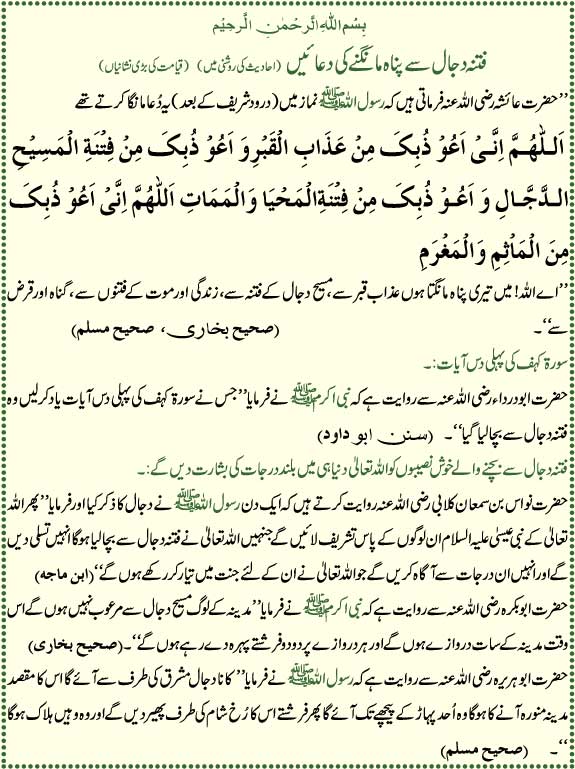
Fitna e Dajjal Say Panah Mangne Ki Duaaien
What Does Istiadhah Mean?
Isti’adhah is to say: A’ooudhu billahi min-ash-shaitaan-ir-rajeem. It means, “I seek refuge with Allah from the cursed Satan.”
Allah’s refuge is sought from Shaitan to prevent him from affecting our religious or worldly affairs or hindering us from adhering to what we are commanded, or luring us into what we are prohibited from. Only Allah is able to prevent the evil of Satan from touching the son of Adam.
Allah allowed us to be lenient and kind with human devils (sinners and wrongdoers among human beings) because soft nature may refrain such sinners from the evil they are indulging in. However, Allah required us to seek refuge from the evil of Satan because Satan neither accepts bribes nor does kindness affect him, for he is pure evil. Thus, only He Who created Satan is able to stop his evil. This meaning is reiterated in only three verses in the Qur’an. Allah said in Surat Al-A`raf:
“Show forgiveness, enjoin what is good, and turn away from the foolish (i.e. don’t punish them).” (Qur’an, 7:199)
This verse is about dealing with human beings. Allah then said in the next verse:
“And if an evil whisper comes to you from Shaytan, then seek refuge with Allah. Verily, He is All-Hearer, All-Knower.” (Qur’an, 7: 200)
Allah also said:
“The good deed and the evil deed cannot be equal. Repel (the evil) with one which is better, then verily he, between whom and you there was enmity, (will become) as though he was a close friend. But none is granted it (the above quality) except those who are patient – and none is granted it except the owner of the great portion (of happiness in the Hereafter, i.e. Paradise and of a high moral character) in this world. And if an evil whisper from Shaytan tries to turn you away (from doing good), then seek refuge in Allah. Verily, He is the All-Hearer, the All-Knower.” (Qur’an, 41:34-36)
– Ibn Kathir’s Tafsir of Surah Fatihah
Bad Aqeedgi
Husband’s Responsibility, Etiquette Towards His Wife
It is certainly not a deficiency, but rather good manners, that the husband shares responsibility in household work like mending garments or what is similar to that. The wife takes care of the household affairs. So, it is from good manners that the husband extends a helping hand to his wife in the house during times of necessity such as when she is sick, pregnant, has given birth, etc. A man should not feel shy in serving himself.
The exemplary husband is he who cooperates with his wife by keeping good relations and showing kind manners (to her). Truly, the husbands who help their wives in their work are the best of mankind in the view of Islam. This good way of living between the spouses must be deeply embedded into the daily marital life, even if the matter were to reach a divorce.
Beware of characterizing the relationship between the spouses with over-seriousness. For indeed characterizing the family life with a militaristic nature amounts to one of the causes for failure and bad results.
Among the kind and noble manners of the husband is that he complies and assents to the requests of his wife, so long as they are not forbidden in the Religion. Extravagance in food, drink, and clothing leads to the door of forbidden things in the Religion.
No human being is perfect. So no doubt the husband will see things in his wife that does not comply with his preferences. If these aspects are not in opposition to the fundaments of the Religion or to the obedience of the husband and his rights, then he should not try to change her personality to make it comply with his preferences.
He must always remember that for each one of the couple, there will be an aspect of one’s personality that conflicts with the other’s personality. The husband should always remember that if he doesn’t like some things in his wife, then indeed she will have other characteristics that are definitely pleasing to him.
Do not look for the errors of your wife and recount them to her, for too much blaming and reprimanding will worsen the relationship between the two of you, and it will pose a threat to your marital life. So overlook each other’s mistakes.
If you are able, do not hold back from providing your wife with good clothing and food, and from being generous in spending money on her. This is of course according to the extent of your ability.
Do not belittle the importance of correcting your wife if she does things that go against Religion. This should be the main, if not the only reason that should cause you to become angry.
The woman is the head of the household, the one responsible for it. So do not attempt to meddle into affairs that do not fall into your area of duties and responsibilities, such as the food and the upkeep of the house.
Beware of scolding your wife in presence of others, even if they are your own children. For indeed that is unsuitable behavior that turns the hearts of people against each other.
Having protective jealousy and caring about the modesty of your wife is a praiseworthy thing, which shows your love for her. However, it is on the condition that you do not go to great lengths in this jealousy. For then at that point, it would turn into something worthy of no praise.
Beware of divulging any secrets connected with the intimate encounters you have with your wife, for that is something restricted and forbidden.
Constantly maintain the cleaning of your mouth and the freshening of your breath.
Guardianship of your wife doesn’t mean that you can exploit what Allah has bestowed upon you from taking charge of her, such that you harm and oppress her.
Showing respect and kindness to your wife’s family is showing respect and kindness to her. And this applies even after her death.
Too much joking will lead to (your family having) little fear (of disobeying you) and a lack of respect for you. So do not joke too much and lose respect.
Fulfilling the conditions that you promised your wife in the marriage contract is very important. So do not neglect that after getting married.
When you advise her or simply talk to her, choose the kindest and nicest of words and expressions. It is not proper for you to ask your wife to look for work outside the house or to spend upon you from her wealth.
Do not overburden your wife with chores that she is not able to handle. Consider, with extreme regard, the environment she was raised up in. Working in a rural atmosphere is not like that in urban places. What a strong woman is prepared for and able to do, cannot be done by a weak woman.