
Healing Belongs to Allah
All praise is due to Allah, Lord of the worlds. May peace and blessings be upon the Messenger of Allah, his household, and companions.
Fellow Muslims! This world is an abode of trials in which no man is safe from an illness that disrupts his life or weakens him. Afflictions are however a blessing; for our, Lord showers mercy through trials and tries some with blessings. The bitterness of this world for the believer is the real sweetness of the Hereafter for him. Many a blessing given to a man has been a source of his illness and many a deprived person has been healed through his depravity. Allah says,
“It may be that you dislike a thing which is good for you and you like a thing which is bad for you. Allah knows but you do not know.” (2:216)
Affliction is a sign of Allah’s love and the way to Paradise. The Prophet, SalAllahu alayhe wa salam, said, “Great reward goes with great affliction, and when Allah loves a people, He tries them. Whoever shows contentedness among them will earn the pleasure of Allah and whoever becomes angry earns the anger of Allah.” (At-Tirmidhî)
Good health is one of the greatest blessings of Allah.
The Prophet, SalAllahu alayhe wa salam, said, “There are two blessings of which many people get deceived: good health and free time.” (Al-Bukhari)
Good health is one of the things that man will be called to account for on the Day of Resurrection. The Messenger of Allah, SalAllahu alayhe wa salam, said, “The first thing that man will be asked of on the Day of Resurrection is, ‘Had I not given you health in your body and quenched your thirst with cold water?’ ” (At-Tirmidhi)
One of the most severe tests is to deprive a man of his health. The best individuals among men have been afflicted with diseases. Ibn Mas’ud entered upon the Messenger of Allah, SalAllahu alayhe wa salam, while he was suffering from an illness, and he said, “O Messenger of Allah, SalAllahu alayhe wa salam, you are seriously suffering from an illness”. The Prophet, SalAllahu alayhe wa salam, said, “Yes, I am suffering from an illness as two men among you would do.” (Al-Bukhaaree and Muslim). Prophet Ayyub was also overwhelmed with disease for years.
Brethren in Faith! Suffering illness exalts one’s degree and erases one’s sins. The Messenger of Allah, SalAllahu alayhe wa salam, said, “No Muslim is afflicted with a disease or other affliction except that his sins are removed from him as leaves fall off a tree.” (Al-Bukharî and Muslim). The sick person will have the reward of what he used to do when he was healthy, written for him in his sickness even if he does not do them. It is during the illness that a believer increases in îman, dependence on Allah, and having a good opinion of Him. It is also the healing for diseases of the heart like arrogance, haughtiness, heedlessness, and self-deception. The guided Muslim learns lessons from trial of his time, for all afflictions that are not in one’s religion is well-being.
The sign of Allah in the creation of man has been known to a lot of doctors. Allah says, “And (there are signs) also in your own selves. Will you not then see?” (51:21)
The greatness of Allah’s creature has astounded the wise men. Allah says, “Verily, We have created man in the best form.” (95:4)
It is the marvelousness of this creation that calls non-Muslims to Islam and that increases the iman of the believer. Let the doctor then take his job as an act of worship by reflecting on the blessings of Allah. Let him be a propagator of this religion by what manifests to him the greatness and perfection of Allah’s creation.
O doctor, be conscious of Allah in all that you say and do. For your word is taken as far as diseases are concerned and your opinion is followed. The sick person is afflicted by Allah for wisdom by which He wants to exalt him and purify him. Do not, therefore, disdain him because of his illness. If a doctor behaves arrogantly with his knowledge, Allah will relegate him. It is wise for him to say about things of which he has no knowledge, “I do not know”. For there are some diseases the cure of which Allah has removed its knowledge. Be gentle with the patient and do not feel inconvenienced by his complaints or rudeness. Give the patient good tiding that he will soon be alright, for Allah loves optimism.
The Muslim doctor should be sincere in his work; for it is by the sincerity that one work is blessed. He should endeavor to know the new things in his profession for the service Islam and Muslims without neglecting any of all that the Shari’ah teaches. He should believe in the existence of magic and its effect. He should not deny the existence of jinn and their mixing with man. He should believe in the existence of evil eye and that if anything could overtake the pre-decree, the evil eye would have done so.
The Muslim doctor is entrusted with the secrets of the patients. Let him protect that and not reveal it and let him treat them with compassion and kindness.
Fellow Muslims! No one cures but Allah and no one removes afflictions but Allah. The medicine and the doctor are the only means by which Allah facilitates the healing. Therefore, make use of the means and use only lawful medications. Do not have total reliance on the doctor for none is capable of causing you any harm or benefit except Allah. Put your trust in Allah and submit your affairs to Him, for He is the One Who brings benefit and causes harm. Know that if the whole of the nation is to be gathered in order to benefit or harm you, they cannot do any benefit or harm to you except only by that which Allah has decreed for you. The most useful medicine is however total reliance on Allah, taking refuge with Him, and having good opinion of Him.
Seeking medication with the Qur’an and invocations narrated in the Sunnah are the best healing for disease, so is sincere and humble supplication with certainty of faith. Doing a lot of almsgivings is also one of the best medications. There are in this world some certain and divine medications that emanated from the Prophet, SalAllahu alayhe wa salam: Pressed dates of Al-Madeenah. It prevents the effects of poison and magic spell. The Messenger of Allah, SalAllahu alayhe wa salam, said,
“Whoever eats every morning seven ‘ajwah dates, no poison or magic spell will harm such a person.” (Muslim)
Water is also a medication for fever. The Prophet, SalAllahu alayhe wa salam, said, “Fever is of the fragrance of the Fire, so douse it with water.” (Al-Bukharî and Muslim). Also, nothing like honey in meaning has been created for us. Cupping is also one of the best methods of healing. The Messenger of Allah, SalAllahu alayhe wa salam, said, “The best of what you treat yourselves with is cupping”. (Al-Bukhari and Muslim) The black seed is also a cure for all diseases. The Prophet, SalAllahu alayhe wa salam, said, “Make use of the black seed for in it is a cure for all diseases.”
There are however some diseases that cannot be cured except with the Qur’an and the Prophetic invocations. They are used for untying a magic spell and expulsion of evil spirits.
Muslims also possess blessed water that is the noblest of all waters and the highest in esteem. It is Zamzam water that springs from the blessed land in the sacred House of Allah. It is a kind of food and cure. These are the curing prophetic medications from which those who accept them and believe in their curing effects benefit.
Brethren in Faith! A lot of Istighfar (seeking for forgiveness) removes diseases and reduces their effects. Allah says, “Ask forgiveness of your Lord and then repent to Him, He will send you (from the sky) abundant rain and add strength to your strength. So do not turn away as criminals.” (11:52)
Sins close doors of knowledge. Islam has forbidden being in seclusion with a strange woman for the purpose of medical examinations and the like. Muslims should therefore follow the injunction of Islam everywhere. Mingling of male and female workers in medical institutions weakens knowledge and removes the blessing of medication. It is also one of the causes of keeping one away from Allah and from healing. The Messenger of Allah, SalAllahu alayhe wa salam, said, “I have not left after me for men a trial that is greater than women”. Conversely, obeying Allah opens doors of knowledge, spiritual upliftment, and perfection of deeds. The patients, as well as medical personnel, should move closer to Allah for removal of the afflictions; for when the trials become severe, none removes them but Allah. Keeping away from Allah and disobeying Him in times of bliss are among the causes of misery.
Fellow Muslims! Of the firmness and completeness of faith is to persevere and be contented with what has been decreed. Be contented, dear patient, with what Allah has portioned out for you. Have patience of the willing noble servant of Allah, for the end of patience is good. Allah says,
“And if you endure patiently, verily, it is better for the patient ones.” (16:126)
Whoever perseveres and is contented, Allah will keep for him what is greater. Remember also that, what Allah afflicted you with is only to purify and elevate you and that, what Allah endows you with of favors are manifolds of what He takes from you. Showing anguish does not cure the illness but aggravates it. If you are afflicted with disease, praise Allah that you were not afflicted with more than that. Supplicate to your Lord in seclusion and do not forget the remembrance of Allah as a way of thanking Him for His abundant gifts. No situation is uglier than when man repents to Allah in affliction and then becomes a sinner during time of bliss.
When you start recovering from your illness, know the estimation of Allah’s blessing on you, hold on to a good relationship with your Lord and be always conscious of Him in times of bliss; He will know you in your times of hardship.
Make a sincere repentance to Allah and learn lessons from vicissitudes of time. Beware of satanic ways like having a bad opinion of Allah, getting annoyed, and showing anguish, for Allah is always All-Compassionate with His slaves and He is the One that removes calamities and hears the agony of the sorrowful. He says,
“If Allah touches you with harm, none can remove it but He and if He touches you with good, then He is able to do all things.” (6:17)
Fellow Muslims! One of the best ways by which man treats his illness is to search his heart, to reform it, and to strengthen his soul by relying on Allah, seeking refuge with him, humbling himself before Him, giving alms, invoking Allah, returning to Him in repentance, doing good to people, aiding the wronged and relieving the distressed. Ibn al-Qayyim said,
“May Allah have mercy on these medications. Many nations have tried it regardless of their religions and beliefs and found it to be very effective in healing what the doctors could not heal. And we and others have also tried these things on many occasions and found that they achieved what physical medications could not achieve.”
by Imam al-Madîna al-Munawarrah ‘Abdul Muhsin Ibn Muhammad al-Qasim
Ilm Seekhna Hazar Nawafil Say Afzal
When Was The Last Time You Raced With Your Wife?
You might mockingly or disapprovingly smile, yet the question remains, for it bespeaks an invitation to you to follow the Sunnah of the Prophet, sallallaahu alayhi wa sallam, in his kind attitude toward his wives.
If you claim to follow and love the Noble Messenger of Allah, sallallaahu alayhi wa sallam, Sunnah, in keeping a beard, cleaning your teeth with a Siwaak (tooth stick), and shortening your clothes to reach above the ankle, you are likewise required to emulate him in the way he treated his spouses.
Moreover, the leniency, mercy, and patience of the Prophet, sallallaahu alayhi wa sallam, with his wives is not merely his tradition, but an obligation confirmed by many Quranic verses, among which is the one in which Allah The Almighty Says (what means): {And live with them in kindness.} [Quran 4:20]
He (PBUH) said: “He is the best amongst you who is the kindest towards his wives and I am the kindest amongst you towards my wives.”
Thus, racing was a compassionate gesture of the Prophet, sallallaahu alayhi wa sallam, in order to be friendly and open with his wives.
Aaishah [Allah be pleased with her] narrates that as a young and thin girl, she was once accompanying the Prophet, sallallaahu alayhi wa sallam, on one of his journeys. He, sallallaahu alayhi wa sallam asked his Companions to move ahead of them, which they did. He, sallaallahu alayhi wa sallam, then asked to race with her; she did and won.
Sometime later, after she had forgotten about this, she was with the Prophet, sallallaahu alayhi wa sallam, on another of his journeys and he wanted to race her. She wanted to excuse herself, by telling him she could not, since she had gained some weight, but he, sallallaahu alayhi wa sallam, insisted. They raced and this time he (PBUH) won; so the Prophet, sallallaahu alayhi wa sallam, laughed and said; “This [is] for that.”
Some husbands content that they do not race with their wives because they are too busy and have many responsibilities. Our retort is that by no means can they be busier than the Prophet, sallallaahu alayhi wa sallam, who bore the responsibility of conveying the Message of Islam to the entire world.
He also led the army in combat alongside running errands for his family and doing household chores. Nevertheless, all this did not stop him from twice racing with his wife Aaishah[RA].
Other husbands might argue that the streets are not a suitable place for racing; so, they can surely take their wives away from people, on a picnic.
Moreover, competition is not just in running.
One can compete to win in a permissible electronic game or general knowledge quiz, in which one can ask each other questions and keep score.
The third group of husbands believes that such competitions may cause their wives to become too bold and eventually challenge them.
This is not true, because the Prophet, sallallaahu alayhi wa sallam, raced with his wife, so this is an act to be followed, for copying his behavior with his wives can bring nothing but good.
Also, modern research has established that being kind and easygoing with one’s wife makes it easier for her to be mindful of you.
There are lessons to be learned from the aforementioned incident related by Aaishah concerning the Prophet’s, sallallaahu alayhi wa sallam, kindness toward his wives.
1- The Prophet, sallallaahu alayhi wa sallam, was the one to ask for a race both times.
This teaches husbands that they should take the initiative in such competitions. Wives may be too busy with housework or fear rejection or, as is the generally innate nature of women, be too shy to propose such an idea.
However, on their part, they should try to urge their husbands when they see they are free and in a good mood.
2- A husband should not incessantly brag of superiority over his wife.
We notice that the Prophet, sallallaahu alayhi wa sallam, outran Aaishah after she had already outrun him the first time.
3- Alternately, a husband should neither always deliberately lose for the sake of his wife or the competition would be meaningless.
The factor that decided the winner of Aaishah the first time was her youth and fitness, and when she put on some weight, the Prophet, sallallaahu alayhi wa sallam, outran her.
4- A husband should remember that such competitions are just for amiability and fun.
Neither of the spouses should get worked up or a row could ensue and the activity would lose its desired aim. This can be understood from the reaction of the Prophet, sallallaahu alayhi wa sallam, who only cheerfully referred to his win to counter that of Aaishah’s.
Verily in the noble way of the Prophet, sallallaahu alayhi wa sallam is there a recipe for happiness
Rooh
Prophet Muhammad: A Relation With God That Is Based On Love
The problem faced by human beings is that they are required to elevate themselves to the level of the highest society of the angels when they have been created of the clay of the earth. They are not required to be angels; that is beyond them since they are subject to the needs of their bodies. They are required to resist sinking into low depths by looking up to the sublime, to counter forgetfulness by God’s remembrance, and to overcome selfishness by human brotherhood. Having been granted life, they are required to dedicate their lives to God; they must not be preoccupied with their own needs. They should look up to the One who granted them life, directing all their life activity to the fulfillment of what He requires of them.
This needs more explanation. Angels do not eat, and as such, they do not need to grow their food and harvest their plants. Human beings need to do all that, but they become equal to the angels if they would only plant the earth, manage their harvests, and eat their food in God’s name. The time they spend in attending to all these activities is equal to the time the angels spend in glorifying and praising God if they will only reflect on God’s power and how He causes crops to grow and ripen, and appreciate His grace in providing them with sustenance, clothing, and shelter.
God has sent His messengers, from the beginning of human life, to guide people along this way. He has not sent angels as messengers, because angels have nothing to do with the tasks assigned to human beings. Unbelievers wondered at the fact that God has given His message to human messengers to deliver. They said: “Can it be that God has sent a human being as His messenger?” Say, “Had there been angels walking about on earth as their natural abode, We would have sent them an angel messenger from heaven.” Say, “Sufficient is God for a witness between me and you. He is indeed fully aware of His servants, and He sees all things.” (17: 94-96)
Prophet Muhammad (peace be upon him) provided the practical example of how people can live at the same level as the angels engaged in their glorification of God and thanksgiving. He has elevated mankind to a level in which we only see the rows of worshippers who praise and thank God or the ranks of those who dedicate themselves and their property to serving God’s cause. Muhammad certainly molded a human generation who were, in God’s measure, placed at the same level as the angels, because they abandoned all life temptations and followed the Prophet who dedicated his total existence to God, seeking only His pleasure, as the following words imply: “Say: My prayers, my worship, my living, and my dying are for God alone, the Lord of all worlds. He has no partner. Thus have I been commanded, and I shall be the first of those who surrender themselves to Him.” (6: 162-163.)
It is Muhammad’s clear knowledge of God, his continuous remembrance of Him, and His great share of the perfection that emanates from His attributes that mold his emotional and intellectual life. God has created man, giving him his form and qualities. He appointed him as His vicegerent on earth. He empowered him and assigned to him the task of exploiting the riches of the earth to build a life on it. He wants him to respect his own divine origin by not sinking into low desires. Man must be knowledgeable, noble, able, generous, compassionate, kind, and willing to give. He must fashion his life in line with the perfect qualities which God’s own attributes symbolize.
The world has never known, and will never know, a man who kept contemplating the sublime as Muhammad did. He walked on earth, but his heart was always looking up to heaven. He provided the model of perfect human life, both within himself as an individual and with his companions as a society. We see in his rational and emotional heritage all the elements man needs to fulfill the mission assigned to him in this life.
Consider the flow of powerful emotion in this heartfelt supplication the Prophet often said after obligatory prayers: “My Lord! You are our Lord and the Lord of all that exists. I bear witness that You alone are the Lord of all, without partners. My Lord! You are our Lord and the Lord of all that exists. I bear witness that Muhammad is Your servant and messenger. My Lord! You are our Lord and the Lord of all that exists. I bear witness that all mankind are brethren. My Lord! You are our Lord and the Lord of all that exists. Make me and my household sincere in our worship at every moment in this life and the life to come. You, the Lord of Supreme Majesty and unparalleled benevolence, answer our prayers. You, the Lord Supreme, Supreme! You are the light of the heavens and the earth. You, the Lord Supreme, Supreme! You are sufficient for me and I rely on You, the Lord Supreme, Supreme.”
When he feels that language cannot adequately express such a flow of feeling, the Prophet resorts to repeating the same words in order to express his love and veneration of God. It may be a repetition of words, but in effect, it airs a sense of greater love.
We note how Muhammad testifies to his being God’s messenger, and that this testimony comes in between asserting God’s oneness and the brotherhood of mankind. What does Muhammad’s assertion to his Lord that he is His servant and messenger signify? It is a kind of reconfirmation that he is willing to fulfill the task assigned to him and to complete his mission, delivering his message complete and intact to all mankind, regardless of how difficult they render his task by their rejection and false accusations.
– By SHEIKH MUHAMMAD AL-GHAZALI
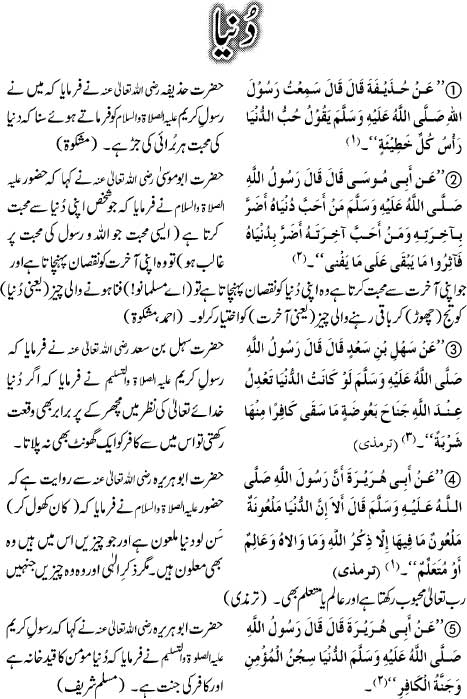
Dunya Parasti Kay Mutaliq Ahkam
Social Relations Between Muslims and Non-Muslims
First of all, it should be stated that Islam does not aim at severing the ties of kinship between its adherents and their non-Muslim relatives. Islam considers these kinds of relationships to be very important, particularly between parents and children. Therefore, it should be clear that Muslims are ordered by Allah to establish good relations with their family, neighbors, and fellow humans, regardless of whether the latter are Muslims or not. So you should never neglect your ties with your parents and relatives.
Muslims are not only encouraged but rather ordered by Allah to establish good relations with their family, neighbors, and fellow humans, regardless of whether the latter are Muslims or not. As a matter of fact, the Qur’an and the Prophetic traditions are replete with orders for Muslims to foster ties of kinship regardless of differences in religion.
Allah says: And your Lord has decreed that you worship none but Him. And that you be dutiful to your parents. If one of them or both of them attain old age in your life, say not to them a word of disrespect, nor shout at them but address them in terms of honor.” (Al-Israa’ 17:23-24)
The Qur’an further teaches us that honoring one’s parents has been an integral part of divine messages to all of God’s prophets and messengers from Adam to Muhammad (peace be upon them) so much so that is the foremost one, second only to worship of the One and only God.
The traditions of the Prophet (peace be upon him) further reinforce the above commandment. The Prophet (peace be upon him) said, “Those who sever ties of kinship cannot hope to enter paradise.” Once a person asked the Prophet (peace be upon him) to guide him to the best of morals, he replied, “Join ties with those who sever ties with you; give to those who deny you, and forgive those who harm you.”
So you should never neglect your ties with your parents and relatives; the fact that you are a Muslim should also enhance rather than diminish your good relations with them. Paying them regular visits and joining them in their family meals are definitely important ways to strengthen your family bond.
Having said this, however, I must also point out that the above must never lead you to compromise your commitment to the dictates of your own faith. You may do well to let them know that you would be honored to join the family at the dinner table, but that you are not allowed to consume alcohol, pork, or their by-products. This will give you an opportunity to educate them on the Islamic dietary laws and their rationale.
Finally, as you have rightly said, your visits to your family can be an excellent opportunity to expose them to the gentle and positive aspects of Islam. It would help you to know that the vast majority of people embraced Islam, coming as they were from extremely diverse religious, ethnic, and racial backgrounds, through their exposure to the beauty of Islam in practical ways. Let us remember the enduring words of the Prophet (peace be upon him), “I have been sent to perfect the highest morals”; and, “I am a gift of mercy (unto the worlds) from Allah.”
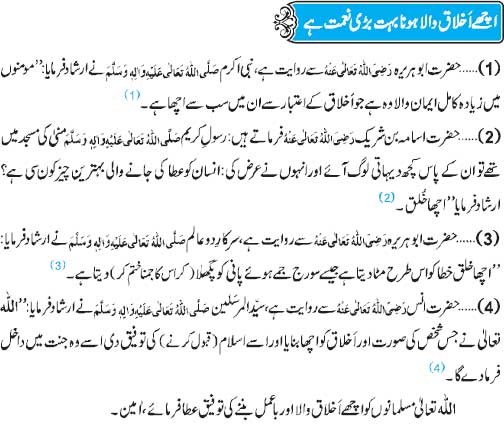
Achay Ikhlaq Wala Hona Bari Naimat Ha
Love, As A Verb
‘Why is it that I don’t feel any love for my grandparents or other close relatives, or for that matter even my spouse?’ If that’s a question that lingers in your mind, you need to look at ‘love’ from a different perspective.
Instead of considering it an emotion (noun), consider it something you gotta do (verb). And look at how your relationships change. So, when you love (as a verb) people who matter, you will serve, sacrifice, and be sincere to them. You’ll develop a sense of selflessness and devotion.
But before we get there, we need to make sure our intentions are right. Read the Qur’anic verses and the statements of the Prophet (peace be upon him) that emphasize the importance of upholding kinship ties. Be encouraged by the abundant reward Allah has promised for those who maintain ties and serve people.
“And worship Allah alone, and do not set-up any partner to Him in worship, and be kind and good to the parents, and to the relatives.” (Qur’an, 4:36)
The Prophet (peace be upon him) said, “The person who severs the bond of kinship will not enter Paradise.” (Al-Bukhari, 8/73, no. 13)
In another narration, the Prophet (peace be upon him) said, “The one who looks after a widow or a poor person is like a Mujahid (warrior) who fights in Allah’s Cause, or like him who performs prayers all the night and fasts all the day.” (Al-Bukhari, 7/64, no. 265)
The Prophet (peace be upon him) said, “Any woman who dies while her husband is pleased with her, she will enter Paradise.” (Al-Tirmidhi)
Al-Aswad Bin Yazid asked Ayesha (may Allah be pleased with her), “What did the Prophet use to do at home?” She said, “He used to work for his family, and when he heard the Adhan, he would go out.” (Al-Bukhari, 7/64, no. 276)
Indeed, the Prophet’s life (peace be upon him) is an example for all people to come. He lived the Qur’an. The Sahabah strove to implement these teachings. Caliph Umar would sweep the floor of the mosque. Abu Bakr would cook and feed the blind old lady. Their lives tell us how they loved their people. They strove in selflessness. The Sahabah gave food to the guests while keeping their own children hungry.
Our world today teaches us to be selfish and materialistic. We hardly tolerate our loved ones, let alone serve them. The pursuit of luxury, wealth, and more wealth has clouded our purpose of life and sense of what happiness is. While career and earning money is required to feed our families, it should by no means become an obsession. Allah says in the Qur’an:
“And I created not the jinn and mankind except that they should worship Me (Alone). I seek not any provision from them nor do I ask that they should feed Me (i.e. feed themselves or My creatures). Verily, Allah is the All-Provider, Owner of Power, the Most Strong.” (Qur’an, 51:56-58)
Our provision has been written down. It is Allah who provides us. Yes, we must seek it, but it’s Allah who provides. Knowing this should free up our mind so we could focus on the thing that matters, i.e. the purpose of life, the worship of Allah.
As Muslims, we submit to our Creator. We seek His Pleasure in what we do and we follow His Guidance. It is only that life that brings true joy to the heart and fills us with contentment, as opposed to a life of greed and dissatisfaction.
So, love with all passion and selflessness, but only and only for the sake of Allah. It is only then that you’ll taste the sweetness of that missing feeling.
The Prophet (peace be upon him) said, “Whoever possesses the following three qualities will have the sweetness (delight) of faith: 1. The one to whom Allah and His Apostle become dearer than anything else; 2. Who loves a person and he loves him only for Allah’s sake; 3. Who hates to revert to (disbelief) as he hates to be thrown into the fire.” (Al-Bukhari, 1/2, no. 15)
– by Faraz Omar