

I’ll Never Beat A Slave Again
Let’s listen to this story narrated by Abu Mas’ood Al-Badri, a Companion of Prophet Muhammad (peace be upon him): I was beating a slave of mine with a whip, then I heard a voice behind me saying, “Remember, Abu Mas’ood!” I did not recognize the voice because I was so angry, but when he drew close to me I saw that it was the Messenger of Allah (peace be upon him), and he was saying, “Remember, Abu Mas’ood; remember, Abu Mas’ood!” I threw the whip aside and he said, “Remember, Abu Mas’ood, that Allah has more power over you than you have over this slave.”
I said, “I will never beat another slave again.” And saying this, he set the slave free for the sake of Allah. At this, the Prophet (peace be upon him) said, “If you had not done so, you would have been touched by the Fire.” (Sahih Muslim)
My eyes were pricked with tears when I read this Hadith. No less marvelous than the soft, yet effective admonition of the Prophet (peace be upon him) is the soft-heartedness and sincerity of the Companion. Subhan Allah! He narrated this incident in spite of the fact that it showed him in a bad light so that future generations would record the teachings of the Prophet (peace be upon him), learn from his mistake, and remember to be mindful of their Lord in similar situations.
Yet, little do we remember!
Horrific incidents of the physical abuse of maids surface with depressing regularity in national newspapers and are featured in the international media, evoking widespread outrage and dismay, and in certain cases, play right into the hands of biased media outlets trying to tar Islam and Muslims with the brush of ‘barbarism’.
The fact is, the Prophet (peace be upon him) not only taught us to honor the rights of servants through the verses of the Qur’an and his personal actions and words during his lifetime, he strenuously urged Muslims to do so even with his last breath! He emphasized the kind treatment of servants to such an extent that it is reported by Ali (may Allah be pleased with him) that the last words spoken by the Prophet at the time of his death were, “The prayer! The prayer! Fear Allah concerning your slaves and servants!” (Al-Adab Al-Mufrad Al-Bukhari)
The early Muslims took these words to heart and followed them to a T. Thus, we have records like that of Al-Ma’roor Bin Suwayd, who said, “I saw Abu Dharr (may Allah be pleased with him) wearing a hullah (a suit of two garments) and his slave was wearing something similar. I asked him about that and he said that he had insulted a man in the time of the Messenger of Allah (peace be upon him) by saying disparaging words about his mother. The man went to the Prophet (peace be upon him) and told him about that, and the Prophet (peace be upon him) said, “You are a man who still has something of Jahiliyyah (pre-Islamic period of Ignorance) in you. They are your brothers and servants whom Allah has placed under your authority. Anyone who has his brother under his authority, let him feed him the same food as he eats and dresses him in the same clothes as he wears, do not overwhelm them with work and if you give them work to do, then help them with it.” (Al-Bukhari and Muslim)
In his exegesis in the book ‘Fath Al-Bari’, Al-Hafiz ibn Hajar said, “This Hadith shows that it is forbidden to insult slaves or speak disparagingly of those who bore them. We are enjoined to treat them well and be kind to them. Although it speaks of slaves, this includes employees and other workers. It also shows that we should not feel superior to another Muslim or look down on him.”
Yet, little do we remember!
Similarly, the successors of the early Muslims were mindful of these rights. There is an account of the righteous Caliph Umar Bin Abdul Aziz who was attended to by a slave, who fanned him as he slept. After a while, the slave was overcome by sleep and dozed off. When the Caliph awoke and realized that she was sleeping, he took the fan from her hand and fanned her so she would feel cool. When she awoke, she saw that he had the fan and was taken aback and expressed surprise at his action. He said, “You are a human-like me, and the heat affects you just as it affects me.”
Another of the early Muslims once became severely angry with his slave and was about to punish him when the slave said, quoting a verse from the Qur’an: “[Allah has praised] those who repress their anger.” The man said: “I have repressed my anger.” The slave said: “[Allah has praised] those who pardon others.” The man said, “I have pardoned you.” The servant said, “Allah loves those who do Ihsan (excellent deeds).” Thereupon the man said, “You can go now, you are free for the sake of Allah.”
It is a sorry reflection of the state of our faith and the hardness of our hearts that in spite of regularly receiving admonitions in this regard, and even warnings of the awful retribution of neglecting these obligations, we continue unabated. Abu Hurayrah (may Allah be pleased with him) narrated that the Prophet (peace be upon him) said, “Allah says: ‘There are three whose opponent I will be on the Day of Resurrection: a man who makes a promise in My name then breaks his word, a man who sells a free man and consumes his price, and a man who employs another and benefits from him (his labor), then does not give him his wages.’”
(Al-Bukhari)
Yet, little do we remember!
Food and dress similar to what one wears, payment of agreed-upon wages before “the sweat of his efforts dries” , not being taxed with work beyond capacity and most of all – forgiveness and leniency with their mistakes and kind treatment – are the fundamental rights of servants in Islam, enjoined upon the Muslims in numerous well-known narrations of the Prophet.
. “Food and dress are the right of the slave and he should not be assigned to the task which may be beyond his capacity.”
. “They are your brothers (the slaves and servants). Allah has placed them under your authority. So he who has a brother under him should feed him and clothe him as he himself does, and should not take from him any work that is beyond his power. If he does tell him to do such work then he should also join in it – (and help him).”
. “When your slave or servant prepares food for you and lays it for you – while he has suffered the inconvenience of heat and smoke when cooking – you should ask him to sit down and share the meal. If the food is in a small quantity (and cannot suffice) at least give him a morsel or two therefrom (at least a little).”
. Once a person came to the Prophet (peace be upon him) and asked, “O Prophet of Allah! To what extent should we forgive the mistakes and faults of our slaves and servants?” The Prophet (peace be upon him) remained silent whereupon the man repeated this question. The Prophet (peace be upon him) again remained silent and when the man asked for the third time, he replied “Seventy times a day.”
. “Whoever beats a slave or servant unjustly, revenge will be taken from him on the Day of Judgment.”
When we send salutations upon the Prophet (peace be upon him), we testify that he conveyed the message, fulfilled the trust, advised the Ummah (Muslim nation) sincerely, and strove in (the religion of) Allah as much as is due.
Now, the onus is on us to follow suit.
– By Rahla KhanI
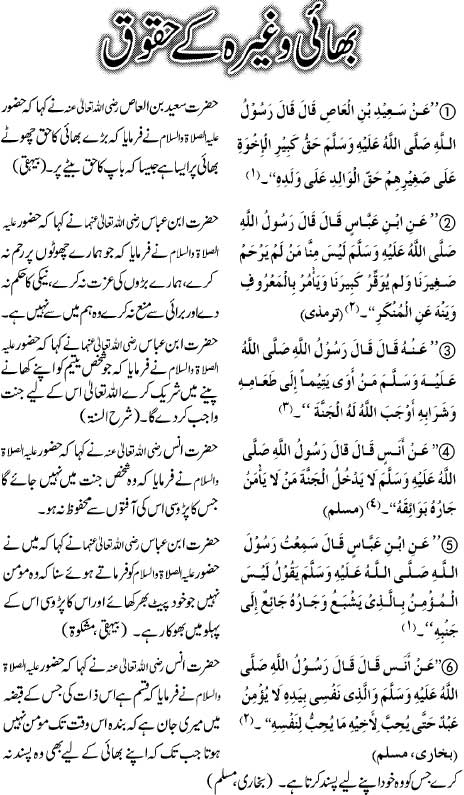
Chori Aur Sharab Noshi

Remember Allah Unceasingly
[ALLAH’S Quran – 33:41 ] “O YOU who have attained to faith! Remember God with unceasing remembrance,”
The Prophet (Peace Be Upon Him) has said:
[Muslim – Book #003, Hadith #0724] “’A’isha said: The Apostle of ALLAH (may peace be upon him) used to remember ALLAH at all moments.”
[Bukhari – Book #76, Hadith #486] “Narrated Abu Huraira: The Prophet said ALLAH will give shade to seven (types of people) under His Shade (on the Day of Resurrection). (one of them will be) a person who remembers ALLAH and his eyes are then flooded with tears.”
[Bukhari – Book #93, Hadith #502] “Narrated Abu Huraira: The Prophet said, “ALLAH says: ‘I am just as My slave thinks I am, (i.e. I am able to do for him what he thinks I can do for him) and I am with him if He remembers Me. If he remembers Me in himself, I too, remember him in Myself; and if he remembers Me in a group of people, I remember him in a group that is better than they; and if he comes one span nearer to Me, I go one cubit nearer to him; and if he comes one cubit nearer to Me, I go a distance of two outstretched arms nearer to him; and if he comes to Me walking, I go to him running.”
[Muslim – Book #035, Hadith #6471] “Abu Huraira reported ALLAH’s Messenger (may peace be upon him) as saying that ALLAH, the Exalted and Glorious, thus stated: I am near to the thought of My servant as he thinks about Me, and I am with him as he remembers Me. And if he remembers Me in his heart, I also remember him in My Heart, and if he remembers Me in the assembly I remember him in assembly, better than his (remembrance), and if he draws near Me by the span of a palm, I draw near him by the cubit, and if he draws near Me by the cubit I draw near him by the space (covered by) two hands. And if he walks towards Me, I rush towards him.”
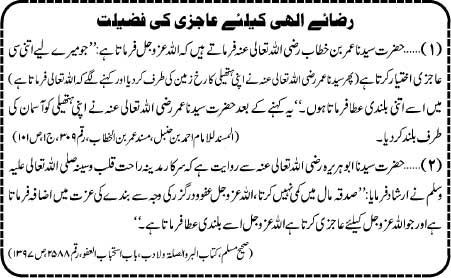
Raza-e-Ilahi Kay Liye Aajzi Ki Fazeelat
Khulu In Islam
Khulu is divorce on the instance of the wife’s request in Islam, who must pay her husband compensation in order for him to accept divorcing her.
If marriage were not based on love, affection, comfort, and agreement between the two spouses, life then would turn into misery rather happiness and comfort. Marriage, in such a case, would no longer be harmony, peace of mind, and comfort, but rather hardship and adversity.
If one of the spouses hated the other or doesn’t trust him, there would be no hope for marriage continuation.
Allah (subhanahu wa taala) states in Quran Sura Nisa (4:19):” On the contrary live with them on a footing of kindness and equity. If ye take a dislike to them it may be that ye dislike a thing, and Allah brings about through it a great deal of good”.
Islam legalized khulu however when life with the other spouse becomes unbearable. Of course, divorce normally is a right to the husband; therefore, he can issue it when he feels fit.
However, if the wife hates the life with her husband and could no longer take it, then, in such a case, she may demand divorce by the process of Khulu, paying the husband compensation for what he had already paid her in order to terminate the marriage.
This is justice in the best form, we believe.
A husband paid the dowry, bore the marriage expenses, and paid other expenses as well.
Allah (subhanahu wa taala) states in Quran Sura Baqarah (2:229):” It is not lawful for you, [men], to take back any of your gifts (from your wives), except when both parties fear that they would be unable to keep the limits ordained by Allah.
If ye [judges] do indeed fear that they would be unable to keep the limits ordained by Allah, there is no blame on either of them if she gives something for her freedom.
These are the limits ordained by Allah; so do not transgress them if any do transgress the limits ordained by Allah, such persons wrong [themselves as well as others]”.
Islam aims at preserving people’s honor and dignity. Islam also aims to protect and secure society by closing all doors for possible social corruption. The presence of a husband with a woman whom he does not like, and vice versa, would very likely lead to suspicious and unlawful relationships.
Therefore, Islam legalized divorce.
The evidence for that from the Sunnah is that the wife of Thaabit ibn Qays ibn Shammaas (may Allah be pleased with him) came to the Prophet (peace and blessings of Allah be upon him) and said, “O Messenger of Allah, I do not find any fault with Thaabit ibn Qays in his character or his religious commitment, but I do not want to commit any act of kufr after becoming a Muslim.”
The Prophet (peace and blessings of Allah be upon him) said to her, “Will you give back his garden?” Because he had given her a garden as her mahr.
She said, “Yes.”
The Prophet (peace and blessings of Allah be upon him) said to Thaabit: “Take back your garden, and divorce her.”
(Narrated by al-Bukhaari, 5273).
Allah (subhanahu wa ta’ala) states in Quran Sura Nisa (4:130):” But if they disagree [and must part], Allah will provide abundance for all from His All-Reaching bounty: for Allah is He that careth for all and is Wise”.
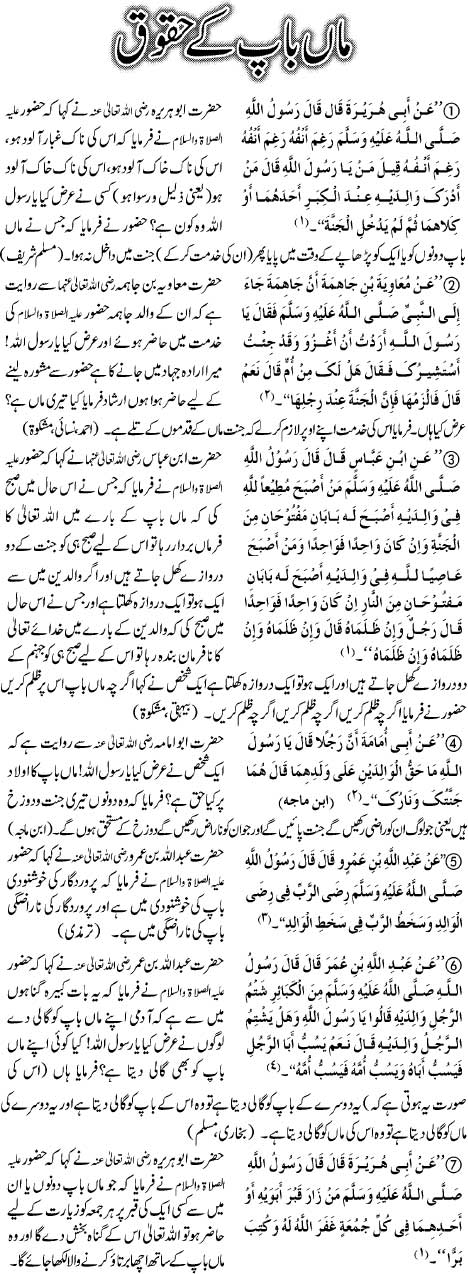
Maa Baap Kay Haqooq
Love For Allah Ta’ala And Rasulullah
1. Hadhrat Anas (radiallahu anhu) narrates that Rasulullah (sallallahu alayhi wasallam) said:
“Whoever has in him three things, will experience the sweetness of Iman.”
(These are):
i) His love for Allah and His Rasool is more than that for all and everything.
ii) His love for another (person) is motivated by only the love of Allah. i.e. His love and friendship with people are not for worldly motives. He befriends people because they happen to be pious men of Allah).
iii) A man who, after having been saved by Allah from kufr, abhors returning to kufr as much as he abhors falling into a fire.” (Bukhari and Muslim)
2. Hadhrat Anas (radiallahu anhu) narrates that Rasulullah (sallallahu alayhi wasallam) said:
“You cannot have total Iman as long as you do not love me more than your father, children and all people.” (Bukhari, Muslim-Mishkaat)
3. Hadhrat Anas (radiallahu anhu) narrates that Rasulullah (sallallahu alayhi wasallam) said:
“A man cannot be perfect of Iman as long as his love for me is not more than his love for his whole family and for all people.” (Muslim)
Also in Bukhari Shareef, it is recorded that Hadhrat Umar (radiallahu anhu) said:
“O Rasulullah! Most assuredly, I love you more than all things, but my own life.”Rasulullah (sallallahu alayhi wasallam) said: ‘I swear by The Being in Whose Power is my life! One is not a perfect believer until one loves me more than one’s own life.” Hadhrat Umar (reflected and) exclaimed: “I now love you more than my own life.”
Rasulullah (sallallahu alayhi wasallam) replied: “Now you are a perfect Muslim.”
Initially, Hadhrat (radiallahu anhu) did not reflect and thought that since one is affected more by difficulty on oneself than difficulty on another, one’s life must be dearer than another’s. However, upon reflection, he realized that for the sake of Rasulullah (sallallahu alayhi wasallam) every Muslim will readily sacrifice his own life and the dignity and honour of Rasulullah (sallallahu alayhi wasallam), even the ordinary Muslim will be prepared to lay down his life at the altar of sacrifice. Hadhrat Umar (radiallahu anhu) thus realized that in actual fact his love for Rasulullah (sallallahu alayhi wasallam) was greater than his love for his own life. And, so it was and remained until the end Hadhrat Umar (radiallahu anhu) remained steadfast on the Deen never turning his face away from the Deen by the slightest degree.
4. Hadhrat Ibn Abbaas (radiallahu anhu) narrates that Rasulullah (sallallahu alayhi wasallam) said:
“Love Allah Ta’ala because He nourishes and sustains you; love me because Allah Ta’ala loves me.” (Tirmizi)
It is not to be inferred from this hadith that we have to love Allah Ta’ala only because He nourishes us. This hadith merely implies that should one be unable to comprehend the limitless and vast favours and bounties of Allah Ta’ala, then at least contemplate and understand this one great Ni’mat of nourishment (Rizq). No one can ever deny or ignore this obvious fact of Allah Ta’ala being the sole Nourisher and Sustainer. Hence, understanding even this single fact will induce one love for Allah Ta’ala.
5. Hadhrat Anas Rasulullah (sallallahu alayhi wasallam) narrates that a villager came to Rasulullah (sallallahu alayhi wasallam) and said:
“O Rasulullah! When will it be Qiyaamah?” Rasulullah (sallallahu alayhi wasallam) said: “What preparations have you made for it?” He replied: “I have no much Salaat nor Saum, but I have love for Allah and His Rasool.” Rasulullah (sallallahu alayhi wasallam) said: “On the Day of Qiyaamah every person will be with the one whom he loved.”
This meant that on the Day of Qiyaamah those who had loved Rasulullah (sallallahu alayhi wasallam) will be with him. Along with this great fortune, they will be in close proximity to Allah Ta’ala. Hadhrat Anas (radiallahu anhu) then commented:
“After having heard this good news, Muslims became exceedingly happy. After having embraced Islam nothing else (besides their embracing) made them as happy (as this statement of Rasulullah (sallallahu alayhi wasallam).” (Bukhari, Muslim)
The glad tidings conveyed in this hadith are of great significance. Even if one has no great stock of acts of Ibaadat, the love of Allah and His Rasool (sallallahu alayhi wasallam) will secure the treasure of Divine Proximity for one in the Aakhirah.
6. Hadhrat Abu Zarr Ghiffaari (radiallahu anhu) narrated that once Rasulullah (sallallahu alayhi wasallam) performed Salaat (Tahajjud). The whole night in his Salaat he recited a single aayat until the morning. The aayat is:
“O Allah! (If you punish them, they are your servants (i.e. You have all the authority over them). If You forgive them (it is within Your Power), for You are All-Powerful and the One of Wisdom.” (Nisaai and Ibn Majah)
Shaikh Dehlwi (rahmatullah alayh) commenting on this hadith, says that the Qur’aanic aayat which was recited the whole night by Rasulullah (sallallahu alayhi wasallam) is the statement of Nabi Isaa (alayhis salaam), which he will be making (on the Day of Qiyaamah) in regard to his Ummah. Rasulullah (sallallahu alayhi wasallam) presented his Ummah’s case for Maghfirat (forgiveness) to Allah Ta’ala in the same manner. This loving attitude of Rasulullah (sallallahu alayhi wasallam) bears testimony to his great love for his Ummah. For the sake of this love, he sacrificed the comfort of whole nights, petitioning and appealing to Allah Ta’ala to forgive his Ummah. It will only be a callous and a heartless one whose heart is not moved when he hears of the great love which Rasulullah (sallallahu alayhi wasallam) had for the Ummah.
7. Hadhrat Abu Hurairah (radiallahu anhu) narrates that Rasulullah (sallallahu alayhi wasallam) said:
“My similitude with you is like a man who strives to prevent moths falling into a fire. The moths plunge into the fire while the man makes great attempts to save them. In spite of his efforts, they continue to fall into the fire. Similarly, I relentlessly grab hold of you and divert you from the Fire (so that you do not plunge into Jahannum by commission of evil), but you continue with your plunge into the Fire.” (Bukhari)
This hadith too indicates the tremendous love and concern which Rasulullah (sallallahu alayhi wasallam) had for his Ummah. His profound concern to save his Ummah from the calamities of the Aakhirah is a manifestation of his love for the Ummah. Which Ummati can ignore this love?
8. Hadhrat Ibn Abbaas Mardas (radiallahu anhu) narrates that Rasulullah (sallallahu alayhi wasallam) made dua of Maghfirat (forgiveness) for his Ummah in the evening of Arafaat. The Divine Answer came: “Your Ummah has been forgiven, excepting huqooqul Ibaad (i.e. the rights of others which were usurped and plundered and for which no proper amends were made).”
Rasullullah (sallallahu alayhi wasallam) then petitioned Allah Ta’ala:
“O, Allah! If You wish, You can award the rights (which were plundered here) of the oppressors with Jannat and forgive the oppressed.”
However, this dua was not accepted on that night. During the morning at Muzdalifah, Rasulullah (sallallahu alayhi wasallam) repeated the dua. On this occasion, the request was granted. The acceptance of this dua induced Rasulullah (sallallahu alayhi wasallam) to laugh with delight Rasulullah (Sallallahu alayhi wasallam) then said to Abu Bakr and Umar (radiallahu anhumaa):
“When Allah Ta’ala accepted my dua and forgave my Ummah, Iblees rubbed hand in his face and cried in despondency and defeat. I laughed on seeing his discomfort.” (Ibn Majah, Baihaqi)
This hadith must not be misconstrued. The inference should not be drawn that usurped, plundered and unfulfilled rights of creation (Huqooqul Ibaad) will compulsorily at all times be waived, without any punishment nor does it mean that the performance of Hajj cancels out such rights. The interpretation of this hadith consists of two possibilities:
1. The possibility of remaining in Jahannum forever as punishment for the usurpation of huqooqul Ibaad.
2. Definite punishment for huqooqul ibaad although such punishment will not be everlasting residence in Jahannum.
When Rasulullah (sallallahu alayhi wasallam) made the due, two Divine Promises were the result:
1. Everlasting residence in Jahannum (the first possibility mentioned above) as compensation for plundering huqooqul ibaad was cancelled. After serving one’s sentence of punishment in Jahannum, one will emerge therefrom and attain salvation.
2. Certainty of punishment for huqooqul ibaad (the second possibility) cancelled. In fact, there will be cases where Allah Ta’ala will by the presentation of favours and ni’mat to the oppressed secure in return forgiveness for the oppressors. The oppressed will become pleased with the bounties and happily pardon the oppressors.
Once again we must reflect and realize the tremendous and deep love which Rasulullah (sallallahu alayhi wasallam) cherished for the Ummah. His concern for the Ummah was so great that he persisted in the supplication to secure forgiveness for even the oppressors of his Ummah. Is it yet possible that the heart of the Believer will not brim over with love for Rasulullah (sallallahu alayhi wasallam)?
9. Hadhrat Abdullah Bin Amr Bin Al-A’as (radiallahu anhu) narrates that once Rasulullah (sallallahu alayhi wasallam), after reciting those verses in which are mentioned the duaa of Hadhrat Ibraheem and Hadhrat Isaa (alahimus salaam) for their respective Ummats, raised his hands and supplicated to Allah Ta’ala as follows:
“O Allah! My Ummah, my Ummah.” Allah Ta’ala said: “Jibraeel, go to Muhammad (sallallahu alayhi wasallam) Your Creator is aware (of all things) and ask him the reason for his grief.”
Jibraeel (alayhis salaam) enquired the reason from Rasulullah (sallallahu alayhi wasallam) for his grief and tears. Rasulullah (sallallahu alayhi wasallam) informed Jibraeel (alayhis sallam) of his concern for the Ummah. Jibraeel (alayhis sallaam) then brought the following message from Allah Ta’ala: “We shall please you in regard to your Ummah and We shall not let you grieve.” (Muslim)
According to Hadhrat Ibn Abbas (radiallahau anhu), Rasulullah (sallallahu alayhi wasallam) said that he will never be happy as long as there remains a single member of his Ummah in the Fire. (Durrul Manthur). In terms of this Divine Promise to Rasulullah (sallallahu alayhi wasallam), Insha’ Allah, Ta’ala will not leave a single Ummati in Jahannum.
O Muslims! The wonderful treasures of the Aakhirah which you will be acquiring will be through the auspicious agency of Rasulullah (sallallahu alayhi wasallam). If, therefore, you cannot love him, for who will you ever love.
10. Hadhrat Umar (radiallahu anhu) narrated that there was a man by the name, Abdullah and was known as Himaar. Rasullullah (sallallahu alayhi wasallam) had punished him for having consumed liquor. After having been punished he was once again brought to Rasulullah (sallallahu alayhi wasallam) for the same crime. Rasulullah (sallallahu alayhi wasallam) ordered him to be punished. Someone cursed him (Himaar) for repeatedly committing the crime. Rasulullah (sallallahu alahi wasallam) commented: “Do not curse him. I swear by Allah that I know he has love for Allah and His Rasool.” (Abdu Dawood)
One can from this incident realize the honour and love which Rasulullah (sallallau alayhi wasallam) had for one who was imbued with love for Allah and love for the Rasool. Even after repeatedly having indulged in a major sin, Rasulullah (sallallahu alayhi wasallam) forbade people from cursing the wrong-doer. It is now necessary that every Muslim fills every vein in his body with the love of Allah and the love of Rasulullah (sallallahu alayhi wasallam). The noble and priceless treasures of the Aakhirah are procurable by virtue of this love without difficulty.
Qurani Ayaat Kay Barey Mein Jhagra

Who Should Have Right To Divorce?
One of the objections raised against the Islamic Law of divorce or Talaq is that in empowering man to divorce, Islam has been harsh and unjust to the woman. While pondering over the issue, three alternative answers come to the query: who should be given the right to divorce? The first option is that both should have this right. The second is that the husband should be so empowered. And the third option could be that the wife should have this right.
In the first instance, if both have the right to divorce, the multiplicity of divorces shall make family life uncertain and insecure. In the case of both exercising this right, there will obviously be a much larger number of “casualties” than with only one armed with this weapon to sever relations.
The second option is that adopted by Islam, which has vested this power in man for the reason that he enjoys a little more dignified position in the family. He is the supervisor of the family, maintainer of the wife and with that bears the heavy burden of children’s upkeep, education, and upbringing.
Therefore, it is he who should decide whether it is possible to bear the burden of these responsibilities in collaboration with the wife or not? In the Qur’anic terminology “in his hands has been placed the power to tie the marriage knot (contract) or untie it.” It would be harsh and unjust to compel him to go on maintaining a woman as the queen of the mini-realm, home, whom he does not like or whose cooperation has been denied to him.
Taking the third option in which the wife will have the right to divorce, it is apparent that in this event the abuse of the right cannot be eliminated. In according the right to the wife, there are some evils associated with it also:
· It would be a grave injustice to man to make him bear all the responsibilities toward the woman (dower, gifts, maintenance, and the like) and to grant the right to divorce to the woman.
· Divorce is damaging to a man entirely, whereas the woman remains immune from any harm. If the right is granted to her, a morally irresponsible wife, whenever she chooses, she shall divorce the husband, and handing over children to him, she will take leave of him with the “booty” of her dower and jewelry and gifts in full triumph, and at the first chance coming her way, she will marry another man getting fresh dower and other privileges.
· It is an obvious fact that woman is much more sentimental than man and can at any time, under the impulse of the moment, sever relations with man. That will go a long way in increasing the rate of divorce under normal conditions, thus confronting society with a new crisis.
The way Islam shapes the mind and temperament of man and educates and trains him, divorce can hardly find room in his life and the lurking fear that merely for sexual enjoyment and gratification of abnormal lust he will go on divorcing women most carelessly is only a remote possibility.
Sayyid Jalaluddin Umri, currently President, India’s Jamaat-e-Islami, is an eminent theologian and scholar of Islamic jurisprudence.