

Who Should Have Right To Divorce?
One of the objections raised against the Islamic Law of divorce or Talaq is that in empowering man to divorce, Islam has been harsh and unjust to the woman. While pondering over the issue, three alternative answers come to the query: who should be given the right to divorce? The first option is that both should have this right. The second is that the husband should be so empowered. And the third option could be that the wife should have this right.
In the first instance, if both have the right to divorce, the multiplicity of divorces shall make family life uncertain and insecure. In the case of both exercising this right, there will obviously be a much larger number of “casualties” than with only one armed with this weapon to sever relations.
The second option is that adopted by Islam, which has vested this power in man for the reason that he enjoys a little more dignified position in the family. He is the supervisor of the family, maintainer of the wife and with that bears the heavy burden of children’s upkeep, education, and upbringing.
Therefore, it is he who should decide whether it is possible to bear the burden of these responsibilities in collaboration with the wife or not? In the Qur’anic terminology “in his hands has been placed the power to tie the marriage knot (contract) or untie it.” It would be harsh and unjust to compel him to go on maintaining a woman as the queen of the mini-realm, home, whom he does not like or whose cooperation has been denied to him.
Taking the third option in which the wife will have the right to divorce, it is apparent that in this event the abuse of the right cannot be eliminated. In according the right to the wife, there are some evils associated with it also:
· It would be a grave injustice to man to make him bear all the responsibilities toward the woman (dower, gifts, maintenance, and the like) and to grant the right to divorce to the woman.
· Divorce is damaging to a man entirely, whereas the woman remains immune from any harm. If the right is granted to her, a morally irresponsible wife, whenever she chooses, she shall divorce the husband, and handing over children to him, she will take leave of him with the “booty” of her dower and jewelry and gifts in full triumph, and at the first chance coming her way, she will marry another man getting fresh dower and other privileges.
· It is an obvious fact that woman is much more sentimental than man and can at any time, under the impulse of the moment, sever relations with man. That will go a long way in increasing the rate of divorce under normal conditions, thus confronting society with a new crisis.
The way Islam shapes the mind and temperament of man and educates and trains him, divorce can hardly find room in his life and the lurking fear that merely for sexual enjoyment and gratification of abnormal lust he will go on divorcing women most carelessly is only a remote possibility.
Sayyid Jalaluddin Umri, currently President, India’s Jamaat-e-Islami, is an eminent theologian and scholar of Islamic jurisprudence.
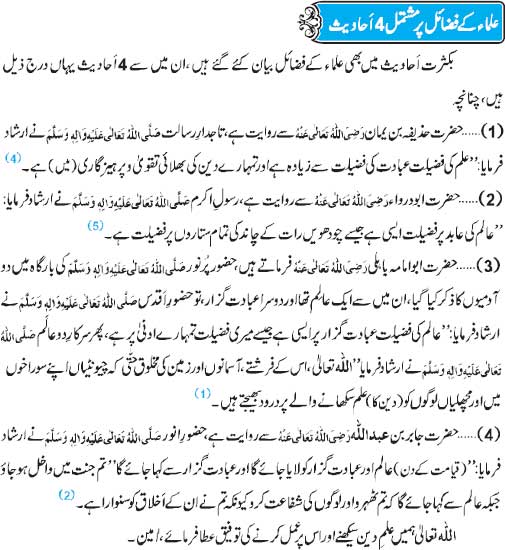
Fazail-E-Ulma
Respecting Parents
A Muslim child should respect and appreciate his or her parents every day throughout the year. Allah asked human beings to recognize their parents after recognition of Allah Himself. Throughout the Qur’an, we notice that parents are mentioned with appreciation and with respect, even if they are senile. In Surah Al-Isra’ (Children of Israel) there is a very beautiful description of how parents are to be treated. Allah (SWT) says:
“Your Lord has decreed that you worship none but Him, and do good to parents. If any one of them or both of them reach old age, do not say to them: uff (a word or expression of anger or contempt) and do not scold them, and address them with respectful words, and submit yourself before them in humility out of compassion, and say, “My Lord, be merciful to them as they have brought me up in my childhood.” [17:23-24]
The recognition and respect of parents is mentioned in the Qur’an eleven times; in every instance, Allah reminds children to recognize and to appreciate the care and love they have received from their parents. In one aspect, Allah demands that children recognize their parents by saying to them:
“We have enjoined on man kindness to parents;” [29:8/46:15]
1. The demand for recognizing parents is made more emphatic when Allah says in the Qur’an Surah Al-Baqarah (The Cow) the following:
“(Remember) when We took a pledge from the children of Isrā’īl (Israel): “You shall not worship anyone other than Allah; and you shall do good to the parents,…” [2:83]
2. In Surah Al-Nisaa’ (The Women) Allah (SWT) emphasized again that children should be kind to their parents.
“And serve Allah. Ascribe nothing as partner unto Him. (Show) Kindness unto parents… ” [4:36]
3. In Surah Al An’Am (The Cattle), Allah (SWT) reemphasized that people should be kind to their parents.
“Say (O Prophet to the infidels), “Come, and I shall recite what your Lord has prohibited for you: Do not associate anything with Him (as His partner); and be good to parents, …” [6:151]
Mothers
Although Islam recognized both parents, mothers are given particular gratitude and respect. This attitude of Islam is understood if we realize the hardships and the suffering that mothers experience in their lives. In this regard, Prophet Muhammad (PBUH) said:
It was narrated by Abu Hurairah (R) that a man came to the Prophet (PBUH) and asked him, ‘Who is to be close to my friendship?’ The Prophet (PBUH) answered:
Your mother, your mother, your mother, then your father, then the one closest to your kinship, and the one after.
Islam has endorsed respect for parents by their children even if the parents are non-Muslims. If parents strive very hard to convert their children to non-Islamic beliefs, they don’t follow them, but they are to be good to them. In this regard, Allah (SWT) says in Surah Luqman:
“We commanded man (to be good) in respect of his parents. His mother carried him (in her womb) despite weakness upon weakness, and his weaning is in two years. (We said to man,) “Be grateful to Me, and to your parents. To Me is the ultimate return. However, if they force you to ascribe partners to Me about whom you (can) have no (source of) knowledge, then do not obey them. Remain with them in this world with due fairness, but follow the way of the one who has turned himself towards Me. Then, towards Me is your return, so I shall tell you what you had been doing.” [31:14-15]
More Respect
Islam teaches us that respect for parents comes immediately after praying to Allah and before Jihad (struggle and striving in the way of Allah). In this respect, the Prophet (PBUH) said the following:
Narrated by Abi Abder Rahman Abdullah bin Massoud (May Allah be pleased with him) saying: I asked the Prophet (PBUH), “Which deed is more liked by Allah?” He replied, “Prayers on time.” Then I asked, “Which one is next?” He said, “Goodness to parents.” Then I asked, “Then which one is next?” He said, “Jihad in the way of Allah.” (Agreed)
In Islam, respect for parents is so great that the child and his wealth are considered to be the property of the parents. In this regard, the Prophet (PBUH) said:
Narrated by Aisha (May Allah be pleased with her) that a person came to the Prophet (PBUH) to resolve his dispute with his father regarding a loan given to the father. The Prophet (PBUH) said to the person,? You and your wealth are to your father.”
Final Remarks
We hope and pray that all of us will respect our parents while they are alive and even after they are dead. You may honor your parents after they died through the following methods:
Make daily Du’a’ for them
Give a charity on their behalf
Institute a perpetual charity on their behalf – such as a Masjid, an Islamic Center, an Islamic library, an Islamic hospital, an orphanage, a senior citizen’s home, etc.
Perform Hajj on their behalf or ask someone to do so.
Read Qur’an on their behalf
Distribute Islamic Literature on their behalf
Let us pray to Allah that we will do our best to respect our parents, honor them, be kind to them, help them, and please them for the love of Allah.
O, Allah! Accept our humble prayers and make us obedient servants to you.
O, Allah! Help us to be respectful children to our parents. Ameen.
Khasais-e-Nabuwat

Significant Role Of Women Companions Of The Prophet
When people became Muslim, they were eager to know more about Islam. During the lifetime of the Prophet (peace be upon him), he was the only source from which they could learn their faith. They realized that by adopting Islam, they committed themselves to a fundamental change in their life pattern and the way they conducted their affairs. Hence, they went to him asking about everything that occurred to them. Men and women sought his guidance. Therefore, it was not uncommon that they should meet and exchange information, or discuss matters. They found nothing wrong with that. Nor did the Prophet at any time point to any need of separation between men and women. We will cite some examples of this, making clear that such exchanges occurred all the time in the early period of Islam. The first is the case of Asma’ bint Umays. She was visiting Lady Hafsah bint Umar, the Prophet’s wife when she had a bit of an argument with Umar about their relative positions. Asma’ had been among those who emigrated to Abyssinia and stayed there for many years until the Prophet instructed them to come back. She was upset by Umar’s remark and she went to seek clarification from the Prophet.
Abu Musa Al-Ashari reports: When the Prophet came in, she said: “God’s Messenger! Umar has just said, ‘We have had the honor of emigrating with the Prophet before you. We have a better claim than yours to the companionship of God’s Messenger (peace be upon him).’ The Prophet asked her, ‘What was your reply to him?’ She reported her answer in the following words: ‘No, by God. You were with God’s Messenger (peace be upon him) who fed those of you who were hungry and admonished the ignorant, while we were in the land of hostile strangers, staying there only for the sake of God and His Messenger… We were often abused and we were scared.’ The Prophet said: ‘He does not have a better claim to me than you. He and his fellow Muslims have the reward of one emigration, while you, the people of the boat, shall have the reward of two emigrations.’ Asma’ added: ‘Abu Musa and the people who came on the boat from Abyssinia came in groups to see Asma’ and ask her about this Hadith. Nothing in this world gave them more joy and greater happiness than what God’s Messenger said to her.'” (Related by Al-Bukhari and Muslim.)
Amir Al-Shaabi was a famous scholar of the Tabieen generation, which followed that of the Prophet’s companions. He said to Fatimah bint Qays, who was one of the early Muslim women to emigrate: “Tell me a Hadith which you yourself had heard from the Prophet, not reporting it through anyone else.” She said that she could easily do that if she had a mind to it. He insisted and she reported to him the following Hadith: “I heard the caller announcing prayer to be held shortly (which meant that a public meeting would be held). I went out to the mosque and joined the Prophet’s prayer. I was in the women’s row that was immediately behind the men’s rows. When the Prophet finished the prayer, he sat on the pulpit smiling. He said: ‘Let everyone stay where they are. Do you know why I have asked you to come?’ They said: ‘God and His messenger know best.’ He said: ‘I have not asked you to come in order to announce anything pleasant or unpleasant. I only want to tell you that Tameem Al-Dari was a Christian man who came forward and declared himself a Muslim, pledging his loyalty to me. He told me something that was in agreement with what I had told you about the Impostor who would claim to be the Messiah. He said to me that he went on a boat in the sea with thirty people…'” (Related by Muslim.)
The Hadith goes on to report what the Prophet said, but we are now interested only in this first part which makes clear that men and women were equal in seeking knowledge and that they met as they pursued what they wanted. Here Fatimah mentions that she was in the first of women’s rows and listened to the Prophet as he gave them this information.
In fact, the Prophet’s companions did not find it odd that they should seek knowledge from the opposite sex. Tawoos, a famous scholar of the Tabieen generation, reports: “I was with Ibn Abbas when Zayd ibn Thabit said to him: ‘Did you rule that a woman pilgrim who is in her period could leave before she had performed the tawaf of farewell?’ Ibn Abbas said: ‘If you are unsure, then go and ask this Ansari woman (he named her) whether it was God’s messenger who ordered her to do so.’ When Zayd ibn Thabit came back to meet Ibn Abbas he said to him: ‘I see that you have said the truth.'” (Related by Muslim.)
This is just one example of men seeking to learn from women. We mentioned many other examples when we discussed how the Prophet’s companions sought to learn from his wives what he said about different issues. Needless to say, when the Prophet traveled for his pilgrimage, there were many occasions when men and women met and exchanged information, or learned together from the Prophet. Here are three examples, the first of which suggests that the Prophet gave a general order, applying to men and women alike: Lady Ayesha reports: “We went out with the Prophet on his farewell pilgrimage. We all declared our intention to do the Umrah. Then the Prophet announced: ‘Whoever has brought his sacrifice with him should declare their intention to do the pilgrimage and the Umrah together. They must not release themselves from consecration until they had done their duties for both.'” (Related by Al-Bukhari and Muslim.)
Yahya ibn Al-Hussayn quotes his grandmother as saying: “I went out with the Prophet on his farewell pilgrimage. I saw him when he did the stoning at Jamrat Al-Aqabah and then left. He was on his camel, and Bilal and Usamah were with him. One of them was leading the camel and the other holding his robe above the Prophet’s head to shelter him from the sun. The Prophet said many things before I heard him saying: “If a slave whose ears and nose have been cut (and the reporter thought that she described the slave as ‘black’) is appointed your leader and he implements God’s book, then you must listen and obey him.” (Related by Muslim.)
Ibn Abbas reports that “the Prophet met a group of travelers at Al-Rawha’ and asked them who they were. They said: ‘We are Muslims. Who are you?’ He said: ‘I am God’s messenger.’ A woman lifted her baby son and asked him: ‘Can this one perform the pilgrimage?’ He said: ‘Yes, and you earn a reward.'” (Related by Muslim.)
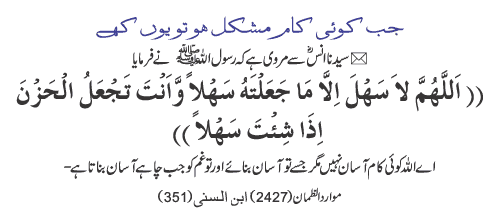
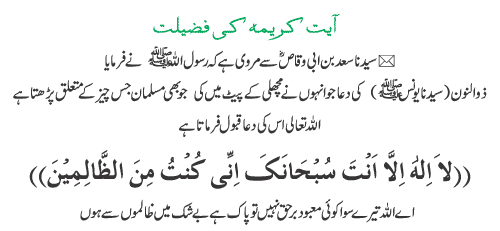
Ayat-E-Kareema Aur Mushkil Kam Ki Asaani Ki Dua
Why Are Non-Muslims Not Allowed In Makkah
According to the Quran, the idol worshipers shall not be permitted to approach the Sacred Masjid in Mecca.
[9:28] O you who believe, the idol worshipers are polluted; they shall not be permitted to approach the Sacred Masjid after this year. If you fear loss of income, GOD will shower you with His provisions, in accordance with His will. GOD is Omniscient, Most Wise.
We can derive the reason for the above restriction from the following verses:
[9:107] There are those who abuse the masjid by practicing idol worship, dividing the believers, and providing comfort to those who oppose GOD and His messenger. They solemnly swear: “Our intentions are honorable!” GOD bears witness that they are liars.
[9:108] You shall never pray in such a masjid. A masjid that is established on the basis of righteousness from the first day is more worthy of your praying therein. In it, there are people who love to be purified. GOD loves those who purify themselves.
[9:109] Is one who establishes his building on the basis of reverencing GOD and to gain His approval better or one who establishes his building on the brink of a crumbling cliff, that falls down with him into the fire of Hell? GOD does not guide transgressing people.
[9:110] Such a building that they have established remains a source of doubt in their hearts until their hearts are stilled. GOD is Omniscient, Most Wise.
The Quran teaches us tolerance. It does not impose any other restriction on idol worshipers, for example, visiting Mecca, Medina, Arafat, or any other places.
[9:6] If one of the idol worshipers sought safe passage with you, you shall grant him safe passage, so that he can hear the word of GOD, then send him back to his place of security. That is because they are people who do not know.
[9:19] Have you considered the watering of the pilgrims and caring for the Sacred Masjid a substitute for believing in GOD and the Last Day, and striving in the cause of GOD? They are not equal in the sight of GOD. GOD does not guide the wicked people.
M. Irtaza
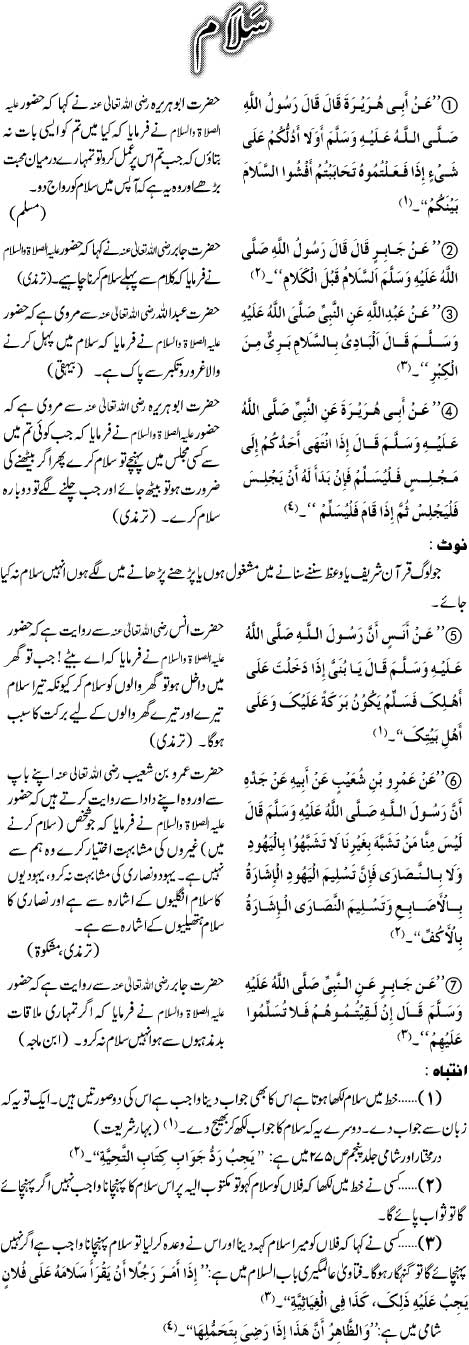
Salam Kay Mutaliq Ahkam
What Are The Signs Of Allah’s Love For His Slave?
All Praises be to Allah
Putting light on a serious and weighty matter, which none attain but very few of the righteous slaves of Allah.
The love of Allah is “the status for which the righteous compete and strive… It is the nourishment of hearts and souls… the delight of the eyes… It is the life of which one who is denied it is dead… the light which the one who loses it is in deep darkness… the healing of which the one who is denied is sick… the joy which the one who is deprived of it lives in distress and pain…
It is the spirit of faith and good deeds… by means of which one may draw closer to Allah… which, when it is absent, one is like a body in which there is no soul.”
O Allah, make us among those whom You love.
The love of Allah has signs and causes which are like the key to the door. These causes include the following:
1 Following the guidance of the Prophet (peace and blessings of Allah be upon him). Allah says in His Holy Book (interpretation of the meaning):
“Say (O Muhammad to mankind): If you (really) love Allah, then follow me (i.e. accept Islamic Monotheism, follow the Qur’an and the Sunnah), Allah will love you and forgive you your sins. And Allah is Oft-Forgiving, Most Merciful”
[Aal ‘Imraan 3:31]
2-5 Being humble towards the believers and stern towards the kaafirs, waging jihad for the sake of Allah, and not fearing anyone or anything but Him. Allah has mentioned these qualities in a single verse, in which He says (interpretation of the meaning):
“O you who believe! Whoever from among you turns back from his religion (Islam), Allah will bring a people whom He will love and they will love Him; humble towards the believers, stern towards the disbelievers, fighting in the way of Allah, and never fear of the blame of the blamers”
[al-Maa’idah 5:54]
In this verse, Allah describes the attributes of those whom He loves, the first of which is: humility and not being arrogant towards the Muslims, and being stern towards the kaafirs, and not humbling or humiliating oneself before them. They (the ones whom Allah loves) strive for the sake of Allah, against the Shaytaan, the kuffaar, the hypocrites, and the evildoers, and they strive against their own selves (jihad al-nafs). They do not fear the blame of any blamer, because so long as they are following the commands of their religion, he will not care about anyone who mocks him or blames him.
6 Doing naafil (supererogatory) acts of worship. Allah says – according to a hadeeth Qudsi – “My slave keeps drawing near to me by means of supererogatory acts of worship until I love Him.” Supererogatory acts of worship include naafil prayers, charity, ‘Umrah, Hajj, and fasting.
8-12 Loving, visiting one another, helping one another (financially), and offering sincere advice to one another for the sake of Allah.
These attributes were mentioned in a single hadeeth in which the Messenger (peace and blessings of Allah be upon him) narrated that his Lord said: “My love is guaranteed for two who love one another for My sake; My love is guaranteed for two who visit one another for My sake; My love is guaranteed for two who help one another (financially) for My sake; My love is guaranteed to two who uphold ties with one another for My sake.”
Narrated by Ahmad, 4/236 and 5/236; al-Tanaasuh by Ibn Hibbaan, 3/338; the two ahaadeeth were classed as Saheeh by Shaykh al-Albaani in Saheeh al-Targheeb wa’l-Tarheeb, 3019, 3020, 3021.
What is meant by “two who visit one another for My sake” is that they only visit one another for the sake of Allah, seeking thereby His pleasure for their loving one another for His sake or cooperating in worshipping Him.
From al-Muntaqa Sharh al-Muwatta’, hadeeth 1779.
13 Being tested. Calamities and disasters are a test for a person, and this is a sign that Allah loves him because this is like a medicine: even though it is bitter, but still, you offer the medicine, despite its bitterness, to the one whom you love; and Allah’s is the highest description. According to a Saheeh hadeeth: “The greatest reward comes from the greatest trial. When Allah loves people, He tests them, and whoever accepts it gains the pleasure of Allah, and whoever complains earns His wrath.
Narrated by al-Tirmidhi, 2396; Ibn Maajah, 4031; classed as Saheeh
For calamities to befall the believer is better than punishments being stored up for him in the Hereafter. How can it be otherwise when he is raised in status and his bad deeds are erased thereby? The Prophet (peace and blessings of Allah be upon him) said: “When Allah wills good for His slave, He hastens his punishment in this world, and when He wills bad for His slave, He withholds his sins until he comes with them on the Day of Resurrection.”
Narrated by al-Tirmidhi, 2396; classed as Saheeh
The scholars have explained that the one from whom calamities and trials are withheld is the hypocrite, for Allah withholds [his punishment] in this world, so as to bring him with all his sins on the Day of Resurrection.
O Allah, make us among those whom You love.
If Allah loves you, do not ask about the good that you will attain and the virtue that you will acquire… it is sufficient for you to know that you are beloved of Allah. The great fruits of the love of Allah for His slave are as follows:
1 People will love him and he will be accepted on earth, as it says in the hadeeth narrated by al-Bukhaari (3209): “When Allah loves a slave, He says to Jibreel, ‘I love so-and-so, so love him,’ so Jibreel loves him and then calls out to the people of heaven, ‘Allah loves so-and-so, so love him,’ and the people of heaven love him, and then acceptance is placed in the Earth for him.”
2 What Allah has mentioned in the hadeeth Qudsi of the great virtues of those whom He loves. It was narrated that Abu Hurayrah said: The Messenger of Allah (peace and blessings of Allah be upon him) said: “Whosoever shows enmity to someone devoted to Me, I shall be at war with him. My servant draws not near to Me with anything more loved by Me than the religious duties I have enjoined upon him, and My servant continues to draw near to Me with supererogatory works so that I shall love him. When I love him I am his hearing with which he hears, his seeing with which he sees, his hand with which he strikes, and his foot with which he walks. Were he to ask [something] of Me, I would surely give it to him and were he to ask Me for refuge, I would surely grant him it. I do not hesitate about anything as much as I hesitate about [seizing] the soul of My faithful servant: he hates death and I hate hurting him.” Narrated by al-Bukhaari, 6502.
This hadeeth Qudsi includes a number of benefits of Allah’s love for His slave:
(i) “I am his hearing with which he hears” i.e., he does not listen to anything but that which Allah loves.
(ii) “his seeing with which he sees” i.e., he does not see anything but that which Allah loves.
(iii) “his hand with which he strikes” i.e., he does not do anything with his hand but that which Allah loves.
(iv) “and his foot with which he walks” i.e., he does not go towards anything but that which Allah loves.
(v) “Were he to ask [something] of Me, I would surely give it to him” i.e., his du’a’s are heard and his requests are granted.
(vi) “and were he to ask Me for refuge, I would surely grant him it” i.e., he is protected by Allah from all things…
We ask Allah to help us to please Him.
And Allah knows best.