

The Holy Prophet Muhammed Sallallahu Alayhi Wa Aallam – I Have Been Sent As A Qasim
The Holy Prophet Muhammed Sallallahu Alayhi wa sallam is the Distributor(Qasim) for the Ummah and the Atta is from Allah.
Sahih Bukhari Book 25, Number 5317:
Jabir b. ‘Abdullah reported that a child was born to one of the persons amongst us and he decided to give him the name of Muhammad We said: We will not allow you to give the name after the name of Allah’s Messenger (may peace be upon him) until you ask him (the Holy Prophet). So he (that person) came and said (to the Holy Prophet): A child was born in my house and I wanted to give him the name (of Muhammad) after the name of Allah’s Messenger, whereas my people did not allow me that I should name him after that (sacred) name until I have asked Allah’s Apostle (may peace be upon him) in this connection, whereupon he said: Give him the name after my name but do not call him by my kunya, for I have been sent as a Qasim as I distribute amongst you.
Sahih Bukhari Book 25, Number 5317:
Some people argue that here Qasim only means the distribution of Zakat and spoils of the war and it is only limited to that, but in this hadith, the Holy Prophet Muhammed Sallallahu Alayhi wa sallam said that he was sent as a Qasim, which clearly signifies that purpose of this attribute “Qasim” is not just distribution of zakat and spoils of war, but Allah’s blessing are doled out to us through the Holy Prophet Muhammed Sallallahu Alayhi wa sallam, He is the door from which we get Allah’s blessings, whether it be in this world or the next.
The distribution of Shafaath is also through him on the day of judgment, Allah will give Shafaath to the Holy Prophet Muhammed Sallallahu Alayhi wa sallam and it is distributed to all by him
To clarify this point I am extracting the incident when Abu Bakr Siddique anhu radi Allahu taala gave his entire wealth to the Holy Prophet Muhammed Sallallahu Alaihi Wa Sallam, The Holy Prophet Muhammed Sallallahu Alaihi Wa Sallam had already refused another Sahabi’s wealth when he gave everything because one must also keep wealth to take care of himself and his family and it is a Muslims fard, but he only accepted Siddique E Akbar’s sacrifice because of the level of Imaan of Siddique E Akbar, who said I have left Allah and his Rasool in my home.
I have left the source (Allah) and the means (the Holy Prophet) of the distribution of wealth in my home.
This is described by Allama Sir Syed Muhammed Iqbaal
The poem from Allama Iqbal is as follows
“To the companions, one day the Holy Prophet(Sallallahu Alayhi wa sallam) appealed, O You of wealth, give in the path of righteousness,
Hearing the command Umar(radiallahu taala anhu) rose with immense desire,
for that day several thousand dirhams he did acquire
he thought to himself compared to Siddique(radiallahu taala anhu) today, my steed will surely lead the way
To the trusted Prophet(Sallallahu Alayhi wa sallam) His Riches he did give
, an act of selflessness for the dependent, he took the initiative
The Master of the World (Sallallahu Alayhi wa sallam) Enquired,
O Umar (radiallahu taal anhu) For whom the passion for the truth is the solace of the heart
For your own family, what did you leave? , What is in their right, the kinsmen must receive
Umar(radiallahu taal anhu) replied, Half the riches to the women and children would suffice,
The rest assigned to the Ummah in sacrifice,
By then the friend of Apostleship arrives
From Whom Love and affection derives
With his sincere nature, he brings forth,
All that in the worlds eye has worth
The Prophet said the concern for the family you must not dismiss
Then replied the secret keeper of love and bliss
From you do the eyes of the moon and the stars get their light
It is your being that is the means for the distribution of livelihood
The Candle is sufficient for the Moth
The Flower to the nightingale,
for Siddique(radiallahu taala anhu) The Messenger of Allah is Sufficient
Sabr Ki Ahmiyat

by Hafiz Ibtisam Ellahi Zahir
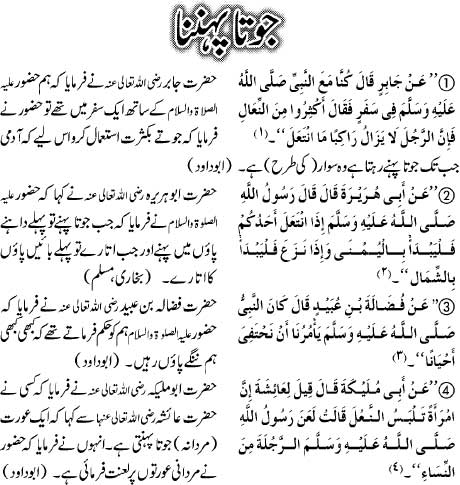
Jootay Pehnany Kay Ahkam
Beautiful Sayings Of Prophet Muhammad(Salaho Alhi Wasalam)
Abu Hurairah (May Allah be pleased with him) reported: The Prophet (PBUH) said, “He who believes in Allah and the Last Day must either speak good or remain silent.”[Muslim].
Abu Musa Al-Ash`ari (May Allah be pleased with him) reported: I asked the Messenger of Allah (PBUH): “Who is the most excellent among the Muslims?” He said, “One from whose tongue and hands the other Muslims are secure. ”[Al-Bukhari and Muslim].
Sahl bin Sa`d (May Allah be pleased with him) reported: The Messenger of Allah (PBUH) said, “Whosoever gives me a guarantee to safeguard what is between his jaws and what is between his legs, I shall guarantee him Jannah. ”[Al-Bukhari].
Abu Hurairah (May Allah be pleased with him) reported: I heard the Prophet (PBUH) saying, “A person utters a word thoughtlessly (i.e., without thinking about its being good or not) and, as a result of this, he will fall down into the fire of Hell deeper than the distance between the east and the west.”[Al-Bukhari and Muslim].
Abu Hurairah (May Allah be pleased with him) reported: The Prophet (PBUH) said, “A man utters a word pleasing to Allah without considering it of any significance for which Allah exalts his ranks (in Jannah); another one speaks a word displeasing to Allah without considering it of any importance, and for this reason, he will sink down into Hell. ”[Al-Bukhari].
Abu ‘Abdur-Rahman Bilal bin Al-Harith Al-Muzani (May Allah be pleased with him) reported: The Messenger of Allah (PBUH) said, “A man speaks a good word without knowing its worth, Allah records for him His Good Pleasure till the day he will meet Him; and a man utters an evil word without realizing its importance, Allah records for him His displeasure till the day he will meet Him. ”[Imam Malik and At-Tirmidhi].
Abu Hurairah (May Allah be pleased with him) reported: The Messenger of Allah (PBUH) said, “He whom Allah saves from the evil of that which is between his jaws and the evil of that which is between his legs will enter Jannah.”[At-Tirmidhi] .
‘Uqbah bin `Amir (May Allah be pleased with him) said: I asked the Messenger of Allah (PBUH), “How can salvation be achieved?” He replied, “Control your tongue, keep to your house, and weep over your sins.”[At-Tirmidhi] .
Abu Sa`id Al-Khudri (May Allah be pleased with him) said: The Prophet (PBUH) said, “When the son of Adam gets up in the morning, all the limbs humble themselves before the tongue and say: `Fear Allah for our sake because we are with you: (i.e., we will be rewarded or punished as a result of what you do) if you are straight, we will be straight; and if you are crooked, we will become crooked. ”'[At-Tirmidhi].
Hajamat Kay Ahkam
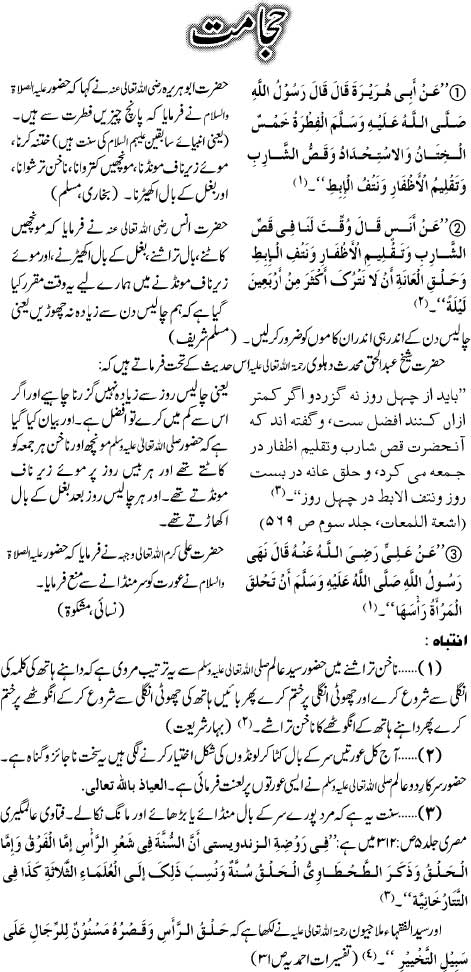
Hajamat Kay Sharai Ahkam Aur Masail
After Performing Umrah For Men
Sahih Al-Bukhari Hadith
Hadith 2.785 Narrated by: Abdullah bin Umar
Allah’s Apostle said, “O Allah! Be merciful to those who have their head shaved [after performing UMRA) .” The people said, “O Allah’s Apostle! And (invoke Allah for) those who get their hair cut short.” The Prophet said, “O Allah! Be merciful to those who have their head shaved.” The people said, “O Allah’s Apostle! And those who get their hair cut short.” The Prophet said (the third time), “And to those who get their hair cut short.” Nafi’ said that the Prophet had said once or twice, “O Allah! Be merciful to those who get their head shaved,” and on the fourth time he added, “And to those who have their hair cut short.”
Sahih Al-Bukhari Hadith
Hadith 2.786 Narrated by Abu Huraira
Allah’s Apostle said, “O Allah! Forgive those who get their heads shaved.” The people asked. “Also those who get their hair cut short?” The Prophet said, “O Allah! Forgive those who have their heads shaved.” The people said, “Also those who get their hair cut short?” The Prophet (invoke Allah for those who have their heads shaved and) at the third time said, “also (forgive) those who get their hair cut short.”
Kisi Bhi Haal Mein Allah Ki Rehmat Say Mayoos Na Ho

Learn To Listen, Just As You Learn To Speak
If a person starts telling you, whether in private or public, something that you already knew very well, pretend as if you do not know it. Do not rush to reveal your knowledge or to interfere with the speech. Instead, show your attention and concentration.
Imam Ata Bin Abi Rabah said: “A young man would tell me something that I may have heard before he was born. Nevertheless, I would listen to him as if I had never heard it before.”
Ata was a Tabi’ee, i.e. the one belonging to the generation coming after the Companions.
Khalid Bin Safwan Al-Tamimi, who frequented the courts of two Caliphs, Umar Bin Abdul Aziz and Hisham Bin Abdul Malik, said: “If a person tells you something you have heard before or news that you already learned, do not interrupt him to exhibit your knowledge to those present. This is being rude and ill-mannered.”
Ibrahim Bin Al-Junaid said: “A wise man said to his son: ‘Learn the art of listening as you learn the art of speaking.'”
Listening well means maintaining eye contact, allowing the speaker to finish the speech, and restraining your urge to interrupt his speech. Al-Hafiz Al-Khateeb Al-Baghdadi said in a poem:
Never interrupt a talk
Though you know it inside out